Discovery of VHE Gamma-Ray Emission from the Binary System LMC P3 - - PowerPoint PPT Presentation

discovery of vhe gamma ray emission from the binary
SMART_READER_LITE
LIVE PREVIEW

Discovery of VHE Gamma-Ray Emission from the Binary System LMC P3 - - PowerPoint PPT Presentation

Discovery of VHE Gamma-Ray Emission from the Binary System LMC P3 Nukri Komin * for the H.E.S.S. Collaboration * Wits University, Johannesburg, South Africa https://www.mpi-hd.mpg.de/hfm/HESS/HESS.shtml H.E.S.S. Motivation Large Magellanic


slide-1
SLIDE 1

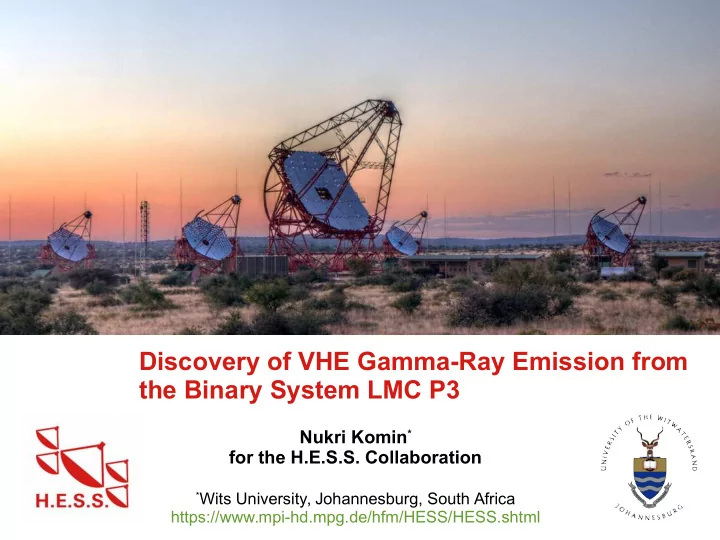
Discovery of VHE Gamma-Ray Emission from the Binary System LMC P3

Nukri Komin* for the H.E.S.S. Collaboration

*Wits University, Johannesburg, South Africa
https://www.mpi-hd.mpg.de/hfm/HESS/HESS.shtml

slide-2
SLIDE 2
  • N. Komin, "VHE emission of the binary LMC P3"

ICRC 2017, 2017/07/13, Busan, South Korea. 2

Motivation

Large Magellanic Cloud in gamma rays

TeV observations with H.E.S.S. [HESS coll., Science 347:6220 (2015)]

N 157B (PWN)

N 132D (SNR)

30 Dor C (superbubble)

MeV/GeV observations with Fermi-LAT [Fermi coll., A&A 586, A71 (2016)]

N 157B, N 132D

PSR J0540−6919

LMC P3

LMC P3

unidentified

compatible with 2 SNRs

  • ptical, 576 – 788 nm (false colour image)

H.E.S.S. Fermi-LAT

slide-3
SLIDE 3
  • N. Komin, "VHE emission of the binary LMC P3"

ICRC 2017, 2017/07/13, Busan, South Korea. 3

Motivation

LMC P3 is gamma-ray binary [Corbet et al., ApJ, 829:105 (2016)]

blind search for periodic emission

period 10.301 ± 0.002 days

X-ray and radio in anti-phase

binary system [Seward et al., ApJ, 759:123 (2012)]

O5 III(f) companion star

25..42 M⊙

compact object ?

6th gamma-ray binary

  • nly one inside detectable SNR

SALT

[Corbet et al. 2016]

slide-4
SLIDE 4
  • N. Komin, "VHE emission of the binary LMC P3"

ICRC 2017, 2017/07/13, Busan, South Korea. 4

High Energy Stereoscopic System

5 Imaging Cherenkov Telescopes

record Cherenkov light of air showers

5° field of view (CT 1–4)

100 GeV ... tens of TeV

angular resolution ~0.07°

Namibia → only instrument for TeV observations of the LMC

data presented here: only 4 telescopes

CT5 ignored when present

slide-5
SLIDE 5
  • N. Komin, "VHE emission of the binary LMC P3"

ICRC 2017, 2017/07/13, Busan, South Korea. 5

Data Set

  • ptical, 576 – 788 nm (false colour image)

[A. Mellinger, PASP 121, 1180 (2009)]

LMC observations since 2004

mainly around Tarantula nebula

N 132D

some data on LMC P3

  • bservation time

total 277 h

LMC P3: 100 h (acceptance corrected)

  • bservation conditions

large zenith angle (45° - 52°)

energy threshold ~700 GeV

slide-6
SLIDE 6
  • N. Komin, "VHE emission of the binary LMC P3"

ICRC 2017, 2017/07/13, Busan, South Korea. 6

)

2

( d e g

2

θ . 2 . 4 . 6 . 8 . 1 1 2 3 4 5 6 7 8 9

Significant Detection

76.3 excess events, 6.4 σ

  • n = 194, off = 7020

α = 59.7

R i g h t A s c e n s i

  • n

( J 2 )

s m

3 5

h

5

s m

4

h

5 D e c l i n a t i

  • n

( J 2 ) ' °

  • 6

8 4 8 ' °

  • 6

7 3 6 ' °

  • 6

7 2 4 ' °

  • 6

7 1 2 ' °

  • 6

7 2 − 1 − 1 2 3

H . E . S . S .

P S F

slide-7
SLIDE 7
  • N. Komin, "VHE emission of the binary LMC P3"

ICRC 2017, 2017/07/13, Busan, South Korea. 7

  • r

b i t a l p h a s e . 2 . 4 . 6 . 8 1 1 . 2 1 . 4 1 . 6 1 . 8 2 ]

  • 1

s

  • 2

F ( > 1 T e V ) [ m 1 2 3 4 5

9 −

1 × σ 2 . 4 σ 7 . 1 σ 2 . 5 σ 1 . σ . 7

Folded Light Curve

folded with 10.301-day orbital period, 0 at GeV maximum

7.1 σ → 6.9 σ post trials

clear phase-locked variability

periodicity search not successful (Lomb-Scargle, zCDF)

slide-8
SLIDE 8
  • N. Komin, "VHE emission of the binary LMC P3"

ICRC 2017, 2017/07/13, Busan, South Korea. 8

  • r

b i t a l p h a s e . 2 . 4 . 6 . 8 1 1 . 2 1 . 4 1 . 6 1 . 8 2 ]

  • 1

s

  • 2

F ( > 1 T e V ) [ m 1 2 3 4 5

9 −

1 × σ 2 . 4 σ 7 . 1 σ 2 . 5 σ 1 . σ . 7

Folded Light Curve

folded with 10.301-day orbital period, 0 at GeV maximum

7.1 σ → 6.9 σ post trials

clear phase-locked variability

periodicity search not successful (Lomb-Scargle, zCDF)

maximum at GeV minimum

slide-9
SLIDE 9
  • N. Komin, "VHE emission of the binary LMC P3"

ICRC 2017, 2017/07/13, Busan, South Korea. 9

Sky Maps

R i g h t A s c e n s i

  • n

( J 2 )

s m

3 5

h

5

s m

4

h

5 D e c l i n a t i

  • n

( J 2 ) ' °

  • 6

8 4 8 ' °

  • 6

7 3 6 ' °

  • 6

7 2 4 ' °

  • 6

7 1 2 ' °

  • 6

7

H . E . S . S .

P S F

R i g h t A s c e n s i

  • n

( J 2 )

s m

3 5

h

5

s m

4

h

5 D e c l i n a t i

  • n

( J 2 ) ' °

  • 6

8 4 8 ' °

  • 6

7 3 6 ' °

  • 6

7 2 4 ' °

  • 6

7 1 2 ' °

  • 6

7 2 − 1 − 1 2 3

H . E . S . S .

P S F

  • n peak

0.2 – 0.4 41.1 excess events, 7.1 σ (5 ± 1) x 1035 erg/s

  • ff peak

0.4 – 0.2 35.0 excess events, 3.3 σ <1.2 x 1035 erg/s (95% CL)

slide-10
SLIDE 10
  • N. Komin, "VHE emission of the binary LMC P3"

ICRC 2017, 2017/07/13, Busan, South Korea. 10

  • rbit-

averaged

  • n-peak

index 2.5 ± 0.2 2.1 ± 0.2 F (>1 TeV) [10-13 cm-2s-1TeV-1] 1.4 ± 0.4 5 ± 2 L (1 – 10 TeV) [1035 erg s-1] 1.4 ± 0.2 5 ± 1

Spectrum

power-law spectrum

no cut-off detection

E n e r g y [ T e V ] 1 1 T e V ]

  • 1

s

  • 2

[ c m

2

E × F l u x

1 4

1

1 3

1

1 2

1 ] χ ∆ R e s i d u a l s [ 4 2 2 4 E n e r g y [ T e V ] 1 1

slide-11
SLIDE 11
  • N. Komin, "VHE emission of the binary LMC P3"

ICRC 2017, 2017/07/13, Busan, South Korea. 11

Context

6th TeV gamma-ray binary

O-type star, no circumstellar disk

→ similar to LS 5039 and 1FGL J1018.6−5856

but earlier, giant star

short peak of emission of about 20%

as 1FGL J1018.6−5856

GeV and TeV in anti-phase

as LS 5039

0.0 0.5 1.0 1.5 2.0 2.5 3.0 3.5

Flux (E> 0.35 TeV) [10−

12 ph cm− 2 s− 1]

0.0 0.2 0.4 0.6 0.8 1.0 1.2 1.4 1.6 1.8 2.0

Orbital Phase

O r b i t a l p h a s e . 2 . 4 . 6 . 8 1 1 . 2 1 . 4 1 . 6 1 . 8 2 )

  • 1

s

  • 2

c m

  • 1

T e V

  • 1

2

( 1 T e V ) ( 1 d E d N . 5 1 1 . 5 2 2 . 5 3 3 . 5 4

S u p e r i

  • r

C

  • n

j u n c t i

  • n

I n f e r i

  • r

C

  • n

j u n c t i

  • n

I n f e r i

  • r

C

  • n

j u n c t i

  • n

S u p e r i

  • r

C

  • n

j u n c t i

  • n

A p a s t r

  • n

P e r i a s t r

  • n

A p a s t r

  • n

1FGL J1018.6−5856 [HESS, A&A, 577 (2015) A131] LS 5039 [HESS, A&A, 460 (2006) 743]

slide-12
SLIDE 12
  • N. Komin, "VHE emission of the binary LMC P3"

ICRC 2017, 2017/07/13, Busan, South Korea. 12

by far most luminous gamma-ray binary

1035 erg/s rather than 1033 erg/s

pulsar driven?

similar luminosity as pulsar wind nebula N 157B in LMC

PSR J0537-6910 (in N 157B): Ė = 4.9x1038 erg/s

putative pulsar in LMC P3 needs about the same Ė

would make it top-four luminous pulsar

non-detection of such luminous pulsar may be due to absorption

accretion of stellar wind?

mass loss ~10-6 M⊙/year (~6x1040 erg/s)

→ ~10-5 of mass loss

Energy Budget

slide-13
SLIDE 13
  • N. Komin, "VHE emission of the binary LMC P3"

ICRC 2017, 2017/07/13, Busan, South Korea. 13

Light Curve

  • r

b i t a l p h a s e . 2 . 4 . 6 . 8 1 1 . 2 1 . 4 1 . 6 1 . 8 2 ]

  • 1

s

  • 2

F ( > 1 T e V ) [ m 1 2 3 4 5

9 −

1 × σ 2 . 4 σ 7 . 1 σ 2 . 5 σ 1 . σ . 7

light curve driven by shape of orbit

conjunctions

MeV/GeV and TeV emission is inverse Compton emission

IC production favoured in head-on collisions

→ gamma-ray maximum at superior conjunction

gamma-gamma absorption disfavoured in tail-on collisions

→ TeV maximum at inferior conjunction

periastron

MeV/GeV emission is synchrotron of highly relativistic electrons

periastron: cooling increased, electron cut-off energy reduced

→ MeV/GeV minimum at periastron

high-density stellar photon field

→ TeV IC emission maximum at periastron

slide-14
SLIDE 14
  • N. Komin, "VHE emission of the binary LMC P3"

ICRC 2017, 2017/07/13, Busan, South Korea. 14

Summary

LMC P3 6th gamma-ray binary

similar to LS 5039 and 1FGL J1018.6−5856

most luminous: 1035 erg/s

requires highly luminous pulsar or strong stellar wind

  • bservations and understanding of many different binaries needed to

understand underlying acceleration mechanism

  • rbital parameters? → optical observations

emission during off-peak? → Cherenkov Telescope Array

R i g h t A s c e n s i

  • n

( J 2 )

s m

3 5

h

5

s m

4

h

5 D e c l i n a t i

  • n

( J 2 ) ' °

  • 6

8 4 8 ' °

  • 6

7 3 6 ' °

  • 6

7 2 4 ' °

  • 6

7 1 2 ' °

  • 6

7

H . E . S . S .

P S F

R i g h t A s c e n s i

  • n

( J 2 )

s m

3 5

h

5

s m

4

h

5 D e c l i n a t i

  • n

( J 2 ) ' °

  • 6

8 4 8 ' °

  • 6

7 3 6 ' °

  • 6

7 2 4 ' °

  • 6

7 1 2 ' °

  • 6

7 2 − 1 − 1 2 3

H . E . S . S .

P S F