
SLIDE 1
Experience of Yokkaichi City: Forerunner of air quality management in Japan
Noriko Kono
Institute for Global Environmental Strategies
- 1. Introduction
This paper presents on the experience of Mie Prefecture and Yokkaichi City titled; Experience of Yokkaichi city: Forerunner of air quality management in Japan. The experience of Yokkaichi city is
- ne of the four biggest environmental pollutions in Japan along as two Minamatas and Itai-itai
disease, and has been known the name not only domestically but internationally. Here the paper will explain its chronological outline and socio-economic background in 1960s, its urban environmental management capacity, its adaptability to developing country in Asia-Pacific. This presentation consists of five sections: Outline of the Yokkaichi /City’s Air Pollution Experience, Analysis of the City’s environmental management capacity, Comparison with the successor cities in Japan, Adaptability to Asian developing countries, and Conclusion.
- 2. City’s Air Pollution Experience
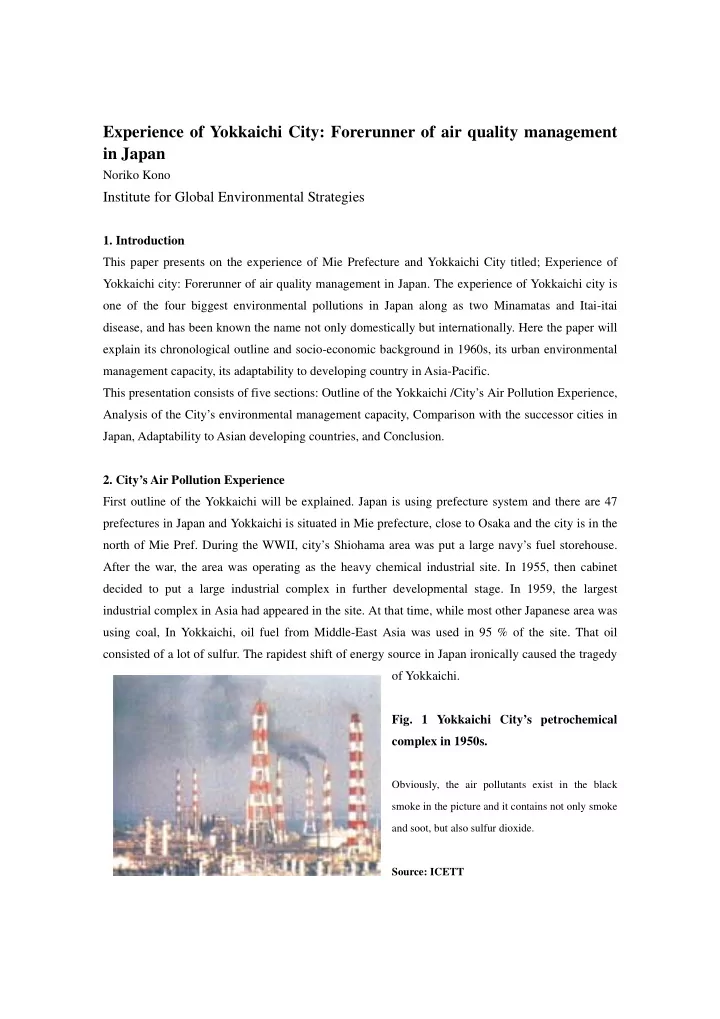
First outline of the Yokkaichi will be explained. Japan is using prefecture system and there are 47 prefectures in Japan and Yokkaichi is situated in Mie prefecture, close to Osaka and the city is in the north of Mie Pref. During the WWII, city’s Shiohama area was put a large navy’s fuel storehouse. After the war, the area was operating as the heavy chemical industrial site. In 1955, then cabinet decided to put a large industrial complex in further developmental stage. In 1959, the largest industrial complex in Asia had appeared in the site. At that time, while most other Japanese area was using coal, In Yokkaichi, oil fuel from Middle-East Asia was used in 95 % of the site. That oil consisted of a lot of sulfur. The rapidest shift of energy source in Japan ironically caused the tragedy
- f Yokkaichi.
- Fig. 1 Yokkaichi City’s petrochemical