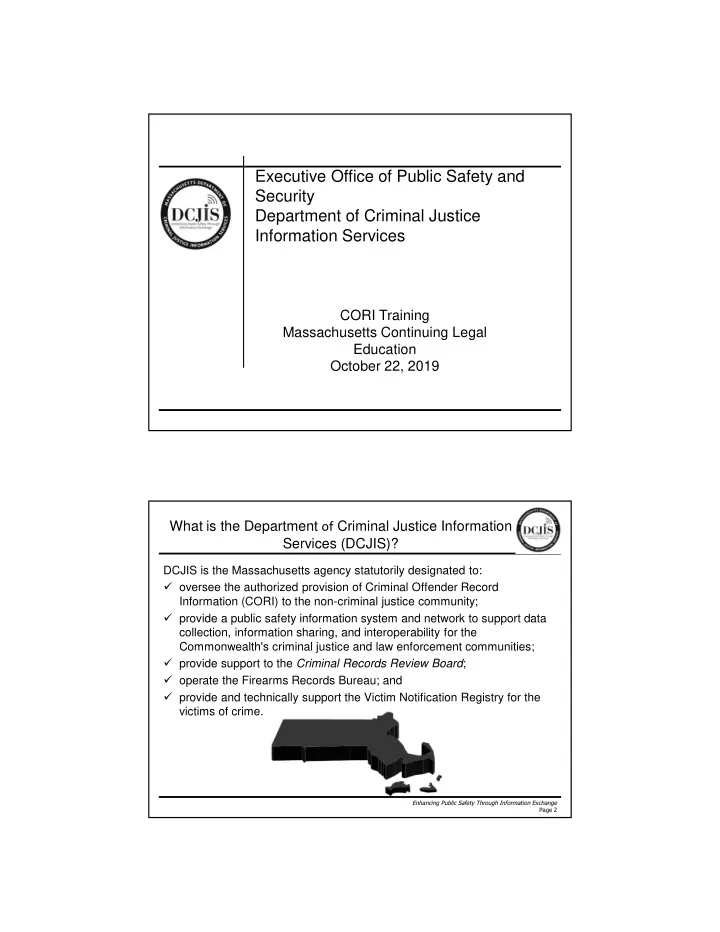
Executive Office of Public Safety and Security Department of - - PDF document

executive office of public safety and security department
SMART_READER_LITE
LIVE PREVIEW

Executive Office of Public Safety and Security Department of - - PDF document

Executive Office of Public Safety and Security Department of Criminal Justice Information Services CORI Training Massachusetts Continuing Legal Education October 22, 2019 What is the Department of Criminal Justice Information Services


slide-1
SLIDE 1

Executive Office of Public Safety and Security Department of Criminal Justice Information Services

CORI Training Massachusetts Continuing Legal Education October 22, 2019 What is the Department of Criminal Justice Information Services (DCJIS)?

DCJIS is the Massachusetts agency statutorily designated to:  oversee the authorized provision of Criminal Offender Record Information (CORI) to the non-criminal justice community;  provide a public safety information system and network to support data collection, information sharing, and interoperability for the Commonwealth's criminal justice and law enforcement communities;  provide support to the Criminal Records Review Board;  operate the Firearms Records Bureau; and  provide and technically support the Victim Notification Registry for the victims of crime.

Enhancing Public Safety Through Information Exchange Page 2

slide-2
SLIDE 2

What is CORI?

Criminal Offender Record Information Records and data in any communicable form compiled by a Massachusetts criminal justice agency about an identifiable individual that relate to: nature or disposition of a criminal charge, an arrest, a pre-trial proceeding, other judicial proceedings, sentencing, incarceration, rehabilitation, or release. Does not include juvenile criminal history, except for charges on which a juvenile was adjudicated as an adult.

Enhancing Public Safety Through Information Exchange Page 3

What is CORI Reform?

On August 6, 2010, the Governor signed into law Chapter 256 of the Acts of 2010, a.k.a. CORI Reform, making significant changes to the CORI law. This law provides ex-offenders with a better chance of re-integration and obtaining employment while taking public safety into account. The law changed who is authorized to access CORI and how CORI is accessed. Most of the CORI Reform provisions became effective on May 4, 2012.

Enhancing Public Safety Through Information Exchange Page 4

slide-3
SLIDE 3

Criminal Justice Reform Bill

  • Chapter 69 of the Acts of 2018, signed into law by Governor Baker on

April 13, 2018.

  • Key provisions related to CORI and FBI records:

– Update to definition of CORI;

  • CORI does not include offenses dismissed prior to arraignment.
  • New definition for what is considered adjudicated as adult for

CORI dissemination purposes. – Dissemination of Not guilty by reason of insanity dispositions;

  • Available to those seeking records under standard and open

CORI access. – Reduced timeframes to seal records; and – Ability to expungement certain records, also includes FBI records.

Enhancing Public Safety Through Information Exchange Page 5

All Employers Have Standard Access to CORI

Employers now have access to:  Any criminal charges pending as of the date of the request, including open cases that have been continued without a finding until dismissed.  All felony or misdemeanor convictions, but only if the individual was found guilty of or released from incarceration for a misdemeanor within 5 years

  • f the request or a felony within 10 years of the request.

 Findings of not guilty by reason of insanity relating to felony offenses for 10 years from disposition date.  All murder, manslaughter, and sex offense convictions (unless sealed), regardless of the date of the individuals last misdemeanor or felony conviction.  CORI Reform and the Criminal Justice bill do not include automatic sealing.

Enhancing Public Safety Through Information Exchange Page 6

slide-4
SLIDE 4

Certain Employers Have Required CORI Access

1. Employers who must comply with statutory, regulatory, or accreditation requirements regarding employees’ criminal records, (e.g. hospitals and banks) have access to additional adult CORI information dating back to an individual’s 18th birthday. 2. Employers that received CORI under a federal or state law authorizing or requiring them to conduct CORI checks under the former CORI system continue to have the same access (e.g. schools, camps, day care centers, nursing homes and assisted living facilities).

Enhancing Public Safety Through Information Exchange Page 7

The Public Has Limited Access to Open CORI

“Open CORI” includes:  Misdemeanor convictions within one year of conviction or release from incarceration;  Felony convictions and findings of not guilty by reason of insanity (“NGRI”) within two years of conviction or release from incarceration;  All felony convictions and findings of NGRI punishable by five or more years of incarceration within ten years of conviction or release from incarceration; and  All murder, manslaughter and sex offense convictions, unless sealed or expunged.

Enhancing Public Safety Through Information Exchange Page 8

slide-5
SLIDE 5

What is Required 1 Access?

 all pending criminal charges, including cases continued without a finding of guilt, until they are dismissed;  all misdemeanor convictions and felony convictions dating from the subject’s 18th birthday;  all information relating to those offenses for which the subject was adjudicated as an adult while younger than 18 years old; and  all convictions for murder, voluntary manslaughter, involuntary manslaughter, and sex offenses. Examples of Required 1 agencies: Hospitals; Healthcare Staffing Agencies; Healthcare Clinical Programs; Banks; Security System Installers; and Amusement Device Operators.

Enhancing Public Safety Through Information Exchange Page 9

What is Required 2 Access?

 non-conviction information;  all pending criminal charges, including cases continued without a finding of guilt, until they are dismissed;  all misdemeanor convictions and felony convictions dating from the subject’s 18th birthday;  all information relating to those offenses for which the subject was adjudicated as an adult while younger than 18 years old; and  all convictions for murder, voluntary manslaughter, involuntary manslaughter, and sex offenses

Enhancing Public Safety Through Information Exchange Page 10

slide-6
SLIDE 6

Agencies with Required 2 CORI Access

Examples of Required 2 Agencies: Schools; Assisted Living Facilities; Nursing Homes; Programs for Children; Councils on Aging; and Military Recruiters.

Enhancing Public Safety Through Information Exchange Page 11

What is Required 3 Access?

 All adult and juvenile non-conviction information;  all adult and juvenile pending criminal charges, including cases continued without a finding of guilt, until they are dismissed;  all adult misdemeanor convictions and felony convictions dating from the subject’s 18th birthday and juvenile delinquency findings;  all convictions for murder, voluntary manslaughter, involuntary manslaughter, and sex offenses; and  information relating to those offenses for which the subject was adjudicated as an adult while younger than 18 years old.

This level of CORI is only available to camps for children!

Enhancing Public Safety Through Information Exchange Page 12

slide-7
SLIDE 7

What is Required 4 Access?

 All adult and juvenile non-conviction information;  all adult and juvenile pending criminal charges, including cases continued without a finding of guilt, until they are dismissed;  all misdemeanor convictions and felony convictions dating from the subject’s 18th birthday and juvenile delinquency findings;  all convictions for murder, voluntary manslaughter, involuntary manslaughter, and sex offenses;  information relating to those offenses for which the subject was adjudicated as an adult while younger than 18 years old; and  information regarding criminal offenses that have been sealed.

This level of CORI is only available to the MA Department of Early Education and Care and Department of Children and Families!

Enhancing Public Safety Through Information Exchange Page 13

Criminal Justice Agency Access to Sealed Records “Criminal justice agencies may obtain all criminal

  • ffender record information, including sealed records,

for the actual performance of their criminal justice duties.”

Enhancing Public Safety Through Information Exchange Page 14

slide-8
SLIDE 8

Requesting your Client’s CORI

  • Advocate’s requests for CORI are accepted online and

through the mail – Personal CORI includes all CORI information and non- incarcerable offenses – CORI form includes space for current and maiden name – Form must be notarized – Affidavit of indigency must be completed for fee waiver requests – Paper Requests are processed within 5 to 10 business days, Electronic requests typically same day return – Forms available at www.mass.gov/cjis

Enhancing Public Safety Through Information Exchange Page 15

Requesting your Client’s CORI Cont.

  • DCJIS regulation 803 CMR 2.07-Attorneys and

advocates request for CORI

– Attorneys and advocates submitting through iCORI:

  • Shall obtain a signed Attorney or Advocate Request

Form; and

  • Form shall be maintained for a period of one year.
  • Attorneys and advocates submitting by mail:
  • Shall obtain a signed Attorney or Advocate Request

form; and

  • May maintain a copy of the form. Only required to

maintain for electronic requests.

Enhancing Public Safety Through Information Exchange Page 16

slide-9
SLIDE 9

National Fingerprint Based Checks by non- criminal justice agencies

 FBI fingerprint based criminal background checks are authorized fro some types of non-criminal justice agencies under either federal law or state law approved by the FBI under Public Law 92-544. Agencies include:

 K-12 Public and Private Schools- Teachers, employees and subcontractors working with children;  EEC- Employees of day care and after school programs licensed by EEC; and  Adoptive and foster parents applying through EEC or DCF;  Cannabis Control Commission for licensees and employees of Cannabis establishments; and  DOR for state employees with access to federal tax data; and  DDS for employees working with DDS clients.

 National checks and payment for checks are processed through a state vendor.  Responses are forwarded to users by DCJIS.  Additional information regarding this law is available at: www.mass.gov/cjis.

Enhancing Public Safety Through Information Exchange Page 17

Consumer Reporting Agency’s Access to CORI

  • CRA may access criminal history from public records including:

– Police daily logs; – Newspaper articles; and – Criminal court files.

  • CRA may access CORI from DCJIS

– May access Open CORI to request public records – May access on behalf of a registered client to obtain standard or required access

  • Level of access depends on what information the client

is entitled to receive – CRAs that access through DCJIS are subject to 803 CMR 11.00 et seq.

Enhancing Public Safety Through Information Exchange Page 18

slide-10
SLIDE 10

CORI Policy Requirement

  • Any individual organization that submits five or more CORI

requests annually shall maintain a CORI policy which must meet the minimum standards of the DCJIS model CORI policy .

  • The DCJIS has posted a Model CORI Policy to its

web site at mass.gov/cjis.

  • A CORI policy may be developed and maintained regardless of

the number of CORI requests conducted.

  • DCJIS recently updated its model CORI Policy: see

www.mass.gov/cjis

Enhancing Public Safety Through Information Exchange Page 19

Adverse Employment & Housing Decisions Based on CORI

Before an individual employer or private landlord makes an adverse decision based on a subject’s CORI, the employer/landlord must:

  • Notify the applicant in person, by telephone, by fax, or by electronic or hard

copy correspondence of the potential adverse employment/housing action;

  • Provide a copy of the applicant’s CORI to the applicant;
  • Provide a copy of the employer’s CORI Policy, if applicable;
  • Identify the information in the applicant’s CORI that is the basis for the potential adverse

action;

  • Provide the applicant with the opportunity to dispute the accuracy of the information

contained in the CORI;

  • Provide the applicant with a copy of the DCJIS document entitled “Information Regarding

the Process for Correcting CORI”; and

  • Document all steps taken to comply with these requirements.

Enhancing Public Safety Through Information Exchange Page 20

slide-11
SLIDE 11

Applicants Have a Right to Due Process

Effective May 4, 2012, if an employer has obtained criminal history information about an applicant, regardless

  • f the source, he or she must provide the criminal history

to the applicant prior to asking him or her about it.

Enhancing Public Safety Through Information Exchange Page 21

“Self-Audits” Will Help Police the System

Individuals will be able to see what non-law enforcement entities have requested their CORI. Individuals will be able to determine if CORI checks were run prior to an interview

  • r job rejection.

Individuals will also be able to determine if someone improperly accessed their CORI.

Enhancing Public Safety Through Information Exchange Page 22

slide-12
SLIDE 12

The Criminal Records Review Board

 May 4, 2012, marked the inauguration of the Criminal Records Review Board (CRRB).  CRRB’s membership includes all members listed in c. 6, s. 168 including representatives from labor and workforce development and ex-offender rehabilitation.  CRRB’s primary role is to investigate and conduct hearings regarding complaints alleging violations of the CORI statutes and regulations.

Enhancing Public Safety Through Information Exchange Page 23

Increased Civil Penalties

The Board can sanction individuals, employers and landlords with increased fines. $1,000-first violation. $2,500-second violation. $5,000-third or subsequent violation. Previous fine was $500

Enhancing Public Safety Through Information Exchange Page 24

slide-13
SLIDE 13

Increased Criminal Penalties

Anyone who knowingly:  knowingly requests, obtains or attempts to obtain CORI or self-audit from DCJIS under false pretenses;  knowingly communicates or attempts to communicate CORI to unauthorized individual; or  knowingly falsifies criminal records shall be punished for each offense:  NMT 1 Year HOC;  NMT $5,000 fine;  Or both. If the offender is not a natural person,  NMT $50,000 for each offense. Increased fines of $7,500/$75,000 for juvenile criminal history violations.

Enhancing Public Safety Through Information Exchange Page 25

iCORI Report (pg 1)

Enhancing Public Safety Through Information Exchange Page 26

Legal Disclaimer Summary Details on entered Subject request Section showing matching subject information Footer displays requestor information

slide-14
SLIDE 14

CORI Report (pg 2)

Enhancing Public Safety Through Information Exchange Page 27

Detailed legal disclaimer

CORI Report (pg 3)

Enhancing Public Safety Through Information Exchange Page 28

Matching subject information Pending case Non-conviction

slide-15
SLIDE 15

CORI Report (pg 4)

Enhancing Public Safety Through Information Exchange Page 29

Conviction Manslaughter conviction

DCJIS Contact Information

  • DCJIS website:

www.mass.gov/cjis

  • Email:

icori.info@state.ma.us

  • Phone number:

617-660-4600

  • Legal:

617-660-4760

Enhancing Public Safety Through Information Exchange Page 30