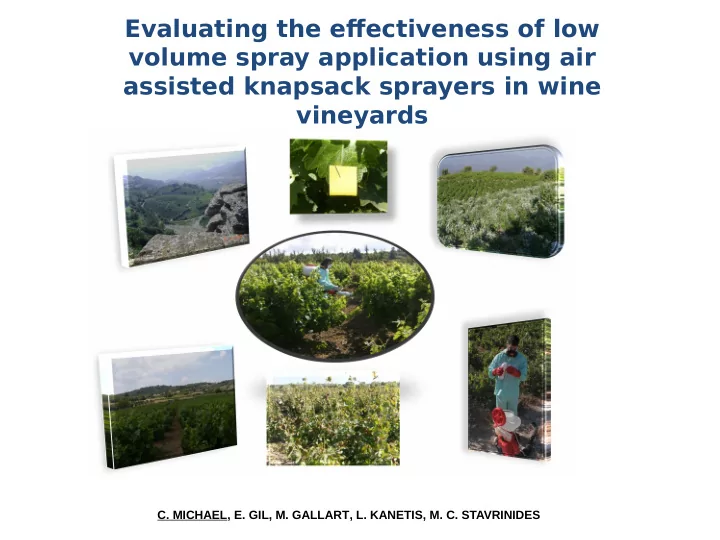
Evaluating the efgectiveness of low volume spray application using air assisted knapsack sprayers in wine vineyards
- C. MICHAEL, E. GIL, M. GALLARΤ, L. KANETIS, Μ. C. STAVRINIDES
Evaluating the efgectiveness of low volume spray application using - - PowerPoint PPT Presentation
Evaluating the efgectiveness of low volume spray application using air assisted knapsack sprayers in wine vineyards C. MICHAEL, E. GIL, M. GALLAR, L. KANETIS, . C. STAVRINIDES Viticulture in Cyprus Is characterized by: Small plots
Κλάδος Προστασίας Φυτών Πάφου
C C C C LVS LVS LVS LVS C S C S C S C S HV S HV S HV S HV S
C= Control CS = Common Sprayer LVS = Low Volume Sprayer HVS = High Volume Sprayer
1, 135, P = 0.20), Leaf position (F = 0.06, df = 1, 135, P = 0.98)
Coverage ≈ 20% CS ≈ 34% LVS ≈ 41% HVS
Signifjcant difgerences between the sprayers (F = 16.9, df = 2, 42, P < 0.001) and orientation (F = 13.69, df = 1, 45, P < 0.001), with a signifjcant interaction between sprayer and orientation (F = 39.03, df = 2, 45, P < 0.001)
% Mean Coverage ≈ 25% CS ≈ 42% LVS ≈ 45% HVS
difgerences in berry infestation (F = 0.74, df = 3, 142, P = 0.50). Mean infestation remained at around 10% .
spray applications depends among
spray coverage, the pesticide active ingredients used, the presence of resistance in the target pest, and the timing of pesticide applications
Signifjcant difgerences in leaf infection by downy mildew between treatments (F = 5.6, df = 3, 189, P = 0.001). There was also a signifjcant efgect of application time (F = 273.7, df = 6, 3140, P <0.001), and a signifjcant interaction between treatment and time (F = 20.4, df = 18, 3140, P <0.001).
LVS can achieve coverage of the spray material similar to that
Higher coverage with HVS rather than LVS was expected because of the higher volume of spray liquid applied with each sprayer, at 1400 L per hectare for HVS and 150 L for LVS. However, the difgerence in coverage between the two sprayers was not proportional to the difgerence in the amount of spray liquid used. For instance, overall mean coverage by HVS was around 50% for both leaves and bunches, while for LVS it ranged between ca. 40% for leaves and 45% for bunches.
HVS LVS
LVS are more environmentally friendly compared to HVS. HVS application resulted in substantial runofg. The excessive runofg of the spraying material from the outer leaves of the vine often misleads the farmers who consider that they fully and efgectively sprayed their vines. However, a relatively small amount of spraying liquid penetrates the foliage and reaches the grape bunches of the sprawl system. A high runofg
material and therefore economic loss for the producer and also soil pollution and subsequently of the groundwater through leaching.
LVS are more environmentally friendly compared to HVS. No runofg was observed with the LVS, because most of the spraying liquid ended up on target. The presence of air at the LVS seems to play a signifjcant role to the dispersion and penetration of the liquid into the foliage.
Adequate spray coverage can be achieved with volumes as low as 150 L/ha Determination of the pesticide dose based on the stage of plant growth and the surface of the leaf area (Barani et al., 2008; Gil et al., 2006) can lead to reduction of the quantity of pesticides applied and therefore the production cost without a corresponding compromise in the efgectiveness of sprays. Future work: Evaluate the coverage of air blast orchard sprayers in indigenous grape varieties of Cyprus