ERI-Indonesian Landscape, Kyoto University Global COE HSE Symposium - - PowerPoint PPT Presentation

eri indonesian landscape
SMART_READER_LITE
LIVE PREVIEW

ERI-Indonesian Landscape, Kyoto University Global COE HSE Symposium - - PowerPoint PPT Presentation

ERI-Indonesian Landscape, Kyoto University Global COE HSE Symposium 2012 Case: ITB AS A EDUCATION, RESEARCH AND INNOVATION UNIVERSITY (ETH Zurich Work shop, June 11, 2014, Singapore) By : Prof Wawan Gunawan A Kadir Vice Rector for


slide-1
SLIDE 1

Kyoto University Global COE HSE Symposium 2012

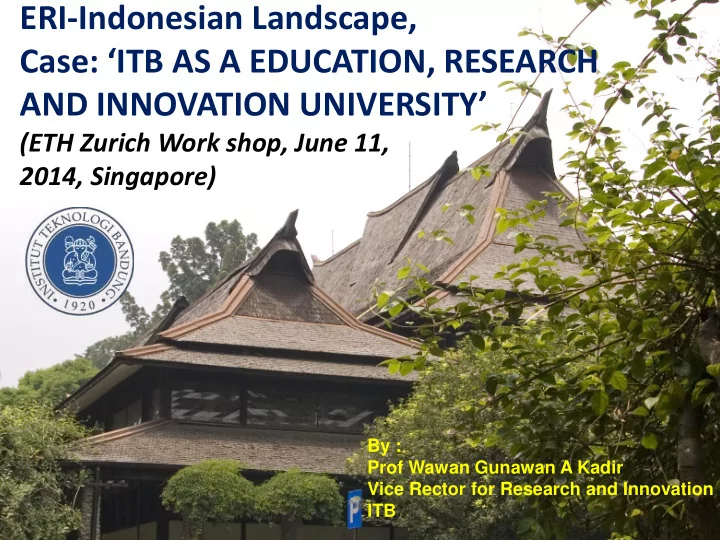
ERI-Indonesian Landscape, Case: ‘ITB AS A EDUCATION, RESEARCH AND INNOVATION UNIVERSITY’

(ETH Zurich Work shop, June 11, 2014, Singapore)

By : Prof Wawan Gunawan A Kadir Vice Rector for Research and Innovation ITB

slide-2
SLIDE 2

Outline

  • INTRODUCTION
  • Case in ITB:

– ITB (Faculty and School) – Research Group

  • RESEARCH FOCUS

– National Policy (Energy Policy) – ITB Research Focus – Some Examples of On Going Research NRE – Conservation Energy – Carbon Capture & Storage

slide-3
SLIDE 3

Sources

The overview of the national landscapes is based on two publicly accessible presentations: 1. Sharing Experience on Innovation: Indonesia Innovation Initiative 1-747 by Ary Syahriar, Ph.D , DIC, Special Staff to the Chairman of the National Innovation Council, National Innovation Council of the Republic of Indonesia Presented at the EU-ASEAN STI Days, Bangkok 21 January 2014 http://www.stidays.net/wp-content/uploads/2014/02/syahriar.pdf 2. International Science and Technology Cooperation 2011 – 2013 http://www.oecd.org/sti/inno/IP-systems-workshop-Indonesia- Marsudi.pdf The ITB case is a short version of the ppt as outlined in the previous slide by Prof Wawan Gunawan A Kadir, Vice Rector for Research and Innovation, ITB.

slide-4
SLIDE 4

“Center for Production and Processing of Natural Resources and As Nation’s Energy Reserves” “Center for Production and Processing of National Mining and Energy Reserves” “Center for Production and Processing of National Agricultural, Plantation, Fishery, Oil & Gas, and Mining”

Sumatera Corridor Kalimantan Corridor Sulawesi Corridor

“Gateway for Tourism and National Food Support” “Driver for National Industry and Service Provision” “Center for Development of Food, Fisheries, Energy, and National Mining”

Java Corridor Bali - Nusa Tenggara Corridor Papua – Maluku Corridor

MP3EI: REGIONAL INNOVATION CLUSTERS In 6 Economic Growth Centers

slide-5
SLIDE 5

GROSS EX EXPENDI ENDITU TURE E ON ON R&D &D (GE (GERD) )

GERD

  • Rp. 4,720,341,818,344

GDP DP

  • Rp. 5,613,441,700,000,000

GERD/ D/GDP GDP 0.08% .08% Nationa nal GE GERD D and nd GE GERD/ D/GDP GDP Ratio,

  • , 2009

2009

Higher Education Manufacturing Industry Government

GERD/GDP, 2009 Source: ce: R&D survey ey in Univer ersity sect ector (2009), Industry sec ector (2010), an and Governmen ent sect ector (2006) Note: 1) Based on R&D Survey in University Sector, 2010 2) Based on R&D Survey in Industry Sector, 2010 3) Based on R&D Survey in Government Sector, 2008* * the estimates with an average growth rate Goverment R&D budget since 2005-2008.

Shows that the breakdowon of R&D expenditure by sector in 2009. Government and Higher Education were the highest R&D expenditure with ratio of GERD 0,04% for Government and 0,03% for Higher Education. Manufacturing industry was a lowest

slide-6
SLIDE 6

Chapter 2. STI Policy

Position of the Ministry of Research and Technology

slide-7
SLIDE 7

Chapter 2. STI Policy

Indonesian S&T Development Strategic Framework: MP3EI

  • Launched as a Presidential Decree, hence

affecting all national executive bodies.

  • Decree Registration: No 32/2011, May 20 2011
  • Target: income parity of US$ 14,250 in 2025
  • The three pillars of MP3EI:
  • 1. Developing Indonesia Economic Corridors
  • 2. Strengthening the national connectivities
  • 3. Accelerating national science & technology

capabilities

slide-8
SLIDE 8

Case: Institute Technology Bandung

slide-9
SLIDE 9

HISTORY & FUTURE

  • f ITB

1920 – 1942 Technische Hogeschool (TH)

July 3, 1920, officially declared by the Dutch government July 1, 1924, the first graduates July 3, 1926, the first Indonesian graduates (among others, Ir. Soekarno, the 1st President of ROI)

1944 – 1945 Bandung Kogyo Daigaku (BKD) April 1, 1944, TH was re-opened & named as BKD by the Japanese government 1945 – 1946 Sekolah Tinggi Teknik (STT)

1945, opened 1946, moved to Yogyakarta & named as STT Bandung in Jogja 1946, became Faculty of Engineering, University of Gajah Mada (UGM)

1946 – 1959 Universitas Indonesia

June 21, 1946, officially declared by NICA 1946, Faculteit van Technische Wetenschap was established October 6, 1947, Faculteit van Exacte Wetenschap was established

1959 – 1999 2000 – 2010

INSTITUT TEKNOLOGI BANDUNG (ITB) As State University/PTN March 2, 1959, officially declared by Soekarno (the 1st President of ROI) 1959, The first Rector of ITB was inaugurated 1973, Common Preparatory Level was opened 1979, The first Graduate Programs

2010 – 2013 FUTURE ITB as Research, Development and Innovation University:

  • Academic excellence for education, contribution to

knowledge, industrial relevance, and community services.

INSTITUT TEKNOLOGI BADUNG (ITB) AS LEGAL ENTITY (AUTONOMOUS/BHMN)

December 26, 2000, ITB embarked on new status of as legal entity (AUTONOMOUS) In 2009, Gov of Indonesia Launched UU BHP (UU no 9 tahun 2009). UU BHP was cancelled by Constitution Court, 31 March 2010

Transition process from BHMN to PTN bh ITB as Autonomous State University
slide-10
SLIDE 10

FACTS & FIGURES*)

  • f ITB

Location: Bandung, capital of province of Western Java

STUDENT BODY Under-graduate 15.000 Master 4.000 Doctor 800 ENROLLMENT Under-graduate 3.131 Master 1.596 Doctor 190 GRADUATES Under-graduate 2.699 Master 1.624 Doctor 100 ACADEMIC STAFF 1.200 EDUCATION Bachelor 40 Master 260 Ph.D. 900 ACADEMIC RANK Professor 139 Associate Professor 491 Assistant Professor 387 Lecturer 121 FACULTY : STUDENT RATIO 1:16 NO OF ADMINISTRATIVE STAFF 1.583

  • ADM. STAFF : STUDENT RATIO

1 : 10,4

Academic & Non Academic Staff

ITB CAMPUS 29 Ha SPORT FACILITIES 4 Ha BUILDING FLOOR PER STUDENT 18.5m2

Students Facilities

slide-11
SLIDE 11

Faculties and Schools within

ITB

Faculty of Art and Design Faculty of Civil & Environmental Engineering Faculty of Math and Natural Sciences School of Architecture, Planning And policy Development School of Pharmacy Faculty of Mechanical And Aeronautical Engineering Faculty of Industrial Engineering Faculty of Mining and Petroleum Engineering School of Electrical Engineering And Informatics School of Business and Management Faculty of Earth Sciences And Technology School of Life Sciences And Technology

slide-12
SLIDE 12

INTERNATIONAL COLLABORATION

slide-13
SLIDE 13
  • International Partnership could increase the

quality of education and research, quality of graduates, and also efficiency, through:

– International Exposure (people mobility and exchanges) – Joint Programs at master or PhD level – Joint research/publication – Resource sharing – Involvement of industries

ITB INTERNATIONAL STATEMENT

slide-14
SLIDE 14

Kyoto University Global COE HSE Symposium 2012

INTERNATIONAL COOPERATION (Joint and double degree programs, Joint Research, Staff and student mobility , etc)

slide-15
SLIDE 15

Partner University Office at ITB

  • Toyohasi University Office at ITB
  • KAGI21 Kyoto University office at ITB
  • Energy Security Laboratory, Tohoku University at ITB

(2008)

  • Kyoto University Global CoE Program (2008)
  • Kanazawa University Office (2009)
  • International Radar Telecommunication Center Indonesia

Branch (ITB-TU Delf)

  • SOI (School of Internet)
  • ITB-Kyoto Univ office for CO2 Sequistration program

(2012-2016)

  • Cyber Security Centre (Koica, South Korea)
  • ETH Zurich, Switzerland (?)
  • Etc.
slide-16
SLIDE 16

ITB RESEARCH FOCUS

slide-17
SLIDE 17

TECHNOLOGY GIVING PROSPERITY BUT ALSO ENVIRONMENTAL IMPACT

ENVIRONMENT HUMAN PROSPERITY

TECHNOLOGY: TOOLS, MECHINES, SYSTEM, TECHNIC, ETC.

ECONOMIC GROWTH FROM INDUSTRY ENVIRONMENTAL PROBLEMS

Sustainable development

slide-18
SLIDE 18
  • Nat. Energy Council, 2013
slide-19
SLIDE 19

CURRENT CONDITION 2012

ENERGY ELASTICITY= 1,65 NON FOSSIL ENERGY SHARE 5%

2025 TARGET PRESIDENTIAL REGULATION NO. 5/2006

ENERGY ELASTICITY LESS THAN 1 IN 2025 OPTIMIZING NEW RENEWABLE ENERGY SOURCES

Biofuel 5% Geothermal 5% Nuclear, Hydro, Solar, Wind, and Other NRE 5% Liquified Coal 2%

  • Min. Energy & Mineral Res., 2014

5x Energy demand increase

slide-20
SLIDE 20

ITB RESEARCH FOCCUSES 2005-2015

ENERGY Regional Development, Infrastructure and Sustainable Environment Hazard Mitigation Food and Health Technology Information and Communication Technology Biotechnology Nanotechnology Fine Art and Culture (Creative Industry)

slide-21
SLIDE 21

RESEARCH CENTER

Center for Research on New and Renewable Energy Center for Research on Information and Communication Technology Center for Research on Food, Health and Medicine Center for Research on Enviromental Management, Infrastructure and Regional Development Center for Research on Cultural and Environmental Products Center for Research on Disaster Mitigation

RESEARCH CENTERS

slide-22
SLIDE 22

CENTERS

Center for Industrial Technology Center for Mathematical Modelling and Simulation Center for Microelectronics Center for Tourism Planning and Development Center for Life Sciences Center for Environmental Studies (CES-ITB) Center for Coastal and Marine Develoment Center for Research on Energy Policy (CREP-ITB) Center for Remote Sensing (CRS-ITB) Center for Instrumentation Technology & Automation (CITA-ITB) Center for Public Policy and Governance (CP2G-ITB)

slide-23
SLIDE 23