1
Khoirul Anam - FSP KAHUTINDO 1 About KAHUTINDO (Indonesian - - PowerPoint PPT Presentation
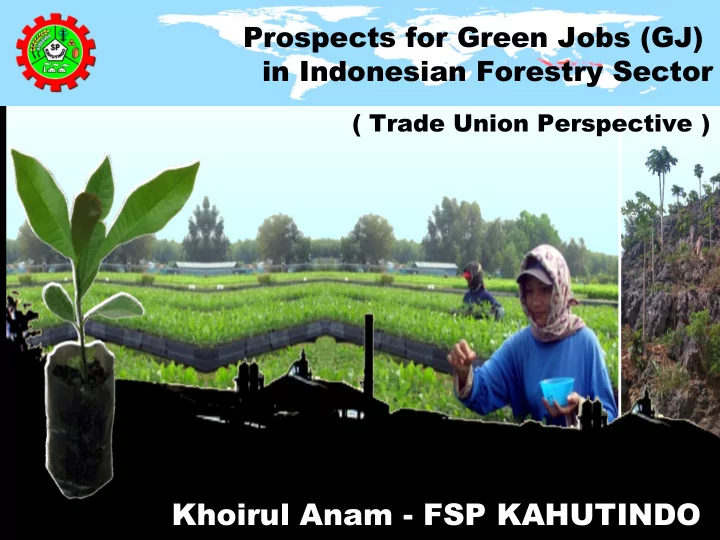
Prospects for Green Jobs (GJ) in Indonesian Forestry Sector ( Trade Union Perspective ) Khoirul Anam - FSP KAHUTINDO 1 About KAHUTINDO (Indonesian Forestry and Allied Workers Union) Founded 14 Juli 1973 as Serikat Buruh Perkayuan
2
- Founded 14 Juli 1973 as Serikat Buruh Perkayuan (Wood Labour Union)
- Coverage: Forestry (HPH-HTI-HTR), Wood Processing Industries, Plantation &
allied sectors
- Membership (June 2010): 96.456 workers; 178 Unit; 25 Districts; 12 Provinces
- Main-campaign: “Sustainable Forest for Sustainable Jobs”
- National Affiliation: Confederation of Indonesian Trade Unions (KSPI-CITU): 1,3M
International Affiliation: Building and Wood Workers International (BWI): 11M
- National Representations:
– National Tripartite Board
- LEI
- DKN
– National OHS Council
- FLEGT-EU
- Global Representations:
– UNFCCC
- FSC
- AFP
– The Forest Dialogues
- PEFC
- ASETUC
- Joint Campaigns:
– BWI, USW, IUF, CFMEU, ForestWorks
About KAHUTINDO
(Indonesian Forestry and Allied Workers’ Union)
3
- 1. Industries and Green House Gases
(GHGs) Emission in Indonesia
- 2. Potential of Green Jobs (GJ) in Forestry
Sector
- 3. Real Issues: Problems and Challenges
- 4. Trade Union Recommendations
Presentation Structure
4
- 1. Industries
and GHGs Emission
5
RI: 80% GHG Emission from Deforestation and Forest Degradation
Source: PEACE-World Bank-DFID. 2007. Indonesia and Climate Change: Current Status and Policies.
GHG Emission Composition Comparison in 6 Countries
6
Profile of RI GHG Emission in 2020 (BAU Scenario)
BAU: Business as Usual
0,5 1 1,5 2 2,5 3 2000 2005 2020
Forest & Peat Land Waste Agriculture Industry Energy & Transportation
Source: Bappenas, 2010
Emisi (Gton CO2 e) 1,72 2,12 2,95
7
80% GHGs Emission from Deforestation?
8
Potential Activities in Forestry Sector In RI Climate Change Mitigation
9
Indonesia Forests
Producti
- n
Forest 82,84 M ha 62,57% Others 19,70 M ha 14,88% Conserv ation Forest 29,85M ha 22,55%
100 187,776 29 55,388 71 132,398 Total 46 87,047 25 46,976 21 40,071 Not Forested 54 100,729 4 8,412 50 92,327 Forested % Area (M ha) % Area (M ha) % Area (M ha) TOTAL OTHER LAND-USE (APL) FOREST AREAS LAND COVER FOREST COVER
Indonesian Forest Coverage = 132.397.729 ha
- r 71% of Indonesian Land Coverage (187.787.000 Ha)
Source: MoF-Dirjen BPK
60% of RI GHG Emission Sourced from Forest and Peat Land (in and outside the forest areas); 17-20% of Global GHG Emission Sourced from Deforestation and Degradation of Forest; 75% Deforestation and Degradation of World’s Forest happen in Tropical zones,
- incl. RI.
10
Pace of Deforestation & Degradation of Forest
0,5 1 1,5 2 2,5 3 3,5 4 1990-1996 1997-2000 2001-2003 2004-2006 Whole Indonesia Inside Forests Outside Forests
- 0,41
0,30 0,68 0,50 Outside the Forests (APL)
- 0,76
0,78 2,83 1,37 In the Forest Areas 0,5 1,17 1,08 3,51 1,87 Whole Indonesia 2005-2007 FAO 2004-2006 (M ha) 2001-2003 (M ha) 1997-2000 (M ha) 1990-1996 (M ha) DEFORESTATION PACE
Source: MoF-Dirjen BPK
11
13,09 14,04 3,24 3,51 2 4 6 8 10 12 14 16 1990-1996 1997-2000 2001-2003 2004-2006
MIO ha
13,09 14,04 3,24 3,51 Pace of Deforestation (Accummulated) from Deforestation Pace Data
Source: MoF-Dirjen BPK
12
Potential of Emission Reductions AFOLU in Indonesia
123
Emiss ion 2020 BAU
Post- reduction emission
Land- Use Allocati
- n
Fire Prevent ion
SFM
Peat Land Rehabili tation
Affore station
Others
1 2 3 4 5
Potential Reduction Emission 2020
17.1 8.2 4.7 3.3 2.9 13.0 433 207 118 83 73 328 2.950 1.287
Source: DNPI
Million Ton CO2 e
By performing 5 major activities in emission reduction, Indonesia has the potential to reduce its emissions up to 36%
13
- 2. Potential of Green Jobs (GJ)
In Forestry Industries
14
Green Jobs Progress To-date and Future Potential (1)
Limited Limited Limited Aviation Excellent Negative Excellent Railways Excellent Limited Excellent Mass Transit Good Limited Fair to Good Fuel-Efficient Cars TRANSPORTA TION Excellent Good Excellent Recycling Good Fair Good Pulp and Paper Fair Fair Fair Cement Fair Fair Good Aluminium Fair Fair Good Steel BASIC INDUSTRY Unknown None Fair Carbon Capture and Sequestration (CCS) Excellent Good Excellent Renewables ENERGI LONG-TERM GREEN JOB POTENTIAL GREEN JOB PROGRESS TO-DATE GREENING POTENSIAL
15
Green Jobs Progress To-date and Future Potential (2)
Excellent Good Excellent Sustainable Forestry Management (SFM) Good to Excellent Limited Good to Excellent Agroforestry Good Limited Good Reforestation/Afforestation FORESTRY Unknown Limited Good Environmental Services Good to Excellent Limited Excellent Organic Farming Excellent Negative Excellent Small Scale Sustainable Farming AGRICULTURE Excellent Fair Excellent Efficient Equipment and Appliances Excellent Good Excellent Lighting Excellent Limited Excellent Retrofitting Excellent Limited Excellent Green Buildings BUILDINGS
LONG-TERM GREEN JOB POTENSIAL GREEN JOB PROGRESS TO-DATE GREENING POTENTIAL
16
Opportunities
17
Projection of Forest Restoration RI
21.150.000 550.000 5.750.000 5.800.000 3.550.000 5.500.000 Total (Ha) 2.149.200 50.000 750.000 499.200 350.000 500.000 2020 2.199.600 50.000 750.000 549.600 350.000 500.000 2019 2.119.600 50.000 650.000 569.600 350.000 500.000 2018 1.799.600 50.000 450.000 499.600 300.000 500.000 2017 1.749.600 50.000 350.000 549.600 300.000 500.000 2016 1.599.600 50.000 300.000 449.600 300.000 500.000 2015 2.249.600 50.000 750.000 599.600 350.000 500.000 2014 2.106.800 50.000 650.000 556.800 350.000 500.000 2013 1.849.600 50.000 450.000 549.600 300.000 500.000 2012 1.703.200 50.000 350.000 503.200 300.000 500.000 2011 1.623.600 50.000 300.000 473.600 300.000 500.000 2010 Total (Ha) Partnership Comm. Forest (Ha) Natural Conserv. Forest (Ha) Planted Forest HTI + HTR (Ha) Riverbank Protected Forest (Ha) Community Forest (Ha) Year Source: MoF-Dirjen BPK
18
A. . Natur Natural al Fo Fores rests ts
- Total commercial/processable timber = 3,285 B m3.
- Commercial timber diameter 50cm up (eligible for logging and
processing) = 2,036 B m3.
- Sustainably harvested potential (35 years rotation) 2.036
M/35yrs = 58,2 M m3/yr
- From real harvesting potential outputs 56% = 32,3 M m3/yr
- B. I
Indu ndustri trial al Plan Plantat tation
- n F
For
- res
est
- Potential 20- 60 M m3 per annum.
Source: Masyarakat Perhutanan Indonesia
Potential of Raw Materials
19
- Wood is a building materials that is the most environment-friendly, compare
Wood is a building materials that is the most environment-friendly, compare to other materials, ie. Steel, aluminium and concrete, with following to other materials, ie. Steel, aluminium and concrete, with following explanation : explanation :
No. Material Energi yang terpakai (Fossil Fuel energy used) Mj/m3 Pelepasan Carbon (Carbon Released) kg/m3 Penyimpanan Carbon (Carbon Stored) kg/m3
1 Wood 750 15 250 2 Baja (steel) 266.000 5.320 3 Beton (Concrete) 4.800 120 4 Aluminium 1.100.000 22.000
- Wood extraction is also a renewable natural source product compared to other sectors
Wood extraction is also a renewable natural source product compared to other sectors
Forestry Sector: the “Greenest” Industry
20
Work Force and Sectors
21.836.768 5.947.673 1.484.598 13.611.841 1.139.495 12.615.440 4.610.695 209.441 43.029.493 Agriculture, Forestry, Plantation, Hunting, Fisheries Mining and Excavating Processing Industries Electricity, Gas, Water Building Trade, Restaurant, Hotel Transportation, Warehouse, Communication Finance, Insurance, Building and Land Rental, Company Services Community, Social and Individual Services
Source: BPS (2009)
21
Green Jobs Good Jobs? Environment - YES Decent Work - YES Environment - NO Decent Work - YES Environment - YES Decent Work - NO Environment - NO Decent Work - NO
GREEN JOBS NO GREEN JOBS NO GREEN JOBS NO GREEN JOBS
22
- Conditions of RI Forestry Industries:
- 3. Real Issues:
Problems and Issues (1)
INVESTMENT PERFORMANCE Total investment in forestry sector of US$ 27,77 Billions consisting of:
- Pulp & Paper US$ 16 B (58 %),
- Plywood US$ 3,3 B (12 %)
- Logging US$ 3,28 B (12 %),
- Forest Plantation US$ 3,00 B (11 %),
- Wood Processing US$ 1,03 B (4 %),
- Furniture US$ 0,80 B (3%)
- Wood Joint US$ 0,19 B (1 %)
- Handycraft US$ 0,17 B (1 %).
WORKFORCE Directly employed 2,35 M, indirectly employed 1,5 M workers.
- Plywood 492.500 workers
- Furniture 472.000 workers
- Woodworking 370.000 workers
- Pulp & paper 178.624
- Industrial Plantation Forest 185.000 workers
- Logging 576.521 workers
- Handycraft 70.000 workers
Source: Masyarakat Perhutanan Indonesia
23
Workers Conditions in Forestry and Plantation Sectors (Nursery, planting, maintenance, harvesting, logging) :
– Low Skills – Low Wages and Welfare – High risks on occupational health and safety – Minimum provision of Social Security and Health Insurance – Child labour – Discrimination of women workers wage and welfare – Short employment contract & sub-contract (Labor Supplier) – Temporary/seasonal work – Informalised work
- 3. Real Issues:
Problems and Challenges (2)
24
- 3. Real Issues:
Problems & Challenges (3)
- Workers Conditions in Forest and Plantation
Products Processing Industries (Sawmills, Wood- working, Plywood, Pulp & paper, PKS/CPO, Rubber, Cacao) :
– Generally labour intensive (except for pulp & paper: capital-intensive) – Low wages and welfare (pulp & paper relatively higher) – High risks on occupational health & safety – Minimum provision of Social Security and Health Insurance – Short employment contract & sub-contracting (Labor Supplier)
25
- Upgrading Forestry & Plantation Sectors
– Combat against Illegal Logging – Revitalizing Forestry Industries – Restoration of Indonesian Forests – Investments (State & Private) for HPH-HTI-Biofuels – Law enforcement and Delineation – ‘Large’ Scale vs ‘Small’ Scale; Minimalising informalisation of industry and work
- Political Will Government/Regulator to support
Sustainable Development
- Promoting Sustainable Forest Management
(SFM) and Premium Price for Wood & Bio-fuels Certification
- 4. Trade Union Recommendation (1)
26
- 4. Trade Union Recommendations (2)
- Enforcement of Labour Laws and Workers Rights:
– Freedom of Associations – Rights to Collective Bargaining – Anti-discrimination
- Improvement of working conditions
– Minimise risks and hazards at work
- Improvement of Welfare & Productivity
– Social security, health & pension insurances
- Improvement of workers skills through vocational
trainings
- Long-term employment
27 27