Environmental impact monitoring of offshore wind farms in Belgian - - PowerPoint PPT Presentation

environmental impact monitoring of offshore wind farms in
SMART_READER_LITE
LIVE PREVIEW

Environmental impact monitoring of offshore wind farms in Belgian - - PowerPoint PPT Presentation

Environmental impact monitoring of offshore wind farms in Belgian waters Royal Belgian Institute of Natural Sciences Management Unit of the North Sea Mathematical Models Steven Degraer and collaborators In collaboration with: Ghent University,


slide-1
SLIDE 1

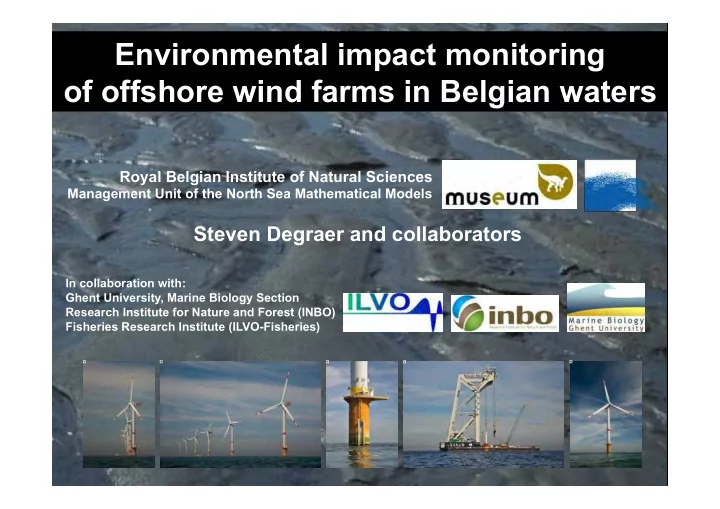
Environmental impact monitoring

  • f offshore wind farms in Belgian waters

Steven Degraer and collaborators

In collaboration with: Ghent University, Marine Biology Section Research Institute for Nature and Forest (INBO) Fisheries Research Institute (ILVO-Fisheries)

Royal Belgian Institute of Natural Sciences

Management Unit of the North Sea Mathematical Models

slide-2
SLIDE 2

OFFSHORE WIND FARMS IN BELGIAN WATERS

C-Power

  • Thorntonbank
  • 56 turbines of 5 and 6 MW (total of 300 MW)
  • Phase I: six turbines (gravity base foundations) operational since May 2009
  • Phase II: 48 turbines (jacket foundations) partly operational since 2012

Belwind

  • Bligh Bank
  • 110 turbines of 3 MW (330 MW)
  • 55 WT + 1 OHVS built on monopiles
  • in 2009-2010
  • Operational since December 2010

Northwind

  • Lodewijkbank
  • 72 turbines of 3 MW (216 MW)
  • Environmental permit “granted”
  • Construction starts in 2013

Other consortia

  • In pipeline...

ENVIRONMENTAL IMPACTS EXPECTED Northwind C-Power Belwind

slide-3
SLIDE 3

Environmental issues to consider

  • Underwater noise
  • Hydrodynamics and sedimentology
  • EMF
  • Hard substrate epifouling organisms
  • Hard substrate-associated fish
  • Soft substrate macrobenthos
  • Soft substrate epibenthos and fish
  • Seabirds
  • Marine mammals (focus: harbour

porpoise Phocaena phocaena)

  • Social acceptance

Mandatory monitoring programme to ensure...

  • possible mitigation or halting of activities
  • understanding of impact processes to support future policy and management

GUARANTEES FOR ECOSYSTEM INTEGRITY

Sula bassana

slide-4
SLIDE 4

THE CHALLENGE...

Baseline and targeted monitoring

  • Understanding rather than observing

impacts

  • Basis for mitigating activities and

future policy

Baseline monitoring Targeted monitoring

  • Observing rather than understanding

impacts

  • Basis for halting activities
  • Focus on a posteriori resultant effect

quantification

  • Site-specific
  • Focus on cause-effect relationships
  • f selected, a priori defined impacts
  • From observation-driven to

hypothesis-driven monitoring

Gadus morhua Phocoena phocoena Balanus perforatus

slide-5
SLIDE 5

SELECTED ENVIRONMENTAL IMPACTS

Pile driving disturbance of marine mammals

Aerial survey results

Phocoena phocoena

slide-6
SLIDE 6

SELECTED ENVIRONMENTAL IMPACTS

Pile driving disturbance of marine mammals

detection positive minutes / hour Time (Date)

Pile driving events

Passive acoustic monitoring

slide-7
SLIDE 7

SELECTED ENVIRONMENTAL IMPACTS

Attraction and macro-avoidance of seabirds

Little gull Common gull Lesser black-backed gull Greater black-backed gull Herring gull Black-legged kittiwake

No impact Impact area Reference area

Predicted density (ind./km²) Month

slide-8
SLIDE 8

SELECTED ENVIRONMENTAL IMPACTS

Attraction of fish

  • Attraction of fish

– up to 29.000 individuals of pouting per windmill !

  • Attraction-production hypothesis

– Hard substrate epifauna is an important food source for pouting (Trisopterus luscus)

Jassa herdmani

Small-scale distribution of cod (Gadus morhua)

Distance from foundation (m) Number of detections

slide-9
SLIDE 9

5 10 15 20 25 30

Summer1 Fall1 Winter1 Spring2 Summer2 Fall2 Winter2 Spring3 Summer3 Fall3 Winter3 Spring4

Species richness (S)

Species richness (n/0.06 m²) Time after installation

SELECTED ENVIRONMENTAL IMPACTS

Artificial hard substrate and epifouling invertebrates

Epifauna on new hard substrates (i.e. foundations) in a sandy environment

– ecological succession to a rich and diverse community (101 species) – dominant organisms are barnacles, mollusks and crustaceans

Surface area

GBF: ± 3000 m² monopile: ± 500 m²

Gravity based foundation Monopile foundation

slide-10
SLIDE 10

SELECTED ENVIRONMENTAL IMPACTS

Artificial hard substrate and non-indigenous species

C-POWER BELWIND Year One Year Two Year Three Year Four Year One Year Two Megabalanus coccopoma (Darwin, 1854) C F Balanus perforatus Bruguiére, 1789 S A A C C Telmatogeton japonicus Tokunaga, 1933 S S S S S Elminius modestus Darwin, 1854 A A A A C C Jassa marmorata (Holmes, 1903) C C C C C S Mytilus edulis (Linneaus, 1758) F S S S C C Semibalanus balanoides (Linnaeus, 1758) S S S C C Balanus crenatus Bruguiére, 1789 F C R Patella vulgata Linnaeus, 1758 F F Hemigrapsus sanguineus (De Haan, 1835) F F Crassostrea gigas (Thunberg, 1793) O O Littorina littorea (Linnaeus, 1758) F F Balanus improvisus Darwin, 1854 O O R Emplectonema gracile (Johnston, 1873) O Emplectonema neesii (Örsted, 1843) O Pleioplana atomata (OF Müller, 1776) O Eulalia viridis (Johnston, 1829) O
slide-11
SLIDE 11

SELECTED ENVIRONMENTAL IMPACTS

Organic enrichment of surrounding sandy sediments

15m 25m 50m 100m 200m

Distance from scour protection (m)

2000 4000 6000 8000 10000 12000

Mean Total Density (ind./m²)

SW SE NW NE Mean±0.95*SE

Benthic density (ind./m²) Distance from scour protection (m)

slide-12
SLIDE 12

SELECTED ENVIRONMENTAL IMPACTS

Fish and the exclusion of fisheries

Density (ind./1000 m²) Length (cm)

Plaice (Pleuronectes platessa)

Outside wind farm Inside wind farm

slide-13
SLIDE 13

ENVIRONMENTAL IMPACTS

Positive or negative? – some hypotheses…

Attraction Production Net increased production Localized increased production

Positive? Negative?

→ Context setting / research needed…

Increased predation

  • f smaller fish

Marine mammals Seabirds Hard substrate fish Fouling invertebrates Soft-sediment benthos Soft-sediment fish Food resources Increased risk

  • f collision

Higher survival rate

  • f larger fish

Direct mortality (Increased food availability) Production (Loss of natural fauna)

slide-14
SLIDE 14

ENVIRONMENTAL IMPACTS

Offshore wind farms and other renewable energy installations

Marine mammals Seabirds Hard substrate fish Fouling invertebrates Soft-sediment benthos Soft-sediment fish Increased length of fish Elevated densities New habitat for hard substrate species Intertidal invasives Attraction & production Attraction Collision Construction noise disturbance

X X X X X X X X X X X X X X X X (X) X X (X)

slide-15
SLIDE 15

Further reading I will be around for further detailing…

www.mumm.ac.be