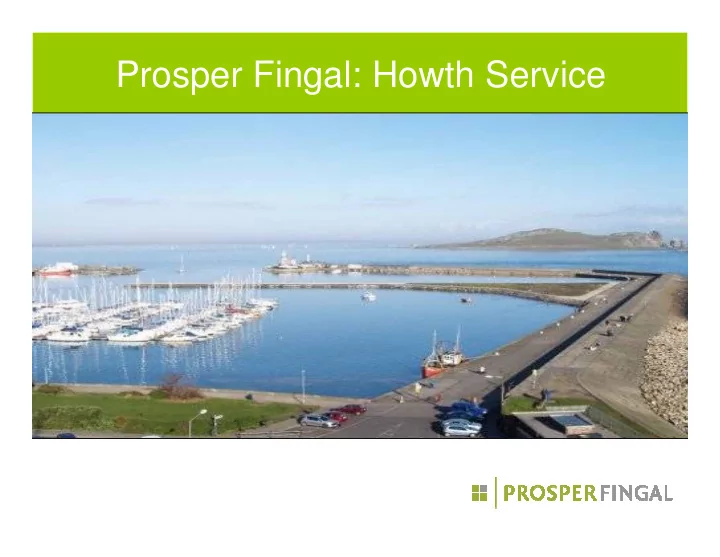
Prosper Fingal: Howth Service Community-Based Support Service New - - PowerPoint PPT Presentation

prosper fingal howth service community based support
SMART_READER_LITE
LIVE PREVIEW

Prosper Fingal: Howth Service Community-Based Support Service New - - PowerPoint PPT Presentation

Prosper Fingal: Howth Service Community-Based Support Service New Directions Policy states supports to the individual should be: Community based and integrated. Accessed through mainstream options/services. Person-Centred.


slide-1
SLIDE 1

Prosper Fingal: Howth Service

slide-2
SLIDE 2

Community-Based Support Service

slide-3
SLIDE 3

Policy states supports to the individual should be:

  • Community based and integrated.
  • Accessed through mainstream options/services.

New Directions

  • Person-Centred.
  • Individual rather than group based.
  • Be “outcomes” driven.
  • Local to the person and their home.
  • Evidence based.
slide-4
SLIDE 4
  • Gap in service provision - local need.
  • Opportunity to build capacity for the future.

Why Howth, Sutton & Baldoyle?

  • Establish a presence in the southern most area
  • f Fingal.
  • “Green field” situation.
slide-5
SLIDE 5
  • Pilot Project (from existing resources).
  • Move away from centre-based mindset & approach.
  • Individualised, not based on groups.

Background to Howth Service

  • Mainstreaming – ‘ordinary things in ordinary places’.
  • Embedded in the community, a local service for local

people.

  • Priority placed on building bridges/reciprocal

partnerships in the community (PR role).

slide-6
SLIDE 6
  • In-depth research of the catchment area, amenities &
  • pportunities divided into 18 domains.
  • Identified key figures/groups in the community.
  • January 2012: hosting of first Prosper Fingal Community

Getting to know the Community

  • January 2012: hosting of first Prosper Fingal Community

Information Sharing Evening. – 21 groups represented & contact made with 16 groups who couldn’t attend on the night. – Follow on meetings organised.

  • Build reciprocal partnerships within the community.
slide-7
SLIDE 7
  • Initially seven individuals, now eight.
  • Spent time exploring their

interests/likes/dislikes/goals/ aspirations…

Getting to know the People we Support

aspirations…

  • ‘Making the match’ was key.
  • Developing & maintaining

reciprocal partnerships with both individuals and families/carers.

slide-8
SLIDE 8

Community Connections

  • St. Joseph’s

Primary School

Howth Library La Verna Day Centre KLEAR

slide-9
SLIDE 9

Changing Routine

MONDAY TUESDAY FRIDAY 9.30am – 10.00am 10.00am – 11.15 am Friendship leisure or drama or choice Prep for Work T2 Independent Living Skills choice 11.15am – 11.15am – 11.35am Break Break 11.15 - 11.45 Break Break Break 11.35am – 1.00pm Health T1 leisure or choice art or choice Independent Living Skills choice 1.00pm – 2.00 pm Lunch Lunch Lunch Lunch 2.00pm - 3.10 pm Communications T1 Citizenship T2 Communications – IT choice 3.10pm - 3.30pm Group feedback Group feedback Group feedback Group feedback

slide-10
SLIDE 10

Changing Routine

slide-11
SLIDE 11

Challenges

  • Significant Challenges for all stakeholders:

– Individuals we support – Family – Community – Prosper Fingal – H.S.E. – Government agencies – Local and other NGO’s

  • Change for all!
slide-12
SLIDE 12

Claire & Brid

  • Video captures some of the challenges for Claire

& her mother.

slide-13
SLIDE 13

Typical Support System

Formal supports Informal supports Family/Natural supports Person Report of Disability Policy Review, Figure 2, pg 64.

slide-14
SLIDE 14

Challenges

  • Community:

– Initial & continued buy-in – Fear/scepticism – Trust – Requested need for continued Prosper Fingal support – Requested need for continued Prosper Fingal support

slide-15
SLIDE 15

Challenges

  • Prosper Fingal:

– Different Roles and Responsibilities – Lots of plates spinning (time management) – Engaging with families/carers on a different level – On-going support needs – Maintaining community partnerships – Gaps in staff training, need for up-skilling? – Positive risk management – Filling “the gaps” with meaningful occupation

slide-16
SLIDE 16

Challenges

  • H.S.E.

– Understanding the “support” model concept & application – Interpretation of support (direct/indirect) – Substantial costs associated with this service model – Dramatic shift from the traditional group & centre based model – Significant resource requirement at set-up & on an

  • ngoing basis to maintain supports

– Less certainty for the individual & family – Issues around client referral & placement

slide-17
SLIDE 17

Next Steps

  • Continue to link in with community groups &

develop new opportunities.

  • Work on life goals with the individuals we

support. support.

  • Promote independence.
  • Maintain trust/reciprocal partnership with

families/carers.

slide-18
SLIDE 18

Thank You!