Effectiveness of Interactive Distance Instruction: Experimental - - PowerPoint PPT Presentation

effectiveness of interactive distance instruction
SMART_READER_LITE
LIVE PREVIEW

Effectiveness of Interactive Distance Instruction: Experimental - - PowerPoint PPT Presentation

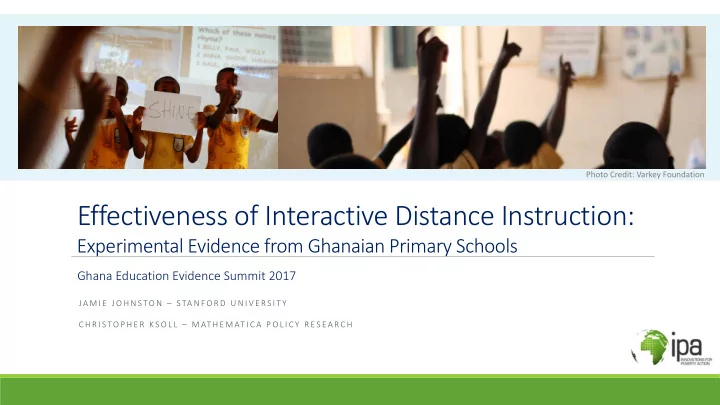
Photo Credit: Varkey Foundation Effectiveness of Interactive Distance Instruction: Experimental Evidence from Ghanaian Primary Schools Ghana Education Evidence Summit 2017 J A M I E J O H N S TO N S TA N F O R D U N I V E R S I T Y C H R


slide-1
SLIDE 1

Effectiveness of Interactive Distance Instruction:

Experimental Evidence from Ghanaian Primary Schools

J A M I E J O H N S TO N – S TA N F O R D U N I V E R S I T Y C H R I S TO P H E R K S O L L – M AT H E M AT I C A P O L I C Y R E S E A R C H

Ghana Education Evidence Summit 2017

Photo Credit: Varkey Foundation

slide-2
SLIDE 2

How can we deliver high-quality teaching to rural students?

  • Students in rural areas significantly underperform (OECD 2013, GES 2012, World Bank 2012)
  • In remote rural areas, shortage of trained primary teachers (World Bank 2012)
  • Teaching quality matters for student learning (Glewwe et al. 2011, McEwan 2015)
  • Structured pedagogy interventions appear to have largest, most consistent

positive effects on learning (Ganimian & Murnane 2016, Snilstveit et al 2015, Kremer et al., 2013 )

  • Little known about effectiveness of interactive distance instruction models
slide-3
SLIDE 3

Video Credit: Varkey Foundation

slide-4
SLIDE 4

MGCubed Satellite Class Program

  • Varkey Foundation MGCubed Program
  • Equipped 72 schools with technology package
  • Broadcasts live lessons daily to remote classrooms

§ 6 trained studio teachers, each broadcasting to 12 classes at a time § 1 hour math and 1 hour English, 5 days a week

  • In-person teachers trained as “facilitators”
  • Targets most marginalized students within schools

§ Grades 2-5 § Girls and boys § Identified according to criteria: distance to school, number of siblings, truancy, age

Photo Credit: Varkey Foundation

slide-5
SLIDE 5

Girls’ After School Program

  • Provides after-school sessions to in-school girls and out-of-school girls in community

(who have left school)

  • 1 hour per day, 4 days a week
  • Engage girls in topics including

§ Early pregnancy § Early marriage § Girls’ rights § Financial literacy

  • Provides access to adult female role models
  • Boys’ monthly after-school program started in response to demand for similar program

Photo Credit: Varkey Foundation

slide-6
SLIDE 6

Theory of Change

Improve quantity and quality of primary school education Increase instructional time-on-task:

§ Reduce absenteeism § Increase classroom time-on-task § “Double” instructor presence

Improve teaching pedagogy:

§ Leverage studio teacher capacity § Improving facilitator capacity

Improve curricular content:

§ More engaging § More interactivity

In-School Gains in numeracy and literacy Research Questions: 1) Is the program effective at increasing skills? 2) What are potential mechanisms of change?

slide-7
SLIDE 7

Evaluation Approach

cohort receives intervention

Cluster Randomized Controlled Trial (RCT)

§ 70 treatment and 77 control schools, assigned at baseline § Followed cohort of students (grades 2-4 at baseline) for two full years

Intervention begins

Year 1 Year 2

Jan 2014 baseline Jun-Jul 2014 monitoring 1

Year 0

Feb-Mar 2015 monitoring 2 Jun-Jul 2016 endline Jan-Feb 2017 post endline Jun-Jul 2015 midline Mar-Apr 2016 monitoring 3 Cohort: Grade 2 Grade 3 Grade 4 Cohort: Grade 3 Grade 4 Grade 5 Cohort: Grade 4 Grade 5 Cohort: Grade 5 (excluded from RCT)

data collections

2 year impact

Grade 6

1 year impact

cohort not receiving intervention

slide-8
SLIDE 8

Data

1) Skills assessments

§ Baseline, midline, and endline § Literacy: Early Grade Reading Assessment (EGRA) § Numeracy: Early Grade Mathematics Assessment (EGMA)

2) Student and teacher data

§ Student surveys at baseline, midline and endline § Teacher survey in Year 2 § Attendance measures (records and spot checks) in Years 1 and 2 § Qualitative interviews and focus group discussions with students, teachers and administrators

3) Classroom observations

§ Year 2 § Adapted Stallings Observation Protocol § Snapshots yielding proportion of class time on (1) active instruction, (2) passive instruction, (3) classroom management, and (4) off task activities

slide-9
SLIDE 9

Measuring Learning: EGRA & EGMA

  • Early Grade Reading Assessment (EGRA)

§ Oral test measuring subtasks: § Letters per minute § Wo Words per minute (WPM) <- focal measure § Invented words per minute § Listening comprehension § Oral vocabulary § Reading comprehension § Baseline WPM: 11.5 § Baseline standard deviation: 21.2

  • Early Grade Mathematics Assessment (EGMA)

§ Oral test, measuring subtasks: 1. Number identification (20%) 2. Quantity discrimination (20%) 3. Missing number patterns (20%) 4. Addition / subtraction / word problems (40%) § Baseline mean score: 46.0 percent correct § Baseline standard deviation: 20.1 focal measure: combined total

SOURCE: RTI International, 2009

EGRA WPM Example Passage:

slide-10
SLIDE 10
  • N=5485 at baseline
  • 60% girls
  • Average age = 10.9
  • ~ 8 household members
  • 50% mothers attended school
  • 60% fathers attended school
  • Treatment and control balance checks
  • Balance on observables at baseline, midline, and endline
  • Midline attrition = 13%
  • Endline attrition = 16%
  • No difference in attrition between treatment and control groups

Sample Characteristics

slide-11
SLIDE 11

Main Results

What is the effect of satellite program on literacy and numeracy skills?

slide-12
SLIDE 12
  • Classes significantly improved num

numerac acy

  • 0.22 standard deviation improvement in year 1
  • 0.26 standard deviation improvement in year 2
  • Gains in math scores las

lasted one year after the program ended

  • 0.23 standard deviation gains for students tested one year after program ended
  • After two years, marginally significant improvement in lit

literac acy

  • 0.07 standard deviation gains after two years

Gains in Numeracy and Literacy

slide-13
SLIDE 13
  • After 2 years of classes, large and significant improvement in fo

foundational skills

  • 0.82 standard deviation gain in letters per minute
  • 0.17 standard deviation gain in invented words per minute
  • 0.17 standard deviation gain in oral vocabulary

Literacy Subtasks

0.07 0.82 0.17 0.17 0.04 0.00

0.1 0.2 0.3 0.4 0.5 0.6 0.7 0.8 0.9

Words per minute Letters per minute Invented words per minute Oral vocabulary Listening comprehension Reading comprehension

Standard deviation gains Two years of classes

***p<0.01, ** p<0.05, * p<0.1 *** *** * **

slide-14
SLIDE 14
  • After one year of classes, significant improvement in all n

all numerac acy s subtas asks

  • After two years of classes, greater gains in number

number iden dentity and mi missing ng number number ta tasks

Numeracy Subtasks

0.2 0.15 0.17 0.19 0.34 0.12 0.25 0.21

0.05 0.1 0.15 0.2 0.25 0.3 0.35 0.4

Number identification Quantity discrimination Missing number Addition/subtraction Standard deviation gains One year of classes Two years of classes

***p<0.01, ** p<0.05, * p<0.1 *** *** *** *** *** ** *** *** *** *

slide-15
SLIDE 15

Mechanisms

What are the potential drivers of learning gains?

slide-16
SLIDE 16

Theory of Change

Improve quantity and quality of primary school education Increase instructional time-on-task:

§ Reduce absenteeism § Increase classroom time-on-task § “Double” instructor presence

Improve teaching pedagogy:

§ Leverage studio teacher capacity § Improving facilitator capacity

Improve curricular content:

§ More engaging § More interactivity

In-School Gains in numeracy and literacy

§

  • > No evidence of effects on attendance

§

  • > No evidence of effects on time-on-task

§

  • > BUT: In-classroom facilitators engaged in on-task

activities (including active instruction) more than half of the time that the video was being shown, essentially increasing classrooms’ teacher-student ratio
slide-17
SLIDE 17

Theory of Change

Improve quantity and quality of primary school education Increase instructional time-on-task:

§ Reduce absenteeism § Increase classroom time-on-task § “Double” instructor presence

Improve teaching pedagogy:

§ Leverage studio teacher capacity § Improving facilitator capacity

Improve curricular content:

§ More engaging § More interactivity

In-School Gains in numeracy and literacy

§

  • > No quantitative evidence of improved teaching methods

§

  • > Qualitative evidence suggests improvements
slide-18
SLIDE 18

Mechanisms: Teaching Pedagogy

  • Student focus groups / interviews suggest improvements in learning experience

“Sometimes teachers leave you behind if you don’t understand and even cane us. MGCubed teachers try their best to make us understand lessons.”

  • Facilitators seen as effective teaching intermediaries

“The facilitator in the MGCubed class explains what the studio teacher teaches if we are finding it difficult to understand the studio teacher.”

  • New teaching methods and approaches learned as part of facilitator role

“And they taught us ways we can use to teach them... Though we were taught ‘think pair share’ at the training college I was not using it so when we had the programme recently I went back and am now using it.”

slide-19
SLIDE 19

Theory of Change

Improve quantity and quality of primary school education Increase instructional time-on-task:

§ Reduce absenteeism § Increase classroom time-on-task § “Double” instructor presence

Improve teaching pedagogy:

§ Leverage studio teacher capacity § Improving facilitator capacity

Improve curricular content:

§ More engaging § More interactivity

In-School Gains in numeracy and literacy

§

  • > Still investigating
slide-20
SLIDE 20

Policy Implications and Next Steps

  • In

Inter eractive e di distanc nce e mo model del effec ective e at inc ncrea easing ng liter eracy and nd numer numeracy skills

  • Increased instructor presence in form of distance and in-person instructor an

important lever to explore – ar are t there w ways t to m mak ake r role les m more c comple lementar ary?

  • Forthcoming is a co

cost effectiveness analysis to determine how intervention compares to other heavier-handed structured pedagogy programs

  • Relevance of interactive model increasing as co

costs of internet and distance in instructio ion d decreas asin ing and institutions increase use of online / blended instruction

slide-21
SLIDE 21

Link to Working Paper

cepa.stanford.edu/sites/default/files/wp17-08-v201708.pdf

slide-22
SLIDE 22

Thank You

Questions and feedback welcome!

jamie.johnston@stanford.edu