
4.1
EE 109 Unit 4
Microcontrollers (Arduino) Overview
4.2
BIT FIDDLING
Using software to perform logic on individual (or groups) of bits
4.3
Numbers in Other Bases in C/C++
- Suppose we want to place the binary value 00111010 into a
char variable, v [i.e. char v;]
– We could convert to decimal on our own (5810) v = 58; – All compilers support hexadecimal using the _____ prefix v = 0x3a; – Our Arduino compiler supports binary using the _____ prefix v = 0b00111010;
- Important note: Compilers convert EVERYTHING to equivalent
________. The 3 alternatives above are equivalent because the compiler will take all 3 and place 00111010 in memory.
– Use whichever base makes the most sense in any given situation – It is your (the programmer's) ______________...compiler will end up converting to binary once it is compiled
4.4
Modifying Individual Bits
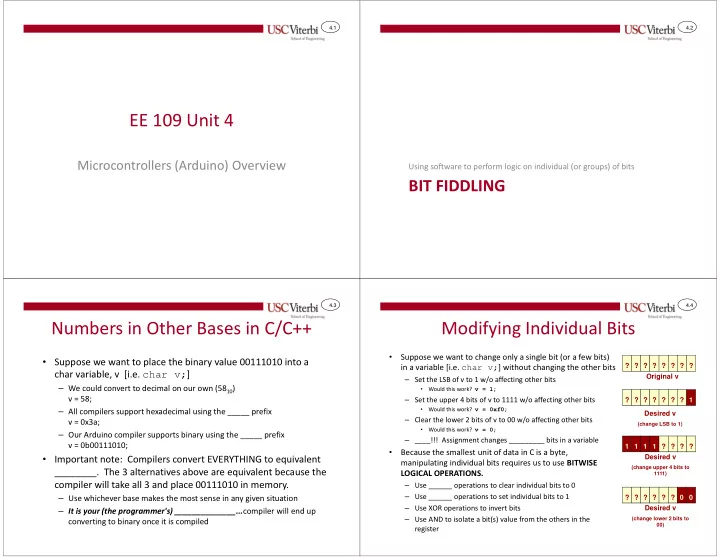
- Suppose we want to change only a single bit (or a few bits)
in a variable [i.e. char v;] without changing the other bits
– Set the LSB of v to 1 w/o affecting other bits
- Would this work? v = 1;
– Set the upper 4 bits of v to 1111 w/o affecting other bits
- Would this work? v = 0xf0;
– Clear the lower 2 bits of v to 00 w/o affecting other bits
- Would this work? v = 0;
– ____!!! Assignment changes _________ bits in a variable
- Because the smallest unit of data in C is a byte,
manipulating individual bits requires us to use BITWISE LOGICAL OPERATIONS.
– Use ______ operations to clear individual bits to 0 – Use ______ operations to set individual bits to 1 – Use XOR operations to invert bits – Use AND to isolate a bit(s) value from the others in the register
? ? ? ? ? ? ? ? ? Desired v
(change LSB to 1)
? ? ? ? ? ? 1 Original v 1 Desired v
(change upper 4 bits to 1111)
1 1 1 ? ? ? ? ? Desired v
(change lower 2 bits to 00)
? ? ? ? ? 0 0