ECONOMIC STATECRAFT AND STRATEGIC-CULTURE INFORM CHINAS RISE AND - - PowerPoint PPT Presentation

economic statecraft and strategic culture inform china s
SMART_READER_LITE
LIVE PREVIEW

ECONOMIC STATECRAFT AND STRATEGIC-CULTURE INFORM CHINAS RISE AND - - PowerPoint PPT Presentation

ECONOMIC STATECRAFT AND STRATEGIC-CULTURE INFORM CHINAS RISE AND QUEST FOR RESOURCES IN HARMONIOUS WORLD: THE SINO-AFRICAN PARTNERSHIPS Prof. Kennedy G., Ondieki The Socio-Economic Transition of China: Opportunities and Threats


slide-1
SLIDE 1

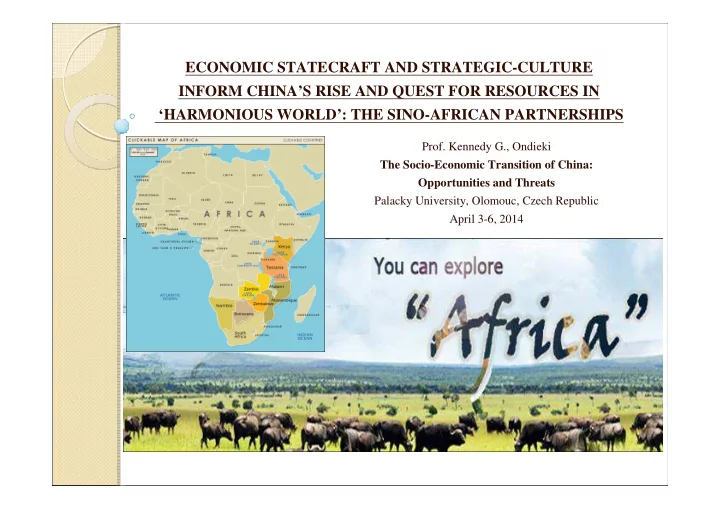
ECONOMIC STATECRAFT AND STRATEGIC-CULTURE INFORM CHINA’S RISE AND QUEST FOR RESOURCES IN ‘HARMONIOUS WORLD’: THE SINO-AFRICAN PARTNERSHIPS

  • Prof. Kennedy G., Ondieki

The Socio-Economic Transition of China: Opportunities and Threats Palacky University, Olomouc, Czech Republic April 3-6, 2014

slide-2
SLIDE 2

ABSTRACT:

This study examines the Sino-Africa partnerships by contextualizing China's economic statecraft and strategic culture to discern Beijing’s socio-economic and geo-political interests in Africa. The study is analyzed from a pragmatic and constructivist theoretical frameworks to inform Sino-Africa evolving partnerships—the quest for resources to boast Chinese growth and foreign aid assistance to develop Africa—symbiotic partnership. The Sino-Africa partnerships must be understood as an offshoot of neo-realistic outcomes of globalization and marginalization of Africa—whereby China bridges the gap in Africa that were created by the western powers’ disengagement and abandonment of African continent immediately after the Cold War. Constructively, Africa embraces China as a consequence of colonial experiences and realities and post-colonial dependence and unfair partnership with the West—instituting tough and strict conditionality on aid and structural adjustment programs. The neo Sino-Africa partnership embodies opportunities (economic development) and threats (competition and conflict that can engender regional security). To investigate China-Africa nexus, it is important to contextualize China’s strategies of adventurism and aggressive scramble for resources in the Africa in a holistic approach to understand the rationale behind Beijing’s steering towards Africa and discern the admixture interplays of China’s grand strategy, Beijing Consensus, charm strategy, soft power, Chinese developmental model and how Beijing’s politburo draw from ancient and contemporary maxims of military strategists, moralists and political leaders to grasp China’s strategic-culture to enable us get past the semantics/veils of China’s “peaceful rise” and “harmonious world”. The study poses some questions: Besides the economic dimension, what accounts for Chinese penetration into African landscape? How has China managed to charm African leaders to turn to China for business ventures and foreign aid? Can Sino- Africa partnerships be discerned without the variables of economic statecraft and strategic-culture? What is the role of Chinese

  • fficial aid assistance (CODA) to Africa and does aid promote Beijing’s grand strategy, developmental model and strategic-

partnerships? What criticisms are directed at Chinese in Africa—Western and African purviews? If Africa is China’s resource bonanza; and China ,Africa’ financial donor, will this symbiotic partnership be considered a marriage of fortunes a win-win? The overarching assumptions are as follows: In the absence of a universal ideology as in the Cold-War period, economic dimension (resources/oil safaris) explain China’s presence in Africa; In a multi-polar world, two models of economic development (the Washington and Beijing Consensuses) provide new impetus for clashes and competition signaling a return to the Cold-war mentalities and strategies. Western and the rest of world’s perceptions of China interest and penetration in Africa is seen as a neo-imperialist power driven to exploit Africa resources for Chinese gains to compete and perhaps replace the EU and US in the African landscape.

slide-3
SLIDE 3

OUTLINE:

  • I. Sino-Africa Partnerships
  • II. Theoretical Framework: Theories and assumptions
  • III. Economic Statecraft and Strategic-Culture

IV: Business ventures linked to Security V: Soft power strategy: Foreign Aid and Oil Diplomacy VI: Conclusions

  • VII. Findings and Observations
slide-4
SLIDE 4

Survey Questions

slide-5
SLIDE 5
slide-6
SLIDE 6

Photos speak volumes…Kenyatta and Xi; Xi and Kikwete

slide-7
SLIDE 7

Africa matters…East meets West …Obama in Tanzania

slide-8
SLIDE 8

US Presidents and first ladies steering towards East Africa—Tanzania & Kenya

slide-9
SLIDE 9

Chinese Freeway & Railway Projects in Kenya

slide-10
SLIDE 10

References

Anne L. Clunan, 2009. The Social Construction of Russia’s Resurgence: Aspirations, Identity, and Security Interests (cover-page). Alves, A.C. “Angola’s Resources: from conflict to development”, in: R Beri and K. Sinha (eds.), Africa and Energy Security, New Delhi: Academic Foundation, 2009, pp.155-175 Baldwin, D. Economic Statecraft, Princeton University Press, 1985.

  • CIA. 2011. The World Fact-book. www.cia.gov/library/publlcations/the-world-factbook
  • Daniel. 2006. As the Beginning Ends: China's Return to Africa. Pambazuka News, 14 December.

www.pambazukajorg/en/category/comments,ents/38852/print __________. 2006b. Conference Report A Chinese Scramble? The Politics of Contemporary China-Africa

  • Relations. Sidney Sussex College, Cambridge, 12-13 July.

Fravel, Taylor M. International Relations Theory and China’s Rise: Assessing China’s Potential for Territorial

  • Expansion. International Studies Review. 2010(12): 505-532

Jawal, G. 2006. Globalization and Development The Implications for the African Economy. Humanity and Social Sciences Journal 1 (l ). 65-78. Gaye, Adam. 2007. “China in Africa”, New African (March). http://findartides.eom/p/articles. Guixuan, Liang. 2005. “Perspectives on China-Africa Trade and Economic Cooperation— Presentation by Minister Counselor Liang Guixuan at the 4th Tswalu Dialogue”, www.chinese-embassy.org.za/eng/znjl/tl94633.htm Hanson, Stephanie. 2008. “China, Africa, and Oil”, http://wwwashingtonpost.om/wp-dyn/content/article. Hu, Jintao (President of the People's Republic of China). 2006. “Work Together to Forge a New Type of China-Africa Strategic Partnership”, Address to the National Assembly of Nigeria, 27 April. http://jim.chineseembassy.org/eng/xw/t259668.htm

slide-11
SLIDE 11

Hu, Raymond. 2011. “Chinese Investment in Africa: A Dangerous Game”, American Foreign Policy, 16 March. afprinceton.com/2011/03/Chinese-investment-in-africa-a-dangerous-game Huffpost World. 2011. “Hillary Clinton Warns Africa of ‘New Colonialism’”, www.huffingtonpost.com/2011/06/11 /hillary- clinton-africa. Ikenienberry, John G., David A. Lake, Michael Mastanduno, 1988. "Introduction: approaches to explaining A American foreign economic policy", International Organization 42:1, ( pp. 1-14). Kaplinky, R. and Morris, Mike. 2010. The Policy Challenge for Sub-Saharan Africa of Large- Scale Chinese FDI (ARI). Real Institute Eleanor . Katzestein, Peter J, 1977. “Introduction: domestic and international forces and strategies of foreign national policy” in International Organization 31:4, (pp. 587-606). Johnston, A. Iain. 1995. Cultural Realism: Strategic Culture and Grand Strategy in Chinese History. Princeton NJ: Princeton University Press Katzenstein, Peter. 1996. The Culture of National Security. New York: Columbia University Press. Karumbidza, John B. 2007. Win-Win Economic Cooperation: Can China Save Zimbabwe's Economy? in African Perspectives on China in Africa, edited by Firoze Manji and Stephen Marks, 8 £1 Town, Nairobi, and Oxford: Fahamu. Keenan, Patrick J. 2008. Curse or Cure? China, Africa, and the Effects of Unconditioned Wealth Berkeley Journal of International Law 27(1):83-125.

  • Kenneth. 2010. China's Cooperation with Africa, and Especially South, in Ed. Education and

Training: A Special Relationship and a Different Approach to Aid? Journal of International Cooperation in Education 13(2):73-87. Marks, Stephen. 2007. Introduction. In African Perspectives on China in Africa, edited by Firoze Man)'and Stephen Marks. Cape Town, Nairobi, and Oxford: Fahamu.

slide-12
SLIDE 12

McGreal, C. 2007. Thanks China, Now Go Home: Buy-Up of Zambia Revives Old Colonial

  • Fears. The Suardian Online, 5 February. www.guardian.co.ukAvorld/chlna.chrismcgreal .

McLaughlin, Abraham. 2005. A Rising China Counters US Clout In Africa. Christian Science Monitor, 30 . Retrieved 22 August 2008 from www.csmonitor.com/2005/0330/p010s01- Michaels, M. 1993. Retreat from Africa. Foreign Affairs 72(1):93-108. Radelet, Steven. 2010. Emerging Africa: How 17 Countries Are Leading the Way. Center for Global Development N. York. Miguel, Edward. Africa Unleashed:Explaining the Secrets to a Belated Boom. Foreign Affairs 90(6):155-160) Manji, Firoze, and Stephen Marks 2007. African Perspectives on China in Africa. UK: Oxford. Mohan, Giles and MayTan-Mullins. 2009. Chinese Migrants n Africa. European Journal of Development Research. 21: 588-605. ***3Gen*** Mohan, Giles and Marcus Power. 2009. Africa, China and the "New” Economic Geography of

  • Development. Singapore Journal of Tropical Geography 30(1):24-28.

Morrissey, Oliver. 2010. Impacts of China and India on SSA Countries: Opportunities, Challenges and Policies. Commonwealth Trade Hot Topics 80 (December). Nairn, M. 2007. Rogue Aid. Foreign Policy, no. 159 (March/April): 95-96. Nnadozie, E. 1995. Oil and Socioeconomic Crisis in Nigeria. Lewiston, New York: Mellon Press. Nyepon, Francis W. 2007. Liberia: Is China Influence Growing at the Expense of America? http://allafrica.com/stories/200712101051

slide-13
SLIDE 13

Mark, McNeilly. 2001. Sun Tzu and the Art of Modern Warfare. Oxford University Press, Inc. Michael, Phillsbury. 2005. China Debates the Future Security Environment. University of the Pacific, pp. xxxv. Michael Chege, 1992. Remembering Africa. Foreign Affairs 7(1):146-156. Obiorah, Ndubisi. 2007. Who's Afraid of China in Africa? Towards an African Civil Society Perspective on China-Africa Relations. In African Perspectives on China in Africa, edited by Firoze Manji and Stephen Marks. UK: Oxford. Okafbr Chike E. 2008. The Chinese Are Coming! Retrieved 24 August 2008 from http://nigeriaworld.com/feature/publicatlon/okafor/081208.html Okwe, Mathias. 2008. China, Nigeria Sign $50b MOU on Infrastructural Development. The Guardian (Nigeria), 29 March. net/news/source/2008/mar/29/4.html Omotola, J. Shola. 2010. Globalization, New Regionalism and the Challenge of Development in

  • Africa. Africana Journal 4(1):103-136.

Onimode, B. 1983. Imperialism and Underdevelopment In Nigeria: The Dialectics of Mass

  • Poverty. Ibadan, Nigeria: Macmillan.

Pegg, Scott 2005. Can Policy Intervention Beat the Resource Curse? Evidence from the Chad- Cameroon Pipeline Project African Affairs 105(418):1 -25. Polgreen, Lydia, and Howard W. French. 2007. China's Trade in Africa Carries a Price Tag. New York Times. www.nytimes.com/2007/08/21/worM/Africa

slide-14
SLIDE 14

Rocha, John. 2007. A New Frontier in the Exploitation of Africa's Natural Resources: The Emergence of China. In African perspectives on China in Africa, edited by Firoze Manji and Stephen Marks, 15-34. UK: Oxford Taylor, Ian. 2006. China and Africa: Engagement and Compromise. New York; Routledge.

  • UNCTAD. 1992. World Investment Report 1992. New York: United Nations.

Wallis, William. 2008. Drawing Contours of a New World Order. Financial Times Special Report, 24 January. Williamson, Jeffrey G. 2002. Winners and Losers over Two Centuries of Globalization. Working Paper W9161 (September). National Bureau of Economic Research. Paul R. Viotti and Mark V. Kauppi. 2010. International Relations Theory. Pearson Education, Inc., pp.24-35.

slide-15
SLIDE 15

Hypotheses

There are a number of factors attracting Chinese investment in resources sectors in developing area and Africa: i) Power balance: Chinese resources investment is attracted to contexts where there is no other major power. ii) Regime type: Chinese resources investment is attracted to autocratic regimes. iii) Political risk: Chinese resources investment is attracted to stable political environments. iv) Burden costs: Chinese resources investment is attracted by low indirect costs /labor & environmental standards v) Competition with other MNC: Chinese resources investment is attracted to contexts where there is low competition vi) Economic risk: Chinese resources investment is attracted to high-risk context that promises high profit margin prospects.