EASA Presentation Pascal Medal Head Of Certification Experts - - PowerPoint PPT Presentation

easa presentation pascal medal head of certification
SMART_READER_LITE
LIVE PREVIEW

EASA Presentation Pascal Medal Head Of Certification Experts - - PowerPoint PPT Presentation

13 th Military Airworthiness Conference 25 th September 2013 EASA Presentation Pascal Medal Head Of Certification Experts Department EASA Index Summary of European Civil Airworthiness Certification Civil aircraft certification: historical


slide-1
SLIDE 1

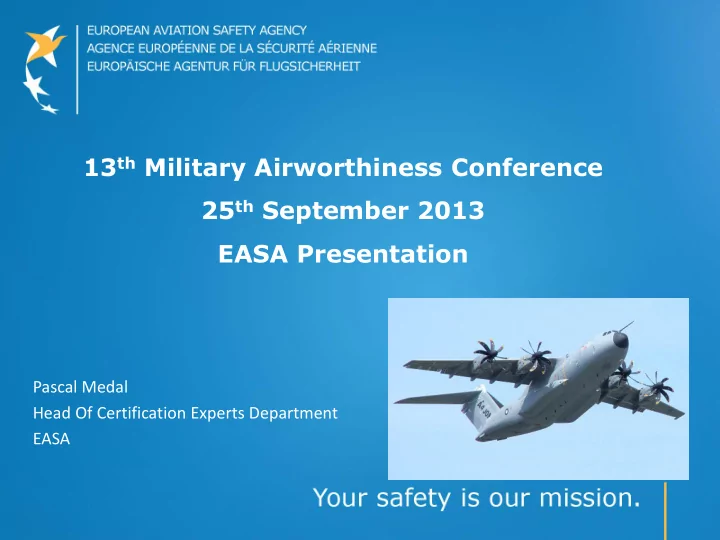
13th Military Airworthiness Conference 25th September 2013 EASA Presentation

Pascal Medal Head Of Certification Experts Department EASA

slide-2
SLIDE 2

25th September 2013 EASA Certification Experience 2

Index

Summary of European Civil Airworthiness Certification Civil aircraft certification: historical background From JAA to EASA System EASA Type Certification Process TC/STC procedures Certification Handbook/PID Certification Memos Level Of Involvement (LOI) Operational Suitability Data Items for cooperation RPAS MIDCAS Extended CAW e.g. A 400M

slide-3
SLIDE 3

3

Civil Type Certification: historical background

Historical Summary of European Civil Airworthiness Certification (1 / 2)

Convention on International Civil Aviation, Chicago in 1944: ICAO ICAO Civil Standards and recommended practices for airworthiness of aircraft adopted by ICAO Council on 01st March 1949 (pursuant to provisions of Article 37 Convention), and were designated as “Airworthiness of Aircraft” Annex 8 to the Convention On 06th June 2000, the Air Navigation Commission reviewed a recommendation of the Continuing Airworthiness Panel to formally introduce the “Type Certificate” concept in Annex 8, (already referred together with type certification process in Airworthiness Technical Manual Doc 9051) ICAO Annex 8 Type Certificate definition: “A document issued by a Contracting State to define the design of an aircraft type and to certify that this design meets the appropriate airworthiness requirements of that State” EASA Framework: Part 21.A.41 definition for Type Certificate 25th September 2013 EASA Certification Experience

slide-4
SLIDE 4

4

From JAA to EASA System

Historical Summary of European Civil Airworthiness Certification (2 / 2)

  • Created on 1970, as an ECAC associated body
  • Member States NAAs (44 ECAC members - 2012)
  • Initial objective: to develop common airworthiness

certification specs for large transport aeroplanes (industry support – first Airbus programmes A300)

  • 1987 extension of scope: common standards for

maintenance – ops – licensing - other aircraft types’ airworthiness specs

  • Headquarter in Hoofdorp (NL) – Decisions with no

national legal value

  • Aircraft Certification processes done by JAA- multi

NAAs teams - Recommendation for TC issued - To be legally adopted one by one by Member States - Subject to addition of National Differences.

  • Standardisation a voluntary process to achieve

mutual recognition status.

  • A JAA Member State may accept or not an initial

standardisation visit.

  • EU Agency depending from DG-MOVE
  • First discussions 1996 – Created by Basic

Regulation 1592/2002, currently EC 216/2008

  • Created Sep 02 – Effective starting date 28 Sep 03
  • Initial HQ Brussels – Moved to Cologne in 2003 –

Brussels Office opened in 2011

  • At a first stage, focused on initial and continued

airworthiness

  • Aircraft Certification processes by EASA teams –

TC’s issued and legally valid on all EASA member States with no further action – EASA adopts certification specifications and guidance material.

  • Standardisation of Member States NAAs based on

EU Law.

  • An EASA team standardisation visit can not be

refused.

  • 1st Remit extension 2008: Ops – Licensing –

Aeromedical - Third Country Operators – Training Orgs

  • 2nd Remit extension 2009: Aerodromes - ATM

25th September 2013 EASA Certification Experience

slide-5
SLIDE 5

5

EASA Type Certification Process

Type Certificate “Basic Regulation” 216/2008

  • Article 3.c): “Product” shall mean an

aircraft, engine, propeller

  • Article 5.2.a): Products shall have a type

certificate

Objectives for a Certification System:

  • Safe
  • Common regulatory and certification standards
  • Effective
  • User friendly and time - cost efficient (single TC

valid in all Member States)

  • Meet both Public and Industry expectations

Principles for a Certification System (EU products):

  • Rely on three related and required approvals
  • Product Type Certification approval – TC
  • Design Organisation Approval - DOA
  • Production Organisation Approval – POA
  • Continued Airworthiness process allow to

legally enforce necessary corrective actions based on in service experience

Advantages:

  • Every organisation (EASA, DOA, POA) having their own

roles and responsibilities

  • Industry has detailed product knowledge, expertise and

I+D capabilities

  • Type Investigation and compliance demonstration by DOAs

approved and audited by EASA

  • Independent Checking function inside DOA
  • Monitoring and verification by EASA on both organisation

and at product level

  • It allows EASA to decide and agree with DOA which

aspects of compliance verification can be delegated to DOA and which ones retained by Agency, allowing to focus on more critical aspects of compliance verification (level of involvement definition)

25th September 2013 EASA Certification Experience

slide-6
SLIDE 6

6

EASA Type Certification Process

Advantages:

It allows EASA to decide and agree with DOA which aspects of compliance verification can be delegated to DOA and which ones retained by Agency, allowing to focus on more critical aspects of compliance verification (level of involvement definition)

25th September 2013 EASA Certification Experience

TC Process: Phases

Phase I Technical Familiarization Establishment Type Certif. Basis Phase II: Certification Programme Agreement Phase III: Compliance Determination Phase IV: Final EASA report – TC Issuance TODAY Certification Programme defines on Applicant side

  • Programme Milestones
  • Responsibles (names,

tasks, competences)

  • Working methods
  • Applicable requirments
  • Proposed testing
  • Substantiation

documents, analysis, reports and evidences to be generated Today’s EASA practice with “big” DOA players about compliance docs:

  • CAT 1 to be EASA

accepted

  • CAT 2: 6 weeks for

EASA comments, after that considered accepted

  • CAT 3: DOA approved,

available to EASA on demand TOMORROW

Level of Involvement

Concept (LoI)

  • For each means of

compliance demonstration, Agency shall determine LoI

  • Objective criteria to

define Agency LoI

  • Potential unsafe

conditions, past accidents, etc

  • Based on level of

performance showed in the past by Applicant

  • Dynamically adapted

as level of performance showed during particular process

  • Applicant shall record

justification of compliance

  • Subject to

revision/update / change as cert. process progress: LoI may decrease or increase

  • Degree of Technology

novelty for both the Agency and applicant

slide-7
SLIDE 7

EASA Certification Procedures

TC/STC procedures

EASA - Internal working procedures

Certification Handbook (User Guide)

Certification Memos

EASA - Certification Memoranda

25th September 2013 EASA Certification Experience 7

slide-8
SLIDE 8

Level Of Involvement Proposal 1/2

Formally introduce a risk based approach both in product certification and design organisation approvals, Enable the Agency to determine its level of involvement in product certification on the basis of consistently tangible criteria, based on safety risk, Introduce the possibility to approve major changes, major repairs and STC under a DOA privilege, under certain conditions, Establish product certification and design organisation approvals as two separate processes sharing the same common risk based elements, Improve the clarity of part 21 text, by separating the requirements applicable to product certification and design organization approvals

25th September 2013 EASA Certification Experience 8

slide-9
SLIDE 9

Level Of Involvement 2/2

Enablers in Part 21, but needs amendments to AMC material to specify the conditions, On going initiatives with Industry participation, pilot projects, Assess & Rely on DOA (rating table), Linked to Safety Management System, Aim is to better tackle the important aspects, focusing resources where really needed,

25th September 2013 EASA Certification Experience 9

slide-10
SLIDE 10

Operational Suitability Data

Referenced in Regulation 216/2008, article 5, 7 , 8, 21, annex 4, etc… Amendment to REG 748/2012 part 21 “OSD” (opinion agreed in July 2013)

Paragraph 21-A-15 is laying down the OSD items:

Minimum Syllabus of Pilot Type Rating (+ CS-FC) Minimum Syllabus of Maintenance Certifying Staff (+ CS-MCS) Determination of type or variant for Cabin Crew (+ CS-CCM) MMEL (+ CS-MMEL) Definition of scope of aircraft validation source data to support

  • bjective qualification of simulators (+ CS-SIM)

Other Type related Operational Suitability elements

25th September 2013 EASA Certification Experience 10

slide-11
SLIDE 11

Cooperation EASA / EDA

Arrangement EASA/EDA signed on 18th June 2013 Support needs to be considered (several options), but EASA certification is funded through a F&C scheme, resources can

  • nly be deployed if income is set adequately

Cooperation already in force: Flight Test Center(s): CEV France, Italy, Germany, to be pursued and amplified,

EASA Focal point for Military coordination: Jose Penedo is acting

25th September 2013 EASA Certification Experience 11

slide-12
SLIDE 12

Items for Cooperation 1/2

Remotely Piloted Aircraft Systems

MIDCAS, EASA involvement has started

EASA - Policy statements On going projects:

A 400M post TC and CAW-MoU Arrangement(s) for surveillance (organisations) Certification of configurations for Civil /Military use, simplifying the processes,

25th September 2013 EASA Certification Experience 12

slide-13
SLIDE 13

Items for Cooperation 2/2

Training activities

EASA workshops & internal training may be opened to military entities, Agreement to use Military facilities for e.g. training of EASA Flight personnel, Temporary staff assignments, TBD

25th September 2013 EASA Certification Experience 13

slide-14
SLIDE 14

Questions ?