[ ] doff : s E.g., each verb can have its own distribution of - - PDF document

doff s e g each verb can have its own distribution of
SMART_READER_LITE
LIVE PREVIEW

[ ] doff : s E.g., each verb can have its own distribution of - - PDF document

Soft Selection Bilexical Grammars doff a cap and a hat O(n 3 ) Probabilistic Parser sombrero shirt sink Adjuncts too: clothe Jason Eisner doffed his cap to her about University of Pennsylvania at her ... for her IWPT - 1997 Jason


slide-1
SLIDE 1

Jason Eisner (U. Penn) 1

Bilexical Grammars

and a

O(n3) Probabilistic Parser

Jason Eisner University of Pennsylvania IWPT - 1997

Jason Eisner (U. Penn) 2

Soft Selection

doff a cap

hat sombrero

shirt

sink

clothe about

...

Adjuncts too: doffed his cap to her

at her

for her

Jason Eisner (U. Penn) 3

Rules are specialized for individual words

(or are implicit in lexical entries)

doff: (S\NP)/NP

NP↓ doff NP↓ S VP doff

subj

  • bj

doff: ___ NP

S → NP doff NP

doff: s L(np) R(np)

[ ]

Lexicalized Grammars

monkeys doffing their hats

Jason Eisner (U. Penn) 4

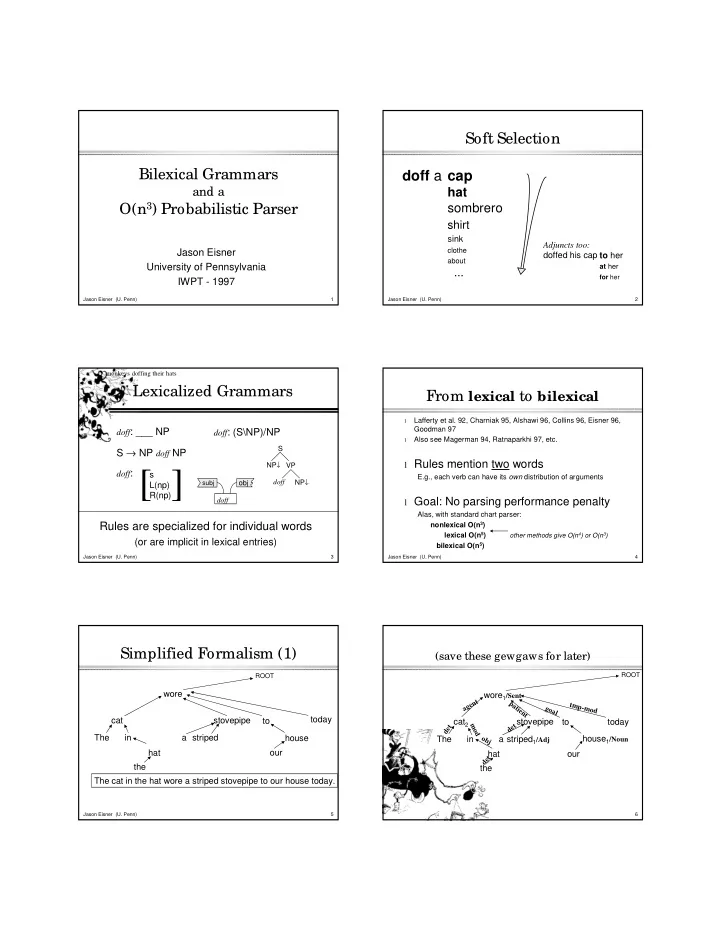
From lexical to bilexical

l

Lafferty et al. 92, Charniak 95, Alshawi 96, Collins 96, Eisner 96, Goodman 97

l

Also see Magerman 94, Ratnaparkhi 97, etc.

l Rules mention two words

E.g., each verb can have its own distribution of arguments

l Goal: No parsing performance penalty

Alas, with standard chart parser: nonlexical O(n3) lexical O(n5) other methods give O(n4) or O(n3) bilexical O(n5)

Jason Eisner (U. Penn) 5

Simplified Formalism (1)

The cat in the hat wore a striped stovepipe to our house today. wore cat The in hat the stovepipe a striped

ROOT

to house

  • ur

today

Jason Eisner (U. Penn) 6

(save these gewgaws for later)

ROOT

wore1/Sent cat2 The in hat the a

agent goal tmp-mod patient det mod

  • bj

d e t det

  • ur

today stovepipe to house1/Noun striped1/Adj

slide-2
SLIDE 2

Jason Eisner (U. Penn) 7

Simplified Formalism (2)

ROOT

wore today cat

The in hat the

stovepipe

a striped

to

house
  • ur

wore: left DFA right DFA

cat stovepipe to today every lexical entry lists 2 idiosyncratic

  • DFAs. These accept

dependent sequences the word likes. Need a flexible mechanism to score the possible sequences of dependents.

Jason Eisner (U. Penn) 8

Weighting the Grammar

doff: right DFA

likes: hat nicely now (e.g., “[Bentley] doffed [his hat] [nicely] [just now]”) hates: sink countably (e.g., #“Bentley doffed [the sink] [countably]”)

hat(8) sink(1)

  • 4

3 nicely(2) now(2) countably(0) sink countably: 1+0+3 = 4 hat nicely now: 8+2+2+3 = 15 doff in(-5)

Transitive verb. accepts: Noun Adv*

Jason Eisner (U. Penn) 9

Why CKY is slow

  • 1. visiting relatives is boring
  • 2. visiting relatives wear funny hats
  • 3. visiting relatives, we got bored and stole their funny hats

visiting relatives: NP(visiting), NP(relatives), AdvP, ... CFG says that all NPs are interchangeable So we only have to use generic or best NP. But bilexical grammar disagrees: e.g., NP(visiting) is a poor subject for wear We must try combining each analysis w/ context

Jason Eisner (U. Penn) 10

Generic Chart Parsing (1)

l interchangeable analyses have same signature l “analysis” = tree or dotted tree or ... l if ≤ S signatures, keep ≤ S analyses per substring NP

[score: 4]

NP

[score: 2]

NP

[score: 5]

VP

[score: 12]

VP

[score: 17]

... [cap spending at $300 million] ...

Jason Eisner (U. Penn) 11

Generic Chart Parsing (2)

for each of the O(n2) substrings,

for each of O(n) ways of splitting it,

for each of ≤ S analyses of first half for each of ≤ S analyses of second half,

for each of ≤ c ways of combining them: combine, & add result to chart if best [cap spending] + [at $300 million] = [[cap spending] [at $300 million]] ≤ S analyses ≤ S analyses ≤ cS2 analyses

  • f which we keep ≤ S

O(n3S2c)

Jason Eisner (U. Penn) 12

Headed constituents ...

... have too many signatures.

How bad is Θ Θ Θ Θ(n3S2c)?

For unheaded constituents, S is constant: NP, VP ... (similarly for dotted trees). So Θ(n3). But when different heads ⇒ different signatures, the average substring has Θ(n) possible heads and S=Θ(n) possible signatures. So Θ(n5).

slide-3
SLIDE 3

Jason Eisner (U. Penn) 13

Forget heads - think hats!

Solution:

Don’t assemble the parse from constituents. Assemble it from spans instead.

The cat in the hat wore a stovepipe. ROOT The cat in the hat wore a stovepipe

ROOT Jason Eisner (U. Penn) 14

Spans vs. constituents

Two kinds of substring.

» Constituent of the tree: links to the rest

  • nly through its head.

» Span of the tree: links to the rest

  • nly through its endwords.

The cat in the hat wore a stovepipe. ROOT The cat in the hat wore a stovepipe. ROOT

Decomposing a tree into spans

The cat in the hat wore a stovepipe. ROOT The cat wore a stovepipe. ROOT

Jason Eisner (U. Penn) 15

cat in the hat wore

+ +

in the hat wore cat in + hat wore in the hat + cat in the hat wore a stovepipe. ROOT

Jason Eisner (U. Penn) 16

Maintaining weights

Seed chart w/ word pairs , , Step of the algorithm:

a ... b b ... c

+ =

a ... b ... c a ... b ... c a ... b ... c

We can add an arc only if a, c are both parentless.

a ... b ... c

weight( ) = weight( ) + weight( ) + weight of c arc from a’s right DFA state + weights of stopping in b’s left and right states

a ... b b ... c x y x y x y

Jason Eisner (U. Penn) 17

Analysis

Where: Signature of has to specify parental status & DFA state of a and b ∴ S = O(t2) where t is the maximum # states of any DFA

S independent of n because all of a substring’s analyses are headed in the same place - at the ends!

a ... b b ... c

+ = a ... b ... c

a ... b

»b gets a parent from exactly one side »Neither a nor c previously had a parent »a’s right DFA accepts c; b’s DFAs can halt

Algorithm is O(n3 S2 ) time, O(n2 S ) space. What is S?

Jason Eisner (U. Penn) 18

Improvement

Can reduce S from O(t2) to O(t)

a ... b b ... c

+ = a ... b ... c

state of b’s left automaton tells us weight of halting likewise for b’s right automaton The halt-weight for each half is independent of the other half.

a ... b Add every span to both left chart & right chart

Above, we draw from left chart, from right chart Copy of in left chart has halt weight for b already added so its signature needn’t mention the state of b’s automaton

b ... c a ... b

slide-4
SLIDE 4

Jason Eisner (U. Penn) 19

Embellishments

l More detailed parses

» Labeled edges » Tags (part of speech, word sense, ...) » Nonterminals

l How to encode probability models

Jason Eisner (U. Penn) 20

More detailed parses (1)

cat The in hat the

agent det adj

  • bj

d e t

Labeled arcs

Grammar: DFAs must accept strings of word-role pairs e.g., (cat, agent ) or (hat, obj) Parser: When we stick two spans together, consider covering with: nothing, , , , Time penalty: O(m) where m is the number of label types agent agent

  • bj
  • bj

etc.

Jason Eisner (U. Penn) 21

More detailed parses (2)

cat3 The1 in6 hat2 the1 Optimize tagging & parsing at once

Grammar: Every input token denotes confusion set

cat = {cat1, cat2, cat3, cat4}

Choice of cat3 adds a certain weight to parse Parser: More possibilities for seeding chart Tags of b must match in + Signature of must specify tags of a and b Time penalty: O(g4) where g is max # tags per input word since S goes up by g2 O(g3) by considering only appropriate

a ... b a ... b b ... c b ... c

Jason Eisner (U. Penn) 22

Nonterminals

C B A a b b’ c’ c

c b b’ c’

C C B

aA,B,C

B Use fast bilexical algorithm, then convert result to nonterminal tree. Want small (and finite) set of tags like aA,B,C. (Guaranteed by X-bar theory: doff = {doffV,V,VP , doffV,V,VP,S}. ) Articulated phrase projected by head a Flat dependency phrase w/ head a. The bilexical DFAs for aA,B,C insist that its kids come in order A, B, C.

  • ne-to-one

(cf. Collins 96)

Jason Eisner (U. Penn) 23

Using the weights

l Deterministic grammar: All weights 0 or -∞ l Generative model: log Pr(next kid = nicely | doff in state 2) l Comprehension model: log Pr(next kid = nicely | doff in state 2, nicely present)

l

Eisner 1996 compared several models, found significant differences

hat sink nicely now in

doff:

Jason Eisner (U. Penn) 24

String-local constraints

x y Seed chart with word pairs like We can choose to exclude some such pairs. Example: k-gram tagging. (here k=3)

N P Det tag with part-of-speech trigrams

  • ne cat in the hat weight = log Pr(the | Det)Pr(Det | N,P)

Det V P N P Det excluded bigram:

in the the 2 words disagree on tag for “cat”

slide-5
SLIDE 5

Jason Eisner (U. Penn) 25

Conclusions

l Bilexical grammar formalism

How much do 2 words want to relate? Flexible: encode your favorite representation Flexible: encode your favorite prob. model

l Fast parsing algorithm

Assemble spans, not constituents O(n3), not O(n5). Precisely, O(n3t2g3m).

t=max DFA size, g=max senses/word, m=# label types These grammar factors are typically small