
SLIDE 1
PHASE 1 COMMUNITY ENGAGEMENT SUMMARY
DISTRICT OF SQUAMISH OCP UPDATE ENGAGEMENT SNAPSHOT In Phase 1 of - - PDF document
PHASE 1 COMMUNITY ENGAGEMENT SUMMARY DISTRICT OF SQUAMISH OCP UPDATE ENGAGEMENT SNAPSHOT In Phase 1 of Squamishs Offjcial Community Plan (OCP) Update process, community members and stakeholder groups were invited to identify, share and
PHASE 1 COMMUNITY ENGAGEMENT SUMMARY
KEY THEMES:
» Smart growth: Squamish is growing rapidly and needs to carefully manage growth to avoid sprawl, create complete neighbourhoods, plan for effjcient infrastructure, and develop in a sustainable way. Squamish should be a community where people can live, work, play and shop. » Economic development and local jobs: Squamish needs more well-paying local jobs to ensure we are more than just a bedroom community. We need to preserve lands for industrial and other employment uses to ensure a diverse economy with a focus on sustainability and innovation. » Afgordable and diverse housing: Afgordability is a key issue and many residents are concerned about being able to afgord to stay in Squamish, especially youth, young families, and seniors. » Local and regional transportation: People need safe and accessible ways to get around Squamish and to neighbouring communities. Walkable neighbourhoods, well-connected trails, and better transit options will help to make Squamish more afgordable and support a healthy and active community. » Sustainable environment and recreation: Squamish’s natural environment is the backbone of
the health and well-being of humans and wildlife. We need to preserve the environment and promote sustainability through our economy and our actions. » Sense of community: Residents want to maintain our unique identity and small town feel while creating a stronger sense of place and vibrant, attractive community and downtown core that celebrates local arts and culture.
SQUAMISH IS AN ENGAGED COMMUNITY
One thing was clear from the 1,200+ people who participated in Phase 1; Squamish residents care about their community. People genuinely love this place and want to preserve the things that make it special while working to improve afgordability and accessibility for current and future residents. In Phase 1 of Squamish’s Offjcial Community Plan (OCP) Update process, community members and stakeholder groups were invited to identify, share and discuss their issues and priorities for the future through a series of activities including: interviews, a public event and questionnaire, and workshops with Squamish Nation members, municipal stafg, and students from Howe Sound Secondary. The following provides an overview of what we heard.
A few core ideas summarized from all the feedback received...
Your Future. Your Plan. Our Squamish.
Students engaged in Youth Workshop
Completed questjonnaires
Atuended the Public Event
Interviews with stakeholder groups
Atuended the Stafg Event
Atuended the Squamish Natjon Event
#SQUAMISH2040 | OCP UPDATE PHASE 1 SUMMARY OF COMMUNITY ENGAGEMENT
INTRODUCTION ........................................................................................................................... 1 Overview ....................................................................................................................... 1 The OCP Update Process ............................................................................................... 1 PART 1. WHAT WE DID ............................................................................................................... 2 Engagement Events in Phase 1 ...................................................................................... 2 Stakeholder Interviews ................................................................................................... 2 Questionnaire ................................................................................................................. 2 Public Visioning Event ..................................................................................................... 3 Youth Workshop ............................................................................................................. 4 Staff Event ....................................................................................................................... 5 Squamish Nation Event ................................................................................................... 5 Promotion and Outreach to Drive Participation ............................................................. 7 PART 2. WHO PARTICIPATED .................................................................................................... 8 PART 3. WHAT WE HEARD ..................................................................................................... 10 Methodology ............................................................................................................... 10 Critical Issues ............................................................................................................... 11 Vision for the Future .................................................................................................... 13 Key Priorities ................................................................................................................ 15 Community Mapping .................................................................................................... 18 How to Engage Squamish ............................................................................................. 26 Feedback on Key Topics ................................................................................................ 27 Other Comments .......................................................................................................... 33 NEXT STEPS ............................................................................................................................... 35 Phase 2 Engagement .................................................................................................... 35
Page 1 #SQUAMISH2040 | OCP UPDATE PHASE 1 SUMMARY OF COMMUNITY ENGAGEMENT
OVERVIEW
The District of Squamish is updating its Official Community Plan (OCP), the District’s most important plan for the future, used by staff and Council to make land use decisions, choose among infrastructure investments, and set community service priorities. OCPs are generally updated every 5-10 years or so. Squamish is in need of an update because our current plan (2010) is out of date: our population and economy is growing faster than anticipated, and we have new and better studies about downtown development, estuary management, community-wide transportation, affordable housing, climate change planning, and more to include in the OCP. By setting out a clear community vision today in an updated OCP, we can shape our growth in a way that is sustainable and provides a high quality of life for both current and future
areas of mutual interest, such as land and marine planning and resource management, economic development, tourism promotion, municipal services and hazard planning. To learn more about the OCP update, please visit www.squamish.ca/OCP.
THE OCP UPDATE PROCESS
Over the next year, we are asking residents, business owners and community stakeholder groups to share what they value most about Squamish and to weigh in on how the District can build on our strengths while planning for the future. There will be many opportunities for you to learn more, attend an event and provide feedback throughout the process. The community engagement process (known as #Squamish2040) is also being guided by a Citizen Advisory Committee, which acts as a sounding board for engagement ideas and helps to encourage community members to get involved in this process.
Your Future. Your Plan. Our Squamish.
Page 2 #SQUAMISH2040 | OCP UPDATE PHASE 1 SUMMARY OF COMMUNITY ENGAGEMENT
From January through February 2016, the District invited the entire community to get involved in Phase 1 of the #Squamish2040 process. The goal was to identify, share and discuss key issues and priorities for the future.
ENGAGEMENT EVENTS IN PHASE 1
Key events are outlined below, along with a description of activities and input collected from each event. This input has been compiled and summarized in Part 3 of this report. STAK TAKEHOLDER EHOLDER INTERVIEWS NTERVIEWS One-on-one Interviews were held with 40 community groups early on in the process to understand their interest in the project, identify key issues for the OCP to address, understand their organization’s goals, and help raise awareness about the project through their networks. These stakeholders were selected by District staff and the OCP Update Citizen Advisory Committee through a detailed identification process and included a range of recreation
developers, industrial/resource-based operations, Squamish First Nations staff and environmental organizations. Input Received: Input from these interviews was used to raise awareness about the project and shape the activities and discussion topics used in Phase 1 engagement activities. QUESTIONNAIRE QUESTIONNAIRE A public questionnaire was available from January 12th to February 8th. The questionnaire was available online through the project webpage and paper copies available throughout the community. A number of project ambassadors were out at popular community locations to help raise awareness and collect feedback through digital surveys on tablets. A total of 701 questionnaire responses were received (including 630 online and 71 paper submissions).
Page 3 #SQUAMISH2040 | OCP UPDATE PHASE 1 SUMMARY OF COMMUNITY ENGAGEMENT Input Received: The questionnaire collected input on the following:
statement “In 2040, Squamish will be _______.”
important they were for the OCP to address, and explained why they felt this way. Respondents could also add other issues they felt were important to the future of Squamish.
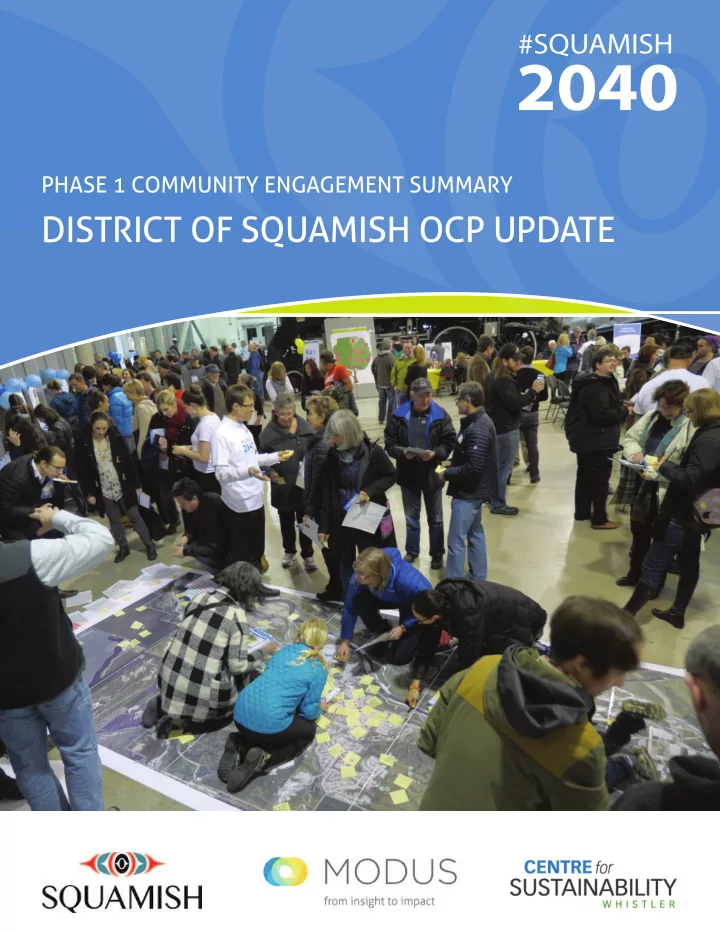
comments. PUBLIC VISIONING EVE PUBLIC VISIONING EVENT NT A public visioning event was held on January 28th at the West Coast Railway Heritage Park from 6-9pm. This interactive drop-in event included a range of activities to share information about the project and gather community input. Approximately 350 people attended this event. Activities and Input Received: The public event used a ‘passport’ to guide participants through the various interactive stations; some stations provided information (shown in grey) while others collected input:
OCP Update must address.
learned more about the Official Community Plan and why it is being updated. Planning staff were available to answer questions.
_______.” Participants wrote their ideas on a leaf and added it to the ‘vision tree’.
about a local resident from a different walk of life to see Squamish from a different perspective.
Page 4 #SQUAMISH2040 | OCP UPDATE PHASE 1 SUMMARY OF COMMUNITY ENGAGEMENT
about community health and considered how we can make Squamish healthier. Staff from Vancouver Coastal Health were available to answer questions.
they love today and places that need improvement for the future.
involved in the project and brainstormed creative ways to engage even more Squamish residents in the process.
papers on 8 key topics and provide more detailed feedback. For each topic, feedback forms asked participants why the topic is important, what the District should do about it, and if there are any good approaches from other cities we can learn from. YOUTH W OUTH WORKSHOP ORKSHOP A youth engagement workshop was held with students at Howe Sound Secondary School on February 25th. Close to 80 students from 3 leadership classes participated in activities with District Mayor, Council and staff to share their ideas for the future of Squamish. Activities and Input Received: Students completed a number of activities; some were similar to the public event while
information (shown in grey) while others collected input:
be _______.” Participants wrote their ideas on a leaf and added it to the ‘vision tree’.
about a local resident from a different walk of life to see Squamish from a different perspective.
they love today and places that need improvement for the future.
Page 5 #SQUAMISH2040 | OCP UPDATE PHASE 1 SUMMARY OF COMMUNITY ENGAGEMENT
display showing a self-directed 4min ‘Speaker’s Corner’ video highlighting what they wished for Squamish2040. This video can be viewed at www.squamish.ca/OCP. Following these activities and a slam poem presentation by the Mayor, students participated in a World Café style dialogue session with Mayor and Council as well as District staff. Topic areas discussed included: access to recreation and the arts, transportation, waste reduction and climate action goals, affordable housing, local business and sustainable job creation and working towards Truth and Reconciliation Commission recommendations. STAFF STAFF EVENT EVENT A drop-in event was also held with a range of municipal staff across a variety of departments
share their ideas for the future as well as their local knowledge and expertise. Activities and Input Received:
_______.” Participants wrote their ideas on a leaf and added it to the ‘vision tree’.
that they felt were most important for the future of Squamish.
love today and places that need improvement for the future. SQUAMISH SQUAMISH NATION NATION EVENT EVENT An informal drop-in session at Totem Hall was held on March 14th to introduce the OCP process to Squamish Nation members and provide additional opportunities to provide input and discuss the future of Squamish2040. This session was separate from formal Council-to- Council Consultation that is occurring as part of the OCP update process. Activities and Input Received:
vision for Squamish in 2040; children attending the event were invited to draw and show what they wanted for Squamish.
Squamish Natjon Stafg
Page 6 #SQUAMISH2040 | OCP UPDATE PHASE 1 SUMMARY OF COMMUNITY ENGAGEMENT
OCP Update must address.
about a local resident from a different walk of life to see Squamish from a different perspective.
they love today and places that need improvement for the future.
Page 7 #SQUAMISH2040 | OCP UPDATE PHASE 1 SUMMARY OF COMMUNITY ENGAGEMENT
PROMOTION AND OUTREACH TO DRIVE PARTICIPATION
The launch of the project and Phase 1 activities were promoted extensively and in advance through the following channels:
December 3rd to begin sharing information about the project. Phase 1 engagement events and activities announced in early January.
Facebook Event for the Public Visioning Event with an invite total of 1.3K.
February; Half-page ad in Squamish Reporter (January 1st issue).
28 event.
and Community Advisory Committee Members (day of event).
Commerce, Tourism Squamish, Squamish Chief, Squamish Reporter, Squamish Baby.
various social media accounts, activities and networks.
activities through their networks In addition to the online, radio, and print media listed above, project ambassadors helped to raise broader awareness through community outreach. Ambassadors visited the following locations:
and 30th
Page 8 #SQUAMISH2040 | OCP UPDATE PHASE 1 SUMMARY OF COMMUNITY ENGAGEMENT A grand prize of a Sea to Sky Gondola Annual Family Pass has been offered to encourage
take place at the conclusion of the OCP Update process, anticipated to be in late 2016.
Overall, a broad and diverse range of people participated in Phase 1 engagement activities. Of those who participated, 922 people shared their gender and 1,093 shared their age range. Participation by gender was fairly evenly split for all activities. There were fewer youth (under 19) who participated in the survey; however, when combined with the youth engaged through the public event and student workshop, this age group was more equally represented. The range of age groups who participated in Phase 1 is quite similar to the population demographics of Squamish residents (over 15). However, as participation in these events was voluntary, these results are not necessarily representative of the whole community.
54% 46% Female Male 100 200 300 Under 19 20 - 29 30 - 39 40 - 49 50 - 59 60+
701
Completed questjonnaires
40
Interviews with stakeholder groups
80
Students engaged in Youth Workshop
350+
Atuended the Public Event
55
Atuended the Stafg Event
Over 1,200 people participated in Phase 1
30
Atuended the Squamish Natjon Event
Page 9 #SQUAMISH2040 | OCP UPDATE PHASE 1 SUMMARY OF COMMUNITY ENGAGEMENT We also asked participants at the event to identify where they live. People came from all
with a few coming from Paradise Valley and other areas
Page 10 #SQUAMISH2040 | OCP UPDATE PHASE 1 SUMMARY OF COMMUNITY ENGAGEMENT
The following provides a summary of feedback received through all Phase 1 engagement activities including the public visioning event, public questionnaire, youth workshop, staff event, and Squamish Nation event.
METHODOLOGY
Engagement activities in Phase 1 used a variety of quantitative and qualitative questions to collect feedback from participants; however, the majority of feedback in this process was qualitative so that the District can get a better idea of what is important to the community and why people feel that way. Qualitative questions included a range of focused questions and broad, open-ended questions to provide an opportunity for input on specific topics as well as more general, uninhibited input. To analyze the data, a non-partisan approach with third-party researchers was taken. This ensures anonymity of participants and an objective approach during the coding and analysis process. Each of the engagement activities included a range of activities although most included similar questions. Where activities asked the same questions, this feedback has been
highlighted specific topics, this has been noted in the summaries below.
Page 11 #SQUAMISH2040 | OCP UPDATE PHASE 1 SUMMARY OF COMMUNITY ENGAGEMENT
CRITICAL ISSUES
Participants identified their most critical issues or topics for the OCP Update to address. A total of 331 responses were received (310 from the public event, 21 from the Squamish Nation event); the following provides a summary and count of major themes. As some responses address more than one topic, the total number of comments below may exceed the total number of responses.
jobs and diversifying the local economy to ensure Squamish is more than just a ‘bedroom community.’ A total of 24 comments addressed liquefied natural gas (LNG) and all were unsupportive. A number of comments also stressed the need to support industrial lands, education, technology and tourism. (71 comments)
frequently raised and comments focused mainly on improvements to local active transportation infrastructure (trails, pathways, sidewalks), road safety for pedestrians, and public transit. Comments on regional transportation focused mainly on public transit options (bus, rail, boat), as well as Highway 99 traffic, speed and impacts to local air quality. (60 comments)
comments stressed the need for a range of affordable housing types, affordable rental housing and affordable housing for a variety of ages and lifestyles. (54 comments)
sprawl through the creation of ‘complete neighbourhoods,’ and manage the overall pace of growth, which some people feel is happening too quickly. (51 comments)
importance of protecting nature/ecosystems with a specific focus on areas such as the estuary, wildlife habitat and wildlife corridors. (26 comments)
sustainable tourism but the majority focused on supporting access to nature or specific amenities such as trails. Mixed support was shown for attractions such as Garibaldi at Squamish or the proposed water-themed resort. (22 comments) This question was asked via:
Public Event Interviews Squamish Natjon Workshop
Page 12 #SQUAMISH2040 | OCP UPDATE PHASE 1 SUMMARY OF COMMUNITY ENGAGEMENT
and food security. Health comments addressed the need to maintain local care
emergency preparedness and flood hazards. (20 comments)
comments addressing long-term infrastructure planning, balancing land use/growth with infrastructure, water/wastewater systems and waste management. Several comments also mentioned District facilities with a focus on ice rinks as well as general improvements and expansion to indoor recreation facilities. (20 comments)
relationships with Squamish Nation, taxes/fiscal responsibility, climate change adaptation, greenhouse gas reduction, seniors housing, homelessness, respecting local history, adjacent electoral areas, , general affordability and clean air.
Page 13 #SQUAMISH2040 | OCP UPDATE PHASE 1 SUMMARY OF COMMUNITY ENGAGEMENT
VISION FOR THE FUTURE
Participants share their ideas for the future of Squamish by completing the following statement: “In 2040, Squamish will be __________.” A total of 1,045 comments were received (309 from the public event, 583 survey responses, 66 student comments, 67 staff comments and 20 Squamish Nation comments). The following provides an overview of key themes, the larger the theme, the more times it was mentioned. This question was asked via:
Youth Workshop Stafg Workshop Questjonnaire Public Event Interviews Squamish Natjon Workshop
Page 14 #SQUAMISH2040 | OCP UPDATE PHASE 1 SUMMARY OF COMMUNITY ENGAGEMENT Participants covered a wide range of descriptions for a future Squamish though the most common themes included more opportunities to live, work, play and shop in Squamish, being known for recreation-based tourism, protecting the environment, and having great access to nature and outdoor recreation. Participants highlighted a sense of place that was larger with a small town feel and strong sense of community. Words like, vibrant, thriving, progressive, outdoorsy, adventurous, natural beauty, mountains, and waterfront capture the essence of many of the comments. Being suitable for all was another common theme describing a diverse community that is inclusive of all ages (especially youth and seniors), all stages of life, income levels, interests, and cultures. Many noted more affordability and affordable housing as well as a greater ease of moving around the community by trail networks, walkable areas and transit. Highlighting a desire for local jobs, participants described a world-renowned community with a diverse economy including tourism, technology and education, as well as existing industrial and service sectors. Comments described growth of local and new businesses and a unique and thriving downtown. Being economically self-sufficient was a recurring theme, along with the ability to get from sea to city, sea to sky and back again, all with good transit. Participants also focused on protecting environmentally sensitive natural areas, air/water and overall environmental stewardship. More general comments about a sustainable economy, lifestyles and leadership along with specific topics like green/clean renewable energy highlighted the importance of these values even further. Group Highlights: There were a few notable differences between participant groups:
was quite a lot bigger than today. There also tended to be more negative comments/concerns for the future such as ‘too big’, ‘hard to live in’, and ‘traffic’.
community and creating a ‘family friendly’ Squamish.
and places for youth to hang out (i.e., movie theatre, bowling, outdoor recreation), better local transit, and local jobs/careers.
community sustainability, access to recreation and nature, and local jobs.
training programs, housing and health (healing or wellness centre). Further, participants commented on authentic integration of Squamish heritage, as well as youth and elders working together.
Page 15 #SQUAMISH2040 | OCP UPDATE PHASE 1 SUMMARY OF COMMUNITY ENGAGEMENT
KEY PRIORITIES
Questionnaire respondents and participants from in-person events shared their ideas about community priorities in slightly different ways; however the results were quite similar. Overall, the top priorities for the community included:
IN IN-PERSON EVENT RESPONSES PERSON EVENT RESPONSES Participants from in-person events (including the public visioning event, youth workshop, staff event and Squamish Nation event) reviewed a list of topics and were asked to prioritize them by voting with six marbles. Each person could vote for up to six different topics or vote more than once for a single topic. This question was asked via:
Youth Workshop Stafg Workshop Questjonnaire Public Event Interviews Squamish Natjon Workshop
50 100 150 200 250 300 350 Social support, inclusion, connectedness* Protecmng land for industrial acmvimes Educamon and Learning* Energy efficiency and producmon Planning for new growth and development Flood hazard management and protecmon Suppormng local arts and culture Climate change and sea level rise Collaboramon with Squamish First Namon Transportamon Healthy communimes and individuals Infrastructure (water, sewer, stormwater) Recreamon and access to natural areas Affordable and diverse housing Economy and local jobs Protecmng the natural environment Number of votes * New topics proposed by participants at the public event. Not everyone at the public event saw these options but they were presented at the youth workshop, staff event and Squamish Nation event.
Page 16 #SQUAMISH2040 | OCP UPDATE PHASE 1 SUMMARY OF COMMUNITY ENGAGEMENT QUESTIONNAIRE RESPONSES QUESTIONNAIRE RESPONSES Questionnaire respondents reviewed the same list of topics but were asked to rank how important the topics were for the OCP to address rather than prioritize them. Why do you feel this way? Questionnaire respondents were asked to explain why they felt this way and had the
Participants noted that these topics are important to create a well-planned, affordable and complete community that has opportunities for everyone to live, work and play, especially youth, young families and seniors. These topics also reflect key community values to protect and enjoy the natural environment, promote sustainability and innovation, and celebrate local culture and heritage.
100 200 300 400 500 600 Protecmng land for industrial acmvimes Suppormng local arts and culture Collaboramon with Squamish First Namon Climate change and sea level rise Energy efficiency and producmon Flood hazard management and protecmon Infrastructure (water, sewer, stormwater) Affordable and diverse housing Transportamon Planning for new growth and development Healthy communimes and individuals Economy and local jobs Protecmng the natural environment Recreamon and access to natural areas Number of responses Very important Somewhat important Not important
Page 17 #SQUAMISH2040 | OCP UPDATE PHASE 1 SUMMARY OF COMMUNITY ENGAGEMENT Comments emphasized the need to carefully plan new growth and development to provide for current and future residents without overdeveloping or detracting from the unique character that makes Squamish such a desirable place to live. Participants also stressed that careful and strategic planning is needed to ensure Squamish is more than just a bedroom community to Vancouver or Whistler. What other issues are important to the future of Squamish? Questionnaire respondents shared a range of other ideas and comments. These are listed below with the total number of comments shown in brackets.
infrastructure and frequent, affordable, sustainable options to Whistler and Vancouver (boat, rail, highway, transit) (49)
and arts programs/facilities (46)
and views (32)
enforcement, healthcare, fire, waste management) (28)
economic development (24)
engaged citizens (24)
fossil fuel use (18)
climbing areas, mountain biking routes) (16)
spending (15)
and fostering connections (14)
clean energy sectors (13)
inclusiveness (11)
round/indoor activities (10)
homelessness (9)
support our tax base (8)
people with disabilities (6)
roads, sidewalks) (7)
Page 18 #SQUAMISH2040 | OCP UPDATE PHASE 1 SUMMARY OF COMMUNITY ENGAGEMENT
COMMUNITY MAPPING
Participants from the in-person events explored a large map of Squamish and identified places they love today and places that need improvement for the future. Over 800 comments were received in total (530 from the public event, 38 student comments, 177 staff comments, and 58 Squamish Nation comments). A letter submission was also received from the Squamish Access Society, a non-profit advocating for rock- climbing in the Squamish area. Some comments applied to specific locations while others were more general. General Comments General comments emphasized the need to improve transportation infrastructure for pedestrians, cyclists and public transit and improving traffic and road safety (crosswalks, bike paths, enforcing speeding laws), particularly on Highway 99. Many also noted that more diverse and convenient regional commuting options are needed, especially to Vancouver and Whistler, by train, boat and public transit. Comments from students specifically highlighted the need for pedestrian, cyclist and transit infrastructure. Squamish Nation participants also focused on transportation access and gaps in service. As in other activities, participants noted that housing diversity and affordability for a spectrum of income levels are major issues in Squamish. Comments varied on appropriate levels of density for housing but most agreed there is a need/demand for housing that is close to green spaces and recreational activities. The need for local economic development and sustainable jobs was raised by numerous
and renewable energy industries, support local businesses/vendors, and provide more accessible shops and services (locations, hours). Recreation/leisure was another key theme and participants emphasized the importance of preserving and maintaining parks and trails (for hiking, biking, climbing, and skiing) as well as community centres and local arts and culture. These are seen as part of the identity of
and places for youth to hang out (like a movie theatre, updated youth centre). The Squamish Access Society emphasized the need for more affordable low-frills campgrounds. Many participants noted that sustainability and preservation of the natural environment are key priorities for Squamish. Participants noted concerns with logging old growth forests, LNG facilities/pipelines, declining fish stocks, flood management and preservation of important habitats, waterways, and dikes. Comments suggested renewable energy This question was asked via:
Youth Workshop Stafg Workshop Squamish Natjon Workshop Public Event
Page 19 #SQUAMISH2040 | OCP UPDATE PHASE 1 SUMMARY OF COMMUNITY ENGAGEMENT generation, local food production, enforcement of bylaws, and improved facilities in public spaces (such as recycling/composting in public spaces and improved trash/bathroom facilities in natural areas) would help to reduce pollution and promote local sustainability. Students emphasized the need to limit development on forestland and protect views and the natural beauty of Squamish. Protection of the estuary and local rivers was emphasized at the Squamish Nation event. Comments from District staff also focused on health and emergency services noting the need for resilient facilities that are appropriately sized/serviced appropriately for the community and needs for firefighting facilities and equipment. Comments also emphasized green approaches to waste-water treatment. Location-Specific Comments Key locations included:
Garibaldi Highlands
Other locations included:
Ä
Ä
99Ä
Ä
99Ä
Ä
99Ä
Ä
99 Ma m qu a m R i v e r FSquamish
´
1,000 2,000 500 Meters Squamish Location Map District of Squamish1 2 4 3 7 5 9 8 10 6 14 12 16 17 13 15 22 19 20 24 21 25 23
Woodfjbre LNG Shannon Falls Garibaldi Park Airport
18 11
Page 20 #SQUAMISH2040 | OCP UPDATE PHASE 1 SUMMARY OF COMMUNITY ENGAGEMENT The following provides a summary of comments received for each location.
and revitalizing the downtown and recognized this as vital to building a vibrant, social community at the heart of Squamish. Comments addressed accessibility and noted that the downtown should be walkable and road infrastructure leading to and within the downtown core should support all modes of travel. A few comments suggested that Cleveland Avenue should be pedestrian-only and emulate a “Whistler style plaza.” Many participants stressed the need for a strategy to attract and support local businesses and increase the variety of shops, services and entertainment to attract more people to the downtown core. An educational as well as eco-tourism focus and a downtown market space with food hub were also identified. Participants noted there is a demand for affordable housing as well as shelter services and low-income housing downtown although opinions were mixed about the right level of housing diversity and
connectivity along the highway and to neighbourhoods; suggestions included crosswalks, wider bike lanes, improving connections on the Connector Trail and over the highway, improving traffic congestion and spill over from commercial nodes and adding lights to certain intersections. Participants also noted the need for a local commercial area as well as parks, trails and playground facilities to reduce car travel and create a complete community. Several people noted “The Farm” as an example of a small business that should be encouraged along this stretch of the highway. Other comments expressed concerns with sprawling development and large homes, suggesting Squamish should focus on developing existing areas to preserve natural areas and support sustainable transportation. (54 comments total – 38 public, 12 staff, 1 student, 3 Squamish Nation)
community assets to preserve but noted that more local shops, more parks (for people and dogs), dike improvements, and more housing options were needed. Other comments addressed safety and stressed the need for more street/sidewalk lighting, safe trails connecting Brackendale to Squamish, and better traffic signage, road maintenance and slower traffic. Participants also noted concerns about development and traffic impacts on sensitive areas, especially during eagle season. (44 comments total – 30 public, 12 staff, 2 Squamish Nation)
improved and expanded where facilities are at capacity. Suggestions included more classes, upgraded facilities, more community amenities (like meeting rooms,
Page 21 #SQUAMISH2040 | OCP UPDATE PHASE 1 SUMMARY OF COMMUNITY ENGAGEMENT physiotherapy), more affordable gym access, and events. Some people suggested a need for more traffic management/road infrastructure (lights, school zones, bike lanes) in the area to improve safety while others suggested the area should avoid too many buildings and traffic signals to protect wildlife and natural views. The need to increase the supply of affordable rental units in adjacent neighbourhoods was also noted. (43 comments total – 30 public, 8 staff, 3 student, 2 Squamish Nation)
enjoyed by many, and this important wildlife habitat must be protected from any type
the area. Some suggested the area should have a greater connection to the downtown for greater accessibility. (35 comments total – 18 public, 13 staff, 3 student, 1 Squamish Nation)
network that provides world-class outdoor recreation but also supports active transportation with trail connections in and out of town. Participants emphasized the need to protect these trails from industry and development and fund their ongoing maintenance and appropriate staging. (34 comments total – 24 public, 10 staff)
developing the Squamish Oceanfront area. People were generally supportive of improving public spaces, amenities and recreation; however, a number of participants expressed concern about prioritizing development over the protection of natural areas. Others noted they would like to see the plan implemented and the creation of livelier neighbourhood with more shops, meeting spaces, and restaurants, as well as recreation
public, 5 staff)
local amenities (such as shops and services) and the need for streetlights, sidewalks, smoother traffic/vehicle flow and a safe highway crossing for better access and
natural areas, trails, and wildlife/fish habitat. (27 comments total – 17 public, 6 staff, 3 student 1 Squamish Nation)
concerns related to sustainability, environmental degradation, fish habitat, air pollution, water sports, and declining property values. Several people suggested renewable energy as an alternative for boosting the local economy and creating jobs. Other comments suggested the need for a marine plan and public ferry to Woodfibre for recreational access. (22 comments total – 16 public, 4 staff, 2 Squamish Nation)
Page 22 #SQUAMISH2040 | OCP UPDATE PHASE 1 SUMMARY OF COMMUNITY ENGAGEMENT 10. Highway 99 – Participants highlighted the important relationship between the highway and Squamish. Many expressed safety concerns for drivers, pedestrians and cyclists both on the highway and crossing the highway. Comments addressed merging and access points and suggested more traffic regulation is needed to manage speed such as better road markings, road maintenance and drainage, traffic signage and a dedicated bike lane. Important areas include:
(17 comments total – 14 public, 3 Squamish Nation) 11. Business Industrial Park (Government and Queensway/Pioneer) – Comments noted that safety in this area could be improved with lighting for pedestrians/cyclists, better traffic signals and signage and that this area should be supported to increase local jobs. Participants noted the need to buffer industrial areas from adjacent residential areas, parking issues (particularly Yekwaupsum IR 18) and the desire for passenger train service/commuter rail stop. (17 comments total – 8 public, 5 staff, 4 Squamish Nation) 12. Alice Lake Provincial Park – Participants expressed their love for Alice Lake, particularly the accessibility of trails and beaches. A few comments suggested expanding trails and access points to the Highway. (13 comments total – 8 public, 4 staff, 1 student) 13. Quest University – Participants suggested there is a divide between Quest and the rest
amenities in this area while respecting forested areas. (13 comments total – 8 public, 5 student) 14. Garibaldi Provincial Park - The majority of the participants expressed concerns about the proposed Garibaldi at Squamish (GAS) ski resort (1 person was in favour). Participants suggested the development went against community values to preserve natural areas, provide quality housing and jobs, and develop in a way that is sustainable with minimal impact on the environment. Comments stressed that the park is a “ski touring wonderland” and that the priority should be preserving and enhancing access
development goes ahead, the District should safeguard and enhance opportunities for alpine access. (11 comments total – 10 public, 1 Squamish Access Society)
Page 23 #SQUAMISH2040 | OCP UPDATE PHASE 1 SUMMARY OF COMMUNITY ENGAGEMENT 15. Smoke Bluffs Park – Participants noted they appreciated the various activities in the area (rock climbing, dog walking, trails) and it should be protected. One group recommended the District maintain a long-term ambition to acquire the remaining privately owned parcels that contain rock-climbing assets and protect both east and west banks of the Blind Channel north of the Highway 99 road bridge for habitat, not permitting any further construction in this area (11 comments total – 6 public, 4 staff, 1 Squamish Access Society) 16. Crumpit Woods – Participants noted the area’s natural beauty, views, great trails and easy access from the downtown. Comments suggested better advertising and a few amenities in public spaces (like picnic tables and washrooms) would help more people to enjoy the area. Participants also noted the need for environmental monitoring and protection from erosion in the new hillside subdivisions. (9 comments total – 8 public, 1 Squamish Nation) 17. Rockridge Place – Most comments expressed concerns about developing in a floodplain, threats to trails, a lack of sustainable, affordable housing and potential gated community development. One person supported housing in the area and another suggested the need to connect the Wonderland bike trail to the end of Tantalus Rd. (9 comments total – 8 public, 1 Squamish Nation)
connectivity, housing garbage/recycling and servicing infrastructure. (8 comments – 8 Squamish Nation) 19. Shannon Falls – Participants praised Shannon Falls for its recreational value and growing network of trails and bike routes. Comments suggested improvements to parking, bike path/walkway connections from the Gondola, direct highway access to the Gondola site for southbound travellers, and integrating more interpretive elements/signage while preserving the natural environment. One group recommended the area south of Shannon Falls to Murrin Park (on both sides of the highway) be zoned as a Forest Outdoor Recreation Reserve, possibly as part of the proposed Squamish community forest. (7 comments total – 5 public, 1 Squamish Nation, 1 Squamish Access Society) 20. North Yards / Edgewater – Participants noted they liked the trails and park equipment in this area. Comments also suggested the need for a small coffee shop/grocery/deli and more parks in this area. (6 comments total – 6 public) 21. Squamish Airport and surrounding area – Comments debated whether the airport should be expanded or not; some suggested expansion may be a good opportunity to increase local jobs. Squamish Nation members expressed concern about flight paths
Page 24 #SQUAMISH2040 | OCP UPDATE PHASE 1 SUMMARY OF COMMUNITY ENGAGEMENT and training activities over adjacent Waiwakum village (IR 14) and also noted the need for access to traditional fishing areas from the dike, as well as better wayfinding for visitors looking for camping. (6 comments total – 3 public, 3 Squamish Nation) 22. Stawamus Chief Provincial Park – Comments noted the Chief and nearby campground is a big draw for people. Due to its popularity, parking and climbing access have become
the Highlands and building parks and trails on top. (5 comments total – 5 public) 23. Government Road – Comments noted the need for a dedicated pedestrian walkway and/or cycling route to ensure safety. (4 comments total – 3 public, 1 student)
Brennan Park and the Downtown from Government/Mamquam Roads. One comment praised Amblepath for being a well designed community. (4 comments total – 4 public) 25. Monmouth Creek – Participants noted the great trails, beautiful waterfall, and
salmon habitat restoration and limited public access as this area is bear/cougar
Other location specific comments (with 1-3 comments each):
barrier to keep animals out
to recreation assets
the downtown.
camping area due to poor location and lack of walkability
highway’ signs
Page 25 #SQUAMISH2040 | OCP UPDATE PHASE 1 SUMMARY OF COMMUNITY ENGAGEMENT
past Midnight Way; concerns about Garibaldi at Squamish water issues for residents
apartment
and community of Brackendale
roundabouts
Page 26 #SQUAMISH2040 | OCP UPDATE PHASE 1 SUMMARY OF COMMUNITY ENGAGEMENT
HOW TO ENGAGE SQUAMISH
Participants at the event identified the best ways to keep people informed about the project and brainstormed creative ways to engage even more Squamish residents. The following provides a summary and count of major themes. How do you want to be notified? (173 comments) Participants covered all the major approaches to communicating and connecting, though Facebook (46 comments) and email (39) received the most mentions. More specific ideas for Facebook included connecting through groups, launching a new page specific to engagement “Squamish Speaks” and the use of Facebook events. Ideas for email included newsletters and setting up email groups for various topics. The next most popular ideas included newspapers (20) and other social media like Twitter/ Instagram (18). Ideas for newspapers included articles about events and the people involved. Other ideas with multiple mentions included; community gatherings (9), posters in social spaces (7), the District of Squamish Website (6), radio (5), booths at events (3), signage around town (2) and mail (2). Finally, a few cross cutting approaches were recommended such as highlighting one aspect
Creative Ideas to Engage Squamish Residents (156 comments) Events (59 comments) were the most popular way to engage residents about the OCP
approaches included town hall meetings, ‘pop-up’ events/booths in unique places, piggy backing on large events such as Logger’s Sports or Wind Fest, or hosting smaller events like neighbourhood block parties, school groups and small chats. Other ideas included incentives/contests (12) such as “frequent but small lotteries with creative prizes”, increased communication of events and general issues (8) by going out to where people are, ‘Reddit’ style engagement, as well as more traditional approaches like billboards and notices in newspapers. Comments also included surveying, social media and ensuring that feedback is shared and acted on. This question was asked via:
Page 27 #SQUAMISH2040 | OCP UPDATE PHASE 1 SUMMARY OF COMMUNITY ENGAGEMENT
FEEDBACK ON KEY TOPICS
Participants at the public visioning event reviewed backgrounder papers and provided detailed feedback
key ideas for each of topic. Economy and Jobs (45 feedback forms completed) Why is this important? What should the District do about it? Approaches from other cities we can learn from
Squamish
commute (more long- term jobs)
industrial needs
renewable energy, resources, Rec-tech, tourism and knowledge based industries
and industrial zoning to support industries
reduce barriers to attract desired sectors
development working groups/partnerships
market rent model for business spaces
port towns, industrial land management
Dawson Creek
–ON, New Zealand- Tourism, Downtown Vancouver – access to jobs/amenities
This question was asked via:
Page 28 #SQUAMISH2040 | OCP UPDATE PHASE 1 SUMMARY OF COMMUNITY ENGAGEMENT A Growing Town (19 feedback forms completed) Why is this important? What should the District do about it? Approaches from other cities we can learn from
community with its own character, not suburb
development/growth for what we want
downtown and access
reduce barriers to develop downtown, job creators
desires
economic sectors and incentivize
for industry, complete neighbourhoods, development boundary
towns/villages, concentrated live/work areas and preserving surrounding land
from logging to tourism
Hope/Duncan/Gibsons
Page 29 #SQUAMISH2040 | OCP UPDATE PHASE 1 SUMMARY OF COMMUNITY ENGAGEMENT Local Systems (18 feedback forms completed) Why is this important? What should the District do about it? Approaches from other cities we can learn from
highway, active transportation and appropriate industrial truck routes
infrastructure, impacts
including food
improvements
lobby for regional transit
alternatives – not estuary
needs
systems
Courtenay, Nanaimo for estuary protection
neighbourhood hubs
active transportation
management Affordable and Diverse Housing (15 feedback forms completed) Why is this important? What should the District do about it? Approaches from other cities we can learn from
to be able to live, work and age in Squamish
appropriate land use
place and community Don’t want to be a community of recreation homes
such as Whistler
landowners to build more affordable housing
developments and townhouses near amenities
affordable housing
Authority/Banff
for all ages
sponsorship
“I am in my 20s and I want to afford a home in Squamish when I am in my 30s. At the rate that Squamish is growing and developing, I am afraid that this will not be possible. “
Page 30 #SQUAMISH2040 | OCP UPDATE PHASE 1 SUMMARY OF COMMUNITY ENGAGEMENT Recreation Assets and Access (12 feedback forms completed) Why is this important? What should the District do about it? Approaches from other cities we can learn from
residents and visitors
a healthy community
at capacity
access and amenities, maintenance or recreation
create a financial reserve to hold contributions from
areas/access
recreation
facilities/fields
marine activities Natural Environment (12 feedback forms completed) Why is this important? What should the District do about it? Approaches from other cities we can learn from
valued and there is development pressure
air is important for life and economy
flooding, but also natural protections (estuary)
environment
mapping and wildlife assessment capability
NGOs for no net loss
communication of bylaws
– climate change
corridors
California for carbon reduction
“The environment is the backbone to Squamish and the reason most of us are here. It is the love of the great
Page 31 #SQUAMISH2040 | OCP UPDATE PHASE 1 SUMMARY OF COMMUNITY ENGAGEMENT Climate Change (9 feedback forms completed) Why is this important? What should the District do about it? Approaches from other cities we can learn from
us all from skiing to fish, to flooding etc.
solutions and grow our economy
have to do our part
transportation and transit especially on Hwy 99
Composting
and oppose GHG intensive industry
neighbourhoods with amenities and density to support it
Germany, Denmark
complete villages with essential services A Healthy and Learning Community (9 feedback forms completed) Why is this important? What should the District do about it? Approaches from other cities we can learn from
successful and vibrant community
youth, children and seniors
housing and amenities
homes with circle loops
groups with all local social/health agencies
prescription for older population
Communities movement
Deep Cove.- good feel, family oriented, aesthetically pleasing
“Healthy people create a healthy and prospering community.“
Page 32 #SQUAMISH2040 | OCP UPDATE PHASE 1 SUMMARY OF COMMUNITY ENGAGEMENT Arts and Culture (9 feedback forms completed) Why is this important? What should the District do about it? Approaches from other cities we can learn from
and many initiatives to improve access to arts and culture.
and culture
marketing materials
“Squamish is full of many talented visual + performing artists, many of which struggle to find a way to share their art without costing them money.”
Page 33 #SQUAMISH2040 | OCP UPDATE PHASE 1 SUMMARY OF COMMUNITY ENGAGEMENT
OTHER COMMENTS
Survey respondents had the opportunity to provide additional/general comments related to the OCP Update. A total of 201 responses were received; the following provides a summary and count of major themes. As some responses address more than one topic, the total number of comments below may exceed the total number of responses.
the need to stop tax increases, hire a Town Manager, make Council meetings more accessible to the working public, prioritize key issues, and take a bold stance on long-term visioning. (36 comments)
sustainable growth to avoid sprawl and develop attractive, pedestrian-friendly areas. A number of people expressed a strong desire to develop the oceanfront area to its full potential including parks, water access, marine industry, hotels, businesses, housing and tourism services. A few comments suggested new development should include minimum green energy and rental market standards. (34 comments)
theme highlighted the importance of protecting natural areas as well as the need to create, maintain and improve existing recreation infrastructure such as bike parks, the Sea-to-Sky trail and multipurpose trails. (33 comments)
to slow growth in order to preserve the small town character of Squamish. Participants raised concerns about becoming a “bedroom community” or “another Whistler.” Other concerns included resort projects like Garibaldi at Squamish, waterfront development, and the development of natural areas. (31 comments)
housing, including rental and subsidized housing, and many participants expressed fears about not being able to afford to live in Squamish or raise a family. Numerous people suggested the need to create policies to prioritize local ownership and
This question was asked via:
Page 34 #SQUAMISH2040 | OCP UPDATE PHASE 1 SUMMARY OF COMMUNITY ENGAGEMENT
Squamish" and the area’s natural beauty and abundant outdoor opportunities. A few comments suggested a need to build even stronger community connections, such as a Proud of Squamish Citizens volunteer group. (27 comments)
community amenities in Squamish, particularly for youth, seniors and families. Suggestions included ice rinks, swimming pools, parks, and a new recreation centre. (26 comments)
emphasized support for Council, their vision and the opportunity to engage in the OCP planning process. (25 comments)
for better connectivity within Squamish and between Vancouver, Squamish and Whistler by car, rail, and water. The majority of comments focused on sustainable modes of transportation such as walking, cycling and transit although other issues such as parking, pedestrian and cycling safety, and traffic congestion were also
and attract companies that reinforce Squamish’s brand. Participants noted the need for more local jobs to reduce long commutes for those working out of town. Tourism was a major theme as well as local start-ups, TV and film industries, renewable energy and industrial jobs. (21 comments)
Woodfibre LNG and heavy industry citing climate change, environmental degradation, and impact on tourism, branding and the economy. Participants suggested renewable energy, clean-energy start-ups and carbon neutral operations as alternatives. (18 comments)
and wording in the questionnaire and noted it was difficult to prioritize topics, as they are all important for the future of Squamish. (12 comments)
Page 35 #SQUAMISH2040 | OCP UPDATE PHASE 1 SUMMARY OF COMMUNITY ENGAGEMENT
There will be many more opportunities for Squamish residents, business owners and community stakeholder groups to get involved and share their ideas for Squamish2040. Input from Phase 1 will be used to create a draft vision and goals for the plan, which we will bring back to the community for review and comment in Phase 2 to make sure we’re on the right track. Feedback on community priorities will also be used to guide discussions on key topics in Phase 2.
PHASE 2 ENGAGEMENT
Join us in Phase 2 as we dive deeper into early policy directions and discuss key options and trade-offs for updating the Official Community Plan:
workers and neighbours to discuss the future of our community – with food! These citizen-led discussions will be guided by questions in a workbook designed to help you have a conversation about the future of our community in a way that is more comfortable and suits your schedule. As a thank you, the District is offering a $30 gift certificate to support hosts in offering food and beverages at their discussions. These workbooks will also be available online for individual input for those who would rather not attend an in-person discussion.
will provide an opportunity to participate in a group dialogue on key topics. Join us
Sign up for project updates at www.squamish.ca/OCP and stay tuned for details on upcoming activities and events.