
SLIDE 1
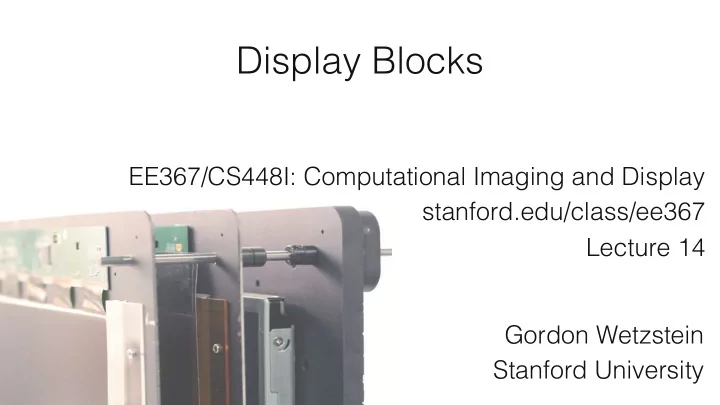
Display Blocks EE367/CS448I: Computational Imaging and Display - - PowerPoint PPT Presentation
Display Blocks EE367/CS448I: Computational Imaging and Display stanford.edu/class/ee367 Lecture 14 Gordon Wetzstein Stanford University Logistics final project poster presentations: Wed 3/11, 3:00-5:30pm, Packard Atrium use poster
poster until both the instructor and your project mentor talked to you
goal of your project? what is your approach to getting there? what results did you get? where were the challenges? how does it compare to other approaches? how did you evaluate your method?
s another eve vent at 6pm in the sa same location, so so we must st clear the area!
structors s will st start at 3pm sh sharp! if we are at yo your post ster and yo you’re not ready y to prese sent, yo your team will get a sc score of 0
you prese sent for more than 4 minutes, s, we will decrease se the sc score of yo your prese sentation! You sh should rehearse se and time yo your post ster pitch!
CODE DE: should run out of the box! should be commented. should contain all data necessary to run it. should contain a README file and be obvious what to run
website (or comparable), should look like a conference paper: abstract, introduction, related work, your method (with equations, pseudo-code, algorithmic details, flow chart, …), experimental results, analysis and evaluation, comparison to previous work, discussion, limitations, conclusion, references
Tupac & Snoop Dogg – Live at Coachella 2012
Gorillaz & Madonna @ Grammy Awards 2006
John Henry Pepper, 1862
http://www.redbubble.com/people/melek0197/works/9472644-childs-reflection-in-train-window
wikipedia
wikipedia
electroembedded.blogspot.com/2014/03/google-glass.html
displayblocks.org
Liquid Crystal Display (LCD) Liquid Crystal Display
Digital Micromirror Device (DMD) Light Emitting Diodes (LEDs) and OLEDs E Ink
wikipedia
wikipedia
blue LED blue LED + phosphor (Ce:YAG)
wikipedia
Samsung Galaxy Note Edge LG
howstuffworks.com
https://www.youtube.com/watch?v=mnh3lt8rnUk
plc.cwru.edu/tutorial/enhanced/files/lcd/tn/tn.htm
plc.cwru.edu/tutorial/enhanced/files/lcd/tn/tn.htm
wikipedia
across viewing angles, don’t change color when touched
more expensive than TN
wikipedia
wikipedia
TN subpixels IPS S-IPS IPS
extremetech.com wikipedia
… at the end, you have a “light box” backlight enhancing films
Cornelissen, SPIE 2008 extremetech.com
Fattal et al. 2013
wikipedia
http://www.ravepubs.com/ quantum-dots-the-end-of-white-leds-in-backlights/
nd polarize
Texas Instruments
http://wordpress.mrreid.org/
Microvision, Freeman et al. 2009
Microvision, Freeman et al. 2009
announced by Sony
many slides from Douglas Lanman (thanks)
binocular disp sparity mo motion para rallax accom accommod
ation/
ur conve vergence current glasse sses-base sed (st stereosc scopic) disp splays ys near near-term: compressi ssive ve light field disp splays ys lo longer-term: holographic disp splays ys
Glasses-bound Stereoscopic Immersive
(blocks direct-viewing of real world)
See-through
(superimposes synthetic images onto real world)
Head-mounted
(eyepiece-objective and microdisplay)
Multiplexed
(stereo pair with same display surface)
Spatially-multiplexed (field-concurrent)
(color filters, polarizers, autostereograms, etc.)
Temporally-multiplexed (field-sequential)
(LCD shutter glasses)
Unencumbered Automultiscopic Parallax-based
(2D display with light-directing elements)
Volumetric
(directly illuminate points within a volume)
Holographic
(reconstructs wavefront using 2D element)
Parallax Barriers
(uniform array of 1D slits or 2D pinhole arrays)
Integral Imaging
(lenticular sheets or fly’s eye lenslet arrays)
Multi-planar
(time-sequential projection onto swept surfaces)
Transparent Substrates
(intersecting laser beams, fog layers, etc.)
Static
(holographic films)
Dynamic
(holovideo)
Taxonomy adapted from Hong Hua
Glasses-bound Stereoscopic Immersive
(blocks direct-viewing of real world)
Head-mounted
(eyepiece-objective and microdisplay)
Multiplexed
(stereo pair with same display surface)
Glasses-bound Stereoscopic Immersive
(blocks direct-viewing of real world)
See-through
(superimposes synthetic images onto real world)
Head-mounted
(eyepiece-objective and microdisplay)
Multiplexed
(stereo pair with same display surface)
Glasses-bound Stereoscopic Immersive
(blocks direct-viewing of real world)
See-through
(superimposes synthetic images onto real world)
Head-mounted
(eyepiece-objective and microdisplay)
Multiplexed
(stereo pair with same display surface)
Spatially-multiplexed (field-concurrent)
(color filters, polarizers, etc.)
Glasses-bound Stereoscopic Immersive
(blocks direct-viewing of real world)
See-through
(superimposes synthetic images onto real world)
Head-mounted
(eyepiece-objective and microdisplay)
Multiplexed
(stereo pair with same display surface)
Spatially-multiplexed (field-concurrent)
(color filters, polarizers, autostereograms, etc.)
Temporally-multiplexed (field-sequential)
(LCD shutter glasses)
Comfort zone Screen Object in left eye Object in right eye Object perceived in 3D Pixel disparity Vergence Depth
Accommodation
(focal plane)
A perceptual model for disparity, SIGGRAPH 2011 [Didyk et al.]
Comfort zone
Scene manipulation
A perceptual model for disparity, SIGGRAPH 2011 [Didyk et al.]
A perceptual model for disparity, SIGGRAPH 2011 [Didyk et al.]
“Nonlinear Disparity Mapping for Stereoscopic 3D” by Lang et al. 2010
“Nonlinear Disparity Mapping for Stereoscopic 3D” by Lang et al. 2010
Unencumbered Automultiscopic Parallax-based
(2D display with light-directing elements)
Volumetric
(directly illuminate points within a volume)
Holographic
(reconstructs wavefront using 2D element)
Parallax Barriers
(uniform array of 1D slits or 2D pinhole arrays)
NewSight MV-42AD3 42'' (1920x1080, 1x8 views)
2D display barrier
Unencumbered Automultiscopic Parallax-based
(2D display with light-directing elements)
Volumetric
(directly illuminate points within a volume)
Holographic
(reconstructs wavefront using 2D element)
Parallax Barriers
(uniform array of 1D slits or 2D pinhole arrays)
Integral Imaging
(lenticular sheets or fly’s eye lenslet arrays)
Alioscopy 3DHD 42'' (1920x1200, 1x8 views)
2D display lenslets
§ Currently promoted by 3M § Requires a high-speed (120 Hz) LCD panel, an additional double-sided prism film, and a pair of LEDs § Allows multi-view display, but requires higher-speed LCD and additional light sources for each view
Nelson and Brott, 2010 US Patent 7,847,869
Unencumbered Automultiscopic Parallax-based
(2D display with light-directing elements)
Volumetric
(directly illuminate points within a volume)
Holographic
(reconstructs wavefront using 2D element)
Parallax Barriers
(uniform array of 1D slits or 2D pinhole arrays)
Integral Imaging
(lenticular sheets or fly’s eye lenslet arrays)
Multi-planar
(time-sequential projection onto swept surfaces)
Unencumbered Automultiscopic Parallax-based
(2D display with light-directing elements)
Volumetric
(directly illuminate points within a volume)
Holographic
(reconstructs wavefront using 2D element)
Parallax Barriers
(uniform array of 1D slits or 2D pinhole arrays)
Integral Imaging
(lenticular sheets or fly’s eye lenslet arrays)
Multi-planar
(time-sequential projection onto swept surfaces)
Transparent Substrates
(intersecting laser beams, fog layers, etc.)
Unencumbered Automultiscopic Parallax-based
(2D display with light-directing elements)
Volumetric
(directly illuminate points within a volume)
Holographic
(reconstructs wavefront using 2D element)
Parallax Barriers
(uniform array of 1D slits or 2D pinhole arrays)
Integral Imaging
(lenticular sheets or fly’s eye lenslet arrays)
Multi-planar
(time-sequential projection onto swept surfaces)
Transparent Substrates
(intersecting laser beams, fog layers, etc.)
Static
(holographic films)
Unencumbered Automultiscopic Parallax-based
(2D display with light-directing elements)
Volumetric
(directly illuminate points within a volume)
Holographic
(reconstructs wavefront using 2D element)
Parallax Barriers
(uniform array of 1D slits or 2D pinhole arrays)
Integral Imaging
(lenticular sheets or fly’s eye lenslet arrays)
Multi-planar
(time-sequential projection onto swept surfaces)
Transparent Substrates
(intersecting laser beams, fog layers, etc.)
Static
(holographic films)
Dynamic
(holovideo)
Tay et al. [Nature, 2008] MIT Media Lab Spatial Imaging Group
[Holovideo, 1989 – present]
Cyclostereoscope, France, 1940-50s Seymon Palovich Ivanov, Russia, 1935 Inventors & Filmmakers, 1950s
John Henry Pepper, 1862
Gorillaz & Madonna @ Grammy Awards 2006
Huang et al. 2014 Jones et al. 2009 Favalora et al.
Nature 2013