Disks and Files (Part 2) Disk technology and how to make disk - - PDF document

disks and files part 2
SMART_READER_LITE
LIVE PREVIEW

Disks and Files (Part 2) Disk technology and how to make disk - - PDF document

Outline Disks and Files (Part 2) Disk technology and how to make disk read/writes faster (last time) Buffer management Storing database files on disk (Chapter 9 of textbook)


slide-1
SLIDE 1

Disks and Files (Part 2)

(Chapter 9 of textbook)

Outline

Disk technology and how to make disk read/writes faster (last time) Buffer management Storing “database files” on disk

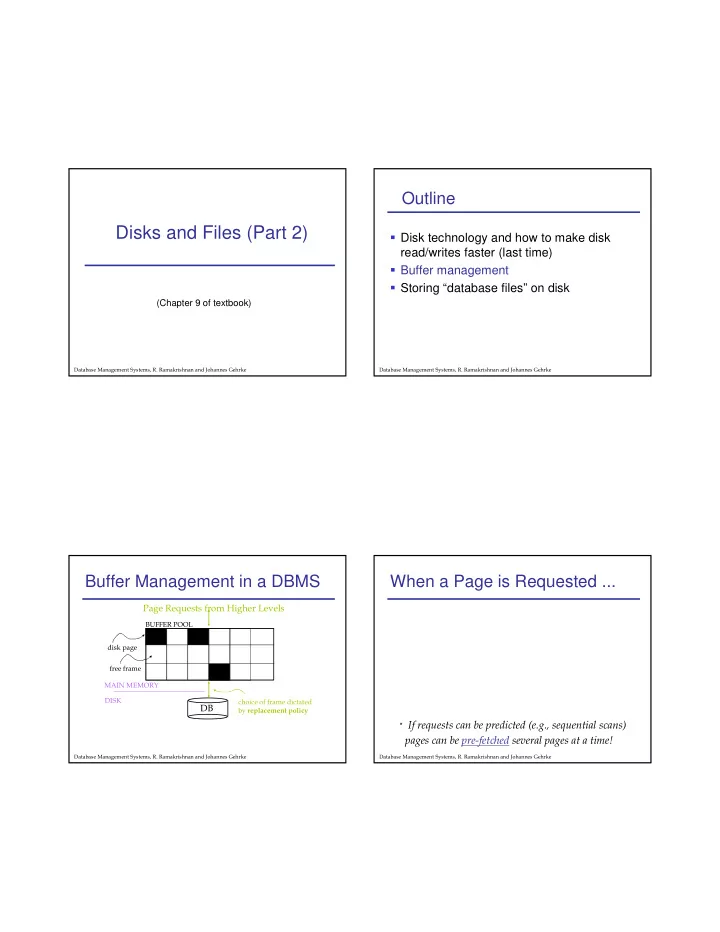
Buffer Management in a DBMS

  • !

""

#$%"&'()

*++#' ,,"",

  • When a Page is Requested ...

*

slide-2
SLIDE 2

More on Buffer Management

Requestor of page must unpin it, and indicate whether page has been modified Page in pool may be requested many times CC & recovery may entail additional I/O when a frame is chosen for replacement.

In Class Exercise

What happens if the buffer is full and all frames have pin count > 0? What happens if multiple transactions (users) want to access the same page?

In Class Exercise Solution Buffer Replacement Policy

Frame is chosen for replacement by a replacement policy:

Least-recently-used (LRU) Clock Many others

First-in-first-out (FIFO), Most-recently-used (MRU),

Random

slide-3
SLIDE 3

Buffer Replacement Policy (Contd.)

Policy can have big impact on # of I/O’s; depends on the access pattern. Ex: Sequential flooding

DBMS vs. OS File System

OS does disk space & buffer mgmt: why not let OS manage these tasks?

Outline

Disk technology and how to make disk read/writes faster (last time) Buffer management Storing “database files” on disk

Files of Records

Page or block is OK when doing I/O, but higher levels of DBMS operate on records, and files of records. FILE: A collection of pages, each containing a collection of records. Must support:

slide-4
SLIDE 4

Things to decide

Record format Page format File format

Record Formats: Fixed Length

Information about field types same for all records in a file; stored in system catalogs. Finding i’th field requires scan of record.

  • .

L1 L2 L3 L4 F1 F2 F3 F4

/0'10'2

Record Formats: Variable Length

Two alternative formats (# fields is fixed):

3 4 4 4 4

+) 5%

+))!,))

+1+2+6 +3 +1+2+6+3

"+)""

Page Formats: Fixed Length Records

)1 )2 )

  • #5

+ !, % ",

slide-5
SLIDE 5

Page Formats: Fixed Length Records

  • 1

7

  • 621

*#5 8# )1 )2 ) + !, ) 1 1 % ")

Page Formats: Variable Length Records

* Can move records on page without changing rid; so, attractive for fixed-length records too.

# /-. /-2. /-1.

#

  • ""

!,

'858

  • 21

27 19 23

  • :)

Unordered (Heap) Files

Simplest file structure contains records in no particular order. As file grows and shrinks, disk pages are allocated and de-allocated. To support record level operations, we must:

keep track of the pages in a file keep track of free space on pages keep track of the records on a page

There are many alternatives for keeping track

  • f this.

Heap File Implemented as a List

The header page id and Heap file name must be stored someplace. Each page contains 2 `pointers’ plus data.

& #

  • #
  • #
  • #
  • #
  • #
  • #

#; +!, +%))#

slide-6
SLIDE 6

Heap File Using a Page Directory

The entry for a page can include the number

  • f free bytes on the page.

The directory is a collection of pages; linked list implementation is just one alternative.

Much smaller than linked list of all HF pages!

  • #1
  • #2
  • #
  • Indexes

A Heap file allows us to retrieve records:

by specifying the rid

Usually <page id, slot number>, or some integer (need

lookup table for corresponding page id and slot number)

by scanning all records sequentially

Sometimes, we want to retrieve records by specifying the values in one or more fields, e.g.,

Find all CS students with a gpa > 3

Indexes are file structures that enable us to answer such value-based queries efficiently.

System Catalogs

For each index:

structure (e.g., B+ tree) and search key fields

For each relation:

name, file name, file structure (e.g., Heap file) attribute name and type, for each attribute index name, for each index integrity constraints

For each view:

view name and definition

Plus statistics, authorization, buffer pool size, etc.

* <

Attr_Cat(attr_name, rel_name, type, position)

= )= ! ! = %=5

  • 1

)= %=5

  • 2

! %=5

  • 6

! %=5

  • 3
  • %
  • 1
  • %
  • 2

) %

  • 6
  • %
  • 3

! % ) > " +,%)

  • 1

" +,%)

  • 2

) +,%) ) 6

slide-7
SLIDE 7

Summary

Disks provide cheap, non-volatile storage Buffer manager brings pages into RAM DBMS vs. OS File Support Fixed and Variable length records Slotted page organization