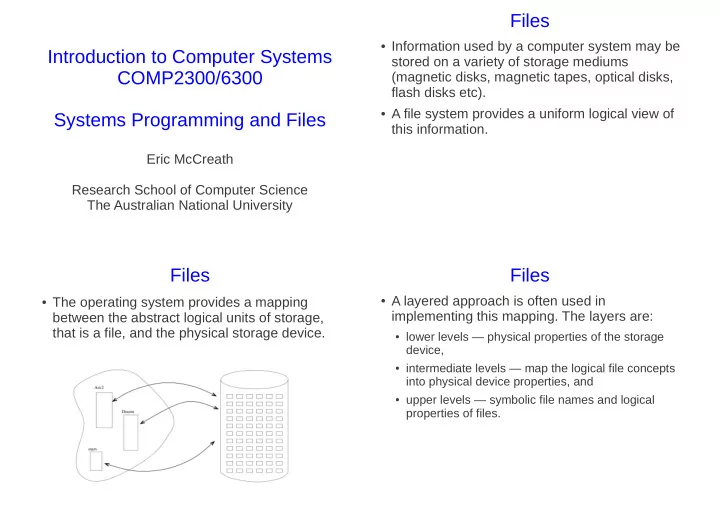
SLIDE 2 Files
- A file is a named collection of related information.
- Files consists of a sequence of bits, bytes, lines, or records.
- The information in a file is generally defined by its creator.
- There is numerous types of files. These include: text, source, object,
executable, binary, compressed, graphics image, video, data base, etc...
- Typically the operating system will keep track of attributes for each
- file. These attributes include: name, type, location, size,
protection,temporal information about creation and use.
Unix:
- The 'stat' command can be used to obtain information about a file.
There is also a 'stat' system call that provides information about a file.
- The 'file' command will attempt to determine the type of a file. This
will use the 'magic' number at the beginning of the file.
File
- A file is an abstract data type. The operating system will provide a set of routines to uniformly
view/manipulate this data type. A basic set of routines includes:
- creation,
- writing,
- reading,
- repositioning,
- deletion,
- truncating,
- appending, and
- renaming.
- From these basic operations other operations such as copying or printing may be performed.
- Rather than the operating system constantly searching the directory for each operation that is
performed on file. Files are generally opened and information about the file is stored in the
- pen file table. Then all file operation are performed using an index to this table. The process
will close the file once the interaction with the file is complete.
OPEN(2) Linux Programmer's Manual OPEN(2) NAME
- pen, creat - open and possibly create a file or device
SYNOPSIS #include <sys/types.h> #include <sys/stat.h> #include <fcntl.h> int open(const char *pathname, int flags); int open(const char *pathname, int flags, mode_t mode); int creat(const char *pathname, mode_t mode); DESCRIPTION Given a pathname for a file, open() returns a file descriptor, a small, nonnegative integer for use in subsequent system calls (read(2), write(2), lseek(2), fcntl(2), etc.). The file descriptor returned by a successful call will be the lowest-numbered file descriptor not cur‐ rently open for the process.
read – man page
READ(2) Linux Programmer's Manual READ(2) NAME read - read from a file descriptor SYNOPSIS #include <unistd.h> ssize_t read(int fd, void *buf, size_t count); DESCRIPTION read() attempts to read up to count bytes from file descriptor fd into the buffer starting at buf.