Disclosures Ablation of Persistent AF: What to do Beyond - - PDF document

disclosures
SMART_READER_LITE
LIVE PREVIEW

Disclosures Ablation of Persistent AF: What to do Beyond - - PDF document

9/14/2019 Disclosures Ablation of Persistent AF: What to do Beyond Biosense-Webster research support PV Isolation Boston Scientific research support Abbott Fellows education course Aman Chugh, MD September 13, 2019 CHRS


slide-1
SLIDE 1

9/14/2019 1

Ablation of Persistent AF: What to do Beyond PV Isolation

Aman Chugh, MD September 13, 2019 CHRS San Francisco, CA

Disclosures

  • Biosense-Webster – research support
  • Boston Scientific – research support
  • Abbott– Fellows education course

Outline

  • Pathophysiologic differences b/w paroxysmal

(PAF) and persistent (Ps) AF

  • Evidence for mapping and ablation outside the

PVs in patients with Ps and longstanding (LS) Ps AF

  • Present an intuitive, evidenced-based approach

to catheter ablation of Ps AF

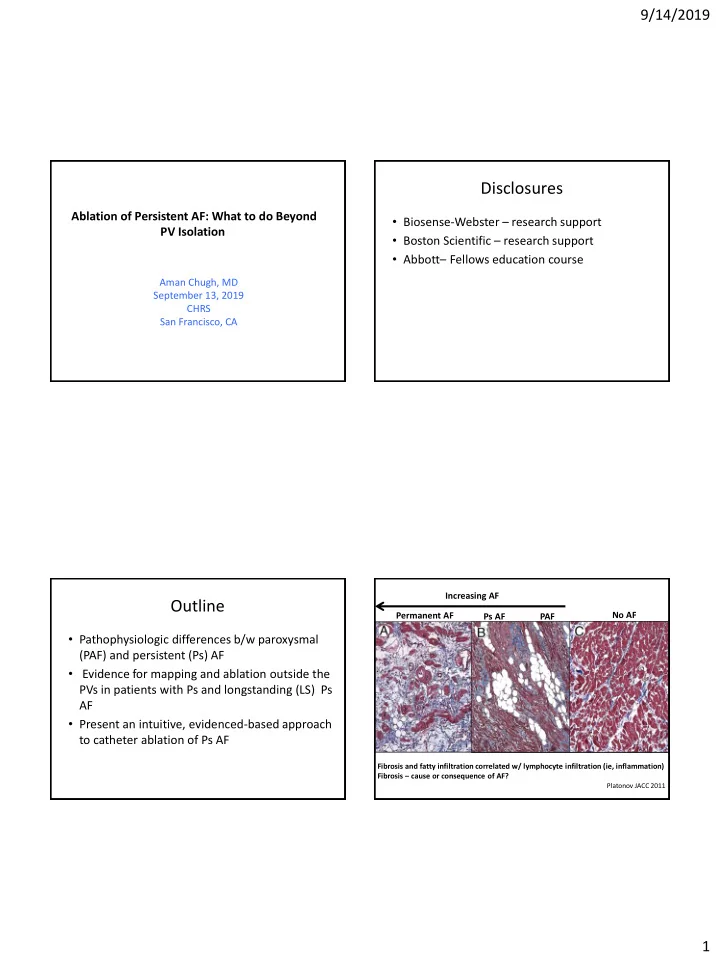
Permanent AF Increasing AF No AF

Platonov JACC 2011

Fibrosis and fatty infiltration correlated w/ lymphocyte infiltration (ie, inflammation) Fibrosis – cause or consequence of AF?

PAF Ps AF

slide-2
SLIDE 2

9/14/2019 2

5000 10000 15000 20000 25000 30000 1LAA 2Base 3Ridge 4LtAntrum 5RtAntrum 6Anterior 7Posterior 8Roof 9 9aMI 9bInferior 9cCS p c ‡ ‡ § § ‡ ¶ ¶ ¶ ¶ appendage base of LAA ridge anterior wall posterior wall roof septum mitral isthmus inferior wall CS left PVA right PVA LA regions Paroxysmal Persistent 0.75 1.50 2.25 Amplitude (mV) NS † †

Structural differences b/w Ps and PAF

Yoshida…Chugh Heart Rhythm 2010

5.5 5.6 5.7 5.8 5.9 6 6.1 6.2 6.3 6.4 Paroxysmal AF Persistent AF DF (Hz) Paroxysmal AF Persistent AF P=0.0006

Electrical remodeling – faster drivers

Paroxysmal AF (N=18) Persistent AF (N=40) P Age 58±8 59±10 0.71 Gender (M/F) 14/5 33/7 0.44 Body mass index (kg/m2) 27±3 32±5 0.0001 Sleep apnea syndrome 3 (17%) 7 (18%) 0.94 Hypertension 6 (32%) 25 (63%) 0.03 Diabetes 1 (6%) 2 (5%) 0.93 Period from the first diagnosis of AF (month) 54±38 53±47 0.96 Duration of continuous AF (month) N/A 26±19

  • LA pressure (mmHg)

10±4 18±5 <0.0001

LA diameter (mm) 38±4 48±6 <0.0001 LA volume indexed (ml/m2) 43±10 68±20 <0.0001 Ejection Fraction (%) 64±7 (during SR) 58±7 (during AF)

  • Yoshida…Chugh HR 2010

Ghanbari et al HR 2014

Is PAF really different from Ps AF?

slide-3
SLIDE 3

9/14/2019 3

3 6 9 12 15 18 21 24 27 30 33 36 39

Months

0.0 0.1 0.2 0.3 0.4 0.5 0.6 0.7 0.8 0.9 1.0

Cumulative Proportion Free from AF

Freedom from Recurrent AF after PV Isolation

Paroxysmal AF (234)

Persistent AF (20)

P<0.001

Oral et al Circ 2001 Cumulative Proportion Free from AF

Longstanding Ps AF - PVI alone was able to establish long-term SR in only 24% (49 of 202)

Tilz et al JACC 2012

Sanders et al JCE 2006

ms ms

Ps AF – no Δ in global AF CL with PVI PAF – progressive increase

in AF CL with PVI

DF of PVs: 8.8 Hz DF of LA: 6.9 Hz

∇ : 1.9 Hz

DF of PVs: 11 Hz DF of LA: 5.8 Hz

∇ : 6.2 Hz

Why aren’t PVs enough in persistent AF? PV-LA gradient (∇ ) STAR AF 2: PV isolation is all you need for Ps AF?

Verma NEJM 2015 With or without AAD

PVs alone – 41% after one procedure

slide-4
SLIDE 4

9/14/2019 4

STAR AF 2

Takeaways

  • Unproven adjuncts

– automated “CFAE” algorithms – “lack of pathophysiologic relevance” (Lau et al HR 2015)

  • Ambiguous endpoints (linear ablation/procedural)
  • If AF →AT, cardioverted at operator discretion
  • Did additional ablation do anything to AF?

– Was AF slowed? If not, targets were not identified

  • Excellent single center results not reproducible
  • 20% of patients presented in sinus rhythm – how

applicable to patients presenting in AF?

* * * * *

180 250

Septal LAd II Septal LAp

Septal RA

180 80?

CS V1 LA

180

LAd V1 RFA

Continuous electrical activity - specific but uncommon Most ”CFAEs” are generated by far- field activity (Narayan et al HR 2010) Our eyes are appear to be better than algorithms in ascertaining FF EGMs/local activation rates @ inferior LA

Linear block across mitral isthmus? s/p endo/epi (CS) RFA and EtOH VOM

CS3-4 CS5-6 CS1-2 CS7-8 Abld Ablp V1 CS9-10 S

Ridge LAA

S

145

S S

Ridge – RFA endo MI 180 Avoid mitral isthmus

O.K., So what then

  • Approach must be

– Evidenced-based – proven – Unambiguous – Intuitive – Practical, with conventionally available tools

slide-5
SLIDE 5

9/14/2019 5

Case

  • 50 yo man with LS Ps AF

since 2013

  • AVR for congenital AS
  • CV – SR for seconds
  • Ef 35% and CHF
  • RFA on 1/2015

– PVI for rapid PV tachycardia – AF persists

CSd CSp Abld V1 RAA

RFA @ low posterior LA

Last f/u 2/2019– SR without AAD Ef 50%

CSd CSp Abld V1 RAA

AF terminates to SR

What’s next after PVI?

Posterior Wall Isolation proven unambiguous prevents roof dependent atrial flutter

(Heart Rhythm 2016;13:132–140) Bai et al

Conclusions – “ePVAI+LAPW is still associated with a significant high incidence of very late recurrence of atrial tachyarrhythmia.”

Abld V1 LAA CSd V1 Abld PV LIPV Abld Ablp V1

Case

  • DK

Baseline LAA CL 178 LAA<LIPV AF Persists despite PVI

OK, LA is driver but how to target? PVs/Posterior LA – out; CS – slow→ LAA driver

CS

LAA

V1 RAA

Post PVI/PWI LAA=162 ms RAA=200 ms

V1 RAA CSd CSp

*

AF terminates to AT during RFA around LAA

slide-6
SLIDE 6

9/14/2019 6

V1 II aVF CSd CSp V1 Abld Ablp

ECG – AT 240 RFA at posterior RA, Eustachian ridge, and finally at CTI terminates AT Endpoint of LAA RFA – AF termination SR without AAD for 4 years

Case

  • 52 yo man with

permanent AF since 2013

  • DC CV 1995
  • PVI 2010 at OSH – PV

stenosis

  • “Mini-maze” 2013
  • Worsening effort

intolerance

  • RFA 11/2018

Posterior LA LAA 137

V1 CS LA LA V1 CS LA LA V1 CS LAA LAA

Septum– slow activity

640 150

V1 CS LAA LAA LAA

After extensive ablation around LAA, entrance block into LAA

Endpoint of LAA RFA – slowing of conduction into LAA LAA no longer driving AF LAA as driver – proven and unambiguous*

LAA RAA

CSd CSp

178 161

III V1

Case-

  • 54 yo man Ps AF
  • AF persists post PVI,

PWI, LAA RFA

  • RA to LA gradient
slide-7
SLIDE 7

9/14/2019 7

Where to ablate in RA? SVC?

AF termination sites in RA

Hocini et al JACC 2010

RAA V1 RAA

SVC SVC

288 ms

179 ms

  • 90 patients Ps AF
  • 26 (29%) required RA ablation
  • RA targets: RAA, lateral RA, lateral TA, RA roof
  • Follow up of 21±18 months

– 53 of the 64 patients in the LA only group (83%) – 20 of the 26 patients in the RA group (77%) in SR w/o AAD (p=0.57) Ghannam…Chugh HRS 2014

Lateral RAA base

CSd CSp V1

50 ms

Extremely fast bursts from RAA (20 Hz!)

AF terminates to AT after RFA at RAA

*

CSd CSp V1 Abld CSd CSp V1 Abld Ablp

Termination w/o global capture @ MI Linear block achieved RAA driver – intuitive, evidence-based SR w/o AAD for 6 yrs

230 230 S S S S

230

LAA RAA SVC Tricuspid valve CS LPV

Cut-Sew Maze Anatomically based

slide-8
SLIDE 8

9/14/2019 8

CASE

  • 76 yo woman with persistent AF since 2013
  • Recurrence despite cardioversion and propafenone
  • s/p stenting of RCA
  • RFA 10/2015

CSd CSp V1 III LIPV

Right PVs isolated AF terminates to SR during RFA of L PVs What would you do next? A. Linear ablation at LA roof B. Linear ablation at mitral isthmus C. Nothing more D. Linear ablation at CTI Noninducible with isoproterenol and rapid pacing SR w/o AAD x 4 years

Procedural details

  • Persistent AF - 2-3 procedures
  • RF duration 60-80 minutes
  • If AF terminates to AT, map and ablate
  • Procedure time 4-5 hours
  • AT/”atypical atrial flutter” is unavoidable in most patients
  • If AF recurs after first procedure

– Likely RA ablation (30% of patients)

  • Emphasis on AF termination during 2nd procedure
  • 80% without antiarrhythmic medications
  • Complications 1%
  • No perforation during LAA/RAA RFA
  • Secondary prevention measures

Summary

  • Ps and LS Ps AF – more structural and electrical alterations cf. PAF

– Calls for a measured, more aggressive approach than PVs

  • Mapping during AF – identification of drivers; not possible during SR
  • Tailored to patient

– if AF terminates with PVI – no reason to do more – If AF terminates during LAA RFA, don’t need to isolate LAA

  • ATs are unavoidable in most if we wish to get rid of AF
  • Whichever approach → must show that fibrillatory process was

affected – was AF slowed or terminated?