Disclosures Basic Dermatology Procedures I have no conflicts of - - PDF document

disclosures basic dermatology procedures
SMART_READER_LITE
LIVE PREVIEW

Disclosures Basic Dermatology Procedures I have no conflicts of - - PDF document

3/26/2014 Disclosures Basic Dermatology Procedures I have no conflicts of interest to disclose for the Non dermatologist Lindy P. Fox, MD Associate Professor Director, Hospital Consultation Service Department of Dermatology University


slide-1
SLIDE 1

3/26/2014 1

Basic Dermatology Procedures for the Non‐dermatologist

Lindy P. Fox, MD Associate Professor Director, Hospital Consultation Service Department of Dermatology University of California, San Francisco foxli@derm.ucsf.edu

1

Disclosures

  • I have no conflicts of interest to disclose

2

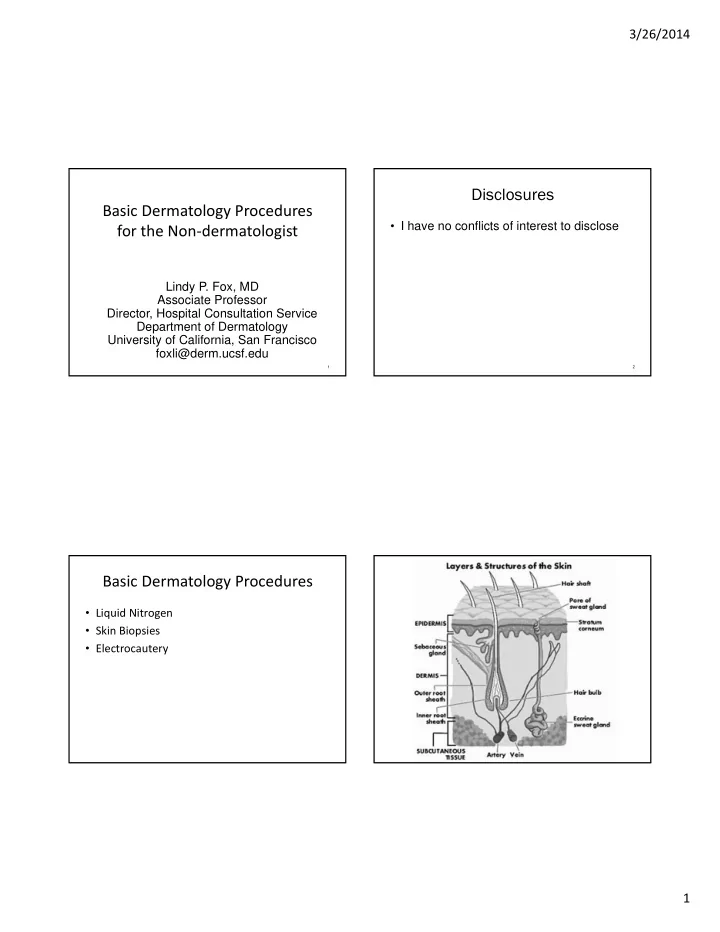
Basic Dermatology Procedures

  • Liquid Nitrogen
  • Skin Biopsies
  • Electrocautery
slide-2
SLIDE 2

3/26/2014 2

Liquid Nitrogen Cryosurgery Liquid Nitrogen Cryosurgery

  • Indications

– Benign, premalignant, in situ malignant lesions

  • Objective

– Selective tissue necrosis

  • Reactions predictable

– Crust, bulla, exudate, edema, sloughing

  • Post procedure hypopigmentation

– Melanocytes are more sensitive to freezing than keratinocytes

Liquid Nitrogen Cryosurgery Principles

  • ‐ 196°C (−320.8°F)
  • Temperatures of −25°C to −50°C (−13°F to −58°F)

within 30 seconds with spray or probe

  • Benign lesions: −20°C to −30°C (−4°F to −22°F)
  • Malignant lesions: −40°C (−40°F) to −50°C.
  • Rapid cooling  intracellular ice crystals
  • Slow thawing  tissue damage
  • Duration of THAW (not freeze) time is most

important factor in determining success

Am Fam Physician. 2004 May 15;69(10):2365‐2372 From: Bolognia, Jorizzo, and Schaffer. Dermatology 3rd ed. Elsevier 2012

slide-3
SLIDE 3

3/26/2014 3

Liquid Nitrogen Cryosurgery

  • Fast freeze, slow thaw cycles

– Times vary per condition (longer for deeper lesion) – One cycle for benign, premalignant – Two cycles for warts, malignant (not commonly done)

  • Lateral spread of freeze (indicates depth of freeze)

– Benign lesions 1‐2mm beyond margins – AKs‐ 2‐3mm beyond margins – Malignant‐ 3‐5+mm beyond margins (not commonly done)

Liquid Nitrogen Cryosurgery Technique

  • Hold spray gun 1‐1.5cm away from target
  • Freeze until ice field fills the margin
  • Maintain the spray for the appropriate time

BEYOND initial time of ice field formation

  • If more than one cycle required, allow for

complete thawing before beginning next cycle

slide-4
SLIDE 4

3/26/2014 4

Cryosurgery for Common Warts

  • Freeze time 20‐60 seconds
  • Margin‐ 2‐3mm
  • Thaw 30‐45 seconds
  • TWO cycles better than one
  • Repeat every 3‐4 weeks
  • Average # of warts cleared= 40%
  • Average # of treatments to clear

warts = 12

– ONE YEAR!

Cryosurgery for Planar Warts

  • May consider

cotton tipped applicator technique

Ring Wart Bullae

http://www.dermnet.com

slide-5
SLIDE 5

3/26/2014 5

Cryosurgery for Actinic Keratoses

  • One freeze‐thaw cycle
  • margin‐ 2‐3mm
  • Freeze time

– AK 5‐7s – Actinic cheilitis 10‐20s

www.dermquest.com

Cryosurgery for Seborrheic Keratoses

  • Freeze‐ thaw cycle

depends on thickness

  • Thin/flat‐ freeze 5‐10s
  • Large/thick‐freeze >10s,

may need second cycle

Cryosurgery for Lentigines

  • Quick 3‐4s freeze
  • Avoid overfreeing

– Risk of hypopigmentation

Cryosurgery for SCC in situ*

  • One 30 second freeze

Or

  • Two 20 second freezes
  • Close follow up

*ED+C still preferred treatment option

slide-6
SLIDE 6

3/26/2014 6

Skin Biopsies Skin Biopsy

  • Procedure itself is easy
  • Knowing when and where to biopsy much

more difficult

  • Pathologist can only comment on the tissue

provided (not what’s left on patient)

  • Potential pitfalls in technique

Skin Biopsy Types

  • Curettage
  • Snip/scissors
  • Shave biopsy
  • Saucerization
  • Punch
  • Incisional
  • Excisional (in toto)

Curettage with Biopsy

  • Samples epidermis only
  • Clinically benign lesions involving the epidermis

– Verrucae (warts), seborrheic keratoses, actinic keratoses

  • Send pathology at same time as treating the

lesion

  • Limitations

– Limited to the epidermis – Fragmented tissue

slide-7
SLIDE 7

3/26/2014 7

From: Bolognia, Jorizzo, and Schaffer. Dermatology 3rd ed. Elsevier 2012

  • Hold like pencil
  • Draw pressure under the lesion (epidermis)

Snip/Scissors Biopsy

  • Pedunculated lesions
  • Benign growths

– Acrochordons (skin tags) – Filiform warts – Pedunculated nevi

From: Bolognia, Jorizzo, and Schaffer. Dermatology 3rd ed. Elsevier 2012

  • If very thin attachment to skin (stalk) don’t need anesthesia
  • Use iris or Gradle scissors
  • May require hemostasis with aluminum chloride, electrodesiccation

Shave Biopsy

  • Samples epidermis and papillary (superficial)

dermis

  • Ideal for elevated lesions involving the epidermis

and superficial dermis

– Inflammatory dermatoses of epidermis, superficial dermis (psoriasis, eczema, CTCL, lichen planus) – Nevi, benign adnexal tumors – Diagnosis of basal cell or squamous cell carcinoma – Diagnosis of lentigo maligna (MIS)

slide-8
SLIDE 8

3/26/2014 8

Am Fam Physician. 2011 Nov 1;84(9):995‐1002 Onsurg.com www.hovesskinclinic.co.uk From: Bolognia, Jorizzo, and Schaffer. Dermatology 3rd ed. Elsevier 2012

  • Be sure to get below simple hyperkeratosis and upper dermis
  • Palms, soles, hyperkeratotic lesions
  • Require hemostasis with aluminum chloride, electrodesiccation

Saucerization Biopsy

  • Deeper biopsy with intentional deeper placement of

the blade

  • Samples epidermis and superficial and deep dermis
  • Advantage

– Histologic examination of the entire circumference of the lesion with adequate depth to assess invasion

  • Ideal for

– Inflammatory dermatoses with dermal infiltrate – Atypical pigmented lesions (to r/o melanoma) – Keratoacanthoma/SCC

From: Bolognia, Jorizzo, and Schaffer. Dermatology 3rd ed. Elsevier 2012

  • Intention is to get to deep dermis
  • Requires hemostasis with aluminum chloride, electrodesiccation
slide-9
SLIDE 9

3/26/2014 9

Punch Biopsy

  • Samples epidermis, dermis and superficial subcutaneous fat
  • Varying barrel sizes‐ 2mm‐ 8mm
  • Ideal for

– Inflammatory dermatoses with deep dermal infiltrate (lupus) – Infiltrative diseases (amyloid, sarcoid, lymphoma cutis) – Blistering diseases (pemphigus, pemphigoid) – Depressed lesions (scleroderma)

  • Limitations

– Only samples portion of larger lesion – Requires suture (>3mm) – Not ideal for subcutaneous lesions

Punch Biopsy

  • Stabilize skin around punch with free hand
  • Twist with firm downward pressure in one direction
  • Gently lift tissue with forceps at edge of epidermis (do not crush)
  • If plug not elevating, angle scissors downward to base
  • Try to make sure there is some fat at the base of the sample

Slide courtesy of Wilson Liao, MD

Incisional Biopsy

  • Samples epidermis, dermis, subcutaneous fat
  • Removes wedge from center or edge of lesion
  • Ideal for

– Large tumors – Subtle diseases of connective tissue – Diseases of the fat (panniculitis) – Diseases of the fascia

From: Bolognia, Jorizzo, and Schaffer. Dermatology 3rd ed. Elsevier 2012

slide-10
SLIDE 10

3/26/2014 10

Excisional Biopsy

  • Samples epidermis, dermis, subcutaneous fat
  • Intended to be definitive treatment
  • Ideal for

– Suspected invasive melanoma

Skin Biopsies‐ Potential Pitfalls

  • Crush artifact
  • Leaving part of tissue in punch tool
  • Multiple specimens, mislabeling

Crush Artifact

Slide courtesy of Jeff North, MD

Failure to Deliver

  • Leaving part of the biopsy in the punch tool

Biopsy

Slide courtesy of Jeff North, MDc

slide-11
SLIDE 11

3/26/2014 11

Multiple Biopsy Specimens

  • Critically important to have an established

protocol/routine to ensure the correct biopsy goes in the correct bottle A B C

Slide courtesy of Jeff North, MD

Shave Biopsy Tray Punch Biopsy Tray How to biopsy a specific lesion

Lesion Type of biopsy

Papulosquamous (eczema, psoriasis) Shave or saucerization biopsy r/o melanoma Saucerization or excisional biopsy Blister Punch biopsy at the edge for H+E and DIF Wart, seborrheic keratosis, actinic keratosis Shave biopsy or curettage Scalp (alopecia) Punch biopsy from hair containing region adjacent to alopecia, request transverse sections

slide-12
SLIDE 12

3/26/2014 12

Where to Biopsy

Lesion Location of biopsy Tumor Thickest portion, avoid necrotic tissue Blister Edge of the lesion, include about 2mm

  • f blister edge; send for H+E and DIF

Ulceration/necrotic lesion Edge of ulcer or necrosis plus adjacent skin Generalized polymorphic eruption Characteristic lesion of recent onset (+/‐ more developed lesion) Small vessel vasculitis (palpable purpura) Characteristic lesion of recent onset (ideally <24 hours old)

Adapted from: Bolognia, Jorizzo, and Schaffer. Dermatology 3rd ed. Elsevier 2012

Direct Immunofluorescence

  • Location of the biopsy depends on diagnosis
  • Vasculitis‐ lesional skin from an early lesion
  • Lupus

– DLE/SCLE Lesional skin – SLE‐ Lesional, uninvolved can be positive as wel

  • Blistering

– Peri‐lesional

Slide courtesy of Jeff North, MD Slide courtesy of Jeff North, MD

DIF‐ peri‐lesional

  • Eclipsing the edge of new

blister

  • Being too far from a blister

can cause false negative DIF

DIF in Pemphigoid and Pemphigus

Slide courtesy of Jeff North, MD Photo courtesy of Kari Connolly, MD
slide-13
SLIDE 13

3/26/2014 13

DIF in Other Immunobullous Disease

  • Dermatitis herpetiformis
  • Up to 1 cm away from lesion
  • Don’t overlap the clinical lesion
  • Higher risk for loss of epidermis and

destruction of Ig by the neutrophilic inflammatory infiltrate

  • Serology: anti‐transglutaminase and anti‐

endomysium antibodies also helpful

Slide courtesy of Jeff North, MD

Electrosurgery Electrosurgery

  • Electrodesiccation

– Superficial tissue destruction

  • Electrocoagulation

– Deep tissue destruction

  • Electrosection

– Cutting

Electrosurgery

  • Electrodesiccation

– Superficial tissue destruction

  • Electrocoagulation

– Deep tissue destruction

  • Electrosection

– Cutting

slide-14
SLIDE 14

3/26/2014 14

Electrodesiccation

  • Damped, high‐

voltage current

  • Causes superficial

tissue damage via dehydration

Electrodesiccation and Electrofulguration

Am Fam Physician. 2002 Oct 1;66(7):1259‐1267

Electrodesiccation Indications‐ Epidermal Lesions

  • Acrochordons
  • Actinic keratosis
  • Angioma (small)
  • Hemostasis
  • Lentigo
  • Seborrheic keratoses/dermatosis papulosa

nigra

  • Verrucae

Electrodesiccation for Epidermal Lesions‐ Technique

  • Typically doesn’t require anesthesia
  • Use lowest setting that produces a very subtle

gray char

  • May see pinpoint bleeding (indicates you have

reached dermis and time to stop)

  • Doesn’t require post procedure wound care other

than vaseline

  • Target lesions “fall off” within 1‐2 weeks
  • Typically doesn’t scar or lead to pigmentary

damage if done correctly

slide-15
SLIDE 15

3/26/2014 15

Basic Dermatology Procedures Summary Points‐ Liquid Nitrogen

  • Duration of thaw determines amount of tissue

damage

  • Warts require monthly treatments for 12 months
  • Avoid over freezing (to avoid hypopigmentation)

Basic Dermatology Procedures Summary Points‐ Skin Biopsies

  • Pathologists can only comment on the tissue

provided

  • Curettage is a good way to treat warts, SKs
  • Shave/saucerizaton biopsies are best for

inflammatory lesions, BCC, SCC

  • Punch biopsies are best to evaluate deep dermis
  • Incisional biopsies are the best way to assess the

subcutis

  • Try to perform excisional biopsies for melanoma,

but large saucerization acceptable

  • Electrodesiccation is a good option to

cosmetically treat seborrheic keratoses, dermatosis papulosa nigra

  • If shave remove a wart, electrodesiccate the

base to decrease risk of recurrence

Basic Dermatology Procedures Summary Points‐ Electrocautery