Differential Equations Overview of differential equation Initial - - PowerPoint PPT Presentation

differential equations
SMART_READER_LITE
LIVE PREVIEW

Differential Equations Overview of differential equation Initial - - PowerPoint PPT Presentation

Differential Equations Overview of differential equation Initial value problem Explicit numeric methods Implicit numeric methods Modular implementation Physics-based simulation An algorithm that produces a


slide-1
SLIDE 1

Differential Equations

slide-2
SLIDE 2
slide-3
SLIDE 3
slide-4
SLIDE 4
  • Overview of differential equation
  • Initial value problem
  • Explicit numeric methods
  • Implicit numeric methods
  • Modular implementation
slide-5
SLIDE 5

Physics-based simulation

  • An algorithm that produces a sequence of

states over time under the laws of physics

  • What is a state?
slide-6
SLIDE 6

Physics simulation

xi ∆x xi+1 xi xi+1 = xi + ∆x

differential equations integrator

slide-7
SLIDE 7

Differential equations

  • What is a differential equation?
  • It describes the relation between an unknown

function and its derivatives

  • Ordinary differential equation (ODE)
  • is the relation that contains functions of only
  • ne independent variable and its derivatives
slide-8
SLIDE 8

Ordinary differential equations

An ODE is an equality equation involving a function and its derivatives What does it mean to “solve” an ODE?

˙ x(t) = f(x(t))

known function time derivative of the unknown function unknown function that evaluates the state given time

slide-9
SLIDE 9

Symbolic solutions

  • Standard introductory differential equation

courses focus on finding solutions analytically

  • Linear ODEs can be solved by integral

transforms

  • Use DSolve[eqn,x,t] in Mathematica

Solution: x(t) = e−kt Differential equation: ˙

x(t) = −kx(t)

slide-10
SLIDE 10

Numerical solutions

  • In this class, we will be concerned with

numerical solutions

  • Derivative function f is regarded as a black box
  • Given a numerical value x and t, the black box

will return the time derivative of x

slide-11
SLIDE 11

Physics-based simulation

xi ∆x xi+1 xi xi+1 = xi + ∆x

integrator differential equations

slide-12
SLIDE 12
  • Overview of differential equation
  • Initial value problem
  • Explicit numeric methods
  • Implicit numeric methods
  • Modular implementation
slide-13
SLIDE 13

Initial value problems

In a canonical initial value problem, the behavior of the system is described by an ODE and its initial condition:

˙ x = f(x, t) x(t0) = x0

To solve x(t) numerically, we start out from x0 and follow the changes defined by f thereafter

slide-14
SLIDE 14

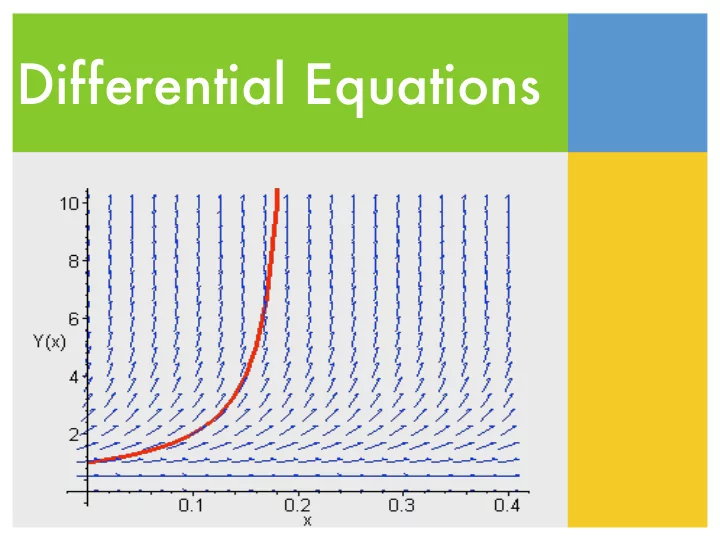
Vector field

The differential equation can be visualized as a vector field

˙ x = f(x, t)

x2 x1

slide-15
SLIDE 15

Quiz

Which one is the vector field of ˙

x = −0.5x ?

slide-16
SLIDE 16

Vector field

How does the vector field look like if f depends directly on time? The differential equation can be visualized as a vector field

˙ x = f(x, t)

x2 x1

slide-17
SLIDE 17

Integral curves

f(x, t)

  • t0

f(x, t)dt

slide-18
SLIDE 18

Physics-based simulation

xi ∆x xi+1 xi xi+1 = xi + ∆x

Newtonian laws gravity wind gust elastic force

. . .

integrator

slide-19
SLIDE 19
  • Overview of differential equation
  • Initial value problem
  • Explicit numeric methods
  • Implicit numeric methods
  • Modular implementation
slide-20
SLIDE 20

Explicit Euler method

Discrete time step h determines the errors Instead of following real integral curve, p follows a polygonal path How do we get to the next state from the current state?

x(t0 + h) = x0 + h ˙ x(t0)

x(t0 + h) x(t0)

p

slide-21
SLIDE 21

Problems of Euler method

Inaccuracy

The circle turns into a spiral no matter how small the step size is

slide-22
SLIDE 22

Problems of Euler method

Instability

Oscillation: x(t) oscillates around equilibrium.

˙ x = −kx x(t) = e−kt

Symbolic solution: Divergence: x(t) eventually goes to infinity (or negative infinity).

slide-23
SLIDE 23

Problems of Euler method

Instability ˙ x = −kx x(t) = e−kt

Symbolic solution: h < 1/k to avoid oscillation

slide-24
SLIDE 24

Quiz

Instability ˙ x = −kx x(t) = e−kt

Symbolic solution: What’s the largest time step without divergence?

slide-25
SLIDE 25

Quiz

Instability ˙ x = −kx x(t) = e−kt

Symbolic solution: What’s the largest time step without

  • scillation?
slide-26
SLIDE 26

Accuracy of Euler method

  • At each step, x(t) can be written in the form of

Taylor series:

  • What is the order of the error term in Euler method?
  • The cost per step is determined by the number of

evaluations per step

x(t0 + h) = x(t0) + h ˙ x(t0) + h2 2! ¨ x(t0) + h3 3! x(3)(t0) + . . . hn n! ∂nx ∂tn

Taylor series is a representation of a function as an infinite sum of terms calculated using the derivatives at a particular point

slide-27
SLIDE 27

Stability of Euler method

  • Assume the derivative function is linear
  • Look at x parallel to the largest eigenvector of A
  • Note that eigenvalue can be complex

d dtx = Ax d dtx = λx λ

slide-28
SLIDE 28

The test equation

  • Test equation advances x by
  • Solving gives
  • Condition of stability

xn+1 = xn + hλxn xn = (1 + hλ)nx0

|1 + hλ| ≤ 1

slide-29
SLIDE 29

Stability region

  • Plot all the values of hλ on the complex plane

where Euler method is stable

slide-30
SLIDE 30

Real eigenvalue

  • If eigenvalue is real and negative, what kind of

the motion does x correspond to?

  • a damping motion smoothly coming to a halt
  • The threshold of time step
  • What about the imaginary axis?

h ≤ 2 |λ|

slide-31
SLIDE 31

Imaginary eigenvalue

  • If eigenvalue is pure imaginary, Euler method is

unconditionally unstable

  • What motion does x look like if the eigenvalue is

pure imaginary?

  • an oscillatory or circular motion
  • We need to look at other methods
slide-32
SLIDE 32

The midpoint method

  • 2. Evaluate f at the midpoint
  • 3. Take a step using fmid

fmid = f(x(t0) + ∆x 2 )

  • 1. Compute an Euler step

∆x = hf(x(t0)) x(t0 + h) = x(t0) + hfmid x(t + h) = x0 + hf(x0 + h 2 f(x0))

slide-33
SLIDE 33

Accuracy of midpoint

Prove that the midpoint method has second order accuracy x(t + h) = x0 + hf(x0 + h 2 f(x0)) x(t + h) = x0 + h ˙ x0 + h2 2 ¨ x0 + O(h3) x(t + h) = x0 + hf(x0) + h2 2 f(x0)∂f(x0) ∂x + hO(x2)

∆x = h 2 f(x0)

f(x0 + ∆x) = f(x0) + ∆x∂f(x0) ∂x + O(x2)

slide-34
SLIDE 34

Stability region

xn+1 = xn + hλxn+ 1

2 = xn + hλ(xn + 1

2hλxn) xn+1 = xn(1 + hλ + 1 2(hλ)2) hλ = x + iy

  • 1
  • +

x y

  • + 1

2 x2 − y2 2xy

  • ≤ 1
  • 1 + x + x2−y2

2

y + xy

  • ≤ 1
slide-35
SLIDE 35

Stability of midpoint

  • Midpoint method has larger stability region, but

still unstable on the imaginary axis

slide-36
SLIDE 36

Quiz

RK1 RK2 What is the largest time step for RK1? What is the largest time step for RK2? Consider a dynamic system where λ = −2 − i2

slide-37
SLIDE 37

Runge-Kutta method

  • Runge-Kutta is a numeric method of integrating

ODEs by evaluating the derivatives at a few locations to cancel out lower-order error terms

  • Also an explicit method: xn+1 is an explicit

function of xn

slide-38
SLIDE 38

Runge-Kutta method

  • q-stage p-order Runge-Kutta evaluates the

derivative function q times in each iteration and its approximation of the next state is correct within O(hp+1)

  • What order of Runge-Kutta does midpoint

method correspond to?

slide-39
SLIDE 39

4-stage 4th order Runge-Kutta

f(x0, t0) f(x0 + k1 2 , t0 + h 2 ) f(x0 + k2 2 , t0 + h 2 ) f(x0 + k3, t0 + h) x0 x(t0 + h) 2. 1. 3. 4.

k1 = hf(x0, t0) k2 = hf(x0 + k1

2 , t0 + h 2 )

k3 = hf(x0 + k2

2 , t0 + h 2 )

k4 = hf(x0 + k3, t0 + h) x(t0 + h) = x0 + 1

6k1 + 1 3k2 + 1 3k3 + 1 6k4

t x

slide-40
SLIDE 40

High order Runge-Kutta

  • RK3 and up are include part of the imaginary axis
slide-41
SLIDE 41

Quiz

RK1 If lambda is where the red dot is, which integrators can generate stable simulation? (A) RK4 only (B) RK4 and RK3 (C) RK4, RK3, and RK1

slide-42
SLIDE 42

Stage vs. order

p 1 2 3 4 5 6 7 8 9 10 q 1 2 3 4 6 7 9 11 12-17 13-17 The minimum number of stages necessary for an explicit method to attain order p is still an open problem Why is fourth order the most popular Runge Kutta method?

slide-43
SLIDE 43

Adaptive step size

  • Ideally, we want to choose h as large as possible,

but not so large as to give us big error or instability

  • We can vary h as we march forward in time
  • Step doubling
  • Embedding estimate
  • Variable step, variable order
slide-44
SLIDE 44

Step doubling

e

xb = xtemp + h 2 f(xtemp, t0 + h 2 ) xtemp = x0 + h 2 f(x0, t0)

Estimate by taking a full Euler step xa Estimate by taking two half Euler steps xb

e = |xa − xb| is bound by O(h2)

Given error tolerance , what is the optimal step size?

  • e

1

2 h

xa = x0 + hf(x0, t0)

slide-45
SLIDE 45

Quiz

I use step doubling at the current step and the error is 0.4. Given that the error threshold of the simulation is set at 0.001, I should (A) Increase h by 400 times (B) Decrease h by 400 times (C) Increase h by 20 times (D) Decrease h by 20 times

slide-46
SLIDE 46

Embedding estimate

  • Also called Runge-Kutta-Fehlberg
  • Compare two estimates of
  • Fifth order Runge-Kutta with 6 stages
  • Forth order Runge-Kutta with 6 stages

x(t0 + h)

slide-47
SLIDE 47

Variable step, variable order

  • Change between methods of different order as

well as step based on obtained error estimates

  • These methods are currently the last work in

numerical integration

slide-48
SLIDE 48

Problems of explicit methods

  • Do not work well with stiff ODEs
  • Simulation blows up if the step size is too big
  • Simulation progresses slowly if the step size

is too small

slide-49
SLIDE 49

Example: a bead on the wire

˙ Y = d dt

  • x(t)

y(t)

  • =
  • −x(t)

−ky(t)

  • Ynew =
  • (1 − h)x(t)

(1 − kh)y(t)

  • Ynew = Y0 + h ˙

Y(t0) =

  • x(t)

y(t)

  • + h
  • −x(t)

−ky(t)

  • Explicit Euler’s method:

Y(t) = (x(t), y(t))

y(t) x(t)

slide-50
SLIDE 50

Stiff equations

  • Stiffness constant: k
  • Step size is limited by the largest k
  • Systems that has some big k’s mixed in are

called “stiff system”

slide-51
SLIDE 51
  • Overview of differential equation
  • Initial value problem
  • Explicit numeric methods
  • Implicit numeric methods
  • Modular implementation
slide-52
SLIDE 52

Implicit methods

Implicit Euler:

Ynew = Y0 + hf(Ynew)

Explicit Euler:

Ynew = Y0 + hf(Y0)

Solving for such that , at time , points directly back at

  • f

Ynew t0 + h Y0

slide-53
SLIDE 53

Implicit methods

Ynew = Y0 + hf(Y0) + h∆Yf ′(Y0) ∆Y = 1 hI − f ′(Y0) −1 f(Y0)

Approximating f(Ynew) by linearizing f(Y)

f(Ynew) = f(Y0) + ∆Yf ′(Y0) ∆Y = Ynew − Y0

, where Our goal is to solve for Ynew such that

Ynew = Y0 + hf(Ynew)

f(Y, t) = ˙ Y(t)

f(Y, t) = ∂f ∂Y

slide-54
SLIDE 54

Example: A bead on the wire

Apply the implicit Euler method to the bead-on-wire example

∆Y = 1 hI − f ′(Y0) −1 f(Y0)

= −1 −k

  • f ′(Y(t)) = ∂f(Y(t))

∂Y f(Y(t)) = −x(t) −ky(t)

  • ∆Y =
  • 1+h

h 1+kh h

−1 −x0 −ky0

  • =
  • h

h+1 h 1+kh

−x0 −ky0

  • = −
  • h

h+1x0 h 1+khky0

slide-55
SLIDE 55

Example: A bead on the wire

What is the largest step size the implicit Euler method can take?

lim

h→∞ ∆Y = lim h→∞ −

  • h

h+1x0 h 1+khky0

  • = −
  • x0

1 kky0

  • = −
  • x0

y0

  • Ynew = Y0 + (−Y0) = 0
slide-56
SLIDE 56

Quiz

Consider a linear ODE in If h = 1 and the current state is What is the next state computed by an implicit integrator?

˙ x = f(x) =  −1 −99

  • x

R2  100 100

slide-57
SLIDE 57

Stability of implicit Euler

  • Test equation shows stable when
  • How does the stability region look like?

|1 − hλ| ≥ 1

slide-58
SLIDE 58

Problems of implicit Euler

  • Implicit Euler could be stable even when physics

is not!

  • Implicit Euler damps out motion unrealistically
slide-59
SLIDE 59

Implicit vs. explicit

correct solution: x(h) = e−hk implicit Euler:

x(h) = 1 1 + hk

explicit Euler:

x(h) = 1 − hk

h ˙ x(h) = −kx(h) x(0) = 1 x

slide-60
SLIDE 60

Trapezoidal rule

  • Take a half step of explicit Euler and a half step of

implicit Euler

  • Explicit Euler is under-stable, implicit Euler is
  • ver-stable, the combination is just right

xn+1 = xn + h(1 2f(xn) + 1 2f(xn+1))

slide-61
SLIDE 61

Stability of Trapezoidal

  • What is the test equation for Trapezoidal?
  • Where is the stability region?
  • negative half-plane
  • Stability region is consistent with physics
  • Good for pure rotation

hλ ≤ 0

slide-62
SLIDE 62

Terminology

  • Explicit Euler is also called forward Euler
  • Implicit Euler is also called backward Euler
slide-63
SLIDE 63
  • Overview of differential equation
  • Initial value problem
  • Explicit numeric methods
  • Implicit numeric methods
  • Modular implementation
slide-64
SLIDE 64

Modular implementation

  • Write integrator in terms of
  • Reusable code
  • Simple system implementation
  • Generic operations:
  • Get dim(x)
  • Get/Set x and t
  • Derivative evaluation at current (x, t)
slide-65
SLIDE 65

Solver interface

System (black box) Solver (integrator)

GetDim Deriv Eval

Get/Set State

slide-66
SLIDE 66

Summary

  • Explicit Euler is simple, but might not be stable;

modified Euler may be a cheap alternative

  • RK4 allows for larger time step, but requires

much more computation

  • Use implicit Euler for better stability, but beware
  • f over-damp
slide-67
SLIDE 67

Quiz

When I tried to simulate an ideal spring using explicit Euler method, the simulation blew up very quickly after a few iterations. Which of the following actions will result in stable simulation? Why?

  • 1. Reduce time step

  • 2. Use midpoint method

  • 3. Use implicit method

  • 4. Use fourth order Runge Kutta method
  • 5. Use trapzoidal rule