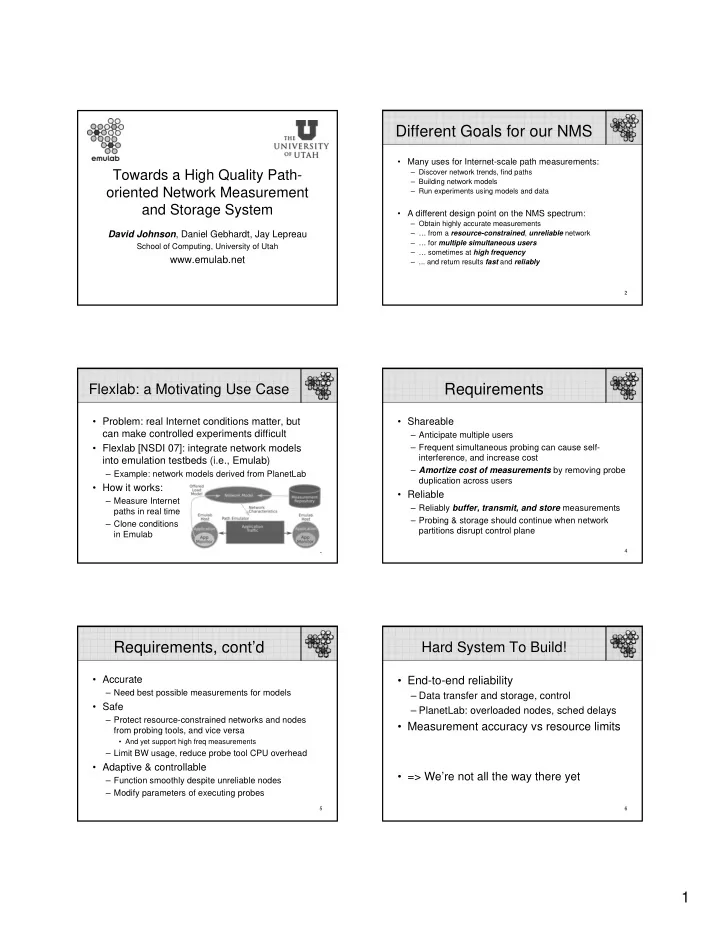

SLIDE 1
1
Towards a High Quality Path-
- riented Network Measurement
and Storage System
David Johnson, Daniel Gebhardt, Jay Lepreau
School of Computing, University of Utah
www.emulab.net
2
Different Goals for our NMS
- Many uses for Internet-scale path measurements:
– Discover network trends, find paths – Building network models – Run experiments using models and data
- A different design point on the NMS spectrum:
– Obtain highly accurate measurements – … from a resource-constrained, unreliable network – … for multiple simultaneous users – … sometimes at high frequency – ... and return results fast and reliably
3
Flexlab: a Motivating Use Case
- Problem: real Internet conditions matter, but
can make controlled experiments difficult
- Flexlab [NSDI 07]: integrate network models
into emulation testbeds (i.e., Emulab)
– Example: network models derived from PlanetLab
- How it works:
– Measure Internet paths in real time – Clone conditions in Emulab
4
Requirements
- Shareable
– Anticipate multiple users – Frequent simultaneous probing can cause self- interference, and increase cost – Amortize cost of measurements by removing probe duplication across users
- Reliable
– Reliably buffer, transmit, and store measurements – Probing & storage should continue when network partitions disrupt control plane
5
Requirements, cont’d
- Accurate
– Need best possible measurements for models
- Safe
– Protect resource-constrained networks and nodes from probing tools, and vice versa
- And yet support high freq measurements
– Limit BW usage, reduce probe tool CPU overhead
- Adaptive & controllable
– Function smoothly despite unreliable nodes – Modify parameters of executing probes
6
Hard System To Build!
- End-to-end reliability
– Data transfer and storage, control – PlanetLab: overloaded nodes, sched delays
- Measurement accuracy vs resource limits
- => We’re not all the way there yet