
SLIDE 1
Conductive textiles
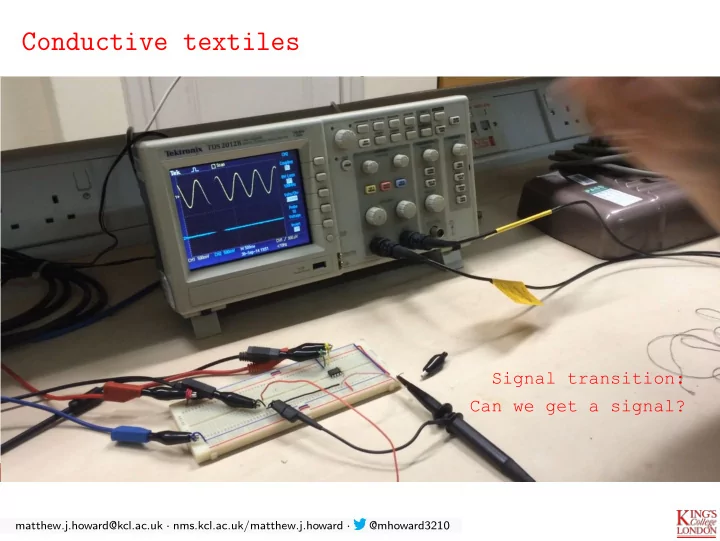
Signal transition: Can we get a signal?
matthew.j.howard@kcl.ac.uk · nms.kcl.ac.uk/matthew.j.howard · @mhoward3210
Conductive textiles Signal transition: Can we get a signal? - - PowerPoint PPT Presentation
Conductive textiles Signal transition: Can we get a signal? matthew.j.howard@kcl.ac.uk nms.kcl.ac.uk/matthew.j.howard @mhoward3210 Textile CAD Accuracy in programming matthew.j.howard@kcl.ac.uk nms.kcl.ac.uk/matthew.j.howard
Signal transition: Can we get a signal?
matthew.j.howard@kcl.ac.uk · nms.kcl.ac.uk/matthew.j.howard · @mhoward3210
Accuracy in programming
matthew.j.howard@kcl.ac.uk · nms.kcl.ac.uk/matthew.j.howard · @mhoward3210
matthew.j.howard@kcl.ac.uk · nms.kcl.ac.uk/matthew.j.howard · @mhoward3210
matthew.j.howard@kcl.ac.uk · nms.kcl.ac.uk/matthew.j.howard · @mhoward3210
Possible solutions:
Undesired movement of the fabric → poor quality data
Publications
International Conference on Humanoid Robots, 2014, 868-873
Transactions on Neural Systems and Rehabilitation Engineering , 2015 matthew.j.howard@kcl.ac.uk · nms.kcl.ac.uk/matthew.j.howard · @mhoward3210
estimate function , where Standard regression fails → poor model of noise
motion (errors on the input x)
matthew.j.howard@kcl.ac.uk · nms.kcl.ac.uk/matthew.j.howard · @mhoward3210
mounted wearable sensors. IEEE TNSRE, 24(12):1395-1404 2016
wearable sensors. Humanoids 2014 matthew.j.howard@kcl.ac.uk · nms.kcl.ac.uk/matthew.j.howard · @mhoward3210
matthew.j.howard@kcl.ac.uk · nms.kcl.ac.uk/matthew.j.howard · @mhoward3210
Ali Shafti – CORE Seminar 11th January 2017
to create the same design repeatedly
parameters affecting EMG quality have not been investigated before
6
matthew.j.howard@kcl.ac.uk · nms.kcl.ac.uk/matthew.j.howard · @mhoward3210
Ali Shafti – CORE Seminar 11th January 2017
7
Embroidered Electrodes for Wearable Surface Electromyography”, ICRA 2016
matthew.j.howard@kcl.ac.uk · nms.kcl.ac.uk/matthew.j.howard · @mhoward3210
Ali Shafti – CORE Seminar 11th January 2017
force values with their hand on the dynamometer
are kept steady for 5 seconds and EMG recorded.
linear EMG/Force relationship is expected
and gel based electrodes are compared.
8
matthew.j.howard@kcl.ac.uk · nms.kcl.ac.uk/matthew.j.howard · @mhoward3210
Ali Shafti – CORE Seminar 11th January 2017
Electromyography: A Systematic Design Guide”, TNSRE 2016 matthew.j.howard@kcl.ac.uk · nms.kcl.ac.uk/matthew.j.howard · @mhoward3210