
SLIDE 1
Designing Toys: An exploration of Digital Fabrication Technologies - - PowerPoint PPT Presentation
Designing Toys: An exploration of Digital Fabrication Technologies Daniel SanGiacomo Jennifer Woodin Background A financially available technology 3D Scanning technology has recently become financially available to individuals and academic
A financially available technology
3D Scanning technology has recently become financially available to individuals and academic institutions but because of the specific skill sets required to operate this equipment this equipment has not been fully utilized.
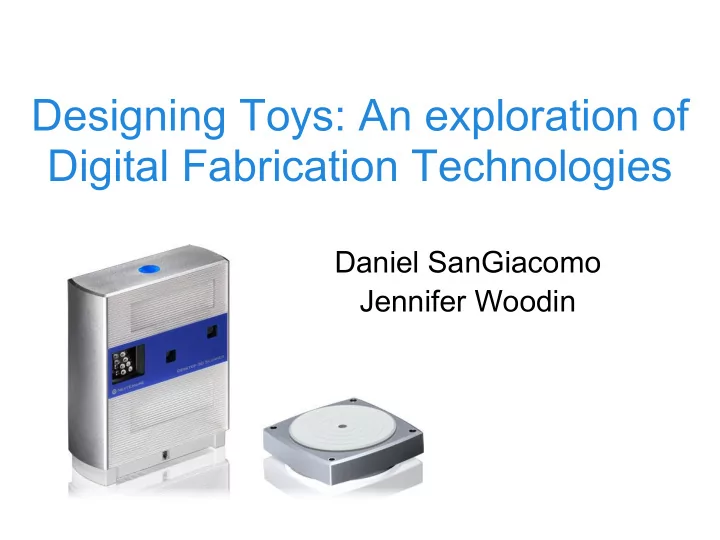
The Nextengine 3D Laser Scanner seen on the right is currently the least expensive professional 3D scanning software on the market.
and techniques related to 3D scanning
student art practice
manual for the use of the Nextengine 3D Scanner
Overcoming obstacles inherent of 3D scanning Scanning objects is not an automated process and presents multiple obstacles in obtaining clean and useful data that is free of errors. Obtaining "watertight" object
manipulate this data in other programs and required in
using other equipment like a 3D printer.
Example of a 3D scanned object with multiple defects in the data
Why scan toys?
Why scan toys?
A technical exercise depicting the manual alignment of two sets of 3D data
Shark project Appropriated object, a shark toy seen on the left and multiple iterations of that object seen on the right.
Shark project Owen Jones an accomplished english architect and designer of the mid 1800's "In the best periods of art all
upon observation of the principles which regulate the arrangement of form in nature, than on an attempt to imitate the absolute forms
Jones, Grammar of Ornament
The "Spring Fresco" from Thera
Shark project An iteration of the
a mathematical reduction in the number
with the 3D scanner.
March Doll Project
March Doll Project
March Doll Project Integration of rolling rubber ring joint into toy design.
Ostrich project
Offering this technology to other students Detailed user manual that will allow other artists to utilize this equipment more readily and expand the connection between the fields of fine art and industrial design.
Expanding culture with new technology