Design Considerations for Electrical Wiring Interconnect Systems in - - PDF document

design considerations for electrical wiring interconnect
SMART_READER_LITE
LIVE PREVIEW

Design Considerations for Electrical Wiring Interconnect Systems in - - PDF document

The Aerospace & Defense Forum Dallas Ft. Worth Chapter May 11, 2017 Design Considerations for Electrical Wiring Interconnect Systems in Drones Manuel Lozano Applications Engineer Manager / Central Region Why is this important?


slide-1
SLIDE 1

The Aerospace & Defense Forum Dallas – Ft. Worth Chapter May 11, 2017 1

Design Considerations for Electrical Wiring Interconnect Systems in Drones

Manuel Lozano

Applications Engineer Manager / Central Region

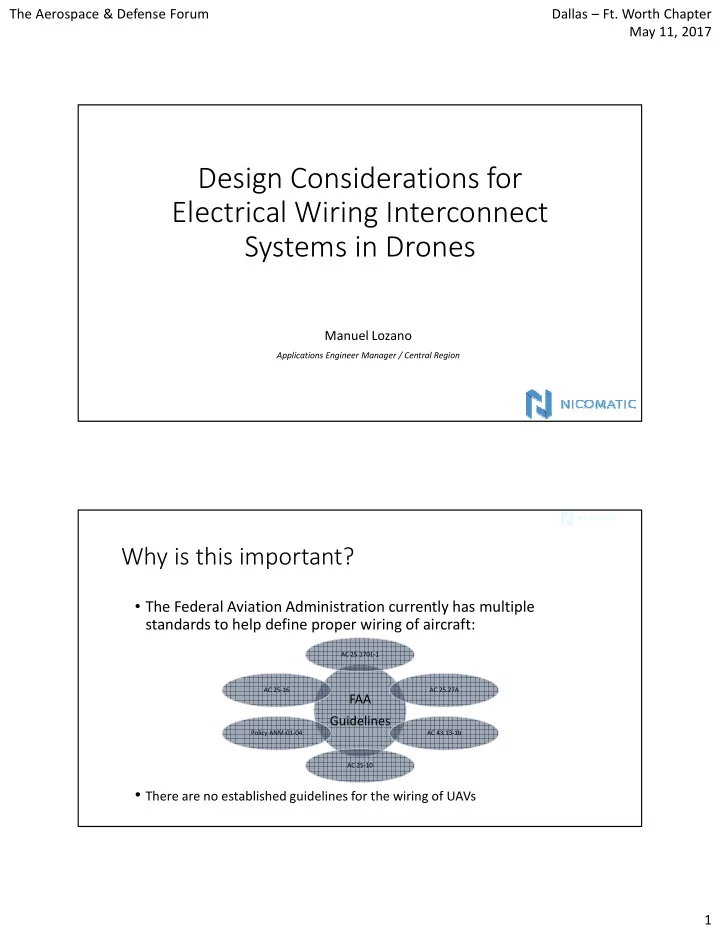
Why is this important?

  • The Federal Aviation Administration currently has multiple

standards to help define proper wiring of aircraft:

FAA Guidelines

AC 25.1701-1 AC 25.27A AC 25-16 Policy ANM-01-04 AC 43.13-1b AC 25-10

  • There are no established guidelines for the wiring of UAVs
slide-2
SLIDE 2

The Aerospace & Defense Forum Dallas – Ft. Worth Chapter May 11, 2017 2

Electrical Wiring Interconnection System

  • Federal Aviation Administration defines EWIS as:

Any wire, wiring device, or combination of these, including termination devices, installed in any area

  • f the airplane for the purpose of transmitting

electrical energy between two or more intended termination points.

Market size

  • More than 181,000 people have

registered UAVs with the federal government since December 21 (9)

  • The FAA has approved more than 3,000

companies to use UAVs (9)

  • 4.3 million UAVs were sold worldwide in

2015

Figure 2 – (10)

slide-3
SLIDE 3

The Aerospace & Defense Forum Dallas – Ft. Worth Chapter May 11, 2017 3

Market size – Section 333

  • By law, any commercial aircraft operation in national airspace requires a certificated

and registered aircraft, a licensed pilot, and operational approval

  • Section 333 of the FAA Modernization and Reform Act of 2012 (FMRA) grants the

Secretary of Transportation the authority to determine whether an airworthiness certificate is required for a UAS to operate safely in the National Airspace System

Market size – Section 333

  • As of April 13, 2016, the FAA has approved more than 5,542 petitions for Section

333 exemption (16)

(15)

slide-4
SLIDE 4

The Aerospace & Defense Forum Dallas – Ft. Worth Chapter May 11, 2017 4

Statistics

  • More than 400 large military drones crashed between

September 2001 and December 2013 (1)

  • Of those, 194 were Class A accidents
  • Destroyed aircraft or caused at least $2 million in

damage

  • The number of military drone crashes is increasing
  • Consumer drone crashes is expected to follow

the same pattern

Figure 1 – (2)

Military

Related Industries

  • United States Navy created the Wiring Systems Branch to research, test, and

evaluate U.S. Navy aircraft electrical wiring systems

  • 3,045 U.S. Navy aircraft fly approximately 921,658 flight hours per year
  • U.S. Navy experiences approximately 1,446 maintenance events per year

due to wiring systems (14)

  • From 1995 to 2002, there were 31 mishaps due to aircraft electrical wiring

system failures

  • 6 Class A mishaps
  • Resulting total cost of damages of $1 million or more, a DoD aircraft is destroyed, or an injury

results in fatality or permanent disability

  • 3 Class B mishaps
  • Resulting total cost of damages is between $200,000 and $1 million, an injury results in

permanent partial disability, or when 3 or more personnel are hospitalized for inpatient care

  • 22 Class C mishaps
  • Resulting total cost of damages is between $20,000 and $200,000, a nonfatal injury that causes

any loss of time from work beyond the or shift on which it occurred, or a nonfatal occupational illness that causes loss of time from work or disability at any time

United States Navy

slide-5
SLIDE 5

The Aerospace & Defense Forum Dallas – Ft. Worth Chapter May 11, 2017 5

Related Industries

United States Navy

Figure 4 – Typical Wire System Failure Modes For U.S. Navy Aircraft (1980-1999) (13)

Related Industries

  • 43 percent of aircraft mishaps related to electronics were due to the wiring

interconnect system (17)

United States Air Force

Figure 3 – Electrical Components Contributing To Air Force Aircraft Mishaps (13)

slide-6
SLIDE 6

The Aerospace & Defense Forum Dallas – Ft. Worth Chapter May 11, 2017 6

Related Industries

  • Reported accidents:

Non-Military

Date Location Event Injuries Reference May 2014 Vancouver Filming Commercial 3 April 25, 2014 Texas Police Training Exercise 4 April 7, 2014 Australia Triathlon 1 5 October 2, 2013 New York City Manhattan Street 7 August 24, 2013 Virginia Virginia Motorsports Park Multiple 8 August 20, 2013 Wyoming Wedding 1 9

Projected Statistics

Registered Individuals Registered Companies Purchased UAVs

1Based on usage of 12

hours per year per UAV

2Based on usage of 48

hours per year per UAV

3Based on usage of 3 hours

per year per UAV

Registered Individuals Registered Companies Purchased UAVs

1 2 3

[VALUE] [VALUE] [VALUE] 2000000 4000000 6000000 8000000 10000000 12000000 14000000 Projected Flight Hours [VALUE] [VALUE] [VALUE] 500000 1000000 1500000 2000000 2500000 3000000 3500000 4000000 4500000 5000000 Market Size

slide-7
SLIDE 7

The Aerospace & Defense Forum Dallas – Ft. Worth Chapter May 11, 2017 7

Projected Statistics

Registered Individuals Registered Companies Purchased UAVs

4Based on U.S. Navy’s

average flight hours between maintenance events caused by wiring

6Based on U.S. Navy’s

average flight hours between Class A mishaps caused by wiring (Occur every 1,075,267 hours of flight)

5Based on U.S. Navy’s

average flight hours between mishaps caused by wiring system failure (Occur every 208,116 hours

  • f flight)

[VALUE ] [VALUE ] [VALUE ] 5000 10000 15000 20000 25000 Number of Yearly Maintenance Events Caused by Wiring

4

[VALUE ] [VALUE ] [VALUE ] 2 4 6 8 10 12 14 Number of Yearly Fatalities Caused by Wiring System Failures [VALUE ] [VALUE ] [VALUE ] 10 20 30 40 50 60 70 Number of Yearly Mishaps Caused by Wiring System Failure

5 6

Projected Statistics

Registered Individuals Registered Companies Purchased UAVs [VALUE ] [VALUE ] [VALUE ] 100 200 300 400 500 600 Number of Yearly Mishaps

7

7Based on Air

Force’s average flight hours between Class A mishaps (Occur every 25,125 hours of flight)

slide-8
SLIDE 8

The Aerospace & Defense Forum Dallas – Ft. Worth Chapter May 11, 2017 8

Study Findings - Causes of EWIS degradation

  • Vibration

Federal Aviation Administration Department of Defense

  • Moisture
  • Heat
  • Contamination
  • Installation
  • Maintenance

Wiring

slide-9
SLIDE 9

The Aerospace & Defense Forum Dallas – Ft. Worth Chapter May 11, 2017 9

Pre-Installation Design Considerations

  • Wire should be received from supplier on a spool
  • Conductors and shielding should be free of corrosion and/or broken strands
  • Insulation should not be damaged or cracked

Receiving

Pre-Installation Design Considerations

  • Each wire should be marked with a part number
  • Used to identify wire and circuit relating to the wiring diagram
  • Marking can be printed on wire or on a tag which is attached to the wire

Marking

slide-10
SLIDE 10

The Aerospace & Defense Forum Dallas – Ft. Worth Chapter May 11, 2017 10

Pre-Installation Design Considerations

  • Visually inspect the wire for any of the following conditions:
  • Nicked or cut strands
  • Frayed insulation
  • Un-stranded or bird cage strands
  • Over-twisted conductors after reshaping
  • Visually inspect the wire insulation for any damage including:
  • Crushed or cut by the tool
  • Deformation exceeding 20 percent of the insulation thickness
  • End of the insulation is not cut cleanly

Mechanically Stripping Wire

Installation Design Considerations

  • The proper bend radius for wire on aircraft should be 10 times the outside diameter
  • f the largest diameter wire in the bundle
  • If wire is supported on both ends, the bend radius can be 3 times the wire diameter

Bending

slide-11
SLIDE 11

The Aerospace & Defense Forum Dallas – Ft. Worth Chapter May 11, 2017 11

Installation Design Considerations

  • Cables should not be riding on a structure or another wire bundle
  • Grommets should be installed around holes to prevent chafing
  • Use standoffs to maintain clearance between cables and structure
  • Tape and tubing is acceptable when clamps cannot be installed

Chafing

  • Wire bundles

riding on each

  • ther
  • Properly installed

grommet

Installation Design Considerations

  • Cables should have slack between clamps
  • Prevents strain at the terminal and reduces effects of stress caused by shock and vibration
  • Route cables perpendicular to clamps to prevent stress on the wires
  • Pinching of wires can be caused by improper installation or too many wires in a

clamp

Clamping

90° ±5°

Sufficient slack should be provided between clamps

slide-12
SLIDE 12

The Aerospace & Defense Forum Dallas – Ft. Worth Chapter May 11, 2017 12

Connectors Pre-Installation Design Considerations

  • Be sure contacts are properly seated on both mating halves
  • Confirm that there are no bent contacts

Visual Inspection

2 bent contacts Contact is shorter than the others

slide-13
SLIDE 13

The Aerospace & Defense Forum Dallas – Ft. Worth Chapter May 11, 2017 13

Installation Design Considerations

Loose connectors Insufficient or lack of strain relief Worn seals Tight wire bends

Focus

Installation Design Considerations

  • Be sure wire is not loose after being attached to the contact, either by crimping or

soldering

  • Contacts should be secure when inserted into the connector housing
  • It is recommended that connectors be mated with a retention mechanism

Loose Connectors

Latch Screw

Acceptable Retention Mechanisms

slide-14
SLIDE 14

The Aerospace & Defense Forum Dallas – Ft. Worth Chapter May 11, 2017 14

Installation Design Considerations

  • Increases strength and reliability of the cable assembly
  • Decrease strain on wire, which can lead to product failure
  • Backpotting and backshells are recommended forms of strain relief
  • Especially important in areas of high vibration and frequent mating cycles

Strain Relief

Installation Design Considerations

  • Cause strain on wires, contacts, and connectors
  • Cause deformation of connector seals
  • Strain caused by tight wire bends is exaggerated in high vibration environments
  • Eliminating tight wire bends and providing slack in the wire is recommended for

connectors with frequent mating cycles

Tight Wire Bends

Grommet Grommet Wire Distortion caused by tight wire bend

slide-15
SLIDE 15

The Aerospace & Defense Forum Dallas – Ft. Worth Chapter May 11, 2017 15

Installation Design Considerations

  • Seals are used to prevent foreign objects from entering the connector
  • Moisture, dirt, or other objects can cause a potential failure if the seal is worn
  • Any split, crack, chip, nick, or gouge extending out of the recessed or chamfered

area is unacceptable and should be repaired or replaced

Worn Environmental Seals

Performance Considerations

Weight Size

slide-16
SLIDE 16

The Aerospace & Defense Forum Dallas – Ft. Worth Chapter May 11, 2017 16

Performance Design Considerations

  • Wgr = We + Wpay + Wewis + Wmisc
  • Wgr = Gross Weight (Takeoff Weight)
  • Wpay = Payload weight
  • Wewis = Electronic wiring interconnect system weight
  • Wmisc = Other weights
  • Decreasing weight of EWIS allows for increased payload capacity

Payload Capacity

Performance Design Considerations

  • Vver = √((2 * m * g) / (ρ * cD * A)) * √(TR – 1)
  • Vver = √((2 * 1.24 * 9.81) / (1.2 * 1.3 * 0.554)) * √(1.9 – 1)
  • Vver =5.033 m/s
  • Vver = Maximum rate of climb
  • m = Mass
  • g = gravity
  • ρ = Air density
  • cD = Drag coefficient
  • A = Area
  • TR = Thrust ratio

Rate of Climb

slide-17
SLIDE 17

The Aerospace & Defense Forum Dallas – Ft. Worth Chapter May 11, 2017 17

Performance Design Considerations

4.7 4.8 4.9 5 5.1 5.2 5.3 5.4 5.5 5.6

Rate of Climb (m/s) Mass (kg)

Rate of Climb vs. Mass

1.24 1.21 1.18 1.15 1.12 1.09 1.06 1.03 1.0

10.23% Increase

Performance Design Considerations

  • Vhor = 4√(1 – (1 / TR2)) * √((2 * m * g) / (ρ * cD * A)) * TR
  • Vhor = 4√(1 – (1 / 1.92)) * √((2 * 1.24 * 9.81) / (1.2 * 1.3 * 0.554)) * 1.9
  • Vhor =9.048 m/s
  • Vhor = Maximum rate of climb
  • m = Mass
  • g = gravity
  • ρ = Air density
  • cD = Drag coefficient
  • A = Area
  • TR = Thrust ratio

Flight Speed

slide-18
SLIDE 18

The Aerospace & Defense Forum Dallas – Ft. Worth Chapter May 11, 2017 18

Performance Design Considerations

8.4 8.6 8.8 9 9.2 9.4 9.6 9.8 10 10.2

Flight Speed (m/s) Mass (kg)

Flight Speed vs. Mass

1.24 1.21 1.18 1.15 1.12 1.09 1.06 1.03 1.0

11.35% Increase

Performance Design Considerations

  • Flight Time = (((Battery / 1000mAh) * Capacity) / AMotor) * 60minutes
  • Flight Time = (((4480 / 1000) * 80%) / 24.8) * 60
  • Flight Time = 8.67 minutes
  • Battery = Battery size (mAh)
  • Capacity = Amount of battery used
  • AMotor = Amp draw required for thrust
  • 1 amp = 100g thrust
  • Drone weight = 1240g
  • Thrust per motor = 2480 / 4 = 620g
  • AMotor = 4 * (620 / 100) = 24.8 amps

Endurance

slide-19
SLIDE 19

The Aerospace & Defense Forum Dallas – Ft. Worth Chapter May 11, 2017 19

Performance Design Considerations

2 4 6 8 10 12

Endurance (minutes) Mass (kg)

Endurance vs. Mass

1.24 1.21 1.18 1.15 1.12 1.09 1.06 1.03 1.0

24% Increase

Examples

  • Wires properly

labeled

slide-20
SLIDE 20

The Aerospace & Defense Forum Dallas – Ft. Worth Chapter May 11, 2017 20

Examples

  • Tight wire bends

Examples

  • Lack of strain relief
  • Tight wire bends
slide-21
SLIDE 21

The Aerospace & Defense Forum Dallas – Ft. Worth Chapter May 11, 2017 21

Examples

http://turbo.paulstamatiou.com/uploads/2014/07/DSC00489-2000.jpg

  • Lack of strain relief
  • Tight wire bends

Examples

  • Missing section
  • f grommet
slide-22
SLIDE 22

The Aerospace & Defense Forum Dallas – Ft. Worth Chapter May 11, 2017 22

Examples

  • Properly

stripped cable

  • Contact is

properly seated in the connector

Examples

  • Lack of proper

locking mechanism

slide-23
SLIDE 23

The Aerospace & Defense Forum Dallas – Ft. Worth Chapter May 11, 2017 23

Examples

http://www.flytrex.com/static/pictures/installation_phantom_wire_flytrex_cable_outside.png

  • Lack of proper

locking mechanism

Examples

https://i.ytimg.com/vi/5UWoGsZR0wA/maxresdefault.jpg

  • At least 16

points of potential failure on industry leading drone

slide-24
SLIDE 24

The Aerospace & Defense Forum Dallas – Ft. Worth Chapter May 11, 2017 24

References

1) Whitlock, Craig, “When Drones Fall From the Sky,” The Washington Post. 20 June 2014 2) Chow, Emily, “Fallen from the skies,” The Washington Post. 20 June 2014 3) http://www.cbc.ca/news/canada/british-columbia/drone-crash-prompts-vancouver-to-review-film-industry-use-1.2671977 4) http://montgomerycountypolicereporter.com/mcso-drone-crashes-into-lake-conroe/ 5) http://www.smh.com.au/technology/technology-news/river-of-blood-after-drone-hits-australian-athlete-20140407-zqruh.html 6) http://abc7ny.com/archive/9270668/ 7) http://wtvr.com/2013/08/24/watch-drone-crashes-into-crowd-at-great-bull-run/ 8) http://www.dailymail.co.uk/news/article-2395933/Fail-Photographers-drone-smacks-groom-head-looked-perfect-shot.html 9) http://blogs.wsj.com/digits/2016/01/06/u-s-drone-users-number-at-least-181000/ 10) KPCB, Internet Trends 2015: http://www.kpcb.com/internet-trends 11) Federal Aviation Administration, Aircraft Electrical Wiring Interconnect System (EWIS) Best Practices. https://www.faa.gov/training_testing/training/air_training_program/job_aids/media/EWIS_job-aid_2.0_Printable.pdf 12) http://dc.etsu.edu/cgi/viewcontent.cgi?article=2073&context=etd 13) https://www.whitehouse.gov/sites/default/files/microsites/ostp/wire_rpt.pdf 14) The Challenges Facing U.S. Navy Aircraft Electrical Wiring Systems. http://www.ewp.rpi.edu/hartford/users/papers/engr/ernesto/buih/EP/Supporting%20Materials/Literature_References/ref_19.pdf 15) http://www.auvsi.org/auvsiresources/exemptions 16) https://www.faa.gov/uas/legislative_programs/section_333/ 17) Review of Federal Programs for Wire System Safety. https://www.whitehouse.gov/sites/default/files/microsites/ostp/wire_rpt.pdf 18) Department of Defense Handbook – Electrical Wiring Interconnect System (EWIS) Integrity Program.