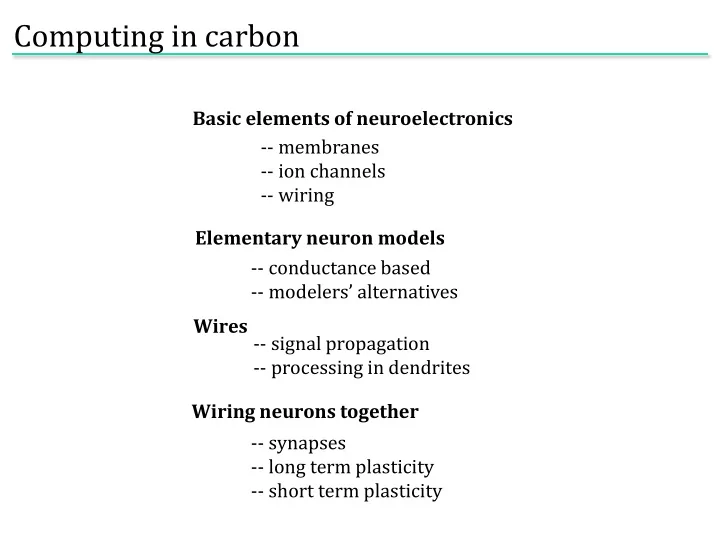
SLIDE 1 Basic elements of neuroelectronics Elementary neuron models
- - conductance based
- - modelers’ alternatives
- - membranes
- - ion channels
- - wiring
Wires
- - signal propagation
- - processing in dendrites
Wiring neurons together
- - synapses
- - long term plasticity
- - short term plasticity
Computing in carbon
SLIDE 2
Equivalent circuit model
SLIDE 3
Membrane patch
SLIDE 4
Ohm’s law: Capacitor: C = Q/V Kirchhoff:
The passive membrane
SLIDE 5
Energetics: qV ~ kBT V ~ 25mV
Movement of ions through ion channels
SLIDE 6
Na+, Ca2+ K+
Ions move down their concentration gradient until opposed by electrostatic forces
Nernst:
The equilibrium potential
SLIDE 7 Different ion channels have associated conductances. A given conductance tends to move the membrane potential toward the equilibrium potential for that ion V > E positive current will flow outward V < E positive current will flow inward ENa ~ 50mV ECa ~ 150mV EK ~
ECl ~
depolarizing depolarizing hyperpolarizing shunting
V
Vrest ENa EK more polarized
Each ion type travels through independently
SLIDE 8
Several I-V curves in parallel: New equivalent circuit:
Parallel paths for ions to cross membrane
SLIDE 9
Neurons are excitable
SLIDE 10
- Voltage dependent
- transmitter dependent (synaptic)
- Ca dependent
Excitability arises from ion channel nonlinearity
SLIDE 11 Persistent conductance
K channel: open probability increases when depolarized
PK ~ n4 n is open probability 1 – n is closed probability Transitions between states
- ccur at voltage dependent
rates
C O O C
n describes a subunit
The ion channel is a cool molecular machine
SLIDE 12 Gate acts as in previous case
PNa ~ m3h
Additional gate can block channel when open
m and h have opposite voltage dependences: depolarization increases m, activation hyperpolarization increases h, deinactivation m is activation variable h is inactivation variable
Transient conductances
SLIDE 13
We can rewrite: where
Dynamics of activation and inactivation
SLIDE 14
Dynamics of activation and inactivation
SLIDE 15
and Kirchhoff’s law
Capacitative current Ionic currents Externally applied current
Putting it together
SLIDE 16
The Hodgkin-Huxley equation
SLIDE 17
Na ~ m3h K ~ m3h
EK ENa
Anatomy of a spike
SLIDE 18
EK ENa
Runaway +ve feedback Double whammy
Anatomy of a spike
SLIDE 19
Where to from here?
Hodgkin-Huxley Biophysical realism Molecular considerations Geometry Simplified models Analytical tractability
SLIDE 20
Ion channel stochasticity
SLIDE 21
approach to macroscopic description
Microscopic models for ion channel fluctuations
SLIDE 22
Different from the continuous model: interdependence between inactivation and activation transitions to inactivation state 5 can occur only from 2,3 and 4 k1, k2, k3 are constant, not voltage dependent
Transient conductances
SLIDE 23
Like a passive membrane: but with the additional rule that when V VT, a spike is fired and V Vreset. EL is the resting potential of the “cell”.
The integrate-and-fire neuron
SLIDE 24
V
Vmax Vreset Vth
f(V)
Vrest
f(V) = -V + exp([V-Vth]/D)
Exponential integrate-and-fire neuron
SLIDE 25
Vth Vrest
dq/dt = 1 – cos q + (1+ cos q) I(t)
The theta neuron
Ermentrout and Kopell Vspike
SLIDE 26
- determine f from the linearized HH equations
- fit a threshold
- paste in the spike shape and AHP
Kernel f for subthreshold response replaces leaky integrator Kernel for spikes replaces “line”
Gerstner and Kistler
The spike response model
SLIDE 27
Two-dimensional models
V w
Simple™ model: V’ = -aV + bV2 - cW W’ = -dW + eV
SLIDE 28 Truccolo and Brown, Paninski, Pillow, Simoncelli
- general definitions for k and h
- robust maximum likelihood fitting procedure
The generalized linear model
SLIDE 29
Dendritic computation
SLIDE 30
Passive contributions to computation Active contributions to computation Dendrites as computational elements: Examples
Dendritic computation
SLIDE 31
r Vm = Im Rm Current flows uniformly out through the cell: Im = I0/4pr2 Input resistance is defined as RN = Vm(t∞)/I0 = Rm/4pr2 Injecting current I0
Geometry matters
SLIDE 32
rm and ri are the membrane and axial resistances, i.e. the resistances of a thin slice of the cylinder
Linear cables
SLIDE 33
ri rm cm For a length L of membrane cable: ri ri L rm rm / L cm cm L
Axial and membrane resistance
SLIDE 34
(1) (2)
The cable equation
x+dx x
SLIDE 35 (1) (2) (1)
where Time constant Space constant
The cable equation
SLIDE 36
General solution: filter and impulse response
Exponential decay Diffusive spread
SLIDE 37
Current injection at x=0, T ∞
Voltage decays exponentially away from source
SLIDE 38
Electrotonic length
Properties of passive cables
SLIDE 39
Johnson and Wu
Electrotonic length
SLIDE 40
Electrotonic length Current can escape through additional pathways: speeds up decay
Properties of passive cables
SLIDE 41
Johnson and Wu Current can escape through additional pathways: speeds up decay
Voltage rise time
SLIDE 42
Electrotonic length Current can escape through additional pathways: speeds up decay Cable diameter affects input resistance
Properties of passive cables
SLIDE 43
Electrotonic length Current can escape through additional pathways: speeds up decay Cable diameter affects input resistance Cable diameter affects transmission velocity
Properties of passive cables
SLIDE 44
Step response: pulse travels
Conduction velocity
SLIDE 45
www.physiol.usyd.edu/au/~daved/teaching/cv.html
Conduction velocity
SLIDE 46
Finite cables Active channels
Other factors
SLIDE 47 Impedance matching: If a3/2 = d1
3/2 + d2 3/2
can collapse to an equivalent cylinder with length given by electrotonic length
Rall model
SLIDE 48
New cable equation for each dendritic compartment
Active cables
SLIDE 49
Genesis, NEURON
Who’ll be my Rall model, now that my Rall model is gone
SLIDE 50
Passive computations
London and Hausser, 2005
SLIDE 51 Enthusiastically recommended references
- Johnson and Wu, Foundations of Cellular Physiology, Chap 4
The classic textbook of biophysics and neurophysiology: lots of problems to work through. Good for HH, ion channels, cable theory.
- Koch, Biophysics of Computation
Insightful compendium of ion channel contributions to neuronal computation
- Izhikevich, Dynamical Systems in Neuroscience
An excellent primer on dynamical systems theory, applied to neuronal models
- Magee, Dendritic integration of excitatory synaptic input,
Nature Reviews Neuroscience, 2000 Review of interesting issues in dendritic integration
- London and Hausser, Dendritic Computation,
Annual Reviews in Neuroscience, 2005 Review of the possible computational space of dendritic processing