Description of Coffee Aroma with the Electronic Nose which Learned - - PowerPoint PPT Presentation

description of coffee aroma with the electronic nose
SMART_READER_LITE
LIVE PREVIEW

Description of Coffee Aroma with the Electronic Nose which Learned - - PowerPoint PPT Presentation

International Electronic Conference on Sensors and Applications Description of Coffee Aroma with the Electronic Nose which Learned Wine Aromas, Le Nez du Vin Kouki FUJIOKA KA 1 , , Yasuko TOMIZAWA 2 , , Nobuo SHIMIZU 3 and Yoshinob obu


slide-1
SLIDE 1

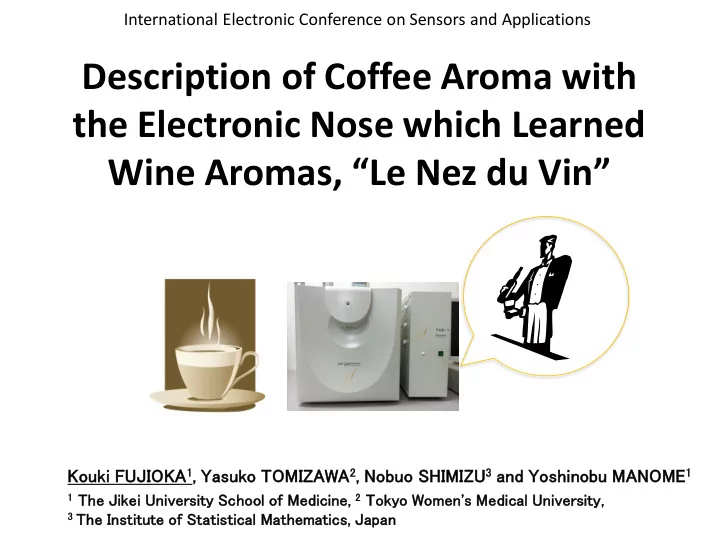
Description of Coffee Aroma with the Electronic Nose which Learned Wine Aromas, “Le Nez du Vin”

Kouki FUJIOKA KA1, , Yasuko TOMIZAWA2, , Nobuo SHIMIZU3 and Yoshinob

  • bu MANOME1

1 The

The Jikei Universi sity y School

  • l of Medic

icine, , 2 Tokyo yo Women's s Medical al Universit sity,

3 3 The Instit

itute of Statis istic ical al Mathemat atics, s, Japan

International Electronic Conference on Sensors and Applications

slide-2
SLIDE 2

Background

1. Coffee aroma is considered to be one of the most complicated food aromas which have more than 600 components. (Schaller, E (1998)) 2. For evaluation of the coffee qualities, cup tests are usually performed by expert

  • tasters. However, it depends on the skill of the tasters (Rodriguez, J (2010))

3. Sensor technologies have been applied to evaluate the qualities objectively. (Schaller, E (1998))

Problem: However, it is difficult to understand the feature of coffee aroma directly from the electronic signals of sensors.

slide-3
SLIDE 3

AIM

To Describe coffee aroma understandably from the electronic signals

FF-2A electronic nose (Shimadzu corporation)

  • FF-2A can describe similarities to the

9 standard gasses in default setting. Fujioka K et al. Plos One (2009)

  • 9 standard gasses

(1)Hydrogen sulphide, (2) methylmercaptan, (3) ammonia, (4) trimethylamine, (5) propionic acid, (6) butylaldehyde, (7) butylacetate, (8) toluene, (9) heptane Expansion of Description

  • Recording of signals from several aromas in wine

aroma kit, Le Nez du Vin (Editions Jean Lenoir).

  • Calculation of the similarities between coffee

aroma samples and the wine aromas. Le Nez du Vin (Wine aroma kit)

slide-4
SLIDE 4

Methods

  • Coffee aroma sample:

Drip coffee (Colombia), Instant coffee (Colombia type), Canned coffees (2 coffees with milk, sugar & flavor, 1 black coffee) *Note: The data from the Drip coffee and the Instant coffee were referred to our previous report

(Fujioka K et al. The Japanese Journal of Taste and Smell Research, 2013).

  • Similarities to wine aromas of Le Nez du Vin and cofees:

51 aromas were selected from the Le Nez du Vin. Similarities were calculated with the Asmell2 software (Shimadzu). The aromas which indicated similarity > 0 were shown in this presentation.

aroma θ Sample FF-2A Sensor signals Similarity to 51 aromas from the Le Nez du Vin (like wine experts)

slide-5
SLIDE 5

Result: Similarities of coffee sample to 8 aromas (Bar graph)

  • Canned coffee: Coffee, Mushroom, Pine (Can 1, 2), Honey (Can 2), Orange (can 3)
  • Drip coffee: Coffee, Mushroom, Pine, Honey, Strawberry, Musk, Caramel
  • Instant coffee: Coffee
slide-6
SLIDE 6

Result: Similarities of coffee sample to 8 aromas (Rader Chart)

  • The patterns of canned coffees were similar to each other.
slide-7
SLIDE 7

Result: Similarities of coffees to Drip and Instant coffees

  • Canned coffees has both similarities to Drip and Instant (> 60%)
slide-8
SLIDE 8

Discussion

  • Analysis data indicated that the drip coffee had

more complex aromas than other coffees.

  • All the coffees were similar to Coffee aroma &

Mushroom aroma. Mushroom aroma may contribute to Koku taste, mouthfulness and continuity of the flavor. (Ref: Hayase, F. et al. (2013))

  • Canned coffees has both similarities to Drip

and Instant coffees which may reflect market segmentation.

slide-9
SLIDE 9

Study limitations

  • Similarity with the wine aromas may need

further data fitting to human olfactory senses.

  • The expansion of descriptors about coffee

aromas using coffee specific chemicals may be needed for more optimal description.

  • Measurement condition will need optimization.

(sample volume, temperature, dilution gas etc.)

slide-10
SLIDE 10

Conclusion

  • The electronic nose which learned wine aromas

has the potential to describe the features of coffee aromas objectively.