
SLIDE 1
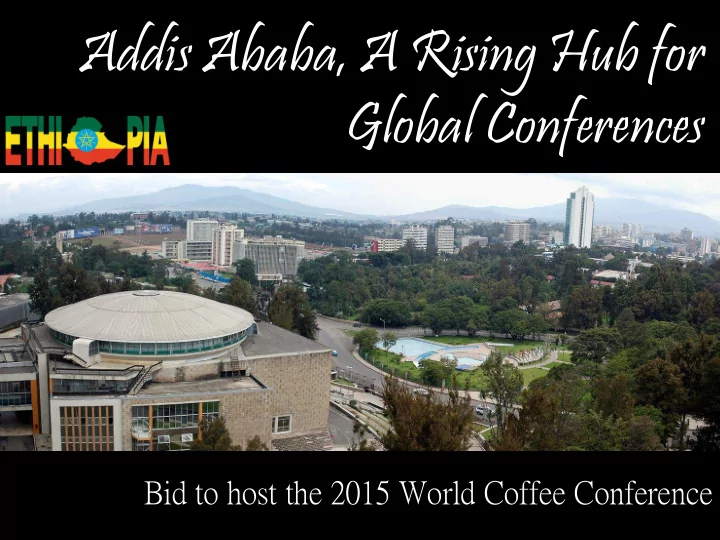
Global Conferences Bid to host the 2015 World Coffee Conference - - PowerPoint PPT Presentation
Addis Ababa, A Rising Hub for Global Conferences Bid to host the 2015 World Coffee Conference Coffee, Ethiopias gift to the world Ethiopia is widely believed to be the birthplace of coffee Legend has it that coffee was accidentally
Kaldi, a goat herder who lived in Ethiopia. One day, Kaldi
he had never noticed before, after which they became energised.
cherries to a local monastery, where the monks tossed them in the fire as they disapproved of the idea of using the strange fruit. Instead of burning the beans, it actually roasted them. Those roasted beans were used to create the first coffee.
spread over centuries to the Arabic world and India. Europeans began drinking coffee in the 1600s.
experts to identify and address matters of common concern.
horizons on ways of addressing common concerns in the coffee sector.
proceedings of the past Conferences that took place in the UK, Guatemala and Brazil.
held in Africa!
producing countries and has a long tradition of consultation through its continental organization the Inter-African Coffee Association.
Major coffee producers. The top ten coffee producers are shown in yellow. Image courtesy of National Geographic Society.
coffee makes it the ideal host
Conference.
known as the capital city of Africa and is the headquarters of the African Union.
With a per capita consumption of 2.40kg, Ethiopia leads the African continent in domestic
directly or indirectly, for generations, depend on coffee production and trading for a living.
the incredible pool of coffee genetic diversity, of which most of them are identified by their distinct and characteristic flavor, aroma or taste.
in the Ethiopian economy.
living, hundreds of thousands of middlemen are involved in the collection of the crop from farmers and supply to the export and domestic market.
up to 30% of the total yearly export income, is derived from coffee.
Exchange, the first of its kind in Africa, has modernised coffee trading since its debut in 2008. This venture has revolutionalised Ethiopia’s economy and has inspired
follow suit.
efficiency to the coffee market, which has motivated market players to come to the formal channel.
is ready and willing to adopt to current global practices and initiatives, such as traceability and specialty issues.
Base year Year 1 Year 2 Year 3 Year 4 Year 5
2009/10 2010/11 2011/12 2012/13 2013/14 2014/15 Coffee production 341,000 405,790 482,890 579,468 695,362 831,000 ( in tons) Coffee exports( in tons) 172,210 221,115 283,907 364,531 468,052 600,970 Coffee export earnings ( mil in USD) 528,000 692,000 906,000 1,187,000 1,555,000 2,037,000
Growth Rate (%)
Coffee production
19 20 20 20 Coffee exports
28 28 28 28 Coffee export earnings ( in USD)
31 31 31 31
Source: GTP main document and Policy matrix
– Yearly African Union summits and other Conferences that draw more than 10,000 delegates – East African Fine Coffees Association (EAFCA) – African Fine Coffees Association (AFCA) – The World Economic Forum – The 2013 International Conference on Family Planning – The AGOA conference – Two consecutive international coffee conferences (2012/ 2013) – Regular UN ECA Ministerial Conferences – EU-ACP Parliamentary Conferences
tourism last Ethiopian budget year according to the Ministry of Culture and Tourism (MoCT), secured from local, continental and international conferences hosted within the country.
attended conferences conducted in the country with the majority held in Addis Ababa.
African Union Conference Centre (AUCC) and the UN ECA Conference Centre as well as Millennium Hall.
very latest technology ensuring participants remain internationally connected during their stay in Ethiopia.
Hotels like the Sheraton, Radisson and Hilton also have the capacity to host conferences and meetings.
Ethiopia hiopian n co comman ands ds the e lion shar are e of the e pan an-Af Afri rican can pas assenge enger r an and ca cargo
etwo work, rk, oper erat ating ing the e youngest ngest an and most moder ern n flee eet t to more e than an 76 intern ernation ational al des estina ination tions s ac across ss five e co contine tinents. nts.
such as the Boeing 787 Dreamliner, Boeing 777-200LR, Boeing 737, Boeing 777-200LR Freighter and Bombardier Q-400 with double cabin. In fact, Ethiopian pian is the first t airline e in Africa to own and operate these aircraft. aft.
massive transformation with road and rail networks currently under construction, including the Addis Ababa Light Rail project
descended from some of the world’s oldest civilisations
diplomatic capital - a major metropolis
highest capital in the world
First-class hotels and restaurants, museums and palaces, and good shopping, which includes the Mercato – Africa’s largest open-air market
colour and presentation Wot (sauce or stew), is always accompanied by a sour dough, pancake-like bread called Injera
coffee which showcases, among others, a centre for research on Coffee Arabica guides visitors through the world of coffee production.
news and well-wishing with friends and relatives as well as expressing respect to elders and to appreciate the blessing of life.
is shared with family and friends through coffee ceremonies.
mortar, and coffee is made in a spherical-shaped pot called a
Ethiopia is a mosaic of people with more than 80 languages, different lifestyles, costumes and cultural dances
12th century, chipped out of solid rock
a place of pilmigrage and devotion.
world’s most powerful kingdoms from 1st to 7th centuries AD
enormous monolithic obelisks
fortresses and temples
Sheba
church which has the original Ark of the Covenant
Main Gate into Harar
built between the 13th and 16th centuries.
three of which date from the 10th century, and 102 shrines.
processed coffees which bear the same name.
Created by massive erosion, the mountains reach a height of over 4,000 metres Home to some of the rarest animals on earth, including the Simien wolf, Gelada baboon and the Walia ibex
Visas are required for all visitors to Ethiopia, with the exception of nationals of Djibouti and Kenya. Ethiopian Diplomatic Missions will offer fast-track service for all business visa applications during the conference.
The official working language in Addis Ababa is called Amharic. However, almost everyone you encounter will speak at least enough English for you to communicate.
The local currency is called the Ethiopian Birr (ETB). All local banks provide currency exchange services with an exchange rate that is uniform across the board. All major hotels have FOREX services on site you can easily use. Most credit cards are also accepted in the major hotels and some of the larger restaurants.
Ethiopia follows the Julian calendar, which con-sists of 12 months of 30 days each and a 13th month of five days (six days on leap year). The calendar is seven years and eight months behind the Western (Gregorian) calendar.
Addis Ababa enjoys a temperate climate with an average range of 10 to 23 degree all year round. The rainy seasons are between June and September but temperature. Weather is one major factor that attracts visitors to the city and Ethiopia
International mobile phones will need to be “unlocked” in order for them to work in Ethiopia, but you may incur roaming charges. Alternatively, for less than $20 you can purchase a local pre-paid SIM card for your unlocked mobile phone.
The electricity in Ethiopia is 220V/50Hz. You will need appropriate adapters (and convertors for 110V electrical goods).
Photo: Meskel Flowers, endemic to Ethiopia, blossom during the Ethiopian New Year, which is marked in September.