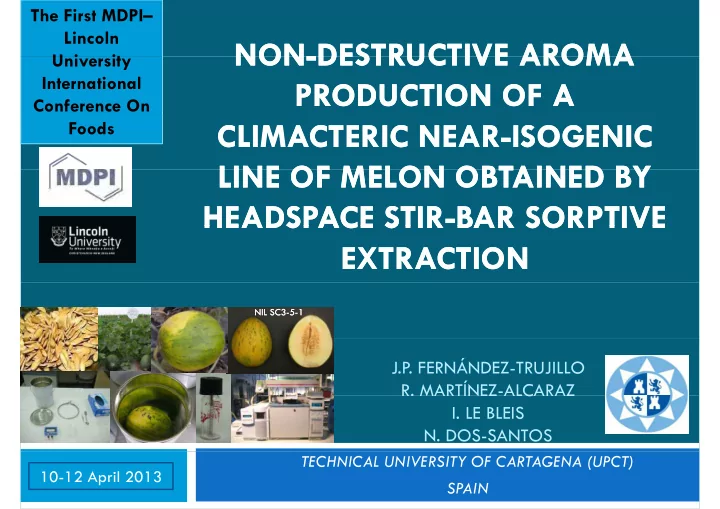
SLIDE 2 NON-DESTRUCTIVE AROMA PRODUCTION OF A CLIMACTERIC NEAR ISOGENIC
h a d
The The aromatic aromatic profile profile was was constituted constituted by 66 aroma volatiles
(18 acetate esters, 16 non-acetate esters, 6 thioesters, 6 organic acids, 5 aldehydes, 5 ketones, 1 alcohol, 5 terpenes, 4 compounds of other chemical groups) NEAR-ISOGENIC LINE OF MELON OBTAINED BY HEADSPACE STIR- BAR SORPTIVE EXTRACTION
i b c d e f g
with with predominance predominance of
esters, particularly particularly acetate acetate: :
methylbutyl acetate acetate
methylpropyl acetate acetate
hexyl acetate acetate
EXTRACTION Figure 2. Material for sampling aromas in whole fruit
- melon. a) hermetic containers, b) hermetic seal, c) metalic
cover d) gloves e) tweezers f) ziplock bags g) vials box
i
phenylmethyl acetate acetate
cover, d) gloves, e) tweezers, f) ziplock bags, g) vials box, h) detail of a vial with a bar (twister), i) detail of a bar (twister) Picture provided by GERSTEL, Inc.
- 2-methylpropyl hexanoate
- n-hexadecanoic acid
75 uction rate g/s)
typical from the melon senescence, with similar levels at harvest
50 thylene produ (pmol/kg
Sulfur Sulfur-
derived compounds Acetate esters Acetate esters
- 3 methylbutyl acetate
- S methyl butanethioate
Non Non-
Acetate esters
25 Et
- 3-methylbutyl acetate
- butan-2-yl acetate
- phenylmethyl acetate
- 2-methylbutyl acetate
- S-methyl butanethioate
- S-methyl 3-methylbutanethioate
- ethyl butanoate
Figure 1. Ethylene production (EP) during ripening at 21±1 1oc and 93±3% RH of
7 14 Time (days) 2 methylbutyl acetate CONCLUSION The acetate and thioesters predominated in the aroma profile of the intact fruit of the NIL SC3-5-1 particularly 2-methylbutyl acetate. Aroma volatiles identified during ripening of the climacteric NIL SC3 5 1 f ll d d ff h h d b l f ll h l
J.P. Fernández J.P. Fernández-
Trujillo, R. Martínez-
Alcaraz, I. Le , I. Le Bleis Bleis, N. Dos , N. Dos-
Santos
ripening at 21±1.1oc and 93±3% RH of intact fruit of near-isogenic line SC3-5-1 (mean±se, n=4).
SC3-5-1 followed different patterns though during ripening but apparently following an ethylene- dependent pattern due to their biosynthesis or degradation.. .