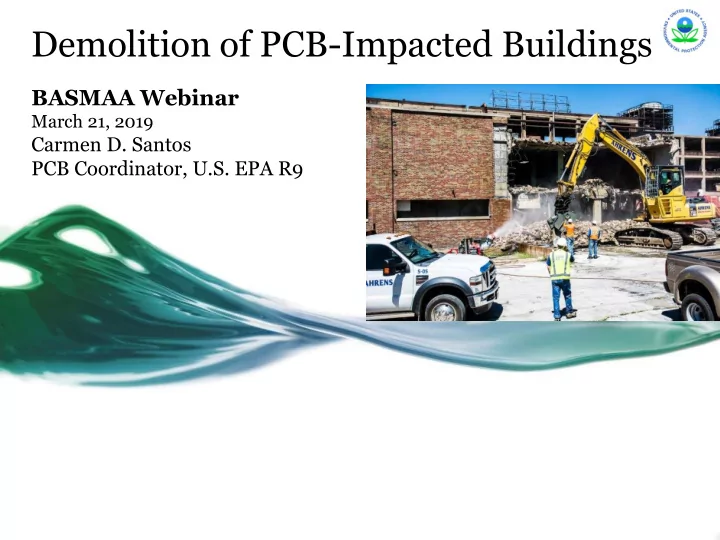
Demolition of PCB-Impacted Buildings BASMAA Webinar March 21, 2019 - - PowerPoint PPT Presentation

demolition of pcb impacted buildings
SMART_READER_LITE
LIVE PREVIEW

Demolition of PCB-Impacted Buildings BASMAA Webinar March 21, 2019 - - PowerPoint PPT Presentation

Demolition of PCB-Impacted Buildings BASMAA Webinar March 21, 2019 Carmen D. Santos PCB Coordinator, U.S. EPA R9 EPA R9 Land Division TSCA PCB Cleanup Program TSCA: Toxic Substances Control Act EPA R9 Land Division - RCRA Branch Nicole


slide-1
SLIDE 1

Demolition of PCB-Impacted Buildings

BASMAA Webinar

March 21, 2019

Carmen D. Santos PCB Coordinator, U.S. EPA R9

slide-2
SLIDE 2

EPA R9 Land Division TSCA PCB Cleanup Program

TSCA: Toxic Substances Control Act

EPA R9 Land Division - RCRA Branch Nicole Moutoux, Assistant Director

RCRA Corrective Action Office Steve Armann, Manager Carmen Santos, PCB Coordinator TSCA PCB Cleanup Program RCRA Issues

  • 1. Permits Office

Barbara Gross, Manager

  • 2. Underground Storage

Tanks Steve Linder, Manager

2

slide-3
SLIDE 3

EPA R9 Presentation What is it about?

Demolition of PCB-impacted buildings built between 1950 and 1979 (1980)

  • Applicable PCB regulations
  • Identification of PCBs in the buildings and removal
  • Waste segregation and disposal
  • Measures to protect human health and the environment

3

slide-4
SLIDE 4

EPA R9 Presentation Goals

  • Raise awareness of TSCA PCB regulations
  • PCB regulations applicable to demolition - Examples
  • Share what EPA R9 may need from you

4

slide-5
SLIDE 5

Roles & Responsibilities: EPA R9 / Building Owner

EPA R9 - General

  • Protect human health and the

environment

  • Return cleanup sites (e.g.,

demolition sites) to beneficial use

  • Provide technical/regulatory

assistance

  • Identify resources
  • Approve cleanup plans
  • Determine if additional actions

necessary

Building Owner - General

  • Understand and follow

applicable PCB regulations and

  • ther federal state/local

regulations

  • Remove PCBs from building

before full demolition

  • Clean up soils; clean up, protect

storm water drains

  • Engineering controls/land use

restrictions, if necessary

  • Protect human health and

environment by doing the above

5

slide-6
SLIDE 6

Key Messages #1

  • PCBs - persistent, bioaccumulative, toxic chemicals
  • Cancer and non-cancer effects
  • Toxic Substances Control Act PCB regulations - 40 CFR 761
  • Several applicable to demolition PCB-impacted buildings
  • PCB regulations have prohibitions, restrictions, and requirements for:
  • Manufacturing
  • Processing
  • Distribution in commerce
  • Use
  • Storage
  • Disposal
  • Marking
  • Recordkeeping

6

slide-7
SLIDE 7

Key Messages #2

  • EPA regulates PCBs ≥ 50 ppm and < 50 ppm In discussing

demolition sites we focus attention on requirements for:

  • Sampling
  • Site cleanup
  • Decontamination
  • Disposal, but
  • Consider all applicable requirements
  • TSCA PCB regulations not delegated
  • EPA R9 partners with state/local agencies and industry

7

slide-8
SLIDE 8

Key Messages #3

  • Demolition sites and process
  • Overarching Goal – Be protective of human health / environment
  • Notify EPA about PCBs
  • Conduct PCB removal steps in sequence that is protective
  • Follow applicable PCB regulations and state/local regulations

8

slide-9
SLIDE 9

40 CFR 761, Examples of Applicable Requirements Demolition PCB-Impacted Buildings

  • Applicability, 761.1 and 761.2
  • Definitions, 761.3
  • PCB remediation waste, 761.61
  • PCB bulk product waste, 761.62

9

slide-10
SLIDE 10

40 CFR 761, Examples of Applicable Requirements Demolition PCB-Impacted Buildings

  • Disposal requirements, 761.60
  • Storage for disposal, 761.65
  • Decontamination, 761.79
  • 761 Subpart C and Subpart K
  • Use authorizations and exclusions, 761.20 and 761.30

10

slide-11
SLIDE 11

EPA Extraction and Laboratory Methods Demolition PCB-Impacted Buildings

  • PCB Extraction Methods
  • EPA Method 3540C, Soxhlet (preferred)
  • EPA Method 3550C, Ultrasonic
  • PCB Analytical Method
  • EPA Method 8082A

11

slide-12
SLIDE 12

EPA Resources #1

  • EPA PCB national website:
  • www.epa.gov/pcbs
  • Specific pages: e.g., Learn (guidance), Building Materials, Cleanup
  • PCB Facility Approval Streamlining Toolbox (PCB FAST), EPA

Publication, EPA530-F-17-002, May 2017

  • October 2012: Reinterpretation of PCB bulk product waste
  • Sampling Porous Surfaces, EPA Region 1 SOP, May 2011

12

slide-13
SLIDE 13

EPA Resources #2

  • PCBs in Building Materials, Q/A, EPA July 28, 2015
  • Practical Actions for Reducing Exposure to PCBs in Schools

and Other Buildings, EPA Fact Sheet, July 28, 2015

  • PCB Question and Answer Manual, EPA 2014
  • PCB Site Revitalization Guidance Under the Toxic Substances

Control Act, November 2005

  • Call EPA Region 9 PCB Coordinator – 415.972.3360

13

slide-14
SLIDE 14

Examples of PCB Applications

  • High Intensity discharge lamps
  • Electrical equipment
  • Caulk and sealants
  • Adhesives / mastics
  • Thermal insulation (e.g., felt, foam)
  • Floor finishes and tiles
  • Ceiling tiles
  • Fire Retardants
  • Tank coatings

14

slide-15
SLIDE 15

Full Demolition PCB-Impacted Buildings Built or Renovated Between 1950 and 1979 (1980)

Indoor Air Primary Sources (e.g., caulk, paint, PCB light ballasts) Secondary Sources (e.g., substrates like concrete, carpets) Dust

15

Why remove PCBs from building before demolition?

slide-16
SLIDE 16

Before Full Demolition Why Remove PCBs from Building?

  • PCBs - persistent, bioaccumulative, toxic chemicals
  • Cancer and non-cancer effects
  • Buildings built or renovated between 1950 and 1979 (1980)
  • Sources PCB contamination to: soils, storm water, and surface

water (e.g., San Francisco Bay)

16

slide-17
SLIDE 17

Before Full Demolition Why Remove PCBs from Building?

  • Buildings built or renovated between 1950 and 1979 (1980)
  • Impacts to surface water
  • E.g., San Francisco Bay impacted by PCBs - TMDL
  • SF Bay sediments – reduce PCBs to an average of 1 ug/kg

(microgram/kilogram) (based on fish consumption)

  • 1 ug/kg = 0.001 milligram/kilogram

17

slide-18
SLIDE 18

Before Full Demolition Why Remove PCBs from Building?

18

slide-19
SLIDE 19

Full Demolition of PCB-Impacted Buildings

19

1950 – 1979 Potentially widespread use of PCB-containing materials Pre- Demolition

  • Survey building
  • Sample building

materials (e.g., caulk), substrates (e.g., concrete)

  • Sample soils

and storm drains

  • Clean, protect

storm drains

  • Remove PCBs

from building After Above Ground Demolition Remove contaminated soils, sample soils after removal; resample storm drains and reclean if needed

Actions to Reduce PCB Exposures and Impacts

slide-20
SLIDE 20

Building Demolition Examples of PCB Wastes

  • PCB Bulk Product Wastes – e.g., caulk, paint, Galbestos
  • Non-liquid wastes derived from manufactured products

containing PCBs

  • Currently contain PCBs ≥ 50 ppm
  • Regulatory definition in 40 CFR 761.3
  • PCB Remediation Wastes – e.g., soils, sediments, concrete
  • Contamination due to liquid PCB spills or releases or migration

from PCB-containing materials

  • Regulatory definition in 40 CFR 761.3

20

slide-21
SLIDE 21

Building Demolition Examples of PCB Wastes

  • Other PCB wastes – also see 40 CFR 761.60
  • PCB Liquids – e.g., transformer mineral oil ≥50 ppm
  • PCB Articles – e.g., transformers, capacitors

21

slide-22
SLIDE 22

EPA Regulations PCB Bulk Product Waste Disposal

  • Performance-based option, 40 CFR 761.62(a)
  • No EPA approval needed
  • Other options
  • Municipal Solid Waste Landfill, 40 CFR 761.62(b)
  • No EPA approval needed
  • May not be able to use in California
  • Risk-based 40 CFR 761.62(c)
  • EPA approval needed
  • No unreasonable risk determination by EPA

22

slide-23
SLIDE 23

EPA Regulations PCB Remediation Waste Cleanup and Disposal

  • Self-Implementing Cleanup, 40 CFR 761.61(a)
  • Prescribed sampling / cleanup levels / disposal
  • Notification to EPA, 30-day EPA response
  • Disposal options
  • Risk-based Cleanup, 40 CFR 761.61(c)
  • Not prescribed sampling, cleanup levels, disposal
  • Unreasonable risk determination by EPA
  • EPA approval of application needed to implement
  • Schedule sufficient time for EPA approval
  • Performance-based Disposal, 40 CFR 761.61(b) – Disposal only

23

slide-24
SLIDE 24

EPA Regulations Decontamination Standards and Procedures

40 CFR 761.79 contains:

  • Performance-Based Standards
  • Self-Implementing Procedures
  • Alternative Decontamination Procedures, 40 CFR 761.79(h)
  • EPA approval needed
  • Disposal requirements for decontamination waste

24

slide-25
SLIDE 25

EPA’s Reinterpretation of PCB Bulk Product Waste

  • What is it?
  • EPA Policy Memo – October 24, 2012
  • How can it be helpful if applied to demolition of PCB-

impacted buildings?

  • Abatement plan recommended
  • Designation of the combined PCB-containing material and

contaminated substrate as PCB bulk product needs to be made ahead of removal and disposal

25

slide-26
SLIDE 26

Pre-Demolition Steps (Recommended)

26

1 Survey Building Materials and Substrates 2 Sample Materials; Substrates (Pilot Studies) 2a Sample Soils and Storm Drain Sediments 3 Waste Segregation and Disposal Plan

(Notification/Application for PCB Cleanup)

3a Cleanup Plan for Soils and Storm Drains 3b Air Dust Monitoring Plan 4 Remove PCBs from Building, Air-Dust Monitoring

slide-27
SLIDE 27

Post-Above Ground Demolition Steps (Recommended)

27

1 Clean up Soils Contaminated with PCBs 1a Air-Dust Monitoring

2 Soil Cleanup Verification Sampling

  • 2a. Storm Drains Resample, Reclean, Protect

3 Complete Disposal PCB Wastes Offsite 4 Reuse/Recycling Non-PCB Materials 5 PCB Cleanup Completion & Disposal Report

slide-28
SLIDE 28

Examples PCB Cleanup – Building Demolition

Mixed Land Use Including Residential

Example #1

PCB Findings – Building Survey, Pilot Studies, and Sampling

  • 9-Story concrete building, 1972
  • Caulk - up to 22,0o0 ppm
  • Sediments - storm water drains,

up to 270 ppm

  • Soils – up to 11 ppm
  • EPA risk-based approval 761.61(c)
  • PCB cleanup goal 0.24 ppm
  • First step – 3 to 5 storm drains

cleaned up, protective measures

  • Air dust monitoring - PCB

removal

Example #2

PCB Findings – Building Survey, Pilot Studies, and Sampling

  • 2-Story concrete building, 1960s
  • Caulk – up to 307,000 ppm
  • Sediments – storm water drains,

up to 2.76 ppm

  • Soils – up to 0.77 ppm
  • EPA risk-based approval 761.61(c)
  • PCB cleanup goal 0.24 ppm
  • First step – 3 to 5 storm drains

cleaned up, protective measures

  • Air dust monitoring - PCB

removal

28

slide-29
SLIDE 29

Examples #1 & 2 - Sequence PCB Removal

  • After Building Survey - Pilot Studies (Substrate Sampling)
  • Extent of substrate contamination
  • Where does substrate meet cleanup goal?
  • Before Full Above Ground Demolition
  • Removed PCB caulk together with adjacent contaminated concrete
  • EPA PCB bulk product reinterpretation applied
  • After Full Above Ground Demolition
  • Contaminated soils removed via excavation, cleanup verification

29

slide-30
SLIDE 30

Example #3 Exterior Metal Panels with Rubber Gaskets

30

slide-31
SLIDE 31

Example #3 – Exterior Metal Panels on Building

  • 14-Story Building, 1962
  • Exterior 4’ by 8’ metal panels on two sides of the building on

Floors 2 through 14

  • Panels contained mounting frame with rubber gasket
  • Rubber gaskets - PCBs up to 1,100 ppm
  • Caulk in contact with panel mounting frame and gasket - PCBs up

to 140,000 ppm

  • Metal panels removed from building before demolition

31

slide-32
SLIDE 32

Example #3 – Exterior Metal Panels on Building

  • Building owner wanted to recycle metal panels
  • Panel surfaces contaminated – source PCBs in gaskets/caulk
  • EPA approved alternative decontamination procedure, 40

CFR 761.79(h)

  • Metal panels decontaminated to ≤10 micrograms/sq cm
  • Decontaminated panels sent to recycler
  • Caulk and gaskets disposed of as PCB bulk product waste

32

slide-33
SLIDE 33

Conclusion

  • Demolition sites and process
  • Overarching Goal – Be protective of human health / environment
  • Notify EPA about PCBs
  • Conduct PCB removal steps in sequence that is protective
  • Follow applicable PCB regulations and other federal,

state/local regulations

33

slide-34
SLIDE 34

How can our PCB Cleanup Program help you?

  • EPA R9’s TSCA PCB Cleanup Program
  • Main Goal: Protect human health and the environment
  • PCB FAST and other resources
  • How can we help you?
  • Schedule a call or meeting with EPA R9 about your demolition project
  • Share findings of pre-demolition activities (e.g., building surveys,

pilot studies [substrate], sampling, types of wastes)

  • Seek EPA R9 guidance on cleanup of soils and storm drains
  • Consider applicable green remediation best management practices

34

slide-35
SLIDE 35

PCB Questions or Issues?

Carmen D. Santos Regional PCB Coordinator U.S. EPA Region 9 75 Hawthorne Street San Francisco, California 94105 Voice: 415.972.3360 Email: santos.carmen@epa.gov

35