DC Motors the two motors come in all in the kit shapes and sizes - - PowerPoint PPT Presentation

dc motors
SMART_READER_LITE
LIVE PREVIEW

DC Motors the two motors come in all in the kit shapes and sizes - - PowerPoint PPT Presentation

DC Motors the two motors come in all in the kit shapes and sizes You probably have 3-4 on you right now (cell vibrate, laptop fan, laptop dvd drive) When motors first came out, people thought wed just have one for the house. The household


slide-1
SLIDE 1

DC Motors

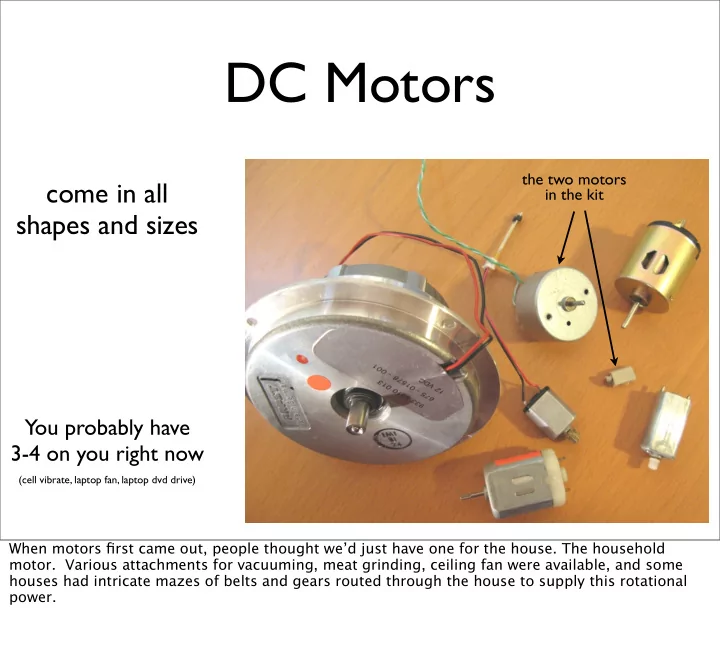
come in all shapes and sizes

You probably have 3-4 on you right now

(cell vibrate, laptop fan, laptop dvd drive)

the two motors in the kit

When motors first came out, people thought we’d just have one for the house. The household

  • motor. Various attachments for vacuuming, meat grinding, ceiling fan were available, and some

houses had intricate mazes of belts and gears routed through the house to supply this rotational power.

slide-2
SLIDE 2

DC Motors

  • direct-drive vs. gearhead – built-in gears or not
  • voltage – what voltage it best operates at
  • current (efficiency) – how much current it needs to spin
  • speed – how fast it spins
  • torque – how strong it spins
  • oh, and also: size, shaft diameter, shaft length,etc.

A dizzying array of parameters specify a motor

The two motors you have are small direct-drive, high-efficiency motors that work at 5 volts

Gearhead motors are the best.

slide-3
SLIDE 3

DC Motors Characteristics

  • When the first start up, they draw a lot more

current, up to 10x more.

  • If you “stall” them (make it so they can’t

turn), they also draw a lot of current

  • They can operate in either direction, by

switching voltage polarity

  • Usually spin very fast: >1000 RPM
  • To get slower spinning, need gearing
slide-4
SLIDE 4

DC Motors

M

DC motor battery

polarity determines which way it rotates To drive them, apply a voltage The higher the voltage, the faster the spinning Try this out real quick. Then swap polarity

Don’t let it go to long. These motors will work at 9V for awhile, but aren’t made to continuously run at that voltage.

slide-5
SLIDE 5

DC Motors as Generators

M

DC motor LED

Just as voltage causes rotation... ...rotation causes voltage

Try it out, but you have to spin really fast to get it to light (if LED doesn’t light, try spinning the other direction)

This is used for “regenerative braking” in electric & hybrid cars

These high-effjciency motors I gave you don’t generate much current (because they don’t use much current). I have a cheapy motor that lights LEDs better that I can show you.

slide-6
SLIDE 6

Transistors

TIP120

TIP120

base collector emitter base collector emitter

Act like switches

Turning on the “base” connects the “collector” & “emitter” together schematic symbol

electricity flicks the switch instead of your finger

collector emitter base

how it kind of works

The difgerences between the pins are very important. The names aren’t that important, but their functions are. The “base” is the input that you use to open and close the “switch” across the “collector” and “emitter”. On this type of transistor (called an NPN), you need to make sure the collector is always more positive than the emitter. Generally you do this by connecting the emitter to ground.

slide-7
SLIDE 7

Switching Motors with Transistors

M

DC motor transistor resistor battery + switch

M

DC motor transistor resistor + switch + + + big power source

transistors switch big signals with little signals

little motor big motor

switching a different power source

slide-8
SLIDE 8

Need a “Kickback” Diode

M

DC motor transistor resistor battery + switch diode

schematic symbol line

since motors can act like generators, need to prevent them from generating “kickback” into the circuit

diode

Once a motor starts spinning, its inertia keeps it spinning, this turns it into a generator and thus can generate a “kickback” voltage. The kickback diode routes that voltage harmlessly back into the motor so it can’t damage the rest of the circuit. Kickback is also called “back EMF” (EMF == electromotive force == voltage)

slide-9
SLIDE 9

Controlling a Motor

Arduino board gnd pin 9 +5V +5V

M

DC motor TIP120 500 1N4001

(green-brown-brown)

Can control speed of motor with analogWrite() just like controlling brightness of LED

start with the tiny motor

b c e b c e

motor

Why 500 ohms? Because I have a lot of 500 ohm resistors. Typically you see 1k ohms. Anything 1k

  • r below will work. The lower the value, the more current you’re “wasting” to turn on the transistor.
slide-10
SLIDE 10

Wiring up Motor Circuit

transistor turned around to make wiring easier

white diode line into +5V motor across diode

Arduino board gnd pin 9 +5V +5V

M

DC motor TIP120 500 1N4001

(green-brown-brown)

e b c b c e

slide-11
SLIDE 11

Sketch

“SerialMotorSpeed”

Type a number 0-9 in Serial Monitor to control the speed of the motor

How would you change this to control the motor speed with the potentiometer?

slide-12
SLIDE 12

Controlling a Bigger Motor

Arduino board gnd pin 9 +5V +5V

M

DC motor TIP120 500 1N4001

(green-brown-brown)

+9V battery

Same circuit as before, different voltage source

Motor will spin faster for a given analogWrite() value

9V battery motor w/ tape propellor

desk ding from motor getting loose

Actually with both of the motors you have, you can run ofg the Arduino power supply. But many motors cannot because they either draw too much current or they need a voltage higher than 5 volts.

slide-13
SLIDE 13

Fun Motor Attachments

tape propeller pipe cleaner squiggler popsicle stick beater

I’m terrible at mechanical engineering. If anyone has good ways of mounting things to motors, let me know. :-)

slide-14
SLIDE 14

Wiring Up Bigger Motor

Don’t just add 9V to +5v bus! Move the diode from +5 to another row Add red 9V wire to that row, Add black 9V wire to Gnd

You might find it easier to push the red 9V wire in with the motor wire.

slide-15
SLIDE 15

Can Switch Anything*

Arduino board pin 7 gnd 1k TIP120 1N4004 +5V to load 5V relay

Just on/off, and a relay needs a diode too

to load: light bulb, car ignition, washing machine, etc.

Super bright LED light

Arduino board gnd pin 9 +12V +5V TIP120 1k red LEDs 120

Relay switcher

*Anything up to about 1 amp. Need a bigger transistor or a relay after that

Full brightness control with PWM