Solar+Storage in in Low-Income Communities March 29, 2018 - - PowerPoint PPT Presentation

solar storage in in low income communities
SMART_READER_LITE
LIVE PREVIEW

Solar+Storage in in Low-Income Communities March 29, 2018 - - PowerPoint PPT Presentation

Financing Solar for Public and Affordable Housing New Fin inancing & Ownership Strategies for Solar+Storage in in Low-Income Communities March 29, 2018 Housekeeping Use the red arrow to open and close your control panel Join audio:


slide-1
SLIDE 1

Financing Solar for Public and Affordable Housing

March 29, 2018
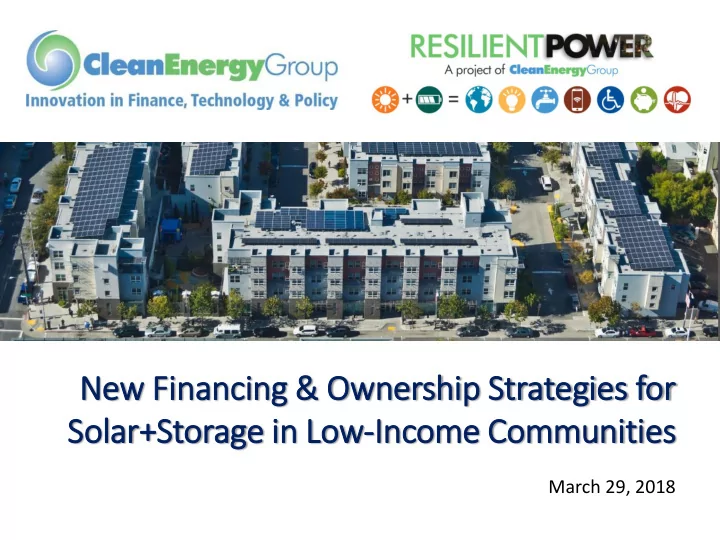
New Fin inancing & Ownership Strategies for Solar+Storage in in Low-Income Communities

slide-2
SLIDE 2

Housekeeping

Use the red arrow to open and close your control panel Join audio:

  • Choose Mic & Speakers to use VoIP
  • Choose Telephone and dial using the

information provided Submit questions and comments via the Questions panel This webinar is being recorded. We will email you a webinar recording within 48

  • hours. Resilient Power Project webinars are

archived online at: www.resilient-power.org

slide-3
SLIDE 3

New Financing & Ownership Strategies for Solar+Storage in Low-Income Communities

  • Lew Milford, President, Clean

Energy Group

  • Rob Sanders, Senior Finance

Director, Clean Energy Group

  • Bracken Hendricks, CEO, Urban

Ingenuity

  • Jared Lang, AVP, Sustainability,

National Housing Trust

slide-4
SLIDE 4

Who We Are

4

www.cleanegroup.org www.resilient-power.org

slide-5
SLIDE 5

5

  • Increase public/private investment in clean, resilient power systems
  • Engage city officials to develop resilient power policies/programs
  • Protect low-income and vulnerable communities
  • Focus on affordable housing and critical public facilities
  • Advocate for state and federal supportive policies and programs
  • Technical assistance for pre-development costs to help agencies/project

developers get deals done

  • See www.resilient-power.org for reports, newsletters, webinar recordings

Resilient Power Project

slide-6
SLIDE 6

Leadership and Technical Assistance Grant Awardees

Resilient Power Project:

Supporting More than 50 Projects Across the Country

6

slide-7
SLIDE 7

www.resilient-power.org

7

  • Hundreds of solar and storage

projects

  • Mainly to reduce electric bills
  • Tesla/SolarCity and others target

this sector

  • Will grow exponentially like solar

High End Markets LMI Markets

  • Too few projects in

housing/communities

  • Need greater than in high end
  • Unequal distribution of incentives
  • Need targeted LMI strategies

The Clean Energy Divide

slide-8
SLIDE 8

Marcus Garvey Apartments (East Brooklyn)

  • Year Commissioned: 2017
  • Services Provided: Demand

management, Demand response, Backup power

  • Solar: 400kW
  • Storage: 300kW/1200kWh
  • Project Partners: L+M

Development Partners, NYCEEC, Demand Energy, Con Edison

  • Revenue from Con Edison:
  • Capacity payments
  • Performance payments (demand

response events)

Marcus Garvey Apartments (East Brooklyn)

slide-9
SLIDE 9

NYCEEC Financing (Marcus Garvey)

  • Borrower: Demand Energy SPE
  • Loan Amount: $1.25 million (total battery project:

$1.32 million)

  • Loan type: Construction/term loan
  • Loan Term: 10.5 years
  • Use of proceeds: Battery storage equipment purchase

& installation

  • Collateral: Battery storage equipment, storage-related

incentives

  • Primary sources of repayment: BQDM incentives

(ConEd), demand response payments, peak shaving utility savings

slide-10
SLIDE 10

Marcus Garvey Apartments (East Brooklyn)

  • Largest solar+storage project in multifamily affordable housing in U.S.
  • Services provided: Frequency regulation, back-up power
  • Public-private financing closed in February 2018
  • $82MM redevelopment, 220 units in 8 buildings, plus community center
  • LIHTCs, solar+storage ITCs, tax-exempt bond, solar RECs, Housing Production

Trust Fund loan, DC solar+storage grant

Parkway Overlook (DC Housing Authority)

  • 717 kW solar PV, 600 kW of

battery storage

  • Produces a third of electricity

to be used by the housing complex

  • Energy resilience: Back-up

power for on-site community center and leasing office (2 buildings)

slide-11
SLIDE 11

A Resilient Power Capital Scan

  • Commissioned by The Kresge

Foundation, Surdna Foundation and The JPB Foundation

  • Identified 5 key barriers and

more than 50 recommended grant, PRI, and MRI investment

  • pportunities in the resilient

power solar and storage space.

14

slide-12
SLIDE 12

Owning the Benefits of Solar+Storage

  • “Owning the Benefits of

Solar+Storage: New Ownership and Investment Models for Affordable Housing”

  • Immediate direct ownership
  • Third-party ownership flips
  • CivicPACE with third-party
  • wnership
  • Third-party ownership

under a utility-contracted payment for services agreement

www.cleanegroup.org/ceg-resources/resource/owning-the-benefits-of-solar-storage

slide-13
SLIDE 13

SOLAR + STORAGE FOR LOW- INCOME COMMUNITIES

March 29, 2018

slide-14
SLIDE 14

Urban Ingenuity: Project oversight, Legal, Energy & Financial Underwriting National Housing Trust: Lead developer, Debt origination, Strong balance sheet

✓ Co-development with housers ✓ Treats solar as a development project ✓ Benefit streams allocated based on risks / reward ✓ Building a scalable platform in DC, CA, CO, NY, NJ, and more

NHT-Ingenuity Power Solar Partnership

slide-15
SLIDE 15

Project Scope Enterprise Role NHT Role

NHT Renewable DC 5 (2014)

  • 500 kW
  • $1.5 M investment

Debt and grant funding Sponsor equity, ownership, guarantees, installation, and ongoing operation Channel Square Renewable (2016)

  • 500 kW
  • $1.5 M investment

Tax equity and debt Sponsor equity, ownership, guarantees, installation, and ongoing operation Nixon Community Solar (2016)

  • 800 kW
  • $1 M investment

Tax equity Debt Denver Housing Authority Community Solar (2017)

  • 2 MW
  • $3 M investment

Debt Co-developer (with housing authority) LINC Housing Solar (2018)

  • 2 MW
  • $2 M investment

Debt Developer

Enterprise & NHT Renewables Track Record

slide-16
SLIDE 16

Urban Ingenuity Track Record

Project Scope UI Role

DC PACE Program (2013 – present)

  • Appx. $35 M in financing closed to date
  • 1 MW+ solar PV installed or in construction
  • First use of PACE for low-income housing and

first use of tax-exempt PACE nationwide Program administrator; UI helped design and now runs the program under contract to DOEE DOEE Microgrid Grant

  • 3-year grant to explore feasibility of district

energy across DC

  • Identified and screened 75 candidate sites
  • ‘Microgrid extension’ TA and predevelopment

services provided to owners / developers of promising sites Lead investigator on grant TA for Solar + Storage at a DC public housing redevelopment

  • Led analysis to design a 700 kW solar + 500

kW / kWh battery system

  • Supported project developer in

understanding economics and integrating the solar + battery into overall project financing Technical assistance, project management (with design and support from Optony and AF Mensah)

slide-17
SLIDE 17

Options for Deploying Solar + Storage

I. Property-level installation

  • 1. Direct purchase by property
  • 2. Lease or PPA at property-level
  • 3. Fold into a planned recapitalization
  • II. Portfolio-scale project development
  • 1. Houser ownership with tax equity investor
  • 2. Houser Development with NHT-IP ownership
slide-18
SLIDE 18

Purchase vs. Lease: Case Study

PROJECT: St. Denis Apartments DEVELOPER: NHT/Enterprise LOCATION: Mount Pleasant, Washington, DC CERTIFICATIONS: Enterprise Green Communities NUMBER OF APARTMENTS: 32 SYSTEM SIZE: 15 KW SYSTEM COST: $50,000

slide-19
SLIDE 19

Purchasing

System Size (kW) 15 Estimated Output (kwh) 20,000 Power Price / kwh 0.14 2014 2015 2016 2017 2018 2019 Financials Equity Investment (50,000) $ Federal Tax Credit (30%) 15,000 $ Income (Savings and Incentives) 9,000 $ 9,000 $ 9,000 $ 9,000 $ 9,000 $ Net Cash Flow (35,000) $ 9,000 $ 9,000 $ 9,000 $ 9,000 $ 9,000 $ 10-Year NPV $20,564 Payback 4 Years

Leasing

System Size (kW) 15 Estimated Output (kwh) 20,000 Power Price / kwh 0.14 2014 2015 2016 2017 2018 2019 Financials Equity Investment (5,000) $ Income (Savings and Incentives) 1,000 $ 1,000 $ 1,000 $ 1,000 $ 1,000 $ Net Cash Flow (5,000) $ 1,000 $ 1,000 $ 1,000 $ 1,000 $ 1,000 $ 10-Year NPV $2,226 Payback 5 Years

Purchase vs. Lease: Financials

slide-20
SLIDE 20

Portfolio-Scale Project Development

1. Owning and operating solar across multiple properties 2. Setting up standardized leases with the property partnerships 3. Opening projects up to new income streams 4. Aggregating multiple projects in one financing to access economies of scale 5. Potential for development fees makes the benefit worth the brain damage

slide-21
SLIDE 21

Portfolio Solar Project Ownership

Solar Manager LLC Tax Equity Investor

Solar Project SPE

Managing Partner Limited Partner

1% ownership (95% after flip) 99% ownership (5% after flip)

Property #1 Property #2 Property # …

Power agreements / leases

  • Housing owner gets devt fee
  • New income + option for

tenant benefits

  • Housing developer can be in
  • wnership of SPE

➢ Makes guarantees ➢ Takes on performance risk ➢ Puts in equity and gets returns

slide-22
SLIDE 22

Illustrative Project: Portfolio Solar + Battery

  • Bldg. Type:

Affordable Multifamily Housing (8 sites) Solar PV: 1 MW Battery Size: 350 kW / kWh Location: Washington D.C.

Sources Tax Equity $ 1,200,000.00 Debt $ 2,200,000.00 Sponsor Equity $ 600,000.00 Total Sources $ 4,000,000.00 Uses Solar PV $ 3,200,000.00 Battery $800,000 Total Uses $ 4,000,000.00

Sources and Uses

Developer Fees (Y1) $400,000 Initial Investment ($600,000) Returns on Equity $900,000 Savings $625,000

10-Year Project Benefits*

*Fees and returns allocated between houser and co-developer

slide-23
SLIDE 23

Illustrative Project: Portfolio Solar + Battery

Solar PV + Battery Example

2019 2020 2021 2022 2023 2024

Income (Energy Payments) 100,000 $ 100,000 $ 100,000 $ 100,000 $ 100,000 $ 100,000 $ Income (Solar Credits) 270,000 $ 270,000 $ 270,000 $ 270,000 $ 270,000 $ 270,000 $ Income (Ancillary Services) 130,000 $ 130,000 $ 130,000 $ 130,000 $ 130,000 $ 130,000 $ Operating Expenses (100,000) $ (100,000) $ (100,000) $ (100,000) $ (100,000) $ (100,000) $ NOI 400,000 $ 400,000 $ 400,000 $ 400,000 $ 400,000 $ 400,000 $ Debt Service (300,000) $ (300,000) $ (300,000) $ (300,000) $ (300,000) $ (300,000) $ DSCR 1.33 1.33 1.33 1.33 1.33 1.33 Available for Returns $ (600,000) $ 100,000 $ 100,000 $ 100,000 $ 100,000 $ 100,000 $ 100,000 Sponsor Equity IRR 12%

2024 2025 2026 2027 2028 2029

Income (Energy Payments) 100,000 $ 100,000 $ 100,000 $ 100,000 $ 100,000 $ 100,000 $ Income (Solar Credits) 270,000 $ 270,000 $ 270,000 $ 270,000 $ 270,000 $ 270,000 $ Income (Ancillary Services) 130,000 $ 130,000 $ 130,000 $ 130,000 $ 130,000 $ 130,000 $ Operating Expenses (110,000) $ (110,000) $ (110,000) $ (110,000) $ (110,000) $ (110,000) $ NOI 390,000 $ 390,000 $ 390,000 $ 390,000 $ 390,000 $ 390,000 $ Debt Service (300,000) $ (300,000) $ (300,000) $ (300,000) $ (300,000) $ (300,000) $ DSCR 1.30 1.30 1.30 1.30 1.30 1.30 Available for Returns $ 90,000 $ 90,000 $ 90,000 $ 90,000 $ 90,000 $ 90,000

slide-24
SLIDE 24

Resilience through Solar + Storage

Challenge:

Battery storage can eliminate disruption to entire communities during electricity grid outages, but is too expensive, complex, and physically large for housing owners to routinely use for entire buildings.

Solution: Community Resilience Hubs / powering select critical loads

  • Practical interim step toward powering every unit in a building
  • Smaller battery size and lower cost
  • Support common area loads (emergency lighting, elevators, etc.)
  • Create cooling / heating shelters in community centers
  • Maintain power for site management offices to allow operations to

continue

slide-25
SLIDE 25

Solar and Resilience: Case Study

Opportunity for Innovation:

  • Large solar PV (multiple

rooftops and ground-mount)

  • Battery storage
  • Larger rehab including many

EE measures Solving to the Challenge:

  • Finance solar + battery as part
  • f 4% LIHTC deal
  • How to capture benefits with

tenant metering

  • Underwriting storage
slide-26
SLIDE 26

Designing a Resilience Hub

Project Design:

  • Feasibility analysis and initial design

by Optony (solar) and AF Mensah (battery)

  • Appx. 700 kW of solar PV
  • 500 kW / kWh of battery storage
  • Powers community center and

site office during outages

  • Potential for several hours of

resilience each day during sustained blackouts. Status: System designs and economics incorporated into project plans prior to closing, construction now underway.

slide-27
SLIDE 27

How can we help?

✓ Provide technical assistance ✓ Co-develop solar projects ✓ Key role

  • Bring financing and legal structure to deal
  • Library of document templates
  • Tasks lists and deliverables
  • Securing property investors & lender approvals

Jared Lang National Housing Trust-Enterprise jlang@nhtinc.org (202) 333-8931 x115 Bracken Hendricks Urban Ingenuity bhendricks@urbaningenuity.com (202) 796-8925

slide-28
SLIDE 28

Find us online: www.resilient-power.org www.cleanegroup.org www.facebook.com/clean.energy.group @cleanenergygrp on Twitter @Resilient_Power on Twitter

Rob Sanders Senior Finance Director Clean Energy Group rsanders@cleanegroup.org

Thank you for attending our webinar

slide-29
SLIDE 29

Upcoming Webinars

FERC Order 841: Leveling the Playing Field for Energy Storage Resource Market Participation Wednesday, April 4, 1-2pm ET FERC and Clean Energy Thursday, April 26, 1-2pm ET Read more and register at www.cesa.org/webinars