Date: 10 th April 2017. Mr. J.M. Kennedy, ADG DGRI Working Group - - PDF document

date 10 th april 2017
SMART_READER_LITE
LIVE PREVIEW

Date: 10 th April 2017. Mr. J.M. Kennedy, ADG DGRI Working Group - - PDF document

Date: 10 th April 2017. Mr. J.M. Kennedy, ADG DGRI Working Group Transport and Logistics GST. Sir, Sub .: GST Air / Sea Cargo Freight Forwarding Customs Broking Multimodal Transportation 1. Background 1.1 Federation


slide-1
SLIDE 1

Page 1 of 14

Date: 10th April 2017.

  • Mr. J.M. Kennedy,

ADG DGRI Working Group – Transport and Logistics – GST.

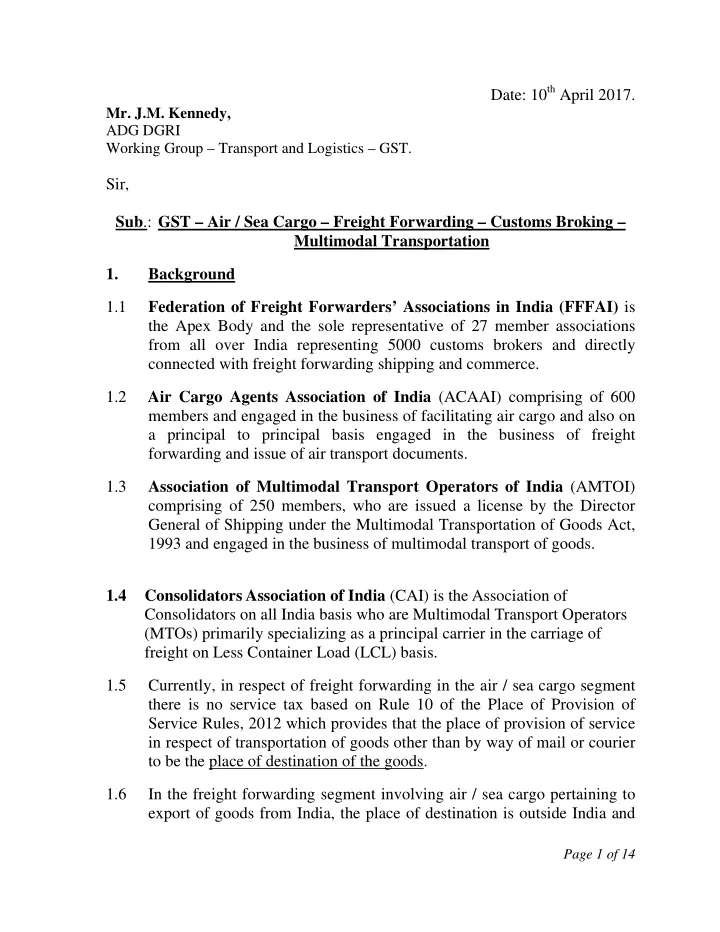
Sir, Sub.: GST – Air / Sea Cargo – Freight Forwarding – Customs Broking – Multimodal Transportation 1. Background 1.1 Federation of Freight Forwarders’ Associations in India (FFFAI) is the Apex Body and the sole representative of 27 member associations from all over India representing 5000 customs brokers and directly connected with freight forwarding shipping and commerce. 1.2 Air Cargo Agents Association of India (ACAAI) comprising of 600 members and engaged in the business of facilitating air cargo and also on a principal to principal basis engaged in the business of freight forwarding and issue of air transport documents. 1.3 Association of Multimodal Transport Operators of India (AMTOI) comprising of 250 members, who are issued a license by the Director General of Shipping under the Multimodal Transportation of Goods Act, 1993 and engaged in the business of multimodal transport of goods. 1.4 Consolidators Association of India (CAI) is the Association of Consolidators on all India basis who are Multimodal Transport Operators (MTOs) primarily specializing as a principal carrier in the carriage of freight on Less Container Load (LCL) basis. 1.5 Currently, in respect of freight forwarding in the air / sea cargo segment there is no service tax based on Rule 10 of the Place of Provision of Service Rules, 2012 which provides that the place of provision of service in respect of transportation of goods other than by way of mail or courier to be the place of destination of the goods. 1.6 In the freight forwarding segment involving air / sea cargo pertaining to export of goods from India, the place of destination is outside India and

slide-2
SLIDE 2

Page 2 of 14

consequently service tax is not payable. This view is also confirmed by Para No.5.9.6 of the CBEC, Education Guide; vide Circular No.197/7/2016 dated 12.08.2016 and by a number of decisions. 2. GST 2.1 ACAAI, FFFAI and AMTOI would like to first congratulate the Government of India for implementing the historic tax reform of GST and all our association fully support the Government in its endeavour to rationalize and harmonize the indirect tax landscape in the country. We are also very glad that the Government has constituted working groups to address issues for specific sectors. 2.2 We in the logistic sector have some serious issues identified based on the CGST / IGST law passed by the Lok Sabha which can affect our

  • perations, business, exporters, export and the country in general.

2.3 In freight forwarding and international transportation of exim cargo and related services, we are worried to note that the GST Law contemplate levy of GST on international transportation as well as freight forwarding which is at variance with the GST provisions in other countries. 3. IGST – Place of Supply 3.1 Section 12 of the IGST Act is applicable for place of supply of services when the location of supplier and location of recipient of services is in India. 3.2 Section 12(8) of the IGST Act reads as under:- “The place of supply of service by way of transportation of goods, including by mail or courier to, (a) a registered person, shall be the location of such person; (b) a person other than a registered person, shall be the location at which such goods are handed over for their transportation. 3.3 These provisions are at variance to the provisions in the Place of Provision of Service Rules, 2012 and in effect would completely paralyze

slide-3
SLIDE 3

Page 3 of 14

exports and would result in export of tax along with the goods which goes completely against the concept of not taxing exports. Currently there is no service tax on air freight or sea freight in the export segment and imposition of GST would completely cripple the entire logistic sector. 3.4 In the air segment, all airlines have registration in India and when a freight forwarder purchases an air freight slot from the airline, the tax would move from zero to the GST rate on services. 3.5 The GST provisions have the following limitations and can completely defeat and negate international transportation of cargo as evident:-

S. NO. TRANSACTION EXISTING GST LAW COMMENTS 1. Air / Sea / Land transport – Freight forwarding – Export Cargo Rule 10 of the Place of Provision of Service Rules provides that the place of provision of service of transportation

  • f goods other than by

way of mail or courier shall be the destination

  • f the goods.

Section 12(8) of the IGST Law in the context of place of supply of services by way of transportation of goods including by mail

  • r courier shall be the

location of the registered person when provided to a registered person and location where the goods are handed over for their transportation, when provided to a person

  • ther than a registered

person. (i) GST becomes applicable on freight forwarding even though currently there is no service tax. (ii) GST may become applicable on airlines / liners even though currently there is no service tax. (iii) The GST will only be passed on to the exporter and would make the exporter even more uncompetitive thereby defeating the

  • bjective of GST

itself. 2. Air / Sea / Land Transport – Freight Originally Section 66D(p) specified service by way of transportation Section 12(8) of the IGST Law in the context of place of (i) GST becomes applicable on freight forwarding

slide-4
SLIDE 4

Page 4 of 14

Forwarding – Import Cargo

  • f goods by an air craft

from a place outside India upto the customs station of clearance in India in the Negative

  • List. Subsequently from

01.06.2016, the provision was deleted but exemption was granted through Entry 53, Notification No.25/2012 which exempts services provided by way of transportation of goods by an aircraft from a place outside India upto the customs station of clearance in India. supply of services by way of transportation of goods including by mail

  • r courier shall be the

location of the registered person when provided to a registered person and location where the goods are handed over for their transportation, when provided to a person

  • ther than a registered

person. even though currently there is no service tax on this segment except in respect of import by sea. (ii) GST becomes applicable on the importer when payment is made directly to the airline / liner as the transaction would be an import of service (iii) GST would result in additional burden and increase in cost for the importer since the freight already forms part

  • f value and

attracts customs duty.

3.6 International Freight whether ocean or air or land is considered as part and parcel of the value of goods and attracts custom duties. The Customs Valuation Rules, 2007 are based on WTO Valuation Rules and in terms

  • f Rule 10(2), value shall include cost of transport of the imported

goods to the place of importation. Further, the cost of transport of imported goods also includes ship demurrage charges on chartered vessels, lighterage or barge charges. Therefore, levy of GST on the import cargo segment would also result in double taxation since on the entire freight; customs duties are being levied under Section 14 of the Customs Act read with the Customs Valuation Rules. 3.7 There is another issue that affects the Indian freight forwarding

  • community. When a foreign buyer engages an airline / liner registered in

India, for export of goods from India directly, by virtue of Section 13, GST is not applicable. Where a foreign freight forwarder engages an airline / liner, registered in India for export of goods, by virtue of Section

slide-5
SLIDE 5

Page 5 of 14

13, GST is not applicable. This would mean loss of business to Indian freight forwarders and to the Country. 4. International practice 4.1 India is implementing GST on the ground that nearly 200 countries of the world have GST in one form of other. It has been reiterated by the Government from time to time that GST would only bring down the cost; benefit logistics; make the supply chain efficient and create a huge market and over all contribute to the GDP growth in the country. However, the Model Law indicates a levy of GST on international transportation that does not exist in other countries which have implemented GST. 4.2 In India logistics cost is much higher than developed countries as a ratio

  • f GDP and GST will only further blunt our competitive edge globally.

(In developed countries logistics cost is around 5% – 8% while in India it is about 13%). 4.3 Internationally there is no levy of VAT or GST on international transportation of goods by air or sea or land or on freight forwarding or on related services. 4.4 Singapore GST provides for the following:- Services provided for transporting or arranging transport of goods are international services and are zero rated where the transport by air/land/sea. From outside Singapore to another place outside Singapore. From a place in Singapore to a place outside Singapore. From a place outside Singapore to a place in Singapore. 4.5 A freight forwarder who ships goods for a customer from Singapore to overseas and also transport the goods from the customer warehouse to Singapore port for export can zero rate the entire transportation services.

slide-6
SLIDE 6

Page 6 of 14

4.6 In Singapore, air freight / ocean freight and freight related charges are zero rated. Freight related charges include fuel surcharge, terminal handling charges, agency fees, documentation fees.

Copy of the GST Guide for Logistics Service Industry issued by the Inland Revenue Authority of Singapore form part of Annexure-A.

4.7 Australia GST provides for the following:- International transport of goods are free from GST if the supplies are From place of export in Australia to a destination outside Australia; From a place outside Australia to their place of consignment in Australia; From a place outside Australia to the same or another place outside Australia. Arranging international transport of goods is also free from GST.

Copy of the relevant statutory provisions in Australia in the context of GST and International Transport form part of Annexure-B.

4.8 Malaysia implemented GST from 01.04.2015 and Article 4, Second Schedule of the Goods and Services Tax (Zero-Rated Supply) Order 2014, zero rates the following transaction. Transport services in relation to passengers or goods- (a) from a place outside Malaysia to another place outside Malaysia; (b) from the last exit point in Malaysia to any place in other country; or (c) from a place outside Malaysia to the first entry point in Malaysia. 4.9 Transport, loading, unloading and handling services as referred to in sub- item 3(2) in relation to the transport of goods from a place in Malaysia to another place in Malaysia to the extent that those services are supplied by the same supplier as part of the supply of services to which sub-item 4(b)

  • r (c) applies is also zero-rated.
slide-7
SLIDE 7

Page 7 of 14 Copy of the relevant statutory provisions in Malaysia in the context of GST and International Transport form part of Annexure-C.

4.10 In New Zealand for the transport of goods, zero-rated services include the international journey, and any transport within New Zealand (including loading and unloading costs), as long as it is part of the international transport and is supplied by the same person or agent. The following services in relation to international transportation are also zero-rated:

  • insuring or arranging insurance
  • arranging the transport.

Copy of the relevant statutory provisions in New Zealand in the context of GST and International Transport form part of Annexure-D.

Recommendation (i) International transportation of goods by road, rail, inland waterways, sea, air or any other mode including freight forwarding should be zero rated. Alternatively, both international transportation and freight forwarding pertaining to international transportation should be exempted. (ii) Ancillary services in relation to international transportation of goods like Customs clearances, warehousing, storage, cargo handling, packing, unitization, port, airport, terminal, etc. should be zero rated or exempted. 4.11 Our recommendations and suggestions specified above may be accepted considering the global thrust that India is making and has to make and have a competitive positioning globally and to ensure that the Exim trade is not adversely affected. 5. GST – Registration 5.1 Currently, as service providers, the law provides for a centralized registration and compliance. In our business, generation of work does not

  • perate in a pre-determined pattern. To illustrate, a freight forwarder who
slide-8
SLIDE 8

Page 8 of 14

is based out of Mumbai and catering to Mumbai customer may get some work to be carried out in Chennai. As a service provider, it is the skill of the individual and expertise and experience that are called into play. It is not feasible or practical to setup an infrastructure or office in Chennai since there would not be regular work and assignments could be sporadic in nature. 5.2 The GST Law indicates that SGST registration could be required in every State where there is a supply of goods or services or both. 5.3 Logistic and transport related services particularly in the Exim trade are different from the traditional manufacturing sector. It is not feasible or practical from a pure operation and cost perspective to have a massive support infrastructure including offices, accounting support, employees in finance and accounts and compliance in order to implement GST in every State. Unlike a manufacturer, a service provider is not required to invest in huge office and accounting administration. Even in cases where there is a small office in a city where the Customs Station, there would be

  • ne or two employees who will have experience and knowledge only

with reference to cargo related procedure and would not have accounting and IT background. The industry cannot afford to increase cost which appears to be a natural corollary if multiple registration regimes are

  • implemented. Any increase in costs would only adversely affect the Exim

rate. 5.4 International transportation of goods and related services operates throughout India as well as across the world and movement of goods and delivery of goods through the shortest route and in time is the sole

  • bjective without compromising the goods in custody. In such

circumstances, it is impossible to confirm with the typical branch vertical in 29 States and 7 Union Territories. The movement must be seamless and State level registration would only hinder the movement and increase cost of compliance and affect pricing. 5.5 International transportation operates on a razor thin margin and in some cases the rates are even negative. In these circumstances, any increase in costs of providing such services which is a natural corollary of separate State-wise registration would only increase the charges on the exporters in the export segment and on the importer in the import segment affecting the entire trade.

slide-9
SLIDE 9

Page 9 of 14

5.6 We also understand that a supplier will have to file data online on the 10th; on the 15th; and a monthly return on the 20th and an annual return. This would mean 37 filings per State if statewise registration is

  • contemplated. It is also understood that if TDS is applicable and ISD is

applicable it would mean 61 filings in a year per State. Our industry does not have the capacity or the capital or the infrastructure to comply with such a complex filing requirements when currently only 2 service tax returns are being filed for the entire country. Recommendation (i) Concept of centralized PAN based registration must be retained whereby any service provider in the international transportation segment can have a centralized registration and discharge applicable taxes through the GST portal. The European Union Model of single registration can be adopted. (ii) Specific provisions to be made in the registration and record related provisions to the effect that the tax payer would be centrally registered at the principal place of business or registered office and undertake compliances from such location for all activities throughout the country. (iii) The location of the service provider should be the centralized registration address in the context of place of supply provisions. (iv) The place of supply for international transportation of goods, freight forwarding and related services should be the location

  • f the billing address of the recipient of the services as specified

in the invoice issued by the service provider. (v) A single registration and pooling of credit will not result in loss

  • f state revenues.

(vi) In terms of procedure, details of primary bank account would adequately serve the purpose and there need not be requirements for details of all bank accounts since basically a number of bank accounts are required for making payment on behalf of clients to various third party service providers.

slide-10
SLIDE 10

Page 10 of 14

(vii) A single periodic return for the entire country should be implemented. 6. Valuation 6.1 Section 15 of the CGST Act refers to value of supply of services to be the transaction value which is considered as the price paid or payable. International freight works on different models and currently, sea freight rates are actually negative. In other words, it is the exporter who receives money to book freight through a vessel and not the other way round. 6.2 The draft Valuation Rules indicate that reimbursements would not form part of value based on pure agency concept. However, it is not clear as to how information has to be uploaded in the GST regime. As per the Input Tax Credit Draft Rules, a registered person can avail credit only if all information prescribed in the Invoice Rules are contained in the document and the information is furnished in Form GSTR – 2. In terms

  • f the draft Invoice Rules, the invoice has to contain the name, address

and GSTN of the recipient. To illustrate, if item A is a reimbursement, the service provider of item A would be required to specify the GSTN of the recipient. The item A is expenditure for and on behalf of the exporter

  • r the importer and is a reimbursement on actual basis. This aspect has

not been covered in the draft Invoice Rules. The draft Invoice Rules only covers ‘address of delivery’ where the same is different from the place of supply. 6.3 Rule 2 of the draft Valuation Rules provides for valuation of supply of goods or services between distinct persons as specified in Section 25(4) and 25(5) of the CGST Act. Unlike the manufacturing sector, which would physically stock transfer goods from one State to another, inter- unit service billing is impossible in the logistics segment. Recommendation (i) It is therefore suggested that the invoice can capture the GSTN of the actual beneficiary of the expenditure in scenarios involving pure agency reimbursement. (ii) It is requested that the inter-unit service billing as a concept is not mandated for this sector.

slide-11
SLIDE 11

Page 11 of 14

7. Composite Supplies and Mixed Supplies 7.1 The entire concept of composite supply and mixed supply are relevant

  • nly to goods and should not be made applicable to services.

7.2 In the logistics segment, a typical service offering would cover shipping, port, demurrage, ground handling, road transport, rail transport, survey, warehouse, transit warehouse, insurance, customs clearance, etc. 7.3 Each of these items fall under multiple place of supply conditions. Some

  • f these items such as transport, rail transport, import sea freight, etc.

qualify for an abatement. If in the GST regime, abatement continues or a lower GST rate is prescribed in lieu of abatement, the industry does not want any dispute with reference to interpretation of rate of tax with reference to composite supply and mixed supply. 7.4 Multimodal transportation is a distinct business involving multiple modes

  • f transport in the same transaction and the activities are governed by the

Multi Modal Transportation of Goods Act, 1993. 7.5 Section 2(k) of the said Act defines multimodal transportation to mean carriage of goods, by at least two different modes of transport under Multimodal transport contract from the place of acceptance of the goods in India to a place of delivery of goods outside India. 7.6 The transaction by itself is a single supply and cannot be considered as a mixed supply. Similarly, the activity of the logistics business which

  • ffers all services in a single rate cannot be considered as a mixed supply.

Recommendation If the primary representation of international transportation being zero rated is implemented, this would solve most of the issues. Further, all inland transportation and related services leading upto international transportation including inbound transportation should also be zero rated. 7. GST Credit 7.1 The current system of cenvat credit is not the best system since there are artificial restrictions and credit is not available on services used for

slide-12
SLIDE 12

Page 12 of 14

construction of or offices or warehouses. It is unfortunate that the same artificial restrictions find place through Section 16(5) of the CGST Act. 7.2 Section 16(11) mandates that credit would not be available unless the tax charged has been actually paid to the credit of the appropriate

  • Government. This is an onerous task and the provisions with reference to

mismatch are likely to affect the entire GST credit management system. In the freight forwarding and logistic business, there are number of service providers and sub-contractors and sub-service providers who are critical for providing the services to the customers. Customs house agents, warehouses, container freight stations, port authorities, airport authorities, testing agencies, certification agencies, transporters, packers, terminal, freight operators and various agents have to be necessarily engaged by us to provide services. It is impossible to ensure that all these agencies and contractors upload the invoice data and the tax data correctly for us to avail the credit. The Central Government has successfully implemented MODVAT from 1986 without this requirement and even in the context of service tax credit, the only requirement is the payment of the value of services and the service tax to the service provider. 7.3 Where services are used and consumed in different States there is a possibility of accumulation of SGST credits in different States. The whole objective of GST would be lost if a service provider is not in a position to avail and utilize the credits. Credits should be capable of easy distribution and should be available for set-off or refund claim based on the single PAN based registration of one central location. Recommendation (i) It is our suggestion that the credit should be based on the invoice raised by the service provider without insisting on the matching of invoice data through the systems. Further, the central location which is allowed a single registration should be allowed to take all credits in that location. (ii) Wherever service providers provide services with reference to logistics such as transport, warehouse, transit warehouse, godown,

slide-13
SLIDE 13

Page 13 of 14

CFS, customs broking, etc. the billing address of the service receiver should be considered as the place of supply. 8. Tax on Advances 8.1 The GST law contemplates tax on advances for supply of goods or

  • services. In our business, in most cases, we will have to remit the service

charges or fees in advance. If advances are subject to GST, unless an appropriate invoice is issued for the advance and the necessary filing is done, the credit would not be available. There is an issue in Section 16 (2) which provides that the registered person must receive the goods or services or both. It is recommended that suitable changes are required to provide for credit in the hands of the buyer / recipient when GST has been paid on advances. 9. Payment by Clients 9.1 The biggest challenge in our industry is that even though services would have been provided by us, the bills are never settled in time and we suffer the consequences. Section 16 of the CGST Act provides that ITC availed by the recipient will have to be reversed if the value of supply along with tax is not paid by the recipient to the supplier within 180 days from the date of invoice. 9.2 In the existing system of service tax, the Cenvat Credit Rules, 2004 provide that credit has to be reversed if the value of the bill of the service provider and the tax thereon is not paid within 3 months from the date of invoice. Recommendation It is recommended that the period of 180 days should be reduced to 3 months in the context of the provision which mandates payment to the service provider as a condition of retention of input tax credit.

slide-14
SLIDE 14

Page 14 of 14

We would like to be provided with an opportunity to be heard in person to highlight our concerns. Thanking you, A joint submission by the International Transport / Logistics Industries in India represented by:

  • 1. Federation of Freight Forwarders’ Associations in India (FFFAI),
  • 2. Air Cargo Agents Association of India (ACAAI)
  • 3. Association of Multimodal Transport Operators of India (AMTOI)
  • 4. Consolidators Association of India (CAI)