SLIDE 1
4829-8563-4115 v.15
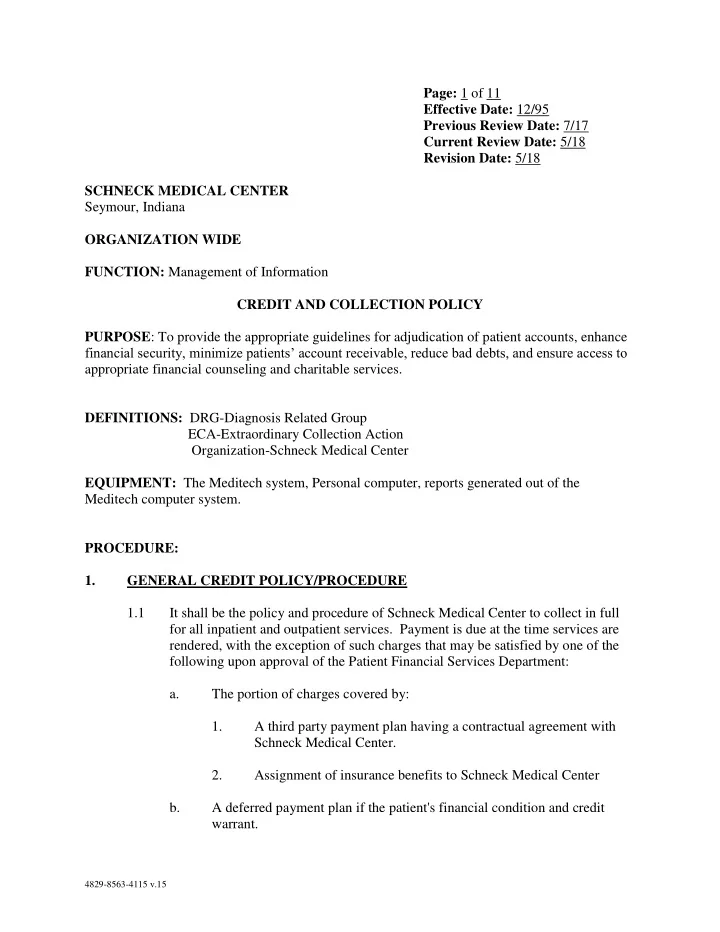
Page: 1 of 11 Effective Date: 12/95 Previous Review Date: 7/17 Current Review Date: 5/18 Revision Date: 5/18 SCHNECK MEDICAL CENTER Seymour, Indiana ORGANIZATION WIDE FUNCTION: Management of Information CREDIT AND COLLECTION POLICY PURPOSE: To provide the appropriate guidelines for adjudication of patient accounts, enhance financial security, minimize patients’ account receivable, reduce bad debts, and ensure access to appropriate financial counseling and charitable services. DEFINITIONS: DRG-Diagnosis Related Group ECA-Extraordinary Collection Action Organization-Schneck Medical Center EQUIPMENT: The Meditech system, Personal computer, reports generated out of the Meditech computer system. PROCEDURE: 1. GENERAL CREDIT POLICY/PROCEDURE 1.1 It shall be the policy and procedure of Schneck Medical Center to collect in full for all inpatient and outpatient services. Payment is due at the time services are rendered, with the exception of such charges that may be satisfied by one of the following upon approval of the Patient Financial Services Department: a. The portion of charges covered by: 1. A third party payment plan having a contractual agreement with Schneck Medical Center. 2. Assignment of insurance benefits to Schneck Medical Center b. A deferred payment plan if the patient's financial condition and credit warrant.
SLIDE 2 CREDIT AND COLLECTION POLICY Page 2 of 12 c. Determination that a patient is to some degree medically indigent as
- utlined in the Financial Assistance Policy.
2. RESPONSIBILITY FOR IMPLEMENTING POLICY 2.1 The responsibility for implementing this Credit and Collection Policy (this "Policy") on a day-to-day basis shall be vested in the Director of Patient Financial
- Services. The director shall be responsible for interpreting and applying written
policy, and properly training his/her employees procedural applications and
- methodology. The director will also be responsible for recommending policy
changes relating to present and anticipated needs, and for assessing this Policy in relation to organization objectives. 3. PRE-REGISTRATIONS, ADMISSIONS, AND IN-HOUSE 3.1 Schneck Medical Center will attempt to pre-register all scheduled out-patient
- procedures. Organization will investigate the data obtained at the earliest feasible
time. a. Based on a review of this data, Organization may contact the insurance company to verify coverage and benefits. b. If pre-certification is required, Organization will make reasonable efforts to pre-certify services, however Schneck Medical Center will not be responsible for any reduction of insurance benefits or financial penalty if the patient does not notify Schneck Medical Center prior to the provision
3.2 Admissions a. Schneck Medical Center may at the time of admission: 1. Request from the patient the payment of estimated charges not covered by an insurance plan, or 2. Offer financial counseling services. 3.3 In-house a. Insurance information obtained after the patient's admission, but prior to discharge will be reviewed by Schneck Medical Center. Based on this review, 1. The patient may be notified of any estimated charges not covered by insurance, and a request for payment will be made before the
SLIDE 3 CREDIT AND COLLECTION POLICY Page 3 of 12 patient's discharge, and/or 2. The patient may be offered financial counseling services. 4. OUTPATIENTS - INSURANCE ASSIGNMENTS 4.1 Insurance assignments will be accepted for the following: a. Insurance plans with current contractual agreements with Schneck Medical Center. b. Commercial Insurance acceptable to Schneck Medical Center. c. Medicare-Medicaid with current identification. d. Township and Welfare vouchers. 5. ACCOUNT FOLLOW-UP 5.1 Accounts which have not responded satisfactorily to follow-up efforts within a defined period of time in relation to the due date will be submitted to the Director
- f Patient Financial Services for special handling. The defined period of time
shall be a minimum of ten (10) days. Follow-up will be continued by the Director
- f Patient Financial Services until the account is written-off to an outside agency.
5.2 Follow-up procedures may consist of one or more of the following collection techniques: a. Automated dunning messages b. Form letters and personal letters c. Telephone calls d. Final notice statements e. Referral to a self-pay outsourcing service f. Subject to Section 5.3 of this Policy, referral to the applicable county court, provided it can be determined the individual(s) responsible for payment have the financial means to pay for the amounts outstanding and due Schneck Medical Center and are not otherwise eligible for charity care as described in the Financial Assistance Policy. g. Referral to Schneck Medical Center attorney
SLIDE 4 CREDIT AND COLLECTION POLICY Page 4 of 12 h. Referral to any organization-contracted collection services. i. Subject to Section 5.3 of this Policy, referral to the applicable county prosecutor in the case of non-sufficient funds checks. j. Subject to Section 5.3 of this Policy, utilizing lien guidelines as applicable according to Indiana law 5.3 Extraordinary Collection Actions (ECAs) - Include (but are not limited to) any actions that require a legal or judicial process. ECAs will be undertaken by Schneck Medical Center and Schneck Medical Center's collection agencies and their representatives only after reasonable efforts have been made to determine whether the individuals accounts are eligible for assistance under Schneck Medical Center's Financial Assistance Policy and upon 30 days prior notice to the
- patient. ECAs shall include, but are not limited to:
a. Placing a lien on an individual’s property; b. Attaching or seizing an individual’s bank account or any other personal property; c. Commencing a civil action on an individual’s bank account other personal property; d. Garnishing an individual’s wages; e. Reporting adverse information about the individual to consumer credit reporting agencies or credit bureaus; f. Selling an individual’s debt to a third party; and/or g. Deferring or denying, or requiring payment before providing, medically necessary care because of an individual's nonpayment of one or more bills for previously provided care covered under the Financial Assistance Policy.. 5.4 Follow-up procedures specifically precluded include: a. Foreclosure or sale of patients’ (or the responsible parties) assets. b. Use of body attachments c. Garnishment of wages unless determination is made on individual cases that patient (or the responsible party) has sufficient income to satisfy the
SLIDE 5 CREDIT AND COLLECTION POLICY Page 5 of 12 Other than procedures specifically precluded by this Policy, Schneck Medical Center may engage in any actions, including ECAs (subject to the restrictions above), to obtain payment of a bill for medical care. 5.5 Schneck Medical Center may take an ECA involving a patient who fails to apply for Financial Assistance within 120 days from the date the first statement was made available to the individual but shall suspend any such ECA, pending a determination of eligibility, if the individual submits a Financial Assistance application within 240 days of such first statement. 5.6 The Patient Financial Services Department shall have responsibility for determining that Schneck Medical Center has made reasonable efforts to determine whether an individual is eligible for financial assistance and may therefore engage in one or more ECAs against the individual. 6. WRITE-OFFS (INPATIENT & OUTPATIENT) 6.1 Criteria for determining write-offs of accounts shall be one of the following. a. A period of four months (120 days) without payment in full on the account unless approval for an extension is given by the Director of Patient Financial Services. b. Cases in which any further delay might seriously impair recovery, such as apparent skips, transient or nomadic patients. c. Repeated violations of contractual agreement with a pattern indicates a lack of proper intent on the part of the patient d. Two missed payment on a deferred payment plan, as outlined in Section 7
6.2 Accounts written-off will generally be given to an outside, independent collection
- firm. Outside collection firms will be required to follow the guidelines set forth
in section 5 of this Policy as well as applicable state and federal regulations pertaining to the collection of debts and are required to acknowledge in writing they understand and will abide by these guidelines and regulations. Patients requesting copies of their itemized bills after the account has been placed with a collection firm shall be charged a nominal service fee. This may be waived at the discretion of the Director of Patient Financial Services. 6.3 Certain accounts that are written-off, but are known to be, or are believed to be collectible may be retained by Schneck Medical Center for further follow-up. 6.4 The act of writing off an account will serve as permission to file suit for collection, provided all provisions of Section 5 have been followed.
SLIDE 6
CREDIT AND COLLECTION POLICY Page 6 of 12 6.5 The Director of Patient Financial Services, utilizing the above criteria, will select accounts to write-off as bad debts. Upon approval of the Board of Trustees, such accounts will be written off. 6.6 Patients who have accounts placed with an outside collection agency with cumulative balances of $1,500.00 and less and have had no activity or payments received for a period of one year or more, will be cancelled back as worthless and returned by the collection agency. All collection activity will cease. 7. CREDIT COUNSELING AND AGREEMENTS 7.1 Credit may be granted to a patient if the credit evaluation indicates the patient is financially unable to pay at the time services are rendered. In determining a deferred payment plan, it is essential that the plan is reasonable in terms of the patient's ability to meet the payments and that it be clearly understood and agreed to by the patient. 7.2 Although extended monthly payment amounts may vary, they generally will represent no less than a twelve (12) month repayment plan for account balances less than $1,000 and a twenty four (24) month repayment plan for account balances greater than $1,000. . The Director of Patient Financial Services must approve accounts that require a smaller payment. a. If the patient cannot pay within the payment agreement terms, it will be the responsibility of the patient to provide to the Director of Patient Financial Services income/expense information to research the patients’/responsible parties’ ability to pay. The Director of Patient Financial Services may require the patient to submit the last three paystubs, the three most recent bank statements, and the previous year's Federal tax form for consideration of an extended repayment period. 8. FINANCIAL COUNSELING 8.1 Any patient who expresses an inability to pay for services rendered due to lack of resources shall be referred to our Financial Counselors. Interviews with the patient/guarantor will normally take place in the Financial Counselor's office but may take place elsewhere. All data pertinent to an evaluation of the patient's financial condition should be obtained so that a determination of eligibility for assistance may be made. A clear explanation of Schneck Medical Center’s charity program and financial assistance program will be made to the patient during the interview. 8.2 Schneck Medical Center's practice of providing financial counseling is limited to those efforts intended to recognize the amount owed to Schneck Medical Center for patient services and to determine alternate sources of payment.
SLIDE 7 CREDIT AND COLLECTION POLICY Page 7 of 12 9. ESTATES 9.1 The applicable county court will be contacted to determine the existence of a deceased patient's estate. Should an estate be in probate, the Director of Patient Financial Services will have the option of filing a claim within sixty (60) days from publication of the estate notice. 10. LITIGATION 10.1 Schneck Medical Center will regard the patient as being responsible for payment
- f his/her account in a situation in which the main source of payment is a civil suit
11. BANKRUPTCIES 11.1 A creditor's claim will be filed immediately with the referee in bankruptcy unless there are no assets to be distributed. Accounts of patients which have been listed
- n a legally declared bankruptcy petition will be written off, but the account will
not be given to an outside collector or attorney. 11.2 Should an account have been written off to an outside collector or attorney, notification of bankruptcy with request to cease collection activity will be forwarded to the appropriate collector/agency. 12. COUNTERSUITS 12.1 The processing of statements to patients will not be altered under the threat or possibility of a countersuit by the patient; the two issues will be regarded as being
- separate. However, if the patient threatens or implies the possibility of a suit
against Schneck Medical Center, we shall seek legal advice as to the disposition
- f our claim against the patient. Administrative notification of disposition other
than normal collection procedure shall be communicated to the Director of Patient Financial Services. 13. DELAYED ADMISSIONS 13.1 If an individual has failed to pay one or more bills for previous episode(s) of emergency or medically necessary organization-based care covered under the Financial Assistance Policy, then Schneck Medical Center may defer, deny or require payment before providing medically necessary care for such individual. Because such action is an ECA with respect to the previously provided care, Schneck Medical Center, before deferring, denying or requiring payment prior to providing such care, shall – a. provide the individual with the plain language summary of the Financial
SLIDE 8 CREDIT AND COLLECTION POLICY Page 8 of 12 Assistance Policy, a Financial Assistance application and written notice stating that financial assistance is available for eligible individuals and identifying the deadline for applying; and b. make reasonable efforts to orally notify the individual about the Financial Assistance Policy and how he or she may obtain assistance with the Financial Assistance application process. The deadline under Section 13.1(a) shall not be earlier than the later of 30 days after the date that the written notice is provided or 240 days after the date that the first post-discharge billing statement for the previously provided care was provided. 13.2 With respect to care that is not medically necessary and therefore not subject to Section 13.1 above, the Patient Financial Services Department and Patient Registration Department may delay the admission of an elective patient until adequate arrangements have been made concerning compliance with governmental regulations and/or other requirements for the payment of accounts. Before considering such action, at least two (2) conditions must exist: a. Delaying the admission would not be injurious or dangerous to the health
- f the patient, nor violate any governmental regulation that requires
Schneck Medical Center to provide service. b. The requested delay can reasonably be expected to achieve compliance with governmental regulations or allow for adequate arrangements for the payment of accounts. 13.3 In all cases, except those relating to sterilization, the attending physician must approve the request before any action can be taken to delay an elective admission. 14. OVERPAYMENTS/CREDIT BALANCES 14.1 Overpayments on patients' accounts occur as a result of duplicate insurance payments, payments by both primary and secondary insurance carriers, or payments by patients and their insurance carriers. Schneck Medical Center's role does not include coordination of benefits between insurance carriers and patients. a. Checks resulting in overpayments on paid-in-full patient accounts received from insurance companies (other than Medicaid, Medicare) shall be returned to the payer, unless overpayment resulted from a prior patient payment, whereupon overpayment would be refunded to the patient. b. Checks resulting in overpayments received from patients on paid-in-full accounts shall be returned to the patient only if the patient does not have
SLIDE 9 CREDIT AND COLLECTION POLICY Page 9 of 12 any other outstanding balances with Schneck Medical Center. c. Payments received from insurance companies (other than Medicaid, Medicare) or patients on patients' accounts with a balance less than the payment amount will be accepted and posted to the appropriate account. A refund will be issued to the payer for the amount of the overpayment. d. Medicare, Medicaid or overpayments will be processed through adjustment billings. e. Refund attempts made to patients who cannot be located after diligent effort will result in those amounts being adjusted from Accounts Receivable in accordance with the State of Indiana Unclaimed Property Statutes. f. Overpayments will be returned to the patient or to the appropriate insurance carrier within 30 days of receipt on average 15. SELF PAY, PROMPT PAY, AND EXTENUATING CIRCUMSTANCE DISCOUNTS 15.1 In addition to offering need-based financial assistance pursuant to the Financial Assistance Policy, Schneck Medical Center provides other discounts for patients under specifically-defined circumstances. While certain of these discounts are listed in this policy for the convenience of the community served by Schneck Medical Center, these discounts are not need-based and are not intended to be subject to Code Section 501(r). 15.2 For all uninsured patients, regardless of financial need, Schneck Medical Center provides an initial automatic discount of 30%. An uninsured individual eligible for this automatic discount also may receive additional Financial Assistance if he
- r she qualifies under the terms of Schneck Medical Center's Financial Assistance
Policy. 15.3 Prompt pay discounts will be offered to Schneck Medical Center accounts with self-pay balances with the following conditions: a. The discount will be 7% of the self-pay balance. b. The discount will be granted if receipt of the entire self-pay balance is received on or before the first statement due date. c. Discounts will be granted to patients who qualify for financial assistance as outlined in the Financial Assistance Policy provided payment of the remaining self-pay balance is received on or before the first statement due date.
SLIDE 10 CREDIT AND COLLECTION POLICY Page 10 of 12 d. The prompt pay discount under this Section 15.2 applies only to Schneck Medical Center hospital facility services. Services provided by Schneck Medical Center physician practices are not eligible for the prompt pay
- discount. A list of such physician practices not covered by this policy is
available by contacting the Schneck Medical Center Patient Financial Services department. 15.4 If an individual who has received emergency or other medically necessary care from Schneck Medical Center has entered into an approved deferred payment plan with Schneck Medical Center, is current on that plan (i.e., has missed or failed to timely make no more than two payments), and has a material change of circumstances (e.g., a job loss or other significant financial event), then that individual may apply for an extenuating circumstance discount with respect to the balance still remaining to be paid according to the approved payment plan. An individual may apply for this discount at any time before the completion of payments under the payment plan, and the application process and determination
- f eligibility shall be as described in Schneck Medical Center's Financial
Assistance Policy. The discount awarded, if any, shall be calculated in reference to the unpaid balance, not for the original amount of the emergency or other medically necessary care, and any amounts previously paid by or for the individual under the payment plan or otherwise shall not be discounted or refunded if an individual is determined to be eligible for this assistance. 16. NO CHARGE FOR SERIOUS ADVERSE EVENTS 16.1 Schneck Medical Center is committed to delivering safe and effective patient
- care. In furtherance of the quality of patient care, Schneck Medical Center
continues to strive to put preventive systems in place and make the changes necessary to keep patients safe from harm. Unfortunately, in rare instances, human error can and does occur. In the event that Schneck Medical Center ever determines that a "serious adverse event" has occurred at Schneck Medical Center that Schneck Medical Center could have reasonably prevented, it is Schneck Medical Center's policy, based upon principles adopted by the American Hospital Association and the Indiana Hospital Association, to not charge patients or their insurers or employers for the care Schneck Medical Center provided that was related to the preventable serious adverse event. 16.2 Schneck Medical Center will make determinations pursuant to this Section as set forth below: a. The event must be a "serious adverse event." Serious adverse events, for purposes of this policy, are limited to the following: i. Surgery performed on a wrong body part; ii. Surgery performed on a wrong patient;
SLIDE 11 CREDIT AND COLLECTION POLICY Page 11 of 12 iii. The wrong surgical procedure performed on a patient; iv. Unintended retention of a foreign object; v. Patient death or serious disability associated with air embolism that
- ccurs while being treated in a hospital;
vi. Patient death or serious disability associated with a hemolytic reaction to the administration of incompatible blood or blood products; vii. Stage 3 or 4 pressure ulcers acquired after admission; viii. Patient death or serious disability associated with a fall or trauma after admission; ix. Patient death or serious disability associated with catheter-associated urinary tract infections; x. Patient death or serious disability associated with vascular catheter- associated infection; xi. Patient death or serious disability associated with a medication error. b. The error or event must be preventable. Where there are practices that are effective in preventing a particular harm from occurring, and they could have been implemented by Schneck Medical Center, the error or event would be considered preventable. Schneck Medical Center should not be held accountable, and no charge should be waived pursuant to this section, for an occurrence that it could not reasonably prevent. c. The error or event must be within the control of Schneck Medical
- Center. Errors that may have occurred in the manufacture of drugs,
devices or equipment, well before the materials reached Schneck Medical Center’s doors, are examples of events that would be outside of Schneck Medical Center’s control. d. The error or event must be the result of a mistake made in Schneck Medical Center. These mistakes are limited to errors in which Schneck Medical Center failed to successfully carry out a practice that would have, in all probability, prevented harm to the patient. Not all mistakes, however, constitute a breach in the requisite standard of care, and nothing in this Section is intended to suggest otherwise. e. The error or event must result in significant harm. The events will be limited to those that yield very serious results. f. Any process for identifying non-payable events will incorporate a case-by-case review and determination. While the sources and cause of some serious adverse events may be clear, most would require further peer review investigation and analysis to determine the cause of the serious adverse event and to assign ultimate accountability. Nothing herein is intended to constitute a waiver of any communications, determinations, documents, or other information that constitute confidential and privileged peer review information in the State of Indiana.
SLIDE 12
CREDIT AND COLLECTION POLICY Page 12 of 12 16.3 Schneck Medical Center may request, as a condition of waiving a charge(s) pursuant to this Section, that the waived charge(s) be credited to Schneck Medical Center against any cap on professional liability damages that is provided by Indiana law. Further, nothing in this Section is intended to constitute: (a) an admission of liability by Schneck Medical Center, or (b) an admission by Schneck Medical Center that any act or omission related to the serious adverse event violated the requisite standard of care. Reference: Schneck Financial Assistance Policy AHA-American Hospital Association Internal Revenue Code Section 501(r) Section 1.501(r) of Treasury Regulations Proposed by: Title: Director of Patient Financial Services Date: 8/28/2018 Reviewed by: Title: Policy and Procedure Committee Date: 6/21/2018 Reviewed by: Title: Director of Risk Management & Safety Date: 6/22/18 Reviewed by Title: Director of Patient Access and Communications Date: 6/22/18 Reviewed by: Title: Director of Patient, Volunteer & Nursing Home Services Date: 6/22/18 Approved by: Title: Vice President Finance and CFO Date: 8/27/18 Approved by: Title: President/ CEO Date: 8/28/18 Approved by: Board Trustee Minutes of June 18, 2018 Title: Board of Trustees Date: 8/28/18