Schedule Date Day Class Title Chapters HW Lab Exam No. Due - - PowerPoint PPT Presentation

schedule
SMART_READER_LITE
LIVE PREVIEW

Schedule Date Day Class Title Chapters HW Lab Exam No. Due - - PowerPoint PPT Presentation

Schedule Date Day Class Title Chapters HW Lab Exam No. Due date Due date 2.4 2.5 10 Sept Wed 3 Power 11 Sept Thu 12 Sept Fri Recitation HW1 13 Sept Sat 14 Sept Sun Ohms Law 2.5 2.6 15 Sept Mon 4 LAB 1 16


slide-1
SLIDE 1

ECEN 301 Discussion #3 – Electric Power 1

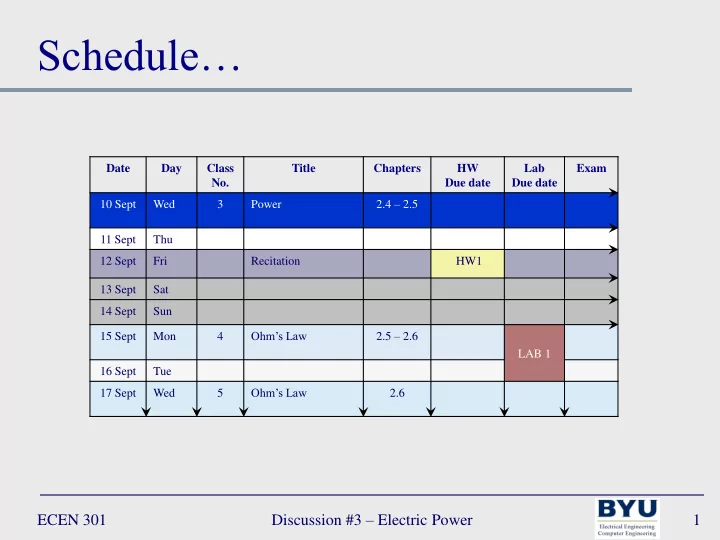
Date Day Class No. Title Chapters HW Due date Lab Due date Exam 10 Sept Wed 3 Power 2.4 – 2.5 11 Sept Thu 12 Sept Fri Recitation HW1 13 Sept Sat 14 Sept Sun 15 Sept Mon 4 Ohm’s Law 2.5 – 2.6 LAB 1 16 Sept Tue 17 Sept Wed 5 Ohm’s Law 2.6

Schedule…

slide-2
SLIDE 2

ECEN 301 Discussion #3 – Electric Power 2

True Power – The Book of Mormon

Alma 37:14, 16, 18 14 And now remember, my son, that God has entrusted you with these things, which are sacred, which he has kept sacred, and also which he will keep and preserve for a wise purpose in him, that he may show forth his power unto future generations. 16 But if ye keep the commandments of God, and do with these things which are sacred according to that which the Lord doth command you, (for you must appeal unto the Lord for all things whatsoever ye must do with them) behold, no power of earth or hell can take them from you, for God is powerful to the fulfilling of all his words. 18 For he promised unto them that he would preserve these things for a wise purpose in him, that he might show forth his power unto future generations. Mormon 8:15, 16, 22, 26, 28 15 For none can have power to bring it to light save it be given him of God; for God wills that it shall be done with an eye single to his glory, or the welfare of the ancient and long dispersed covenant people of the Lord. 16 And blessed be he that shall bring this thing to light; for it shall be brought out of darkness unto light, according to the word of God; yea, it shall be brought out of the earth, and it shall shine forth out of darkness, and come unto the knowledge of the people; and it shall be done by the power of God. 22 For the eternal purposes of the Lord shall roll on, until all his promises shall be fulfilled. 26 And no one need say they shall not come, for they surely shall, for the Lord hath spoken it; for

  • ut of the earth shall they come, by the hand of the Lord, and none can stay it; and it shall come

in a day when it shall be said that miracles are done away; and it shall come even as if one should speak from the dead. 28 Yea, it shall come in a day when the power of God shall be denied…
slide-3
SLIDE 3

ECEN 301 Discussion #3 – Electric Power 3

Lecture 3 – Electric Power

slide-4
SLIDE 4

ECEN 301 Discussion #3 – Electric Power 4

Energy vs. Power

Consider filling a pool of water

 The rate (power) at which the water comes out determines how long it will take to fill the pool  The water that has filled the pool represents energy  Both pools have the same amount of water (energy) – the rate at which they were filled (power) was different

20 minutes 10 minutes

slide-5
SLIDE 5

ECEN 301 Discussion #3 – Electric Power 5

Energy vs. Power

Power: the rate at which energy (electricity) is consumed

 How fast energy can be generated/delivered to/from an electrical device

Energy: the ability to do work

 EX: a battery, a capacitor, a fuel cell

Use

  • f

Duration Power Energy

joule (J): electric energy unit. 1 J = the work required to move an electrical charge of 1C through 1V 1 J = the energy required to lift a small apple (102 g) one meter against Earth's gravity. 1 J = the energy required to heat one gram of dry, cool air by 1 degree Celsius. 1 J = 6.241506363091018 eV (electron-volts) 1 J = 2.7778 x10⁻⁷ kilowatt-hour

kilowatt-hour (kWh): electric energy unit.

slide-6
SLIDE 6

ECEN 301 Discussion #3 – Electric Power 6

Electric Power

Electric Power: the power generated by an active element, or dissipated by a passive element is equal to the product of: voltage across the element and current flowing through it

v i P

Watt (W): electric power unit. 1 Watt = 1 joule/second (J/s) 1 Watt = 1 volt-amp (VA)

slide-7
SLIDE 7

ECEN 301 Discussion #3 – Electric Power 7

Electric Power

Passive sign convention: power dissipated by a load is a positive quantity – the power generated by a source is positive

+

vab

_

a b i

vba

_

a b i

+

Active Element (source)

  • power dissipated = -vi
  • power generated = vi

Passive Element (load)

  • power dissipated = vi
  • power generated = -vi

Positive voltage Negative voltage

slide-8
SLIDE 8

ECEN 301 Discussion #3 – Electric Power 8

Passive Sign Convention

1. Choose an arbitrary direction for current flow 2. Label polarities of all active elements (sources) based on direction of current flow 3. Label polarities of all passive elements (loads) based

  • n direction of current flow

4. Compute the power dissipated by each element based on:

a) If current flows into the positive terminal of the element, the power dissipated is positive (power is absorbed) b) If current flows into the negative terminal of the element the power dissipated is negative (power is delivered)

slide-9
SLIDE 9

ECEN 301 Discussion #3 – Electric Power 9

Electric Power

Example1: find the power dissipated by each element.

va = 8V, vb = 4V, i = 0.1A

Load A Load B

Vs

slide-10
SLIDE 10

ECEN 301 Discussion #3 – Electric Power 10

Electric Power

Example1: find the power dissipated by each element.

va = 8V, vb = 4V, i = 0.1A

1. Assume a clockwise direction of current flow Load A Load B

Vs

i

slide-11
SLIDE 11

ECEN 301 Discussion #3 – Electric Power 11

Electric Power

Example1: find the power dissipated by each element.

va = 8V, vb = 4V, i = 0.1A

1. Assume a clockwise direction of current flow 2. Label polarity of sources according to current flow Load A Load B + _

Vs

i

slide-12
SLIDE 12

ECEN 301 Discussion #3 – Electric Power 12

Electric Power

Example1: find the power dissipated by each element.

va = 8V, vb = 4V, i = 0.1A

1. Assume a clockwise direction of current flow 2. Label polarity of sources according to current flow 3. Label polarity of loads according to current flow + va – + vb – Load A Load B + _

Vs

i

slide-13
SLIDE 13

ECEN 301 Discussion #3 – Electric Power 13

Electric Power

Example1: find the power dissipated by each element.

va = 8V, vb = 4V, i = 0.1A

1. Assume a clockwise direction of current flow 2. Label polarity of sources according to current flow 3. Label polarity of loads according to current flow 4. Calculate power dissipated in each element + va – + vb – Load A Load B + _

Vs

i

slide-14
SLIDE 14

ECEN 301 Discussion #3 – Electric Power 14

Electric Power

Example1: find the power dissipated by each element.

va = 8V, vb = 4V, i = 0.1A

1. Assume a clockwise direction of current flow 2. Label polarity of sources according to current flow 3. Label polarity of loads according to current flow 4. Calculate power dissipated in each element + va – + vb – Load A Load B + _

Vs

i

V v v v v v v

b a s b a s

12 4 8 : KVL Using

slide-15
SLIDE 15

ECEN 301 Discussion #3 – Electric Power 15

Electric Power

Example1: find the power dissipated by each element.

va = 8V, vb = 4V, i = 0.1A

W A V i v P

s s

2 . 1 ) 1 . ( ) 12 (

1. Assume a clockwise direction of current flow 2. Label polarity of sources according to current flow 3. Label polarity of loads according to current flow 4. Calculate power dissipated in each element + va – + vb – Load A Load B + _

Vs

i

V v v v v v v

b a s b a s

12 4 8 : KVL Using W A V i v P

a a

8 . ) 1 . ( ) 8 ( W A V i v P

b b

4 . ) 1 . ( ) 4 (

slide-16
SLIDE 16

ECEN 301 Discussion #3 – Electric Power 16

Electric Power

Example1: find the power dissipated by each element.

va = 8V, vb = 4V, i = 0.1A

W A V i v P

s s

2 . 1 ) 1 . ( ) 12 (

1. Assume a counter-clockwise direction of current flow 2. Label polarity of sources according to current flow 3. Label polarity of loads according to current flow 4. Calculate power dissipated in each element – va + – vb + Load A Load B – +

Vs

i

V v v v v v v

b a s b a s

12 4 8 : KVL Using W A V i v P

a a

8 . ) 1 . ( ) 8 ( W A V i v P

b b

4 . ) 1 . ( ) 4 (

slide-17
SLIDE 17

ECEN 301 Discussion #3 – Electric Power 17

Electric Power

Example1: find the power dissipated by each element.

va = 8V, vb = 4V, i = 0.1A

W A V i v P

s s

2 . 1 ) 1 . ( ) 12 (

– va + – vb + Load A Load B – +

Vs

i

V v v v v v v

b a s b a s

12 4 8 : KVL Using W A V i v P

a a

8 . ) 1 . ( ) 8 ( W A V i v P

b b

4 . ) 1 . ( ) 4 (

NB: Power is conserved (power supplied always equals power consumed): Ps + Pa + Pb = 0

slide-18
SLIDE 18

ECEN 301 Discussion #3 – Electric Power 18

Electric Power

Example2: find the power dissipated by each element.

B E + 10V – – 3V + A D C – 5V + ie = 2A id =3A

slide-19
SLIDE 19

ECEN 301 Discussion #3 – Electric Power 19

Electric Power

Example2: find the power dissipated by each element.

A i i i i i i

e d a e d a

5 2 3 : a node at KCL

B E + 10V – – 3V + A D C – 5V + ie = 2A id =3A a ia

slide-20
SLIDE 20

ECEN 301 Discussion #3 – Electric Power 20

Electric Power

Example2: find the power dissipated by each element.

V v v v v v v v v

b c e a c e b a

12 3 5 10 : Loop1 at KVL

B E + 10V – – 3V + A D C – 5V + ie = 2A id =3A ia = 5A Loop1 + va –

slide-21
SLIDE 21

ECEN 301 Discussion #3 – Electric Power 21

Electric Power

Example2: find the power dissipated by each element.

V v v v v v v v v

c b a d c d b a

10 5 3 12 : Loop2 at KVL

B E + 10V – – 3V + A D C – 5V + ie = 2A id =3A ia = 5A Loop2 + 12V – + vd – NB: since load D and load E share the same node their voltages will be the same

slide-22
SLIDE 22

ECEN 301 Discussion #3 – Electric Power 22

Electric Power

Example2: find the power dissipated by each element.

W W A V P

a

60 upplies s A 60 5 12

B E + 10V – – 3V + A D C – 5V + ie = 2A id =3A ia = 5A + 12V – + 10V –

W W A V P

b

15 upplies s B 15 5 3 W W A V P

c

25 bsorbs a C 25 5 5 W W A V P

d

30 bsorbs a D 30 3 10 W W A V P

e

20 bsorbs a E 20 2 10 W W W P P

b a

75 15 60 : Supplied er Pow Total W W W W P P P

e d c

75 20 30 25 : Absorbed er Pow Total

slide-23
SLIDE 23

ECEN 301 Discussion #3 – Electric Power 23

Electric Power

Example3: The battery supplies a total of 10mW. What is i3?

i1 = 1mA, i2 = 1.5mA

i i

i1 i2 i3

4V

+ _

slide-24
SLIDE 24

ECEN 301 Discussion #3 – Electric Power 24

Electric Power

Example3: The battery supplies a total of 10mW. What is i3?

i1 = 1mA, i2 = 1.5mA

mA A V W V mW v P i v i P

s s

5 . 2 0025 . 4 01 . 4 10 i

i

i1 i2 i3

4V

+ _

mA i i i i i i i i . 1 5 . 1 2 5 . 2 : KCL Using

2 1 3 3 2 1

+ _ + _ + _

slide-25
SLIDE 25

ECEN 301 Discussion #3 – Electric Power 25

i–v Element Characteristics

The relationship between current (i) and voltage (v) at the terminals of a circuit element defines the behaviour

  • f that element within the circuit

+ _

i v

  • If a voltage is imposed across the terminals of the

element the voltage itself (v) and the current that will flow (i) form a unique pair of values.

  • measuring the current while the voltage varies

is known as the i–v characteristic

  • with the i–v characteristic voltage (current)

can be determined from a given current (voltage)

  • power can also be determined
slide-26
SLIDE 26

ECEN 301 Discussion #3 – Electric Power 26

i–v Element Characteristics

i–v characteristic can be given as:

a function a graph

) (v f i

) (i g v

i (amps)

  • 0.3
  • 0.2
  • 0.1

0.1 0.2 0.3

  • 60
  • 40
  • 20

20 40 60

v (volts)

slide-27
SLIDE 27

ECEN 301 Discussion #3 – Electric Power 27

i–v Element Characteristics

Power generated vs. power dissipated quadrants

i (amps)

  • 0.3
  • 0.2
  • 0.1

0.1 0.2 0.3

  • 60
  • 40
  • 20

20 40 60 v (volts)

Generated (sources) Generated (sources) Dissipated (loads) Dissipated (loads)

slide-28
SLIDE 28

ECEN 301 Discussion #3 – Electric Power 28

i–v Element Characteristics

Elements that source and dissipate power

Photovoltaic – solar cells, photodiodes, photodetectors

  • 10
  • 8
  • 6
  • 4
  • 2

2 4 6 8 10

  • 2
  • 1.5
  • 1
  • 0.5

0.5 1 1.5 2 x 10

4

Dissipate Dissipate Generate

slide-29
SLIDE 29

ECEN 301 Discussion #3 – Electric Power 29

i–v Element Characteristics

Ideal DC current source

3A source

1 2 3 4 5 6 7 8 1 2 3 4 5 6 7 8 v i

Ideal DC voltage source

6V source

1 2 3 4 5 6 7 8 1 2 3 4 5 6 7 8 v i

+ _

Vs Is