CSE-571 Localization so far: passive integration AI-based Mobile - - PowerPoint PPT Presentation

cse 571
SMART_READER_LITE
LIVE PREVIEW

CSE-571 Localization so far: passive integration AI-based Mobile - - PowerPoint PPT Presentation

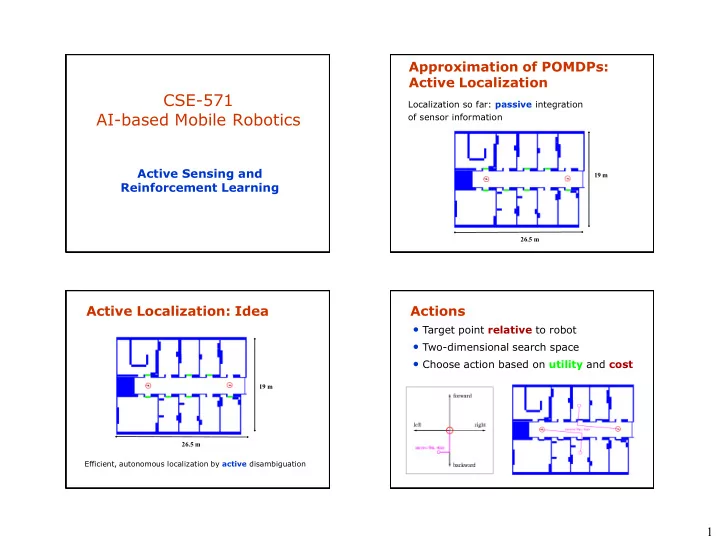
Approximation of POMDPs: Active Localization CSE-571 Localization so far: passive integration AI-based Mobile Robotics of sensor information Active Sensing and 19 m Reinforcement Learning 26.5 m Active Localization: Idea Actions Target


slide-1
SLIDE 1

1

CSE-571 AI-based Mobile Robotics

Active Sensing and Reinforcement Learning

Localization so far: passive integration

  • f sensor information

26.5 m 19 m

Approximation of POMDPs: Active Localization

Efficient, autonomous localization by active disambiguation

26.5 m 19 m

Active Localization: Idea

  • Target point relative to robot
  • Two-dimensional search space
  • Choose action based on utility and cost

Actions

slide-2
SLIDE 2

2

  • Given by change in uncertainty
  • Uncertainty measured by entropy

a z

a z p a x Bel x z p a x Bel x z p X H X H a E X H a U

,

) | ( ) | ( ) | ( log ) | ( ) | ( ) ( )] ( [ ) ( ) (

Utilities

x

x Bel x Bel X H ) ( log ) ( ) (

  • Costs are based on
  • ccupancy probabilities

x a

  • cc
  • cc

x f p x Bel a p )) ( ( ) ( ) (

Costs: Occupancy Probabilities

  • Given by cost-optimal path to

the target

  • Cost-optimal path determined

through value iteration

)] ( [ min ) ( ) ( b C a p a C

b

  • cc

Costs: Optimal Path

  • Choose action based on

expected utility and costs

  • Execution:
  • cost-optimal path
  • reactive collision

avoidance

)) ( ) ( ( max arg a C a U a

a

Action Selection

slide-3
SLIDE 3

3

  • Random navigation failed in 9 out of 10 test runs
  • Active localization succeeded in all 20 test runs

Experimental Results RL for Active Sensing Active Sensing

 Sensors have limited coverage & range  Question: Where to move / point sensors?  Typical scenario: Uncertainty in only one type of

state variable

 Robot location [Fox et al., 98; Kroese & Bunschoten, 99;

Roy & Thrun 99]

 Object / target location(s) [Denzler & Brown, 02; Kreuchner

et al., 04, Chung et al., 04]  Predominant approach: Minimize expected

uncertainty (entropy)

Active Sensing in Multi-State Domains

 Uncertainty in multiple, different state variables

Robocup: robot & ball location, relative goal location, …

 Which uncertainties should be minimized?  Importance of uncertainties changes over time.

 Ball location has to be known very accurately before a kick.

 Accuracy not important if ball is on other side of the field.

 Has to consider sequence of sensing actions!  RoboCup: typically use hand-coded strategies.

slide-4
SLIDE 4

4

Converting Beliefs to Augmented States

Augmented state Belief

Uncertainty variables State variables

Projected Uncertainty (Goal Orientation)

g r (a) (b) (c) (d) Goal

Why Reinforcement Learning?

 No accurate model of the robot and the

environment.

 Particularly difficult to assess how

(projected) entropies evolve over time.

 Possible to simulate robot and noise in

actions and observations.

Least-squares Policy Iteration

 Model-free approach  Approximates Q-function by linear

function of state features

 No discretization needed  No iterative procedure needed for policy

evaluation

 Off-policy: can re-use samples

[Lagoudakis and Parr ’01,’03]

k j j j

w a s w a s Q a s Q

1

) , ( ) ; , ( ˆ ) , (

slide-5
SLIDE 5

5 Least-squares Policy Iteration

 Repeat

  • Estimate Q-function from samples S
  • Update policy

 Until ( )

) , , ( ˆ max arg ) ( ' w a s Q s

A a

' ' ' ) , , ( LSTD S Q w

k j j j

w a s w a s Q

1

) , ( ) ; , ( ˆ

Goal

Mar ker

Robot Ball

Application: Active Sensing for Goal Scoring

Task: AIBO trying to score goals

Sensing actions: looking at ball, or the goals, or the markers

Fixed motion control policy: Uses most likely states to dock the robot to the ball, then kicks the ball into the goal.

Find sensing strategy that “best” supports the given control policy.

Augmented State Space and Features

  • State variables:
  • Distance to ball
  • Ball Orientation
  • Uncertainty variables:
  • Ent. of ball location
  • Ent. of robot location
  • Ent. of goal orientation
  • Features:

1 , , , , , ) , , (

a r b b b

H H H d a s

g

g b

Ball Robot Goal

Experiments

 Strategy learned from simulation  Episode ends when:

  • Scores (reward +5)
  • Misses (reward 1.5 – 0.1)
  • Loses track of the ball (reward -5)
  • Fails to dock / accidentally kicks the ball

away (reward -5)

 Applied to real robot  Compared with 2 hand-coded

strategies

  • Panning: robot periodically scans
  • Pointing: robot periodically looks up at

markers/goals

slide-6
SLIDE 6

6 Rewards (simulation)

  • 10
  • 8
  • 6
  • 4
  • 2

2 4 100 200 300 400 500 600 700 Average rewards Episodes Learned Pointing Panning

Success Ratio (simulation)

0.2 0.4 0.6 0.8 1 100 200 300 400 500 600 700 Success Ratio Episodes Learned Pointing Panning

Learned Strategy

 Initially, robot learns to dock (only looks

at ball)

 Then, robot learns to look at goal and

markers

 Robot looks at ball when docking  Briefly before docking, adjusts by looking

at the goal

 Prefers looking at the goal instead of

markers for location information

Results on Real Robots

  • 45 episodes of goal kicking

Goals Misses

  • Avg. Miss

Distance Kick Failures Learned 31 10 6±0.3cm 4 Pointing 22 19 9±2.2cm 4 Panning 15 21 22±9.4cm 9

slide-7
SLIDE 7

7 Adding Opponents

Ball Robot Goal Opponent

d

  • u
  • b

v

Additional features: ball velocity, knowledge about other robots

Learning With Opponents

0.2 0.4 0.6 0.8 1 100 200 300 400 500 600 700 Lost Ball Ratio Episodes Learned with pre-trained data Learned from scratch Pre-trained

 Robot learned to look at ball when opponent is

close to it. Thereby avoids losing track of it.

Summary

  • Learned effective sensing strategies

that make good trade-offs between uncertainties

  • Results on a real robot show

improvements over carefully tuned, hand-coded strategies

  • Augmented-MDP (with projections)

good approximation for RL

  • LSPI well suited for RL on augmented

state spaces