Schedule Date Day Class Title Chapters HW Lab Exam No. Due - - PowerPoint PPT Presentation

schedule
SMART_READER_LITE
LIVE PREVIEW

Schedule Date Day Class Title Chapters HW Lab Exam No. Due - - PowerPoint PPT Presentation

Schedule Date Day Class Title Chapters HW Lab Exam No. Due date Due date 2.6 2.8 22 Sept Mon 6 Things Practical LAB 2 23 Sept Tue 3.1 3.3 24 Sept Wed 7 Network Analysis 25 Sept Thu 26 Sept Fri Recitation HW 3


slide-1
SLIDE 1

ECEN 301 Discussion #6 – Things Practical 1

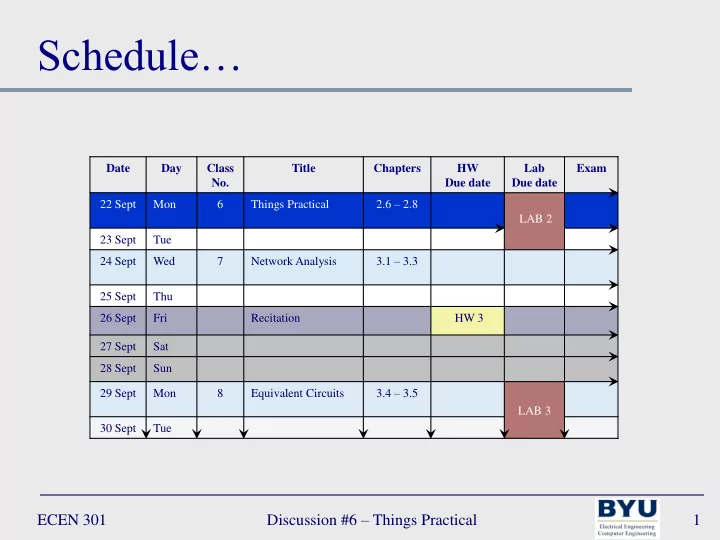
Date Day Class No. Title Chapters HW Due date Lab Due date Exam 22 Sept Mon 6 Things Practical 2.6 – 2.8 LAB 2 23 Sept Tue 24 Sept Wed 7 Network Analysis 3.1 – 3.3 25 Sept Thu 26 Sept Fri Recitation HW 3 27 Sept Sat 28 Sept Sun 29 Sept Mon 8 Equivalent Circuits 3.4 – 3.5 LAB 3 30 Sept Tue

Schedule…

slide-2
SLIDE 2

ECEN 301 Discussion #6 – Things Practical 2

Spiritual – Temporal

1 Nephi 15:32 32 And it came to pass that I said unto them that it was a representation of things both temporal and spiritual; for the day should come that they must be judged of their works, yea, even the works which were done by the temporal body in their days of probation.

Mosiah 2:41

41 And moreover, I would desire that ye should consider on the blessed and happy state of those that keep the commandments

  • f God. For behold, they are blessed in all things, both

temporal and spiritual; and if they hold out faithful to the end they are received into heaven, that thereby they may dwell with God in a state of never-ending happiness. O remember, remember that these things are true; for the Lord God hath spoken it.

slide-3
SLIDE 3

ECEN 301 Discussion #6 – Things Practical 3

Lecture 6 – The Wheatstone Bridge

An Applications of Things Electrical

slide-4
SLIDE 4

ECEN 301 Discussion #6 – Things Practical 4

Wheatstone Bridge

Rx is an unknown resistance to be determined

vs

+ _ R2 R1 R3

Rx

b a

va vb

c d c R1

vs

+ _ R3 R2

Rx

d a b

va vb

slide-5
SLIDE 5

ECEN 301 Discussion #6 – Things Practical 5

Wheatstone Bridge

 The circuit consists of the parallel combination of 3 subcircuits with the same voltage:

a) The voltage source b) Series combination of R1 and R2 c) Series combination of R3 and Rx

 Voltage divider between:

a) R1 and R2

  • v2 = vad

b) R3 and Rx

  • vx = vbd

2 1 2

R R R v v

s ad

vs

+ _ R2 R1 R3

Rx

b a

va vb

c d

x x s bd

R R R v v

3

slide-6
SLIDE 6

ECEN 301 Discussion #6 – Things Practical 6

Wheatstone Bridge

 KVL around the bottom loop:

x x s bd ad ab

R R R R R R v v v v

3 2 1 2

vs

+ _ R2 R1 R3

Rx

b a

va vb

c d

slide-7
SLIDE 7

ECEN 301 Discussion #6 – Things Practical 7

Wheatstone Bridge

 Example1: when is vab = 0?

vs

+ _ R2 R1 R3

Rx

b a

va vb

c d

slide-8
SLIDE 8

ECEN 301 Discussion #6 – Things Practical 8

Wheatstone Bridge

 Example1: when is vab = 0?

1 3 2 2 1 2 3 2 2 1 3 2 3 2 1 2 3 2 1 2 3 2 1 2

R R R R R R R R R R R R R R R R R R R R R R R R R R R R R R v R R R R R R v v

x x x x x x x x x x s x x s ab

vs

+ _ R2 R1 R3

Rx

b a

va vb

c d

slide-9
SLIDE 9

ECEN 301 Discussion #6 – Things Practical 9

Wheatstone Bridge

 Find Rx:

s ab s ab x x x s ab

v v R R R v v R R R R R R R R R R R v v

2 1 2 2 1 2 3 3 2 1 2

1 

vs

+ _ R2 R1 R3

Rx

b a

va vb

c d

slide-10
SLIDE 10

ECEN 301 Discussion #6 – Things Practical 10

Wheatstone Bridge

 Example2: find Rx

 R1 = R2 = R3 = 1kΩ, vs = 12V, vab = 12mV

s ab s ab x

v v R R R v v R R R R R

2 1 2 2 1 2 3

1 vs

+ _ R2 R1 R3

Rx

b a

va vb

c d

slide-11
SLIDE 11

ECEN 301 Discussion #6 – Things Practical 11

Wheatstone Bridge

 Example2: find Rx

 R1 = R2 = R3 = 1kΩ, vs = 12V, vab = 12mV

996 501 . 499 10 2 1 1 10 2 1 10 12 10 12 10 2 10 1 12 10 12 10 2 10 10 1

3 3 3 3 3 3 3 3 3 3 2 1 2 2 1 2 3 s ab s ab x

v v R R R v v R R R R R

vs

+ _ R2 R1 R3

Rx

b a

va vb

c d

slide-12
SLIDE 12

ECEN 301 Discussion #6 – Things Practical 12

Resistance Strain Gauges

Strain gauge: device bonded to the surface of an object and whose resistance varies as a function of surface strain

 Used to perform measurements of:

  • Strain
  • Stress,
  • Force
  • Torque
  • Pressure

NB: cylindrical resistance:

 Compression/elongation will change resistance

A L R

Compression lower resistance Stretch higher resistance L – length of cylindrical resistor σ – conductivity of the resistor A – resistor cross-sectional area

slide-13
SLIDE 13

ECEN 301 Discussion #6 – Things Practical 13

Resistance Strain Gauges

Gauge factor (GF): the relationship between change in resistance and change in length

 value of about 2 is common

L L

Strain (ε): the fractional change in length of an object

Max strain that can be measured is about 0.4 – 0.5 percent

  • i.e. ε = 0.004 to 0.005
  • For a 120Ω resistor: +/– 1.2 Ω

L L R R GF / /

R0 – the zero strain resistance

slide-14
SLIDE 14

ECEN 301 Discussion #6 – Things Practical 14

Resistance Strain Gauges

Change in resistance due to strain:

GF R R

RG Circuit symbol for a strain gauge

slide-15
SLIDE 15

ECEN 301 Discussion #6 – Things Practical 15

Wheatstone Bridge

Wheatstone bridge commonly used to measure force using strain gauge resistors

Example: force applied to a cantilever beam

  • Two strain gauges (R1 and R4) on top
  • Two strain gauges (R2 and R3) on bottom

R1

vs

+ _ R3 R2

R4

d a b

va vb

ia ib c R4 R1 R2 & R3 F L w h

slide-16
SLIDE 16

ECEN 301 Discussion #6 – Things Practical 16

Wheatstone Bridge

Under the strain of force F we have:

R4 R1 R2 & R3 F L w h

vs

+ _ R0 + ∆R b a

va vb

c d R0 + ∆R R0 - ∆R R0 - ∆R ia ib tension tension compression compression

R R R R

4 1

R R R R

3 2

slide-17
SLIDE 17

ECEN 301 Discussion #6 – Things Practical 17

Wheatstone Bridge

From elementary statics it can be shown that:

R4 R1 R2 & R3 F L w h

vs

+ _ R0 + ∆R b a

va vb

c d R0 + ∆R R0 - ∆R R0 - ∆R ia ib

Y wh LF

2

6

Y is the beam’s modulus of elasticity

slide-18
SLIDE 18

ECEN 301 Discussion #6 – Things Practical 18

Wheatstone Bridge

Using Ohm’s Law:

vs

+ _ R0 + ∆R b a

va vb

c d R0 + ∆R R0 - ∆R R0 - ∆R ia ib

4 3

R R v i

s b 2 1

R R v i

s a

R1

vs

+ _ R3 R2

R4

d a b

va vb

ia ib c

slide-19
SLIDE 19

ECEN 301 Discussion #6 – Things Practical 19

Wheatstone Bridge

Using Ohm’s Law:

vs

+ _ R0 + ∆R b a

va vb

c d R0 + ∆R R0 - ∆R R0 - ∆R ia ib

GF v R R v R R R R R R v R R R R R R v R R R v R R R v R i R i v v v v

s s s s s s a b a b ba

  • ut

2 1 2 4 3 4 2 4

slide-20
SLIDE 20

ECEN 301 Discussion #6 – Things Practical 20

Wheatstone Bridge

Find vo in terms of force F:

kF F Y wh GFL v Y wh LF GF v GF v v

s s s

  • 2

2

6 6

k is a calibration constant

vs

+ _ R0 + ∆R b a

va vb

c d R0 + ∆R R0 - ∆R R0 - ∆R ia ib

slide-21
SLIDE 21

ECEN 301 Discussion #6 – Things Practical 21

Wheatstone Bridge

 Example3: using the Wheatstone bridge as a strain measurement tool find vo

 the bridge measures forces ranging from 0 to 500 N  L = 0.3m, w = 0.05m, h = 0.01m, GF = 2, Y = 69x109N/m2, vs = 12V

N mV F N V F F F Y wh GFL v kF v

s

  • /

125 . / 10 25 . 1 10 69 ) 01 . )( 05 . ( ) 3 . )( 2 )( 12 ( 6 6

4 9 2 2

R4 R1 R2 & R3 F L w h

slide-22
SLIDE 22

ECEN 301 Discussion #6 – Things Practical 22

Wheatstone Bridge

 Example3: using the Wheatstone bridge as a strain measurement tool find vo

 the bridge measures forces ranging from 0 to 500 N  L = 0.3m, w = 0.05m, h = 0.01m, GF = 2, Y = 69x109N/m2, vs = 12V

mV N mV F vo 5 . 62 ) 500 ( 10 25 . 1 / 125 . : voltage imum Max

4

R4 R1 R2 & R3 F L w h

slide-23
SLIDE 23

ECEN 301 Discussion #6 – Things Practical 23

Practical Sources

slide-24
SLIDE 24

ECEN 301 Discussion #6 – Things Practical 24

Ideal Sources

Ideal current source

3A source

1 2 3 4 5 6 7 8 1 2 3 4 5 6 7 8 v i

Ideal voltage source

6V source

1 2 3 4 5 6 7 8 1 2 3 4 5 6 7 8 v i

Provides a prescribed voltage across its terminals irrespective of the current flowing through it. Provides a prescribed current irrespective of the voltage across it.

slide-25
SLIDE 25

ECEN 301 Discussion #6 – Things Practical 25

Practical Sources

Actual voltage sources have limitations

 There is a limit to the number of total electrons any battery can motivate through a circuit

  • How to measure limitations?
  • Total number of electrons? (huge number)
  • Use coulombs? (also too huge)
  • amp-hour – unit invented for this purpose
  • 1 amp-hour = 1 amp for 1 hour

= 2 amps for ½ hour = 1/3 amp for 3 hours

 Batteries have ratings indicating their current limitations

  • Car battery – 12V, 70 amp-hours (A-h) @ 3.5 A (for 20 hours)
  • D – cell (1.5V) carbon-zinc battery – 4.6 amp-hours @ 100mA (for 46 hours)
  • 9 – volt carbon-zinc battery – 400 mA-hours @ 8mA (for 50 hours)

1 amp = 1 coulombs/second 1 amp-hour = 3600 coulombs

slide-26
SLIDE 26

ECEN 301 Discussion #6 – Things Practical 26

Practical Sources

Actual voltage sources have limitations

As the load resistance (RL) decreases, the voltage source (vs) is required to provide increasing amounts of current (i) in

  • rder to maintain vs

+ _

vs v

+ _

i Load (RL)

L s

R v i

As RL 0, vs has to provide an infinite amount

  • f current!
slide-27
SLIDE 27

ECEN 301 Discussion #6 – Things Practical 27

Practical Sources

Actual voltage sources have limitations

A series resistance rs poses a limit to the maximum current the voltage source can provide L s s s

R r v i

+ _

vs + vL – is

rs

Practical voltage source

Load (RL)

slide-28
SLIDE 28

ECEN 301 Discussion #6 – Things Practical 28

Practical Sources

Actual voltage sources have limitations

A series resistance rs poses a limit to the maximum current the voltage source can provide

+ _

vs + vL – is

rs

Practical voltage source

Load (RL)

L s L s L s L

R r R v R i v

NB: vs = vL

slide-29
SLIDE 29

ECEN 301 Discussion #6 – Things Practical 29

Practical Sources

Actual voltage sources have limitations

+ _

vs + vL – is

rs

s s S s s s R L s s s

r v i r v i R r v i

L

max

lim

Practical voltage source

A series resistance rs poses a limit to the maximum current the voltage source can provide

slide-30
SLIDE 30

ECEN 301 Discussion #6 – Things Practical 30

Practical Sources

Actual current sources have limitations

As the load resistance (RL) increases, the current source (is) is required to provide increasing amounts of current (v) in order to maintain is

is + vs – Load (RL) L s

R i v

As RL ∞, is has to provide an infinite amount

  • f voltage!
slide-31
SLIDE 31

ECEN 301 Discussion #6 – Things Practical 31

Practical Sources

Actual current sources have limitations

A series resistance rs poses a limit to the maximum voltage the current source can provide

) || (

L s s S

R r i v

is + vs –

rs

Practical current source

Load (RL)

slide-32
SLIDE 32

ECEN 301 Discussion #6 – Things Practical 32

Practical Sources

Actual current sources have limitations

s s S s s s R L s s S

r i v r i v R r i v

L

max

lim ) || (

A series resistance rs poses a limit to the maximum voltage the current source can provide

is + vs –

rs

Practical current source

slide-33
SLIDE 33

ECEN 301 Discussion #6 – Things Practical 33

Practical Sources

1 2 3 4 5 6 7 8 1 2 3 4 5 6 7 8 v i 1 2 3 4 5 6 7 8 1 2 3 4 5 6 7 8 v i

Actual current and voltage sources have limitations

Ideal 3A current source Ideal 6V votage source

slide-34
SLIDE 34

ECEN 301 Discussion #6 – Things Practical 34

Practical Sources

1 2 3 4 5 6 7 8 1 2 3 4 5 6 7 8 v i 1 2 3 4 5 6 7 8 1 2 3 4 5 6 7 8 v i

Actual current and voltage sources have limitations

Practical 3A current source Practical 6V votage source

slide-35
SLIDE 35

ECEN 301 Discussion #6 – Things Practical 35

Measuring Devices

slide-36
SLIDE 36

ECEN 301 Discussion #6 – Things Practical 36

Ohmmeter

Ohmmeter: measures the resistance of a circuit element

NB: the resistance of an element can only be measured when the element is disconnected from all other circuit elements Ω Ω R Ohmmeter symbol Ohmmeter connection setup for circuit element resistance measurement

slide-37
SLIDE 37

ECEN 301 Discussion #6 – Things Practical 37

Ammeter

Ammeter: a device that can measure the current flowing though a circuit element when connected in series with that circuit element

NB: 1. the ammeter must be connected in series with the circuit element

  • 2. the ammeter should not restrict the flow of current (i.e. cause a voltage drop)

– an ideal ammeter has zero resistance A Ammeter symbol

i

R2

vs

+ _ R1 R1

i

R2

vs

+ _ A

slide-38
SLIDE 38

ECEN 301 Discussion #6 – Things Practical 38

Voltmeter

Voltmeter: a device that can measure the voltage across a circuit element when connected in parallel with that circuit element

NB: 1. the voltmeter must be connected in parallel with the circuit element

  • 2. the voltmeter should not draw any current away from the element

– an ideal voltmeter has infinite resistance V Voltmeter symbol

vs i

+ R2 – + _ R1 R1

i

+ R2 –

vs

+ _ V + v2 –

slide-39
SLIDE 39

ECEN 301 Discussion #6 – Things Practical 39

Wattmeter

Wattmeter: a device that can measure the power dissipated by a circuit element

NB: 1. the wattmeter must be connected in parallel with the circuit element, but also in series with the circuit. – a wattmeter is simply the combination of a voltmeter and an ammeter W Wattmeter symbol

vs i

+ R2 – + _ R1 R1

i

+ R2 –

vs

+ _ W

slide-40
SLIDE 40

ECEN 301 Discussion #6 – Things Practical 40

Practical Voltmeters and Ammeters

In reality, voltmeters and ammeters have internal resistances

Practical ammeters will always add some resistance Practical voltmeters will always draw some current

V Ideal Voltmeter V rm Practical Voltmeter A Ideal Ammeter Practical Ammeter A rm