
SLIDE 1
Warmup
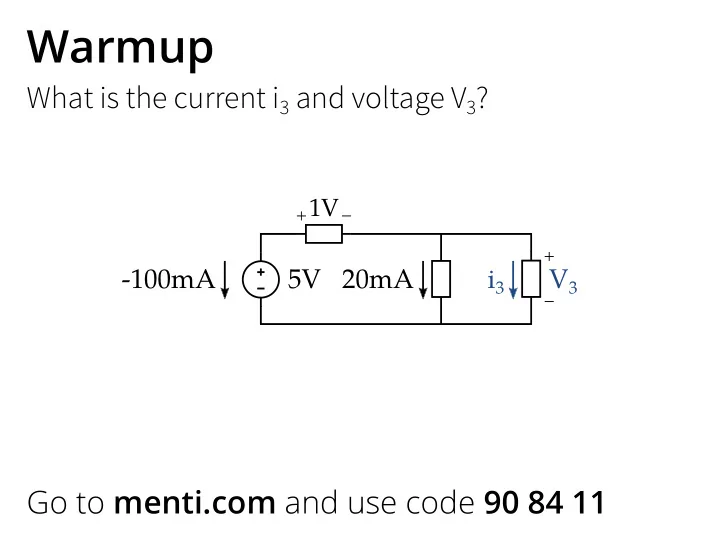
Go to menti.com and use code 90 84 11 What is the current i3 and voltage V3?
- 100mA
V3 i3
1V
5V 20mA
Warmup What is the current i 3 and voltage V 3 ? 1V -100mA 5V 20mA - - PowerPoint PPT Presentation
Warmup What is the current i 3 and voltage V 3 ? 1V -100mA 5V 20mA i 3 V 3 Go to menti.com and use code 90 84 11 ENGR 40M, Lecture 3: Ohm's law, power, and multimeters Steven Bell 30 June 2017 Logistics Lab sections will be posted this
Go to menti.com and use code 90 84 11 What is the current i3 and voltage V3?
V3 i3
1V
5V 20mA
ENGR 40M, Lecture 3:
Ohm's law, power, and multimeters
Steven Bell
30 June 2017
Logistics
Lab sections will be posted this weekend Homework 1 is out (pick up a copy) Lab 1 is posted (we'll bring copies Monday) Sign up on Piazza!
By the end of class, you should be able to:
Use Ohm's law with KVL/KCL to find unknown voltages and currents. Calculate the power supplied or dissipated by a device.
How much power does the source absorb?
120V
This is called the "passive sign convention".
Let's make a deal
When calculating power, current references should match voltage references: Then positive power is always power absorbed, and negative power is always power supplied.
Which of these are absorbing electrical power?
A B C D E F
1A
2V 2V 2V 1A 1A
2V
Watch the signs!
A strange circuit
Which device is providing elctrical power?
(i.e., which has negative power absorbed?)
A) The current source B) The battery C) Both D) Neither, this circuit is broken. 500mA 4V
woodgears.ca
Marble-track resistor
R is the resistance, measured in Ohms
I = V R
For a resistor (and only a resistor):
Ohm's Law
Represented with the schematic symbol:
What is the current i?
Challenge: what would happen to the current if we added a second 1kΩ resistor in parallel?
5V 1kΩ
Breaking break:
My wife's hair dryer
Apr 14, 2017 ENGR 40M Spring 2017 — C.Z. Lee, J. Plummer, R. Howe 1
Take all three AA batteries out
(Keep the third one handy.)
Happy Friday! Do this now:
Take your digital multimeter
as the probes in the box
Open circuit and short circuit
Open circuit
(𝑗 = 0)
Short circuit
(𝑤 = 0)
Apr 14, 2017 ENGR 40M Spring 2017 — C.Z. Lee, J. Plummer, R. Howe 4
circuit short circuit
Modes of your digital multimeter (DMM)
Apr 14, 2017 ENGR 40M Spring 2017 — C.Z. Lee, J. Plummer, R. Howe 5
Voltage meter Voltmeter (V) Resistance meter Ohmmeter (Ω) Current meter Ammeter (A)
Other modes are beyond the scope
please ask if you’re interested
Connecting your multimeter’s probes
normally
milliamps”
higher current
Apr 14, 2017 ENGR 40M Spring 2017 — C.Z. Lee, J. Plummer, R. Howe 6
Using your voltmeter (1)
Do now: w:
00mV scale
end of the battery
Apr 14, 2017 ENGR 40M Spring 2017 — C.Z. Lee, J. Plummer, R. Howe 7
get the probes the “wrong way round”?
Using your voltmeter (2)
Do now: w:
00mV mV
same battery. What does it say?
20V scale?
Apr 14, 2017 ENGR 40M Spring 2017 — C.Z. Lee, J. Plummer, R. Howe 9
choose the scale?
Using your multimeter: scales
digi gits: The 4th digit can
imum um that a scale can measure.
the meter shows this:
greater than what you’re measuring.
Apr 14, 2017 ENGR 40M Spring 2017 — C.Z. Lee, J. Plummer, R. Howe 10
Using your voltmeter (3)
the appropriate scale.
series or in parallel?
Apr 14, 2017 ENGR 40M Spring 2017 — C.Z. Lee, J. Plummer, R. Howe 11
Do Do now:
batteries in the holder
wires touch each other
across the holder
A voltmeter goes in parallel
But this changes the circuit! How should a voltmeter behave to avoid changing the circuit? 4.5V 1kΩ
Voltmeters connect in parallel
probe on either side of it.
voltmeter takes close to zero current.
Apr 14, 2017 ENGR 40M Spring 2017 — C.Z. Lee, J. Plummer, R. Howe 13
Using your ohmmeter
wit ithout
any po power er
esis istor
doesn’t matter
Apr 14, 2017 ENGR 40M Spring 2017 — C.Z. Lee, J. Plummer, R. Howe 21
Do now: w:
resistance of the resistor you just read
Resistance modes
An ammeter goes in series
This also changes the circuit! How should an ammeter behave to avoid changing the circuit? 4.5V 1kΩ
A) 4.5mA B) 0mA C) "1 ." (out of range) D) Nothing, your meter will burn up. 4.5V 1kΩ
If you connect your meter like this, while in current-measuring mode, what will you measure? Don't try it yet - analyze this with what you know.
Ammeters connect in series
place the ammeter to have the same current as it.
takes close to zero voltage.
circuit.
Apr 14, 2017 ENGR 40M Spring 2017 — C.Z. Lee, J. Plummer, R. Howe 16
How do you feel about this material?