SLIDE 1
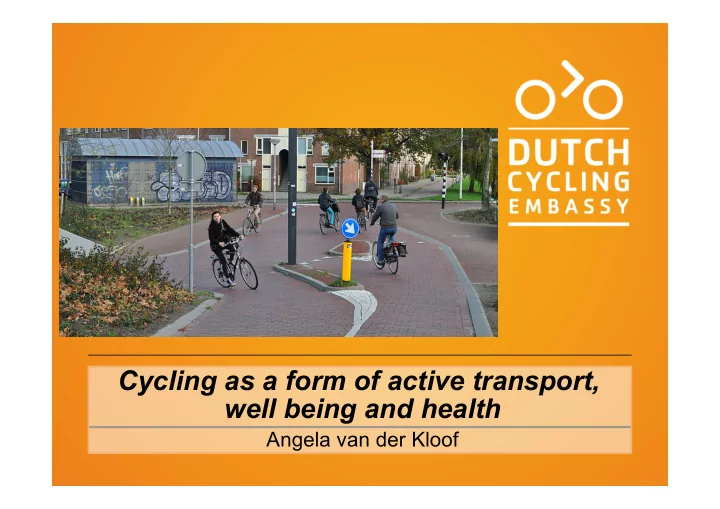
Cycling as a form of active transport, well being and health
Angela van der Kloof
SLIDE 2 Movement People
bicycles, types of people on bikes, types of trips
study tours, reports
@AngelavdKloof a.vanderkloof@mobycon.nl
things in a different way
SLIDE 3
SLIDE 4
SLIDE 5
While mobile people want to feel
Comfortable At ease Safe Secure
SLIDE 6 Emotions linked to transportation in the Netherlands
and driving
Source: Beleving en beeldvorming van mobiliteit, Lucas Harms (projectleider), Peter Jorritsma en Nelly Kalfs (2007)
SLIDE 7 Many reasons to bike
35.000 KM of cycle paths 26% overall mode share
50% 6%
SLIDE 8
Average daily number of trips by bicycle (age and gender)
SLIDE 9
There are many possible barriers to cycling
Access Skills Practices
SLIDE 10
Access: bicycle ownership, looking at average # of bikes a nation has?
SLIDE 11
Access: bike parking @home & @destination and Bike Share Access
SLIDE 12
Access to cycling for different needs
SLIDE 13
There are many possible barriers to cycling
Access Skills Practices
SLIDE 14
Skills: how do we learn to bike?
SLIDE 15
Skills: how do we learn to bike?
SLIDE 16
Skills: how do we learn to bike?
SLIDE 17
Learning new skills, only for children?
SLIDE 18
Learning skills, only for children?
SLIDE 19
There are many possible barriers to cycling
Access Skills Practices
SLIDE 20 20
26% 31% 45% 11% 16%
Practices
Source: Fietsberaad, Cijfers over fietsgebruik per gemeente. (2004 - 2008)
SLIDE 21 Practices: how often do you bike?
Hardly ever / never Once / few times a year Once / few times a months Once / few times a week Every day
Source; Gemeente Amsterdam, dienst O+S, Fietsen in Amsterdam - Resultaten van een online enquête november 2011
SLIDE 22 Bicycle travel time per person, per day according to gender and education (in minutes)
Males Females All Younger than 12 12.78 11.08 11.95 Low education 14.78 11.67 13.04 Average education 10.82 10.96 10.89 Higher education 13.01 13.40 13.20 All categories 13.44 12.48 12.96
Source; CBS 2014
SLIDE 23 Practices are not in the DNA
Cycling is not for me I do not want to be sweatty I am married now … I’m not very sporty I appreciate the time
SLIDE 24
New practices: e-bikes, how are skills acquired? Does everyone have access to it?
SLIDE 25
New practices: (e)-cargo bikes, how are skills acquired? Does everyone have access to it?
SLIDE 26
Does the availability and popularity of e- bikes open new opportunities?
SLIDE 27
Are we willing to get out of the comfort zone when we plan policies or choose measures?
SLIDE 28
Fünda Müjde Deniz Özdemir
SLIDE 29
SLIDE 30 “Oh, but all of this is only happening in the Netherlands…”
Source; http://www.core77.com/posts/51805/Ikea-to-Begin-Selling-a-Chain-less-Bicycle
SLIDE 31 What does all this have to do with health and well being?
Thinking about the future of cycling, keeping in mind different needs of different target groups and the possibilites that modern variations of the bicycle have to offer … What would happen if we would put a healthier and more fair transport system in the heart of transport / cycling policies?
- Would different measures be implemented?
- Would our cities look different?
- Would cycling become more accessible and common?