Cycling Traffic Growth within a City First comes Investment in the - - PowerPoint PPT Presentation

cycling traffic growth within a city
SMART_READER_LITE
LIVE PREVIEW

Cycling Traffic Growth within a City First comes Investment in the - - PowerPoint PPT Presentation

Cycling Traffic Growth within a City First comes Investment in the Cycling Infrastructure, then comes Social Marketing Meeting Agenda Complete presentation available from the Third Wave Cycling Group Inc. website at


slide-1
SLIDE 1

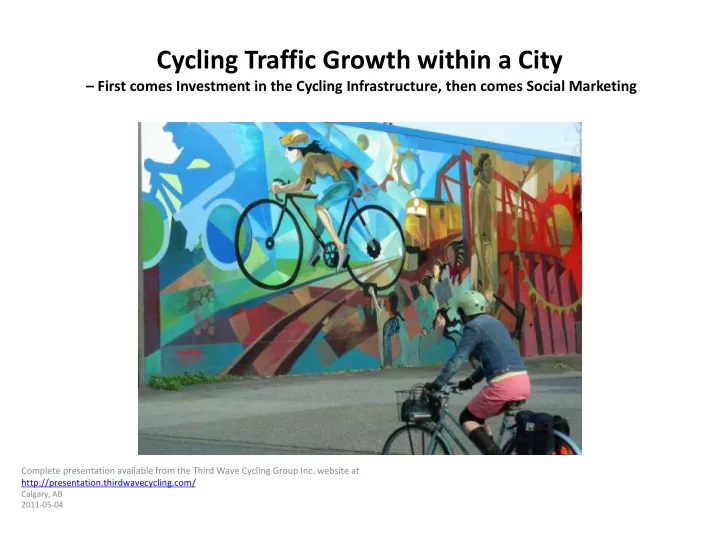
Cycling Traffic Growth within a City

– First comes Investment in the Cycling Infrastructure, then comes Social Marketing

Meeting Agenda

Complete presentation available from the Third Wave Cycling Group Inc. website at http://presentation.thirdwavecycling.com/

Calgary, AB 2011-05-04

slide-2
SLIDE 2

Cycling Traffic Growth within a City

– First comes Investment in the Cycling Infrastructure, then comes Social Marketing

slide-3
SLIDE 3

Cycling Traffic Growth within a City

– First comes Investment in the Cycling Infrastructure, then comes Social Marketing

Data and Images Sources

  • Census Canada
  • City of Vancouver
  • Vancouver Area Cycling Coalition
  • Cycling in Cities Study, Dr. Kay Teschke, University of British Columbia, School of Population

and Public Health

Photo credits

  • Jean Chong
  • Jack Becker

Complete presentation available from the Third Wave Cycling Group Inc. website at http://presentation.thirdwavecycling.com/

slide-4
SLIDE 4

Cycling Traffic Growth within a City

– First comes Investment in the Cycling Infrastructure, then comes Social Marketing

Presentation

  • 1. Introduction
  • 2. Policy Suggestions
  • 3. Presentation Arguments
  • 4. Sizing the Urban Market
  • 5. Infrastructure Investment followed by Cycling Traffic Growth
  • 6. Tracking Infrastructure Investment and Cycling Traffic Growth – City of Vancouver
  • 7. Then Social Marketing, the Fourth Wave - Vancouver's Experiences
  • 8. Street Cases in Vancouver – Cycling Traffic Growth through Investment
  • 9. Observations

Complete presentation available from the Third Wave Cycling Group Inc. website at http://presentation.thirdwavecycling.com/

slide-5
SLIDE 5

Cycling Traffic Growth within a City

– First comes Investment in the Cycling Infrastructure, then comes Social Marketing

  • An attention grabber
  • Explaining or expanding the attention grabber
  • Involving the reader
slide-6
SLIDE 6

Cycling Traffic Growth within a City

– First comes Investment in the Cycling Infrastructure, then comes Social Marketing

  • An attention grabber for the reader

the infrastructure that drivers would observe as they motor along the streets of a city,

  • Explaining or expanding the attention grabber

communications programs usually involving maps of the infrastructure, street name signs with cycling logo, signs designating streets as bike routes,

  • Involving the reader

social programs designed to draw motorists to give cycling for transportation, including commuting, a try.

slide-7
SLIDE 7

Cycling Traffic Growth within a City

– First comes Investment in the Cycling Infrastructure, then comes Social Marketing

“How public investment can contribute to sustainable mobility, can enhancing quality of life in cities. “ Policy Suggestions

  • Urban communities’ growth target and target customers for cycling should drive magnitude
  • f infrastructure investment and cycling infrastructure design toolkit
  • Infrastructure investment first, then followed by social marketing when significant network

is in place

  • At the early stages of developing cycling infrastructure and commuting, social marketing program

focused on general broadcasting techniques for purpose of creating awareness and understanding that cycling capacity within a community is need

  • During cycling infrastructure and network roll-out, then social marketing shifted to target

marketing techniques along corridors where investment in cycling infrastructure is taking place

  • When network substantially complete, then marketing program broadening out into general

marketing concepts

slide-8
SLIDE 8

Cycling Traffic Growth within a City

– First comes Investment in the Cycling Infrastructure, then comes Social Marketing

Presentation Arguments

The presentation will focus on the premise that the public within a city will take on cycling for transportation if the design of the cycling infrastructure is to their liking and the network is extensive enough for their needs. Social marketing undertaken too early will cause “Cyclist Turnover”. Some will try cycling, find it not to their liking, and then give to up. Effort to bring these back to cycling when the conditions are right will be difficult, costly, and take many years.

slide-9
SLIDE 9

Cycling Traffic Growth within a City

– First comes Investment in the Cycling Infrastructure, then comes Social Marketing

Presentation Arguments

First, an appealing cycling infrastructure needs to be in place then comes social marketing of cycling to further spur on the use of cycling for transportation.

The presentation will focus on the premise that the public within a city will take on cycling for transportation if the design of the cycling infrastructure is to their liking and the network is extensive enough for their needs. Social marketing undertaken too early will cause “Cyclist Turnover”. Some will try cycling, find it not to their liking, and then give to up. Effort to bring these back to cycling when the conditions are right will be difficult, costly, and take many years.

slide-10
SLIDE 10

Cycling Traffic Growth within a City

– First comes Investment in the Cycling Infrastructure, then comes Social Marketing

Presentation Introduction

First growth of cycling traffic within a City is fuelled by selection of comprehensive cycling design toolkits and by the extent of the cycling network. The argument for this presentation is that first an appealing cycling infrastructure needs to be in place then comes social marketing of cycling to further spur on the use of cycling for transportation. The presentation will focus on the premise that the public within a city will take on cycling for transportation if the design of the cycling infrastructure is to their liking and the network is extensive enough for their needs. For some cities, the issue is not to grow cycling but how to stop the public’s move from cycling and transit to using cars instead for their transportation needs. The presentation will focus on the City of Vancouver with a population of 550,000 and with medium density urban environment that has seen growth of cycling and also transit while driving in the City’s Centrum has dropped. The presentation will highlight the upgrading of the city’s cycling design toolkit over the years and its effect on cycling traffic growth and mode share over the least 25 years. Vancouver is an up and coming cycling city with a significant cycling mode share for a North American city (4%) and a developing cycling culture.

slide-11
SLIDE 11

Cycling Traffic Growth within a City

– First comes Investment in the Cycling Infrastructure, then comes Social Marketing

Presentation Arguments (Continued)

For people willing to cycle, their personal needs must be met The First Wave Market share potential 0.5% to 1.5%

– the skilled cyclists, the risk takers

Vancouver – 1.3%, $200 k investment The Second Wave Market share potential 3% to 5%, maybe 6%

– the determined, the confident

Vancouver – 3.7%, $12.6 m investment The Third Wave Market share potential 10% to 15%

– Hesitant, Limited cycling skills, less motivated to cycle, the risk averters

Vancouver – Early experimenter, now implementation (2007+), $17.6 m inc. 2011 The Fourth Wave – Social Marketing Market share potential to 25% plus, then share retention

– Social norm now, cycling a socially-acceptable form of transportation

The Fifth Wave

– Enhance the cycling design toolkit for the social followers The 6th, 7th, 8th……Waves – Reducing Cycling Turnover

slide-12
SLIDE 12

Cycling Traffic Growth within a City

– First comes Investment in the Cycling Infrastructure, then comes Social Marketing

Presentation Arguments (Continued)

Cycling in Cities Survey More people are willing to cycle if they can cycle on:

  • Paved, off-street bike trails dedicate to cycling

(85% of respondents, +0.6)

  • Paved, off-street multi-use paths

(77%, =+0.5)

  • Unpaved, off-street multi-use paths

(71%, =+0.4)

  • Separated bike lanes with barriers

(71%, =+0.4)

  • Neighbourhood cycling streets with traffic calming

(65%, =+0.4)

Separation is key to cycling traffic growth

slide-13
SLIDE 13

Cycling Traffic Growth within a City

– First comes Investment in the Cycling Infrastructure, then comes Social Marketing

Presentation Arguments (Continued)

Cycling in Cities Survey 31% of the residents are willing to cycle:

slide-14
SLIDE 14

Cycling Traffic Growth within a City

– First comes Investment in the Cycling Infrastructure, then comes Social Marketing

Presentation Arguments (Continued)

Cycling in Cities Survey

Order of preference of routes

slide-15
SLIDE 15

Cycling Traffic Growth within a City

– First comes Investment in the Cycling Infrastructure, then comes Social Marketing

Presentation Arguments (Continued)

What do people want? What has been successful?

European designs

  • Separation
  • Visibility of cyclists
  • Cyclist knows where they are and where they should go – Pavement markings, signage, and

wayfinding

  • Trip time
  • Intersection passage priority
  • Cycling culture ingrained into daily lifestyle - Social marketing
slide-16
SLIDE 16

Cycling Traffic Growth within a City

– First comes Investment in the Cycling Infrastructure, then comes Social Marketing

I

slide-17
SLIDE 17

Cycling Traffic Growth within a City

– First comes Investment in the Cycling Infrastructure, then comes Social Marketing

Who are the Customers? How big is the Market and the Potential?

Motorists are the Future Customers School children and youths are the Future Customers

In Vancouver, a city of 550,000 residents

  • 60,000 cycling trips a day are made
  • 3.7% or 22,000 cyclists are on the road in any day
  • 9% or 49,500 of the population cycle regularly
  • City population growth will increase daily cycling by 4,000 and regular cyclists by 8,500

Customer growth potential through mode switch from driving to cycling

  • Commute to work range - 50,000 at today’s population to 90,000 with population growth
  • School and other non-work customers - 40,000 at today’s population to 75,000 with population growth
slide-18
SLIDE 18

Cycling Traffic Growth within a City

– First comes Investment in the Cycling Infrastructure, then comes Social Marketing

The potential for cycling is there. In Vancouver, commuting cycling is uneven over the city with cycling mode share ranging from 1% to over 10% by neighbourhoods, averaging 3.7%

slide-19
SLIDE 19

Tracking Infrastructure Investment and Cycling Traffic Growth – CoV I

slide-20
SLIDE 20

First Wave of Cycling Facilities

  • City of Vancouver

Growth to 1.3% cycling mode share, approximately to 1990 Cycling infrastructure investment – minimal, $200 k Streets

  • Shared roads
  • BC Parkway – Combination of cycling neighbourhood streets and off-road bike trail along the

SkyTrain line

  • First traffic-calmed streets in West End in the 1970’s

Bridges

  • Shared sidewalks with pedestrians

Arterial Road Crossing

  • Pedestrian-activated traffic signals installed along route

Transit Systems

  • Slow introduction of bike racks on buses
  • Bikes on ferries
slide-21
SLIDE 21

First Wave of Cycling Facilities in the City of Vancouver

Shared streets White edge line

slide-22
SLIDE 22

First Wave of Cycling Facilities in the City of Vancouver

Cyclist-activated traffic signals – Local streets

Right-in right-out diverters

slide-23
SLIDE 23

First Wave of Cycling Facilities in the City of Vancouver

Neighbourhood cycling streets – first implementation

Bike route signage

Overhead and street-level signage Pavement marking – bike logo, sharrows Traffic circles replacing stop signs'

slide-24
SLIDE 24

First Wave of Cycling Facilities in the City of Vancouver

Neighbourhood cycling streets – first implementation

Cycling-permeable medians Driving discontinuity

slide-25
SLIDE 25

Second Wave of Cycling Facilities

  • City of Vancouver

Growth from 1.3% to 3.3% and then to 3.7% cycling mode share, approximately from 1990 to 2006 Cycling infrastructure investment from 1990 to 2006- $12.6 m Streets

  • Standard North American infrastructure design
  • Bike lanes on arterial streets
  • Cycling neighbourhood streets with evolving traffic calming – traffic circles, corner bulges, speed humps, bus speed humps.

Intersections

  • Cycling travel time improvements
  • Cycling-activated traffic signals on cycling neighbourhood streets crossing arterial and collector roads
  • Push buttons installed for cyclists at all traffic signals with pedestrian buttons
  • Traffic circle roll-out

Off-Road

  • The Seaside path rolled out attracting many less confident cyclists

Transit

  • 100% bike racks on buses fleet
  • Bikes on SkyTrain
slide-26
SLIDE 26

Second Wave of Cycling Facilities in the City of Vancouver

Neighbourhood cycling streets – Evolving traffic-calming

Cul-de-Sac Cycling Permeable Streets Cycling-Permeable Median Barriers

slide-27
SLIDE 27

Second Wave of Cycling Facilities in the City of Vancouver

Neighbourhood cycling streets – Evolving traffic-calming

Wayfinding Humps Diverters Bus hump

slide-28
SLIDE 28

Second Wave of Cycling Facilities in the City of Vancouver

Traffic circles

Small circles Mid-size circles Large circles

Replaces stop signs Checks speed somewhat Too fast, cars tip No speed reduction Corner bulges

slide-29
SLIDE 29

Second Wave of Cycling Facilities in the City of Vancouver

Bike lanes on arterial streets

Between bus and general traffic lane Next to parked cars Next to curb

slide-30
SLIDE 30

Second Wave of Cycling Facilities in the City of Vancouver

Seaside bike path – Partially separated

slide-31
SLIDE 31

Second Wave of Cycling Facilities in the City of Vancouver

Bikes racks on buses Bikes on ferries Bikes on SkyTrain

slide-32
SLIDE 32

Moving into the Third Wave of Cycling Facilities – CoV

Growth stalled at the 3.7% cycling mode share (1996 to 2006). Next census count in 2011.

  • More aggressive infrastructure design and network approach now needed for spurring further

cycling growth.

  • Traffic counts up at new cycling facilities designed with using Third Wave design toolkit techniques.
  • Cycling infrastructure investment from 2007 to 2011- $17.6 m

The Network Third Wave Design Toolkit and Network

Streets Off-Road Intersection Visibility of Cyclists Separation of Like Speed Traffic Cycling Trip Efficiency Cycling comfort Bike Parking Combined Mobility Feeder network to transit Transit vehicles

Cycling Traffic Monitoring Program

slide-33
SLIDE 33

Moving into the Third Wave of Cycling Facilities – CoV

Growth stalled at the 3.7% cycling mode share (1996 to 2006). Next census count in 2011.

  • More aggressive infrastructure design and network approach now needed for spurring further

cycling growth.

  • Traffic counts up at new cycling facilities designed with using Third Wave design toolkit techniques.
  • Cycling infrastructure investment from 2007 to 2011- $17.6 m

The Network

  • Increasing percentage of cyclists within catchment area of cycling infrastructure

Third Wave Design Toolkit and Network

  • Streets
  • Bridges
  • Intersections
slide-34
SLIDE 34

Moving into the Third Wave of Cycling Facilities – CoV

Growth stalled at the 3.7% cycling mode share (1996 to 2006). Next census count in 2011.

  • Streets
  • Separated bike lanes – temporary designs
  • Continued network roll-out
  • Continued bike lanes roll-out
  • Cycling neighbourhood streets with continued more aggressive evolving traffic calming – traffic

circles, corner bulges, speed humps, bus speed humps.

  • 30 kph speed limits on local streets on bikeways

Off-Road

  • The Seaside path was being rolled out attracting many less confident cyclists
  • Central Valley Greenway – combined off-road bike trail and on cycling neighbourhood streets
slide-35
SLIDE 35

Moving into the Third Wave of Cycling Facilities – CoV

Growth stalled at the 3.7% cycling mode share (1996 to 2006). Next census count in 2011. Intersection Visibility

  • Coloured street crossing
  • Bike boxes
  • Left turn bike boxes on intersecting streets
  • CrossBike treatment
  • Bike traffic signal head

Separation

  • Separated bike lanes on arterial streets and bridges
  • Separate bike deck (shared with pedestrians) on new transit bridge
  • Off-streets bike paths – Seaside, Central Valley Greenway
slide-36
SLIDE 36

Moving into the Third Wave of Cycling Facilities – CoV

Growth stalled at the 3.7% cycling mode share (1996 to 2006). Next census count in 2011. Trip Efficiency

  • Traffic circle roll-out

Cycling comfort

  • 30 kph on neighbourhood cycling streets

Bike Parking

  • Starting to roll-out with on-street bike racks, transit station bike lockers, bike cage
  • Updated bylaws for bike parking in buildings with parking requirements directionally based on

target cycling mode share.

slide-37
SLIDE 37

Moving into the Third Wave of Cycling Facilities – CoV

Growth stalled at the 3.7% cycling mode share (1996 to 2006). Next census count in 2011. Feeder network to transit

  • Buses
  • Rapid transit
  • Ferris

Transit

  • 100% bike racks on buses fleet
  • Bikes on rapid transit systems – SkyTrain, Canada Line, West Coast Express

Cycling Traffic Monitoring Program

  • Program implemented in 2007 – 24 hour automatic counts all year
slide-38
SLIDE 38

Moving into the Third Wave of Cycling Facilities in the City of Vancouver

The Network - Vancouver’s ever expending cycling network Increasing percentage of cyclists within catchment area of cycling infrastructure

slide-39
SLIDE 39

Moving into the Third Wave of Cycling Facilities in the City of Vancouver

Intersection Visibility

Coloured street crossing Bike boxes

slide-40
SLIDE 40

Moving into the Third Wave of Cycling Facilities in the City of Vancouver

Intersection Visibility

Left turn bike boxes on intersecting streets CrossBike treatment

slide-41
SLIDE 41

Moving into the Third Wave of Cycling Facilities in the City of Vancouver

Intersection Visibility

Cycling separation through intersections Bike traffic signal head Signage

slide-42
SLIDE 42

Moving into the Third Wave of Cycling Facilities in the City of Vancouver

Separation

Separated bike lanes on arterial streets Carrall Greenway Spyglass – parked car separation Dunsmuir St Great Northern Way 10th Avenue

slide-43
SLIDE 43

Moving into the Third Wave of Cycling Facilities in the City of Vancouver

Separation

Separated bike lanes on arterial streets - Hornby St

From traditional bike lane to

slide-44
SLIDE 44

Moving into the Third Wave of Cycling Facilities in the City of Vancouver

Separation

Separated bike lanes on bridges Burrard Bridge Dunsmuir Viaduct Victoria – Granville Cut Cambie Bridge

slide-45
SLIDE 45

Moving into the Third Wave of Cycling Facilities in the City of Vancouver

Separation

Bike and multi-purpose lanes on bridges Canada Line rapid transit bridge over the Fraser River

slide-46
SLIDE 46

Moving into the Third Wave of Cycling Facilities in the City of Vancouver

Separation

Off-streets bike paths Seaside Path Central Valley Greenway

slide-47
SLIDE 47

Moving into the Third Wave of Cycling Facilities in the City of Vancouver

Feeder network to transit

Buses Rapid Transit

slide-48
SLIDE 48

Then Social Marketing, the Fourth Wave

Hypotheses for social marketing: Built the infrastructure first, then undertake targeted social marketing campaign along the catchment areas of built cycling infrastructure.

  • Cycling infrastructure comes first, then comes social marketing for permanent lifestyle mode

change incorporating cycling as a prime method of transportation.

  • For social marketing of cycling to be effective, urban communities’ cycling infrastructure and

network must be at a quality desired by potential cyclists.

  • Social marketing should follow well-developed marketing advertising models and be focused
  • n target marketing for potential cycling customers.
  • Significant cycling traffic growth will only be achieved through targeting the motorist market

for potential mode change to cycling.

  • “Cyclist Turnover” needs to be minimized through appealing cycling infrastructure and then

targeted social marketing campaigns. Once a persons tries cycling for transportation and gives it up, it will take long time and be costly to bring that person back to cycling.

slide-49
SLIDE 49

Cycling Traffic Growth within a City

– First comes Investment in the Cycling Infrastructure, then comes Social Marketing

Fourth Wave – Social Marketing

Social Marketing should Follow when Ideal infrastructure and Network is In Place

Social marketing should be targeted to – Potential cyclists Why? Lack of retention of shift to cycling – 2001 transit strike, Winter Olympics traffic Two events - Two different levels of social marketing

Two events created surge in cycling traffic and cycling mode share for Vancouver

Increases during events were not sustainable afterwards Why? Infrastructure not to the expectations of the Third Wave of Cyclists – the potential cyclists, drivers who are willing to shift modes to cycling. Result – “Cyclist Turnover”

2001 – TransLink 4-Month Strike

(March 31 to Aug 1, 2001)

Cycling mode share gain – from 3.3% to 4.1% (cc) Post strike levels– mode share dropped back towards 3.7%, some cyclist retention (previous mode share – 3.3%) Cycling infrastructure – Approx. 200 km largely of traffic, calmed cycling neighbourhood streets Social marketing - Limited

2010 Winter Olympic and Paralympic Games

(February 12-28, March 12-21) – Burrard Bridge example(BBD)

Cycling traffic levels – Near summer level Post games levels – Cycling level growth not maintained into summer Cycling Infrastructure – Approx. 400 km, with bike lanes in downtown – 60 km, Seaside Path – 30 km Social Marketing – Significant by the city and TransLink, targeted, supported by VACC, BEST

slide-50
SLIDE 50

Then Social Marketing, the Fourth Wave

Fourth Wave – Social Marketing

slide-51
SLIDE 51

Cycling Traffic Growth within a City

– First comes Investment in the Cycling Infrastructure, then comes Social Marketing

Fourth Wave – Social Marketing

  • Vancouver History
  • CoV – New Infrastructure celebration station, bike maps, Facebook, funding of third party events
  • TransLink – Bus and SkyTrain advertising – TravelSmart, Bike Month, Cycle instead, public lecture, funding of third party events
  • Children-oriented activities – entertainers
  • Customized bikes
  • Bikes and polo
  • Unorganized rides – Midnight rides
  • Others – Bike Shorts, Momentum spirit, used bike programs, community bike store
  • List serve activity – 1991 onward
  • Volunteerism and event participation – 1991 onward
  • BEST - Bike Month, bike valet events – 1996 onward
  • Responding to newspaper articles – 1998 onward
  • VACC – Community Committees for locals to express opinions and volunteer – advocacy – 1998 onward
  • VACC – Provided services – Bike to work, training courses for adults and for children, great ride program, Bikes for business, bike valet

parking – 2003 onward

  • Media attention
  • Newspaper articles – 2003 onward
  • Journalist regular feature on cycling – 2008 onward
  • Velopaloosa events – cyclists participation - 2008
  • Cycling bloggers – Increase in last while – 2009 onward
slide-52
SLIDE 52

Cycling Traffic Growth within a City

– First comes Investment in the Cycling Infrastructure, then comes Social Marketing

Fourth Wave – Social Marketing

2010 Winter Olympic and Paralympic Games– Burrard Bridge example(BBD) Disappointment - Post games levels – Games cycling level growth (1,200 plus) not maintained into summer (2010 summer slightly below 2009) Missing links – Ideal facilities leading to bridge on both ends. (Separated bike lanes on north side opened Dec. 2010) Cycling Infrastructure - Separated bike lanes in each direction over bridge. Northbound - Bike lane from bridge onto Hornby St to downtown, difficult transition from bridge. Southbound – Short bike lanes leading to bridge. Uncomfortable transition from local and collector roads Social Marketing – Significant by the City and TransLink, targeted, and supported by VACC, BEST

Period 24-Hour Cycling Traffic Month of January 1,555 median day count Olympic period - February 2,972 median day count Paralympic period - March 1,784 median day count Period 24-Hour Traffic - Average 24-Hour Traffic - Median Summer 2009 / Winter 2009/2010 3,718/1,724 Average day count 3,891/1,617 median day count Summer 2010 / Winter 2010/2011 3,644/1,511 Average day count 3,574/1,498 median day count

slide-53
SLIDE 53

Cycling Traffic Growth within a City

Fourth Wave – Social Marketing

Social Marketing should Follow Installation of Ideal infrastructure and Network - Success stories

Social Marketing Program - VACC Bike to Work Program Promotes Growth in Cycling Traffic – 2007 to 2010

slide-54
SLIDE 54

Cycling Traffic Growth within a City

Fourth Wave – Social Marketing

Social Marketing should Follow Installation of Ideal infrastructure and Network - Success stories

Social Marketing Program - VACC Bike to Work Program Shows Growth of New Commuter Cyclists – 2009 to 2010

slide-55
SLIDE 55

Cycling Traffic Growth within a City

Fourth Wave – Social Marketing

Social Marketing should Follow Installation of Ideal infrastructure and Network - Success stories

VACC Bike to Work Program Shows Promise in Overcoming Obstacles to Cycling Growth - 2010

slide-56
SLIDE 56

Cycling Traffic Growth within a City

– First comes Investment in the Cycling Infrastructure, then comes Social Marketing

Fourth Wave – Social Marketing

Social Marketing should Follow Installation of Ideal infrastructure and Network - Success stories

VACC Streetwise programs – With Commuter Smart Training, Cycling Frequency Increases

slide-57
SLIDE 57

Street Cases in Vancouver

  • Cycling Traffic Growth through Investment
  • Vancouver seems to be transitioning with a new surge of cycling traffic growth since the last

plateau (census data – 1996 to 2006) as more-advanced, European-style designs are rolled out

  • As evidence by Vancouver’s cycling network cycling traffic monitoring program BBD-8
  • Upgrading bike lanes on streets and replacing multi-use pedestrian and cycling facilities on bridges

with separated bike lanes has increased cycling traffic by 100% plus on these facilities

  • Cycling neighbourhood streets are in growth mode of cycling traffic, coinciding with rollout of year-

round social marketing programs (2005 onward)

  • “Cycling is In” right now in Vancouver. Becoming cool, hip, trendy, awesome, chic in vogue in

Vancouver, socially acceptable. Public seems to be ripe for social marketing programs

  • Cycling is a popular topics for page one in newspapers and the media
  • People are involved in lively discussions on blogs, list serves, and newspaper opinion pages
  • Olympics caused many to cycle in winter, locals may have realized that it is doable
  • Cycling traffic on Burrard Bridge during winter period is at level of summer traffic of pre-2005.

Burrard Bridge With separated bike lanes - Now 3,600 in summer, was 1,200 to 1,600 pre-2005 Now 1,700 in winter, was 1,200 to 1,600 in summer pre-2005 Dunsmuir With separated bike lanes - Now 1,500 in summer and fall, was 500 before separated bike lanes opened Adanac Route Local Neighbourhood Cycling Street Now 2,000 to 3,000 in summer, was 1,000 in 2003

slide-58
SLIDE 58

Cycling Traffic Growth within a City

– First comes Investment in the Cycling Infrastructure, then comes Social Marketing

Street Cases in Vancouver – Cycling Traffic Growth through Investment Burrard Bridge

Separated cycling infrastructure introduced with Social Marketing. Growth up significantly, quickly.

City of Vancouver estimates cycling traffic growth increase of 25% over 2009, Growth on summer and fall weekends up 40% to 70%. Data would suggest 90% growth over 1995 to 2008 traffic volumes

(using average day traffic volumes for count period technique, not peak counts)

Infrastructure – Separated bike lanes on each side Place in Operation Date – July 13, 2009 Social Marketing for Change – Targeted program before and after opening of facility Cycling Traffic Volume BBD-2, BBD-3 Before Implementation Spot Counts: Cycling Trip Counts 1995 to 2008 – Peak hour counts Varying between 1,260 to 1,926 24-hour automatic counts, averaged over count period: 2009 – 25 days before opening 3,776 2009 – August 4,207 2009 – July to October 31 3,718 2009 / 2010 – Nov to Mar 31 1,724 2010 – Apr to Oct 31 3,644 2010 / 2011 – Nov 1,511 (Construction on the Hornby bike lanes) Infrastructure Cost $1.45 m Length 1.0 km

slide-59
SLIDE 59

Cycling Traffic Growth within a City

– First comes Investment in the Cycling Infrastructure, then comes Social Marketing

Street Cases in Vancouver – Cycling Traffic Growth through Investment Burrard Bridge

1.0 km

slide-60
SLIDE 60

Cycling Traffic Growth within a City

– First comes Investment in the Cycling Infrastructure, then comes Social Marketing

Street Cases in Vancouver – Cycling Traffic Growth through Investment Dunsmuir Viaduct and Street Separated cycling infrastructure introduced with Social Marketing, Growth up significantly, quickly

City of Vancouver – Weekday cycling traffic averaging 2,000 per day, peaking at 2,500 Data would suggest 120% to 190% growth over 1995 to 2005 traffic volumes

(using average day traffic volumes for count period technique, not peak counts) Infrastructure – Two-way separated bike lanes (SBL) on viaduct and streets, green coloured intersection crossings, temporary lanes design Place in Operation Date – Viaduct - March 3, 2010, Street – June 15, 2010 Social Marketing for Change – Targeted program before and after opening of facility SBL replaces one-way bike lane on Dunsmuir from Beatty St to Hornby St – (Length 1.5 km, Cost $75 k, Opened 2006-06) Cycling Traffic Volume BBD-2, BBD-3 Before Implementation Spot Counts: Cycling Trip Counts 1995 to 2005 – peak hour counts Varying between 181 to 490 24-hour automatic counts, averaged over count period: 2010 – First 75 days of SBL on Viaduct 490 2010 – June 15 to Oct 20 – SBL on Viaduct 1,089 2010 – June 15 to Oct 20 – SBL on Street 1,379 Infrastructure Cost - Viaduct $0 .3 m

  • Street

$0.8 m Length – Viaduct 0.85 km

  • Street

0.80 km

slide-61
SLIDE 61

Cycling Traffic Growth within a City

– First comes Investment in the Cycling Infrastructure, then comes Social Marketing

Street Cases in Vancouver – Cycling Traffic Growth through Investment Dunsmuir Viaduct and Street

slide-62
SLIDE 62

Cycling Traffic Growth within a City

– First comes Investment in the Cycling Infrastructure, then comes Social Marketing

Street Cases in Vancouver – Cycling Traffic Growth through Investment The Adanac Route – along Cycling Neighbour Streets The original bikeway in the city with traffic calming, growth surpasses traffic on many bike lanes in cities, and continues to grow. Last cycling traffic growth surge at time of Social Marketing rollout.

City of Vancouver – Best used of the commuter bikeways. Data would suggest – Cycling traffic growth stalled approx. 4 years after route installation, then in 2005 the next growth surge started coinciding with social marketing rolled out by the VACC (Bike to Work Week, Streetwise courses, etc.) with support from the City of Vancouver and TransLink

Infrastructure – Community streets with traffic calming, traffic circles, cyclist activated traffic signals at arterial and collector roads, first bike box in city (pre 2001), route signage for awareness of drivers, including street sign with bike symbol at arterial roads, bike art on the road. Network Connectivity – West end - now connecting to separated bike lanes at the Dunsmuir Viaduct. – East End – Connects with the Francis Bike Route in Burnaby Place in Operation Date – 1993 Social Marketing for Change – Limited, bike stations as part

  • f bike to work program, celebration stations

Cycling Traffic Volume BBD-2, BBD-3 Spot Counts: Cycling Trip Counts per day 1992 – Pre Bikeway 330 1993 – Bikeway opens 560 1997 1,080 2000 1,240 2003 1,093 2005 2,064 2008 3,072 Infrastructure Cost - unknown $ m Length – 5.7 km
slide-63
SLIDE 63

Cycling Traffic Growth within a City

– First comes Investment in the Cycling Infrastructure, then comes Social Marketing

Street Cases in Vancouver – Cycling Traffic Growth through Investment The Adanac Route – along Cycling Neighbour Streets

slide-64
SLIDE 64

Cycling Traffic Growth within a City

– First comes Investment in the Cycling Infrastructure, then comes Social Marketing

Observations

  • Vancouver is ripe for significant cycling traffic growth
  • The infrastructure
  • The urban community cycling spirit
  • Cycling is considered as the “in thing” to do
  • European designs in North America do have positive results on cycling traffic

growth – separation, visibility of cyclists

  • Cycling traffic growth results from installation of separation of cyclists from motorists – Burrard

Bridge, Dunsmuir Viaduct and street. Early Hornby St results are also positive.

  • The further away from the downtown peninsula, the university, and the False

Creek business corridor, the greater the potential for cycling traffic growth

  • The farther away from European-style cycling facilities, the less cycling traffic.
  • Growth potential needs to focus on motorist as target customers.
  • Social marketing can increase cycling usage year round and with female cyclises
  • Shotgun-style marketing is becoming more focused on target markets with good

results – cycling traffic growth

slide-65
SLIDE 65

Cycling Traffic Growth within a City

– First comes Investment in the Cycling Infrastructure, then comes Social Marketing

Observations - Other Influences on Cycling Traffic Growth

Positive

  • Television, advertising, and media popularization of cycling
  • Supportive municipal environment

Negative

  • Roll-out of transit system U-Pass for students

Could be Positive or Negative

  • Contribution of dense, urban community planning -
  • Compact, dense, urban communities within walking distance to downtown – ex. West end, False

Creek North – low cycling rate

  • Retailers, developers, and land owners negative reaction to change in streetscape with separated bike

lanes

slide-66
SLIDE 66

Cycling Traffic Growth within a City

– First comes Investment in the Cycling Infrastructure, then comes Social Marketing

References

City of Vancouver 1. BBD-1 City of Vancouver. Hornby Separated Bike Lane. Media Technical Briefing Report, September 8th, 2010 2. BBD-2 City of Vancouver. Burrard Bridge Lane Reallocation Trial, Burrard Bridge Statistics.. City of Vancouver Website, http://vancouver.ca/projects/burrard/statistics.htm 3. BBD-4 - VanMap cycling traffic counts City of Vancouver. VanMap. http://vancouver.ca/vanmap/ 4. BBD-5 – City of Vancouver. Standing Committee on Transportation and Traffic, General Manager of Engineering Services. Burrard Bridge Lane Re-allocation Trial 5. BBD-6 -City of Vancouver. Standing Committee on City Services and Budgets. Acting General Manager of Engineering Service. Dunsmuir Street Separated Bike Lane. 2010-05-12. RTS# 08656 6. BBD-7 - Dobrovolny, Jerry. City of Vancouver. Standing Committee on Transportation and Traffic. Greenways and Neighourhood Transportation Branch 2008/2009 Cycling Statistics Update, Graph, PM Peak Hour Counts, Summer 2008, All directions. Slide 6. 2009-02-03. RTS No. 7905 7. BBD-8 - Dobrovolny, Jerry, Acting General Manager of Engineering Services. City of Vancouver. Standing Committee on Transportation and

  • Traffic. Cycling in Vancouver: Looking Forward to 2010/2011, Page 10. 2010-04-30. RTS No. 07910

Vancouver Area Cycling Coalition 1. Vancouver Area Cycling Coalition. 2010 BTWW Report – TransLink. 2. Vancouver Area Cycling Coalition. 2010 Bike to School Report – TransLink. 3. Vancouver Area Cycling Coalition. 2010 Streetwise Report – TransLink. 4. Vancouver Area Cycling Coalition. VAC Annual Report – 09 – final draft. Census Canada 1. Cc-1 Census Canada 2001. Transportation to Work – City of Vancouver residents