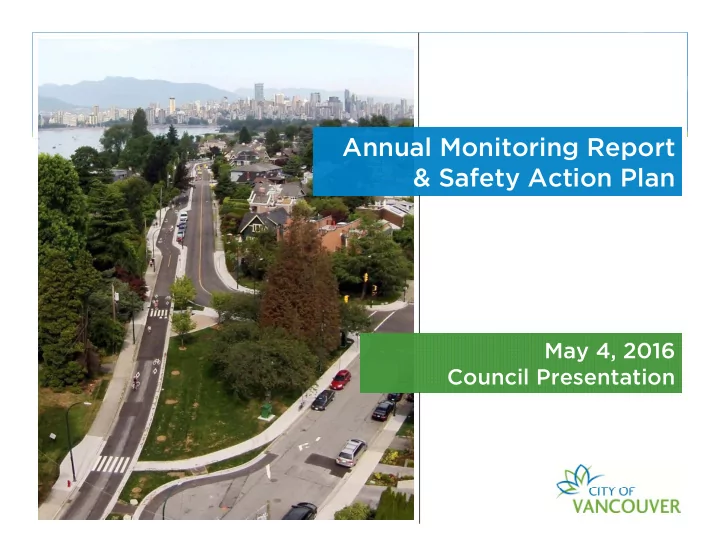
Annual Monitoring Report & Safety Action Plan May 4, 2016 - - PowerPoint PPT Presentation
Annual Monitoring Report & Safety Action Plan May 4, 2016 Council Presentation Presentation Overview 1. 1. 2015 Panel Survey 2015 Panel Survey Results Results 2. 2. Seaside Greenway Seaside Greenway 3. 3. Comox-Helmcken
1. 1. 2015 Panel 2015 Panel Survey Survey Results Results 2.
- 2. Seaside Greenway
Seaside Greenway 3.
- 3. Comox-Helmcken
Comox-Helmcken Greenway Greenway Health Studies Health Studies 4.
- 4. Monitoring Safety
Monitoring Safety 5.
- 5. Zero Traffic-Related Fatalities and
Zero Traffic-Related Fatalities and Serious Injuries Action Serious Injuries Action Plan Plan
Presentation Overview
- 1. 2015 Panel Survey Results
Source: 2013-2015 Panel Surveys, excluding recreational trips
- Pedestrian
travel high but steady
- People
cycling up again
- Transit
slightly down
- Vehicle trips
remain about the same
53% 51% 50% 18% 18% 16% 26% 26% 27% 4% 5% 7% 500,000 1,000,000 1,500,000 2,000,000
2013 2014 2015
Motor Vehicle Transit Walking Cycling
Daily Trips by Mode of Travel
Source: 2013-2015 Panel Surveys, excluding recreational trips
83,300 99,100 131,025
20,000 40,000 60,000 80,000 100,000 120,000 140,000
2013 2014 2015
Total Total Cycling Cycling Trips Trips
Total cycling trips increased 32% from 2014 to 2015 At 2020 target
- f 7% of all
trips
Total Cycling Trips
Source: 2013-2015 Panel Surveys, excluding recreational trips
Cycling Travel to work Mode Share at 10% 10% could be higher than any
- ther North
American City
- ver 500k
population
Work Trips by Mode of Travel
43% 41% 41% 30% 27% 24% 20% 23% 24% 7% 9% 10%
100,000 200,000 300,000
2013 2014 2015
Motor Vehicle Transit Walking Cycling
The average annual distance driven per person fell 27% from 2007 to 2015
5,950 5,821 5,238 4,995 4,840 4,680 4,552 4,319 1,000 2,000 3,000 4,000 5,000 6,000 7,000
20072008 2011 2012 2013 2014 2014 2015
Vehicle km’s Per Person
Source: *ICBC Vehicle Data and AirCare Data Odometer Readings. **City of Vancouver Panel Surveys
Annual Distance Driven per Person
Panel Survey Data AirCare Data
Source: 2013-2015 Panel Surveys. City of Vancouver.
Growing Car Share in Vancouver
13% 20% 26% 0% 5% 10% 15% 20% 25% 30% 2013 2014 2015
% of adults % of adults who are who are car car share members share members
1169 2342 500 1,000 1,500 2,000 2,500 2014 2015
Nu Number of mber of ca car sh r share e vehi vehicl cles es
- 2. Seaside Greenway
Seaside Greenway: Estimated Average Daily Bicycle Volumes (before project)
450-650** 800-1000** 1150-1250** 4500* 50-100** Bicycle Counter Estimates: August 2013 Weekday
Source: *The data provided are approximate average daily two-way bicycle volumes at each location for midweek (Tuesday to Thursday) days in August. These include averages from automatic counters and comparable estimates based on 12 hour (7am - 7pm) manual bicycle counts (with factors derived from automatic counters for 2012- 2013 plus August 2014). **City of Vancouver factored estimates based on manual counts.
Seaside Greenway: Average Daily Bicycle Volumes (after project completion)
The data provided are approximate average daily two-way bicycle volumes at each location for midweek (Tuesday to Thursday) days in August. These include averages from automatic counters and comparable estimates based on 12 hour (7am - 7pm) manual bicycle counts (with factors derived from automatic counters for 2012-2013 plus August 2014).
Bicycle Counter Volumes: August 2014 Weekday 2000 2700 2700 6200 600
Seaside Greenway: Average Daily Bicycle Volumes (after project completion)
2800 3300 3500 5400 600 Bicycle Counter Volumes: August 2014 Weekend
The data provided are approximate average daily two-way bicycle volumes at each location for weekend (Saturday and Sunday) days in August. These include averages from automatic counters and comparable estimates based on 12 hour (7am - 7pm) manual bicycle counts (with factors derived from the five automatic counters for the full month of August).
Source: Burrard Bridge Automatic Bicycle Counter Data
1.04 1.05 1.02 0.98 1.22 1.38
0.0 0.2 0.4 0.6 0.8 1.0 1.2 1.4 1.6
2010 2011 2012 2013 2014 2015
Burrard Bridge Burrard Bridge Cycling Cycling Trips, millions Trips, millions
Total annual cycling trips across the Burrard Bridge increased by more than 30% after South Intersection and Seaside Greenway upgrades
Burrard Bridge Cycling Volumes
Construction (Q3 2013-Q2 2014)
Source: City of Vancouver staff monitored bus travel times for selected routes before, during and after construction
#22 #22 #4 #4
#22 #22 Bus Route Bus Route: No significant travel time increases during or after construction. #4 Bus Route #4 Bus Route: 4th Ave traffic volumes increased and transit travel times increased ~ 30 seconds.
Minimal Impacts on Transit Travel Times
- 3. Comox-Helmcken Health Studies
Source: Centre for Hip Health and Mobility, Active Streets Active People – Comox-Helmcken Greenway, 2011-2015
Centre for Hip Health and Mobility: Active Streets, Active People – Comox-Helmcken Greenway
58% 58% 92% 92% 97% 97% 98% 98% 100% 100% 52% 52% 73% 73% 94% 94% 96% 96% 86% 86% 0% 20% 40% 60% 80% 100% The speed of cyclists on most nearby streets is usually slow The distance between intersections in my neighbourhood is usually short. Sidewalks are separated from the road/traffic in my neighbourhood by parked cars. There are sidewalks on most of the streets in my neighbourhood. There are facilities to bicycle in or near my neighbourhood, such as special use lanes, separate paths or trails, or shared use paths for cycles and pedestrians. T1- Strongly Agree/Agree T2-Strongly Agree/Agree
Source: Centre for Hip Health and Mobility, Active Streets Active People , Comox-Helmcken Greenway, 2011-2015
Centre for Hip Health and Mobility: Active Streets, Active People – Comox-Helmcken Greenway
UBC Health & UBC Health & Community Design Lab: Community Design Lab: Study of Travel, Health, and Activity – Comox-Helmcken Greenway
Participants:
- 473 participants
(red)
- 76 participants
- utside 500 m
study area (blue)
UBC Health & UBC Health & Community Design Lab: Community Design Lab: Study of Travel, Health, and Activity – Comox-Helmcken Greenway
Population Health Population Health
Participants living near the Comox- Helmcken Greenway reported:
- a 16.1%
16.1% increase in the number of days they engaged in moderate physical activity in a week
- an 8.0%
8.0% decrease in the time spent sitting and being sedentary
- a 9.8%
9.8% decrease in the number of days of poor physical and mental health
Source: UBC Health & Community Design Lab - Study of Travel, Health, and Activity, Comox-Helmcken Greenway: 2012-2015
59% 23% 15% 3% 58% 20% 18% 4% 0% 10% 20% 30% 40% 50% 60% Walking Motor Vehicle Transit Cycling Phase 1 Phase 2
Overall, mode share saw an increase in bicycle bicycle and transit transit trips, and a decrease in auto auto and walking trips.
Source: UBC Health & Community Design Lab - Study of Travel, Health, and Activity, Comox-Helmcken Greenway: 2011-2015
UBC Health & UBC Health & Community Design Lab: Community Design Lab: Study of Travel, Health, and Activity – Comox-Helmcken Greenway
16.5% 37.0% 38.9% 7.6% 13.1% 37.4% 38.7% 10.8%
0% 5% 10% 15% 20% 25% 30% 35% 40% 45%
1=Strongly disagree 2=Somewhat disagree 3=Somewhat agree 4=Strongly agree
Phase 1 Phase 2
Source: UBC Health & Community Design Lab - Study of Travel, Health, and Activity, Comox-Helmcken Greenway: 2011-2015
Increased perceived ease of friendship formation:
“It is easy to make friends in my neighbourhood” (mean: 2.4 -> 2.5; somewhat disagree)
- 4. Monitoring Safety
- Transportation related Fatalities – VPD
- Summary reports as they occur
- Annual review
- Collisions involving – ICBC
- Annual collision review
- Last data received for 2013 - pending
database update
Data Sources
25 34 39 21 32 26 25 23 30 25 25 19 16 9 13 19 16 15 12 8
100,000 200,000 300,000 400,000 500,000 600,000 700,000 5 10 15 20 25 30 35 40 1996 1997 1998 1999 2001 2002 2003 2004 2005 2006 2007 2008 2009 2010 2011 2012 2013 2014 2015 2016
Popula Populati tion
- n
Traffic Traffic Relat Related d Fatali Fataliti ties es Pedestrian, Cycling, and Vehicle Fatalities are Decreasing
Source: VPD Traffic Fatality Data (1996-2016)
Population Increasing
Traffic-Related Fatalities - Summary
50 19 Traffic-Related Fatalities by Mode in the past 6 years 10 3 1
Source: VPD Traffic Fatality Data, 2011-2016
Pedestrians 1%
Cyclist
1%
Motorcyclists
1%
Motor Vehicle Occupants
98%
Motor Vehicle Occupants
22%
Motorcyclists
15%
Cyclists
5%
Pedestrians
58% Collisi Collisions
- ns in Vancouver by road
in Vancouver by road user user Fatalities Fatalities in Vancouver by road in Vancouver by road user user
Traffic-Related Collisions and Fatalities
Source: ICBC Collision Data, 2009-2013 Source: VPD Traffic Fatality Data, 2009-2013
71% 28% 1% 1% Traffic Fatalities by Traffic Fatalities by Location Location Intersection Mid-Block Parking Lot Unknown
Traffic-Related Fatalities: Where?
Source: VPD Traffic Fatality Data, 2011-2015
95% 4% 23% 77%
0% 20% 40% 60% 80% 100% Arterial/Collector Roads Local Roads
Traffic Fatalities by Traffic Fatalities by Road Road Type Type
Traffic-Related Fatalities: Where?
Source: VPD Traffic Fatality Data, 2011-2015.
% of All Fatalities % of All Vancouver Roads
95% 95% of all fatalities
- ccur on
arterial/collector roads, which comprise only 23% of all Vancouver roads
0% 10% 20% 30% 40%
0-14 15-24 25-34 35-54 55-64 >=65
Traffic Fatalities by Traffic Fatalities by Age Age
Fatalities % of Total Population 57% 43% 51% 49%
0% 20% 40% 60%
Female Male
Traffic Fatalities by Traffic Fatalities by Gender Gender
Fatalities % Total Population (Census 2011)
Source: VPD Traffic Fatality Data, 2011-2015. Statistics Canada, Census 2011.
Traffic-Related Fatalities: Who?
2015 Fatalities
9 pedestrians 2 motorcyclists 1 driver
- Through vehicle & pedestrian: 7
- Right Turn vehicle & pedestrian: 1
- Parking lot: 1
- Through & through
- Left turn & through
- Left Turn & Through
Traffic-Related Fatalities: How?
Source: VPD Traffic Fatality Data, 2011-2015
- 5. Zero Traffic-Related
Fatalities and Serious Injuries Action Plan
- THEREFORE BE IT RESOLVED THAT Council
direct staff to report back on a strategy for achieving zero traffic-related fatalities and serious injuries, including:
- A review of best practices from other jurisdictions,
- An action plan, and
- A funding strategy to accelerate implementation.
- BE IT FURTHER RESOLVED THAT Council
direct staff to report back with quick start actions by June, 2016, and longer-term policies by November, 2016.
Council Resolution
Vision Zero: Peer Cities Review
- Initiated by Sweden in 1997
- Other countries in Europe
- Netherlands
- Norway
- Spain
- Finland
- North America:
- USA: 16 cities
- Canada: Edmonton, Ottawa, Strathcona
County, Surrey, Toronto
Core Principles Core Principles
- Traffic deaths are preventable and
unacceptable
- Human life takes priority over mobility
- Policies at all levels of government need to
align to make safety a priority
Vision Zero: Peer Cities Review
Key Areas of Focus Key Areas of Focus Vision Zero: Peer North American Cities Review
Engineering Legislation Evaluation Education Enforcement
Key Actions Key Actions
- Identify Priority Corridors with high numbers of
injuries and fatality
- Engineering interventions in high priority areas
- Targeted speed reductions
- Intersection and corridor improvements
- Focus on vulnerable road users
- Vision Zero Task Force
- Education and Enforcement Strategies
- Legislation changes
Vision Zero: Peer Cities Review
- Transportation 2040: Zero Traffic Related
Fatality goal
- Pedestrian Safety Study and Action Plan
- Cycling Safety Study and Action plan
- Creation of Traffic Safety Advisory group
- Working on sharing serious injury data
Vancouver Safety Progress
0.6 1.0 1.3 1.5 1.9 2.2 2.4 2.6 3.1 3.2 3.5 3.6 3.7 4.0 5.2 5.9
1 2 3 4 5 6 7 Oslo Stockholm Copenhagen London Amsterdam Vancouver Toronto Edmonton New York Ottawa Seattle Boston San Francisco Washington DC Los Angeles Portland
Fatalities Fatalities per per 100,000 100,000 inhabitants inhabitants
Vancouver Compared to Other Cities
1. 1. Enhanced Data Enhanced Data 2. 2. Evaluate and Prioritize Locations Evaluate and Prioritize Locations 3.
- 3. Engineering Action Plan
Engineering Action Plan 4.
- 4. Enforcement
Enforcement 5.
- 5. Education &
Education & Public Outreach Public Outreach 6.
- 6. Legislation
Legislation
Moving Towards Zero: Action Plan
Enhanced evaluation to understand traffic-related Enhanced evaluation to understand traffic-related sever severe injuries and make data-driven decisions injuries and make data-driven decisions Actions: Actions:
- Work with Health partners to better understand
serious injury data
- Working with ICBC to share severity of traffic
related injuries
- To better understand:
- How many severe injuries happen per year ?
- When? Where? How? Who?
- Quantify non-vehicle related incidents
- 1. Enhanced Data
Develop Collision Prediction models Develop Collision Prediction models
- Identify priority locations based on high risk
fatal & severe injuries
- Conduct a vehicle & motorcycle study
- 37% of fatalities
- Identify priority locations based on high
presence of vulnerable road users (ie. seniors)
- 2. Evaluate and Prioritize Locations
Example: Focus on Seniors
- Correlate serious
injuries and fatalities with seniors areas
- Work with the
Seniors Advisory Committee to identify strategies
Selected Seniors Centres Hospitals Community Centres Libraries Neighbourhood Houses Swimming Pools
Overrepresented Overrepresented type of type of collision collision
Pedestrian collisions after dark Turning vehicles & pedestrians at signals
Count ntermeasure ermeasure
LED Lighting Leading Pedestrian Intervals Sidewalk bike riding & falling into traffic Protected bike lanes
- Identify priority locations by countermeasure
- 2. Evaluate and Prioritize Locations
Detailed safety studies at priority locations Detailed safety studies at priority locations
- Automated video conflict analysis at priority
ranked locations
- 2. Evaluate and Prioritize Locations
Develop best safety practices toolkit Develop best safety practices toolkit & select & select the most effective solutions to the most effective solutions to address priority address priority locations locations
- Validate Toolkit
- Pilot New Items
- 3. Engineering Action Plan
Evaluate pilot programs Evaluate pilot programs
Rectangular Rapid Flashing Beacons 3 locations in 3 locations in pilot pilot Accessible Pedestrian Signals 2 locations in locations in pilot pilot Leading Pedestrian Intervals 1 locatio location in n in pilot pilot Lagging Right Turn Phase Explore pilot locatio Explore pilot location
Assess effectiveness and Assess effectiveness and further implement further implement
LED Lighting Left turn arrows Protected Intersections and turn phases Highlight conflict zones
- 3. Engineering Action Plan
Proactive safety Proactive safety
- All Ages and Abilities Bike
Network expansion
- Active & safe travel plans to school
- Review key routes around seniors
areas
- Policies for new infrastructure
- LED lighting
- Countdown timers
- Sidewalks
- Curb ramps
- 3. Engineering Action Plan
Target high Target high risk behaviors risk behaviors Actions: Actions:
- Work with VPD to develop targeted
enforcement programs to tackle dangerous behaviors at priority locations
- Speeding
- Failure to yield to pedestrians
- Failure to stop at signals
- Improper turning
- Disobeying signs
- Distracted/impaired driving
- 4. Enforcement
Engage Engage Vancouverites to travel safely & Vancouverites to travel safely & continue to work in cooperation with safety continue to work in cooperation with safety partners partners Actions: Actions:
- Create a Vision Zero website
- Report annual progress
- Work with VPD & ICBC on safety education
campaigns
- Continue to work with Traffic Safety
Advisory Group
- 5. Education and Public Outreach
Work with the provincial government towards Work with the provincial government towards zero safety goal zero safety goal Actions: Actions:
- Explore expanding red light camera
locations
- Advocate for the return of speed camera
enforcement
- School & parks
- High fatal & severe injury locations
- Request changes to blanket speed limit
- Advocate for changes under the Motor
Vehicle Act to protect vulnerable road users
- Increased penalties for dangerous driving
- 6. Legislation
- Serious injury data analysis
Serious injury data analysis
- ICBC
- Healthcare organizations
- Priority Intersection, Corridors &
Priority Intersection, Corridors & Neighborhoods Neighborhoods
- By countermeasure
- By vulnerable road users (ie. seniors, pedestrians etc)
- Select top locations for deep dive
- Engineering Action Plan
Engineering Action Plan
- Best practices toolkit
- Quick start action plan