SLIDE 1
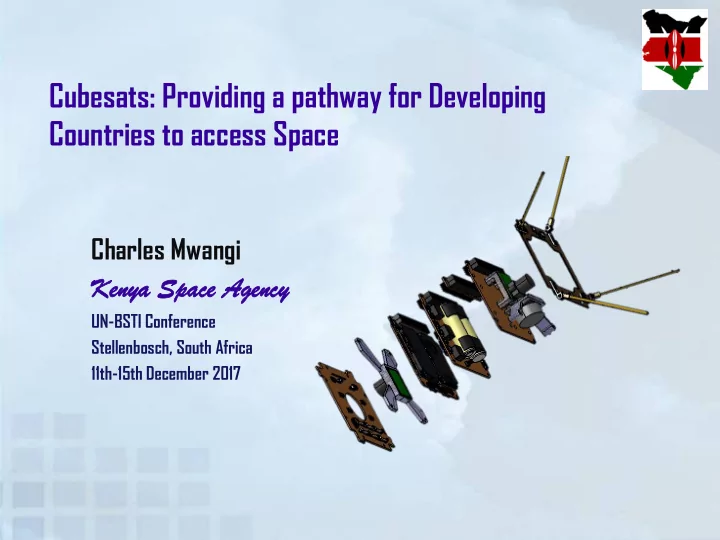
Cubesats: Providing a pathway for Developing Countries to access Space
Charles Mwangi Kenya ya Space e Agency cy
UN-BSTI Conference Stellenbosch, South Africa 11th-15th December 2017
SLIDE 2 Kenya-Italy Cooperation in Space Activities
Prof. Luigi Broglio, pioneer of the Italian space activities, founded the San Marco Project in 1964 in Malindi, Kenya (renamed “Broglio Space Centre” after
his death).
Activities at San Marco Base during the past 54 years span from rocket launches to satellite TT&C support and Remote Sensing data acquisition.
4 Ground Station for satellite data acquisition Number of launches: 27 : 100% success
- First launch: March 1964 - Nike Apache;
- Last launch: 25 March 1988 – SCOUT SV 206 (San
Marco) Brogl
ace e Centre tre
SLIDE 3
International Cooperation – Kenya & Italy
Italy-Kenya University Nano-Satellite (IKUNS) program established in September 2015, in a partnership between University of Rome and University of Nairobi for development and launch of a 6U Cubesat (3 years project). Opportunity for a “precursor flight” for this mission has been made possible by the UNOOSA/JAXA opportunity for 1U Cubesat Launch from the ISS Japanese Module “KiboCube”. In 2017-2018, joint Post-Graduate Course in “Space Mission Design and Management” between University of Nairobi and University of Rome commenced (course on-going). This precursor mission is called 1KUNS-PF (First Kenya University NanoSatellite- Precursor Flight) – to be launched in 2018.
SLIDE 4
Joint program - Sapienza
SLIDE 5
Joint program – University of Nairobi
SLIDE 6
Joint program – Broglio Space Centre
SLIDE 7
1KUNS: Structure of the Cubesat
1st Kenyan University Nano Satellite - Precursor Flight (1KUNS-PF) is a 1U CubeSat, with standard dimensions of 100 x 100 x 113.5 mm and approx weight of less than 1.33 kg. Primary goal: verify the performance of the on-board subsystems, by receiving telemetry data from the satellite. Secondary goal: acquisition, on-board storage and transmission to ground of low-definition, panchromatic images of Kenya and the East African region. Support the development of the IKUNS program
1KUNS CubeSat
SLIDE 8
1KUNS: Exploded view
SLIDE 9 Satellite: Sub-systems
Satellite vs. Cubesat
a) Power Supply Subsystems: generates and distributes power to onboard systems and instruments. b) Telecommunications Subsystems: for communication between the satellite and ground station (uplink/downlink). c) Control & Data Handling Subsystems: The onboard computer responsible for overall management of a spacecraft‘s activity. d) Attitude & Orbit Control Subsystems: manages the
- rientation of the spacecraft in space.
e) Superstructure: for mounting subsystems
SLIDE 10
1KUNS: Manufacturing and integration
SLIDE 11
1KUNS: Vibration and thermal test
SLIDE 12 1KUNS: Fit check test
Inside the J-SSOD
… Kenya to join the space faring countries?
SLIDE 13
1KUNS Launch opportunity from KiboCUBE
Launch opportunity thanks to United Nations Office of Outer Space Affairs/Japan Cooperation Programme on Cubesat Deployment from the International Space Station (ISS) Japanese Experiment Module (Kibo) “KiboCUBE” deployed on ISS by JAXA. Handover and deployment of 1KUNS Cubesat using “KiboCUBE” is planned for early 2018…
SLIDE 14
Benefits of Cubesats
Small groups of engineers which overcomes the challenge of limited staff CubeSats reduce design and launch costs because they are lighter, and thus requires less lift off fuel per unit weight In most cases, they also share a rocket (piggy-back) with a larger satellite. Use of Commercial off-the shelf (COTS) save time during the development phase. Opportunity for training personnel while developing the actual systems for deployment. Uses similar technology with drones, IoT devices etc.
SLIDE 15
Cubesats: Opportunity for Developing countries
a) Going back to the basics: progressively learning the skills from ground up; CanSat…satellite b) Consumers vs producers: learn the skills to develop satellite systems and stop being only consumers of satellite systems… c) Turnkey projects: Develop skills to design, modify and troubleshoot related satellite systems… d) Constellation: due to the high cost of convectional satellites, developing countries can most possibly benefit from Cubesat constellations…
CanSat CubeSat MicroSat Satellite
SLIDE 16
Cubesats: Growth opportunity
“CubeSats started as a tool for education. Profs Jordi Puig- Suari of California Polytechnic State University and Bob Twiggs of Stanford University wanted students to gain hands-on experience in designing, making and flying nanosatellites, but they needed to do it cheaply.” He continues “… CubeSats have the potential to become the autonomous drones of space.”
Roger Walker, ESA’s Technology CubeSat manager
SLIDE 17 Cubesats: African constellation…
“Planet Launches Satellite Constellation to Image the Whole Planet Daily” February 14, 2017, 19:58 PST Today Planet successfully launched 88 Dove satellites to
- rbit—the largest satellite constellation ever to reach orbit.
We calculated that it would take between 100-150 satellites to achieve this, and we started building them. After today’s launch, Planet operates 149 satellites in orbit. *Africa has 55 countries….
SLIDE 18
THANK YOU
Ngomeni, Malindi, Kenya