CS411 Pick application Conceptual design domain Database Systems - - PDF document

cs411
SMART_READER_LITE
LIVE PREVIEW

CS411 Pick application Conceptual design domain Database Systems - - PDF document

Steps in building a DB application CS411 Pick application Conceptual design domain Database Systems What data do I What data do I need for my need for my application application 02: The Entity-Relationship Model How can I How can I


slide-1
SLIDE 1

CS411 Database Systems

Kazuhiro Minami

02: The Entity-Relationship Model

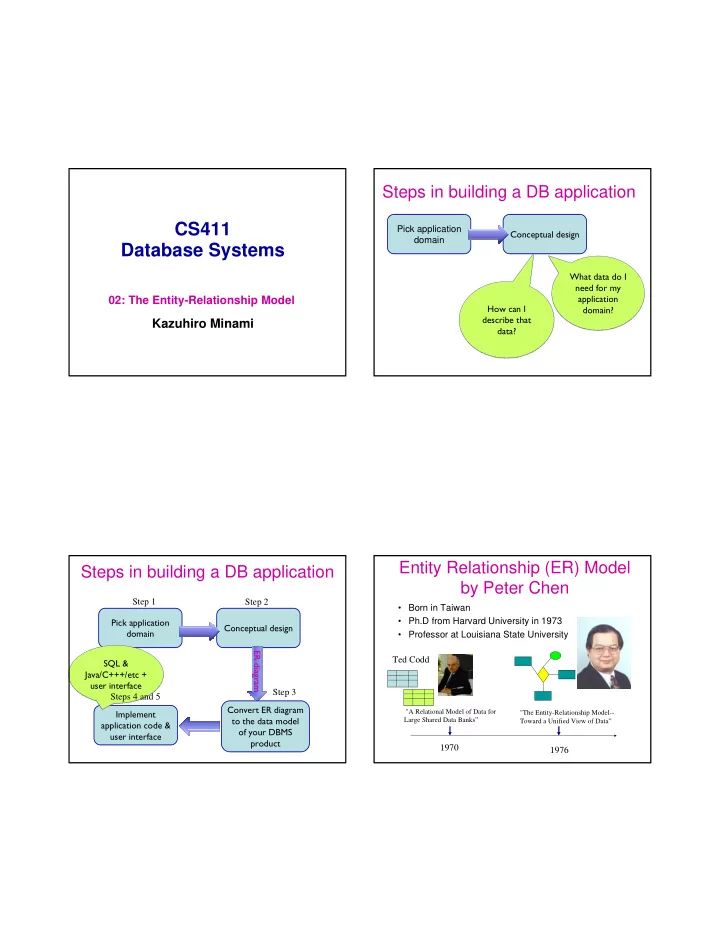
Steps in building a DB application

Pick application domain Conceptual design What data do I need for my application domain? What data do I need for my application domain? How can I describe that data? How can I describe that data?

Steps in building a DB application

Pick application domain Conceptual design ER diagram Convert ER diagram to the data model

  • f your DBMS

product Implement application code & user interface SQL & Java/C+++/etc + user interface SQL & Java/C+++/etc + user interface Step 1 Step 2 Step 3 Steps 4 and 5

Entity Relationship (ER) Model by Peter Chen

  • Born in Taiwan
  • Ph.D from Harvard University in 1973
  • Professor at Louisiana State University

"The Entity-Relationship Model-- Toward a Unified View of Data”

1976

"A Relational Model of Data for Large Shared Data Banks”

1970 Ted Codd

slide-2
SLIDE 2

The ER model is very simple

  • 5

address name ssn Person buys makes employs Company Product name category stockprice name price

Entity

– real-world object distinguishable from other

  • bjects

– described by its attributes

Attribute

– Has an atomic domain: string, integers, date, …

Entity set: all have the same set of attributes

Product name category price Company stockprice name boardOfDirectors

  • Relationships

If A, B are sets, then a relation R is a subset of A x B. A = {1, 2, 3} B = {a, b, c, d}

R = {(1,a), (1,c), (3,b)}

makes is a subset of Product x Company:

1 2 3 a b c d A B

makes Company Product

We can show the cardinality of a relationship

  • ne-one

many-one many-many

1 2 3 a b c d 1 2 3 a b c d 1 2 3 a b c d

makes Company Product

E F

slide-3
SLIDE 3

address name ssn Person buys makes employs Company Product name category stockprice name price

Exercise

Design a database for a bank, including information about customers and their accounts. Information about a customer includes their name, address, phone, and Social Security

  • number. Accounts have numbers, types (e.g., saving, checking)

and balances. Also record the customer(s) who own an account. 1) Draw the E/R diagram for this database. 2) Change your diagram so an account can have only one customer. 3) Further change your diagram so a customer can have only

  • ne account

4) Change your original diagram in (1) so that a customer have a set of addresses.

Customers Accounts

Name Address Phone SSN Type Balance

  • wn

How do we model a multiway relationship?

Purchase Product Person Store Can still model as a mathematical set (how?)

slide-4
SLIDE 4

What do arrows mean in n-way relationships?

If I know the store, person, and invoice, then there is only one possible movie.

“VideoStore, Invoice, and Person determines Movie”

VideoStore Person Movie Invoice Rental

What if there are several arrows?

store, person, invoice determines movie; store, invoice, movie determines person

VideoStore Person Movie Invoice Rental

How do I say “invoice determines store”?

No good way; best approximation: Why is this incomplete?

VideoStore Person Movie Invoice Rental

What if we need an entity set twice in one relationship?

Purchase Product Person Store

salesperson buyer

Person the “role”

slide-5
SLIDE 5

What if we need an entity set twice in one relationship?

Purchase Product Person Store

salesperson buyer

Some versions of the ER model allow attributes on relationships

Purchase Product Person Store date

You can “upgrade” a relationship to be an entity set

Purchase Person Store Product StoreOf ProductOf BuyerOf date

Constraint = assertion about the DB that must always be true

Key: social security number uniquely identifies a person. Single-value constraint: a person can have only one father. Referential integrity: if a person works for a company, the company must also be in the DB. Domain constraint: peoples’ ages are between 0 and 150. General constraint: all others (at most 100 students in this course)

slide-6
SLIDE 6

Constraints are very important

  • Help us to come up

with efficient storage, query processing, etc.

  • Help us keep

garbage out of the DB

– Garbage in, garbage out!

Examples:

Erbana, IL 61801 Brittany Speers

Underline the key for each entity set

address name ssn Person Product name category price multi-attribute keys are okay! Is this a good key? Multiple “candidate keys”? Pick just one to be the key.

Referential Integrity Constraints

makes Company Product makes Company Product )

  • The reference integrity constraint on relationships explicitly

requires a reference to exist

  • The DB equivalent of a dangling pointer

Degree Constraints

  • Constraints on degree of a relationship

takes Courses Students

<= 5

slide-7
SLIDE 7

Sometimes your entity might not seem to have a key

Weak entity set: some or all of its key attributes come from other classes to which it is related. University Team affiliation record sport name )