CS411 than $50,000 and pay taxes in Champaign-Urbana. Database - - PDF document

cs411
SMART_READER_LITE
LIVE PREVIEW

CS411 than $50,000 and pay taxes in Champaign-Urbana. Database - - PDF document

How do we query (specify what info we want from) the database? Find all the employees who earn more CS411 than $50,000 and pay taxes in Champaign-Urbana. Database Systems Could write in C++/Java, but who would want to? 05: Relational


slide-1
SLIDE 1

CS411 Database Systems

Kazuhiro Minami 05: Relational Algebra

How do we query (specify what info we want from) the database?

Find all the employees who earn more than $50,000 and pay taxes in Champaign-Urbana.

  • Could write in C++/Java, but who would

want to?

  • Instead use high-level query languages:

– Theoretical: Relational algebra – Practical: SQL

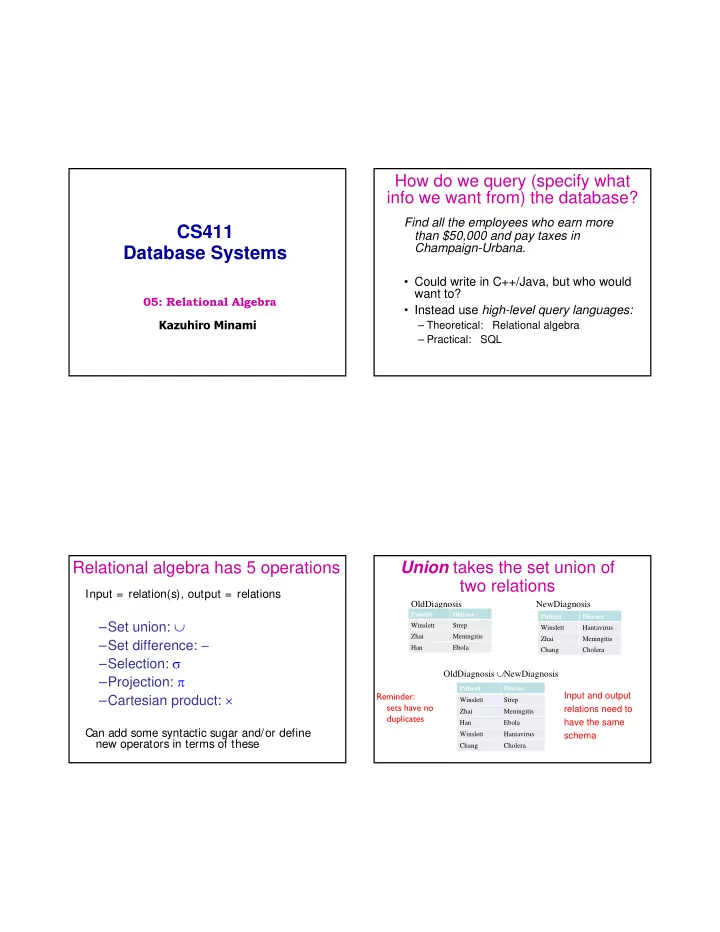
Relational algebra has 5 operations

Input = relation(s), output = relations

–Set union: ∪ –Set difference: − –Selection: σ –Projection: π –Cartesian product: ×

Can add some syntactic sugar and/or define new operators in terms of these

Union takes the set union of two relations

Input and output relations need to have the same schema OldDiagnosis NewDiagnosis OldDiagnosis ∪NewDiagnosis

Patient Disease Winslett Strep Zhai Meningitis Han Ebola Patient Disease Winslett Hantavirus Zhai Meningitis Chang Cholera Patient Disease Winslett Strep Zhai Meningitis Han Ebola Winslett Hantavirus Chang Cholera

Reminder: sets have no duplicates

slide-2
SLIDE 2

Sometimes we’d like to name or rename the output (syntactic sugar)

AllDiag(Patients, Diseases) := OldDiagnosis ∪ NewDiagnosis

  • r

ρAllDiag(Patients, Diseases) (OldDiagnosis ∪NewDiagnosis)

Patients Diseases Winslett Strep Zhai Meningitis Han Ebola Winslett Hantavirus Chang Cholera

Difference takes the set difference of two relations

OldDiagnosis NewDiagnosis WrongDiagnosis := OldDiagnosis − NewDiagnosis

Patient Disease Winslett Strep Zhai Meningitis Han Ebola Patient Disease Winslett Hantavirus Zhai Meningitis Chang Cholera Patient Disease Winslett Strep Han Ebola

Selection keeps only the tuples that satisfy a particular condition

Patient Disease Temperature Winslett Strep 98.9 Zhai Meningitis 101.1 Han Ebola 96.6 Winslett Hantavirus 98.6 Chang Cholera 102.3

Diagnosis Find all patients who have a fever σTemperature > 98.6 (Diagnosis) Better for everyone’s sake if we write this as σ[Temperature > 98.6] (Diagnosis) You can write it any of these two ways in this class.

Selection conditions can be relatively complex

Attribute names

Patient Disease Salary

Constants “Winslett”

“Meningitis” 40,000

= < > ≤ ≠

Patient = “Winslett” Salary < 40,000

and or not

Patient = “Winslett” and Temperature > 98.6

slide-3
SLIDE 3

Selection Example Employee SSN Name DepartmentID Salary 999999999 John 1 30,000 777777777 Tony 1 32,000 888888888 Alice 2 45,000 SSN Name DepartmentID Salary 888888888 Alice 2 45,000 Find all employees with salary more than $40,000. σ Salary > 40000 (Employee)

Projection eliminates all but the listed columns, and puts them in the listed order

For convenience, we may write

π [Disease, Patient] (Diagnosis)

Patient Disease Temperature Winslett Strep 98.9 Zhai Meningitis 101.1 Han Ebola 96.6 Winslett Hantavirus 98.6

Diagnosis List all the patients and their diagnoses

Disease Patient Strep Winslett Meningitis Zhai Ebola Han Hantavirus Winslett

π Disease, Patient (Diagnosis)

The columns you project onto have to actually exist

π[Salary, Town] Diagnosis π[Disease] Employee Formally, π A1, …, An(R) is a legal relational algebra expression if each

  • f A1, …, An is an attribute of R

Projection Example Employee SSN Name DepartmentID Salary 999999999 John 1 30,000 777777777 Tony 1 32,000 888888888 Alice 2 45,000 SSN Name 999999999 John 777777777 Tony 888888888 Alice

Π SSN, Name (Employee)

slide-4
SLIDE 4

The cartesian product of two relations is usually enormous

Disease Ebola Hantavirus

RareDiseases Diagnosis

Patient Disease Winslett Strep Zhai Meningitis Han Ebola

Diagnosis × RareDiseases

Patient Diagnosis.Disease RareDiseases.Disease Winslett Strep Ebola Zhai Meningitis Ebola Han Ebola Ebola Winslett Strep Hantavirus Zhai Meningitis Hantavirus Han Ebola Hantavirus

Take each possible combination of

  • ne tuple from

the first relation and one tuple from the second relation (may need to rename some attributes) Cartesian Product Example Employee Name SSN John 999999999 Tony 777777777 Dependents EmployeeSSN Dname 999999999 Emily 777777777 Joe Employee x Dependents Name SSN EmployeeSSN Dname John 999999999 999999999 Emily John 999999999 777777777 Joe Tony 777777777 999999999 Emily Tony 777777777 777777777 Joe

Relational algebra = every expression you can make using these 5 operators

(plus renaming) Any relation name is a relational algebra expression. If R and S are relational algebra expressions, then so are R – S, R ∪ S and R × S. If R is a relational algebra expression and θ is a selection condition, then σ[θ]R is a relational algebra expression. If R is a relational algebra expression and L is a list of attributes

  • f R, then π[L]R is a relational algebra expression.

Nothing else is a relational algebra expression.

Derived RA Operations

Intersection, join

slide-5
SLIDE 5

Intersection can be defined in terms of difference

OldDiagnosis NewDiagnosis RightDiagnosis = OldDiagnosis ∩ NewDiagnosis = OldDiagnosis – (OldDiagnosis – NewDiagnosis) More generally, R ∩ S = R – (R – (S)).

Patient Disease Winslett Strep Zhai Meningitis Han Ebola Patient Disease Winslett Hantavirus Zhai Meningitis Chang Cholera Patient Disease Zhai Meningitis

A join is a cartesian product followed immediately by a selection

OldDiagnosis NewDiagnosis Who has an old diagnosis that is different from one of their new diagnoses? π [#1] σ [#1 = #3 and #2 ≠ #4] (OldDiagnosis × NewDiagnosis)

Patient Disease Winslett Strep Zhai Meningitis Han Ebola Patient Disease Winslett Hantavirus Zhai Meningitis Chang Cholera Patient Winslett

A A j j

  • i

i n n

How does that work?

19

OldDiagnosis NewDiagnosis

Patient Disease Winslett Strep Zhai Meningitis Han Ebola Patient Disease Winslett Hantavirus Zhai Meningitis Chang Cholera Pat1 Dis1 Pat2 Dis2 Winslett Strep Winslett Hantavirus Zhai Meningitis Winslett Hantavirus Han Ebola Winslett Hantavirus Winslett Strep Zhai Meningitis Zhai Meningitis Zhai Meningitis Han Ebola Zhai Meningitis Winslett Strep Chang Cholera Zhai Meningitis Chang Cholera Han Ebola Chang Cholera

Temp(Pat1, Dis1, Pat2, Dis2) = OldDiagnosis × NewDiagnosis

BothDiagnoses = σ[Pat1 = Pat2 and Dis1 ≠ Dis2] (Temp)

Pat1 Dis1 Pat2 Dis2 Winslett Strep Winslett Hantavirus Zhai Meningitis Winslett Hantavirus Han Ebola Winslett Hantavirus Winslett Strep Zhai Meningitis Zhai Meningitis Zhai Meningitis Han Ebola Zhai Meningitis Winslett Strep Chang Cholera Zhai Meningitis Chang Cholera Han Ebola Chang Cholera

Temp

slide-6
SLIDE 6

BothDiagnoses = σ[Pat1 = Pat2 and Dis1 ≠ Dis2] (Temp)

Pat1 Dis1 Pat2 Dis2 Winslett Strep Winslett Hantavirus

BothDiagnoses

FinalAnswer = π[Pat1] BothDiagnoses

Pat1 Dis1 Pat2 Dis2 Winslett Strep Winslett Hantavirus

BothDiagnoses

Pat1 Winslett

FinalAnswer

There is a convenient shorthand for joins

R ⋈θ S

= σ θ (R × S)

Relational algebra expressions A selection condition I’ll let you write it as

R ⋈[q ] S

This is called a θ-join, or an equijoin when θ is =.

Natural joins join on attributes with the same name

Employees Managers Employees ⋈ Managers

Emp Dept Winslett Complaint Zhai Toy Han Toy Dept Mgr Complaint Mendez Toy Smith Returns Chu Emp Dept Mgr Winslett Complaint Mendez Zhai Toy Smith Han Toy Smith

slide-7
SLIDE 7

A natural join is an equijoin on all attributes with the same name, followed by removal of the duplicate attributes

R ⋈ S = πeverything but the duplicate attributes σ R.A1=S.A1 and…and

R.An=S.An (R × S)

A1 through An are all the attributes R and S have in common

Natural joins don’t always make sense

Emp(name, dept) Dept (name, mgr) Emp ⋈ Dept is nonsensical

Your first real query: who makes more than their manager?

E(emp, dept, sal) M(mgr, dept) ESM(emp, sal, mgr) = π[emp, sal, mgr] (E ⋈ M)

π[ESM.emp](ESM ⋈ [mgr = E.emp AND ESM.sal > E.sal] E)

Why???

28

Emp Dept Sal Jones Missiles 10K Chu Tanks 20K Swami Explosives 50K Mendez Tanks 10K Benson Explosives 40K Mgr Dept Mendez Tanks Swami Explosives Jones Missiles Emp Sal Mgr Jones 10K Jones Chu 20K Mendez Swami 50K Swami Mendez 10K Mendez Benson 40K Swami

ESM = π[Emp, Sal, Mgr] (E ⋈ M) M

Emp Sal Mgr Emp Dept Sal Chu 20K Mendez Mendez Tanks 10K

E

Emp Dept Sal Mgr Jones Missiles 10K Jones Chu Tanks 20K Mendez Swami Explosives 50K Swami Mendez Tanks 10K Mendez Benson Explosives 40K Swami

E ⋈ M ESM ⋈ [ESM.Mgr = E.Emp AND ESM.Sal > E.Sal] E

slide-8
SLIDE 8

You can define relational algebra on bags instead of sets (closer match to SQL)

  • Union: {a,b,b,c} U {a,b,b,b,e,f,f} = {a,a,b,b,b,b,b,c,e,f,f}

– add the number of occurrences

  • Difference: {a,b,b,b,c,c} – {b,c,c,c,d} = {a,b,b}

– subtract the number of occurrences

  • Intersection: {a,b,b,b,c,c} {b,b,c,c,c,c,d} = {b,b,c,c}

– minimum of the two numbers of occurrences

  • Selection: preserve the number of occurrences
  • Projection: preserve the number of occurrences (no

duplicate elimination)

  • Cartesian product, join: no duplicate elimination

More detail in the book (Chapter 5.1)

Summary of relational algebra

Basic primitives: σ [C] (E)

π [A1, …, An] (E) E1 × E2 E1 ∪ E2 E1 – E2

ρ[S(A1, …, An)] (E)

Abbreviations:

E1 ⋈ E2 E1 ⋈ C E2 E1 ∩ E2