CS411 data Has similar capabilities for queries to those in - - PDF document

cs411
SMART_READER_LITE
LIVE PREVIEW

CS411 data Has similar capabilities for queries to those in - - PDF document

SQL = S tructured Q uery L anguage Standard language for querying and manipulating CS411 data Has similar capabilities for queries to those in Database Systems relational algebra Support statements for modifying a database (e.g.,


slide-1
SLIDE 1

CS411 Database Systems

Kazuhiro Minami 06: SQL

SQL = Structured Query Language

Standard language for querying and manipulating data

  • Has similar capabilities for queries to those in

relational algebra

  • Support statements for modifying a database (e.g.,

inserting and deleting tuples) and for declaring a database schema Many standards: SQL92, SQL2, SQL3, SQL99

  • We cover features that conform with SQL99

What is special about SQL?

You describe what you want, and the job of the DBMS is to figure out how to compute what you want efficiently.

(at least in theory)

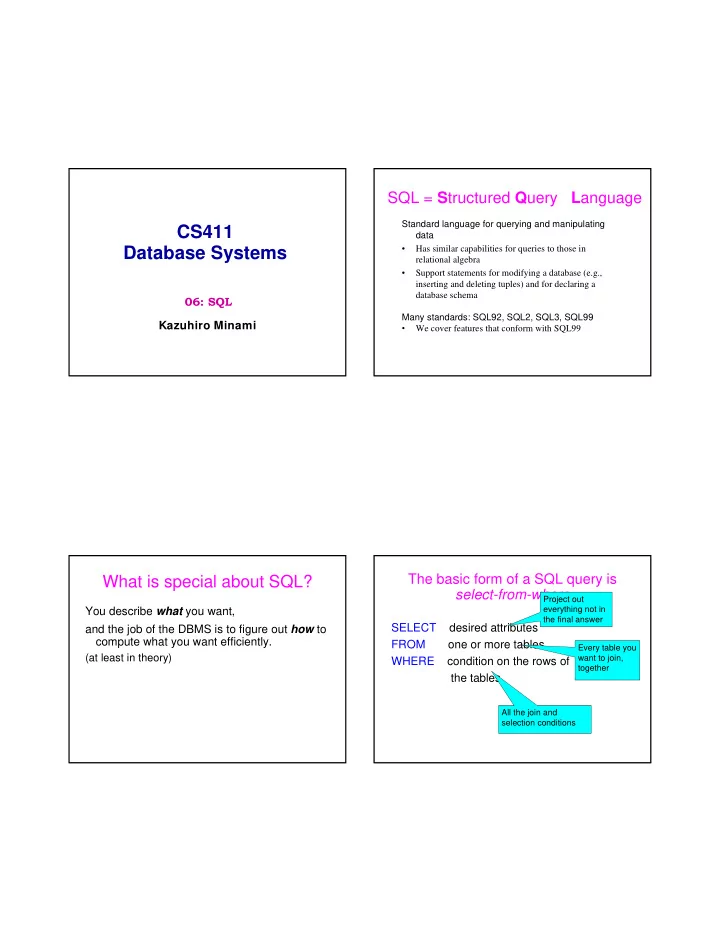
The basic form of a SQL query is select-from-where

SELECT desired attributes FROM

  • ne or more tables

WHERE condition on the rows of the tables

Project out everything not in the final answer Every table you want to join, together All the join and selection conditions

slide-2
SLIDE 2

Single-Relation Queries What beers are made by Anheuser-Busch?

Beers(name, manf)

Name Bud Bud Lite Michelob

SELECT name FROM Beers WHERE manf = ‘Anheuser-Busch’; SELECT name FROM Beers WHERE manf = ‘Anheuser-Busch’;

In relational algebra: σ [manf = “Anheuser-Busch”] Beers Name Manf Bud Anheuser-Busch Bud Lite Anheuser-Busch Michelob Anheuser-Busch Super Dry Asahi

These simple queries can be translated to relational algebra

  • 1. Begin with the

relation in the FROM clause.

  • 2. Apply the selection

indicated by the WHERE clause.

  • 3. Apply the projection

indicated by the SELECT clause.

SELECT A1, …, An FROM R WHERE condition R[condition][A1, …, An] π[A1, …, An] σ[condition] R

Here is a way to think about how the query might be implemented

  • 1. Imagine a tuple variable

ranging over each tuple

  • f the relation

mentioned in FROM.

  • 2. Check if the “current”

tuple satisfies the WHERE clause.

  • 3. If so, output the

attributes/expressions

  • f the SELECT clause

using the components

  • f this tuple.

A B C A B

slide-3
SLIDE 3

Put * in the SELECT clause if you don’t want to project out any attributes

Beers(name, manf)

Name Manf Bud Anheuser-Busch Bud Lite Anheuser-Busch Michelob Anheuser-Busch

SELECT * FROM Beers WHERE manf = ‘Anheuser-Busch’; SELECT * FROM Beers WHERE manf = ‘Anheuser-Busch’;

Find all US companies whose stock is > $500

Company(sticker, name, country, stockPrice)

SELECT * FROM Company WHERE country=‘USA’ AND stockPrice > 500 SELECT * FROM Company WHERE country=‘USA’ AND stockPrice > 500

Sticker Name Country StockPrice GOOG Google USA 550 GOOG Apple USA 485

You can rename the attributes in the result, using “as <new name>”

Beers(name, manf)

SELECT name AS beer, manf FROM Beers WHERE manf = ‘Anheuser-Busch’; SELECT name AS beer, manf FROM Beers WHERE manf = ‘Anheuser-Busch’;

Beer Manf Bud Anheuser-Busch Bud Lite Anheuser-Busch Michelob Anheuser-Busch

You can use math in the SELECT clause

Sells(bar, beer, price)

SELECT bar, bEeR, price*120 AS priceInYen FROM Sells; SELECT bar, bEeR, price*120 AS priceInYen FROM Sells;

Bar Beer PriceInYen Joe’s Bud 300 Sue’s Asahi 360 … … … Case-insensitive , e x c e p t i n s i d e q u

  • t

e d s t r i n g s

slide-4
SLIDE 4

You can create a new column and give it a constant value, in the SELECT clause

Drinker WhoLikesBud Sally Likes Bud Fred Likes Bud

SELECT drinker, ‘Likes Bud’ AS WhoLikesBud FROM Likes WHERE beer = ‘Bud’; SELECT drinker, ‘Likes Bud’ AS WhoLikesBud FROM Likes WHERE beer = ‘Bud’;

Likes(Drinker, beer) Drinker Beer Sally Bud Fred Bud

Find the price Joe’s Bar charges for Bud.

Sells(bar, beer, price)

SELECT price FROM Sells WHERE bar = ‘Joe’’s Bar’ AND beer = ‘Bud’; SELECT price FROM Sells WHERE bar = ‘Joe’’s Bar’ AND beer = ‘Bud’;

Two single quotes inside a string = one apostrophe

What you can use in the WHERE clause conditions:

constants of any supported type attribute names of the relation(s) used in the FROM arithmetic operations: stockprice*2

  • perations on strings (e.g., “||” for concatenation)

comparison operators: =, <>, <, >, <=, >= lexicographic order on strings (<) string pattern matching: s LIKE p special functions for comparing dates and times and combinations of the above using AND, OR, NOT, and parentheses

attr LIKE pattern does pattern matching on strings

pattern is a quoted string that may contain two special symbols:

phone LIKE ‘%555-_ _ _ _’ address LIKE “%Mountain%”

Symbol What It Matches

%

matches any sequence of characters

_

matches any single character

slide-5
SLIDE 5

Find the drinkers with phone prefix 555

Drinkers(name, addr, phone)

SELECT name FROM Drinkers WHERE phone LIKE ‘%555-____’; SELECT name FROM Drinkers WHERE phone LIKE ‘%555-____’;

Find all US companies whose address contains “Mountain”

Company(sticker, name, address, country, stockPrice)

SELECT * FROM Company WHERE country=“USA” AND address LIKE ‘%Mountain%’; SELECT * FROM Company WHERE country=“USA” AND address LIKE ‘%Mountain%’;

What if an attribute value is unknown,

  • r the attribute is inapplicable (e.g., my

daughter’s spouse)?

SELECT bar FROM Sells WHERE price < 2.00 OR price >= 2.00; SELECT bar FROM Sells WHERE price < 2.00 OR price >= 2.00;

Bar Jillian’s

Why???

Bar Beer Price Jillian’s Bud 2.00 White Horse Inn Asahi NULL

Conditions involving NULL evaluate to unknown, rather than true or false

Example condition Evaluates to ‘Smith’ = ‘Smith’ tru true 2 > 6 fal false ‘Smith’ = NULL un unkno known 2 < NULL un unkno known tru true AND unkn unknown un unkno known tru true OR unkno unknown tru true fal false AND un unkno known fal false fal false OR unknown unknown un unkno known un unkno known OR un unknown un unkno known

A tuple only goes in the answer if its truth value for the WHERE clause is true.

slide-6
SLIDE 6

The “law of the excluded middle” doesn’t hold in this 3- valued logic

SELECT bar FROM Sells WHERE price < 2.00 OR price >= 2.00; SELECT bar FROM Sells WHERE price < 2.00 OR price >= 2.00; unknown unknown

Bar Beer Price White Horse Inn Asahi NULL

unkno nown

SQL code writers spend a lot of space dealing with NULL values

Can test for NULL explicitly:

x IS NULL x IS NOT NULL

SELECT * FROM Person WHERE age < 25 OR age >= 25 OR age IS NULL The answer includes all Persons!

Exercise 1: online bookstore

Book(isbn, title, publisher, price) Author(assn, aname, isbn) Customer(cid, cname, state, city, zipcode) Buy(tid, cid, isbn, year, month, day) Q1: Make a list of the ISBNs and titles of books whose price is greater than $1000? SELECT isbn, title FROM Book WHERE price > 1000

Multi-Relation Queries

slide-7
SLIDE 7

If you need to join several relations, you can list them all in the FROM clause

SELECT bar FROM Sells, Likes WHERE drinker = ‘Alice’ AND Likes.beer = Sells.beer; SELECT bar FROM Sells, Likes WHERE drinker = ‘Alice’ AND Likes.beer = Sells.beer;

List the bars that serve a beer that Alice likes. Likes(drinker, beer) Sells(bar, beer, price)

Thi his is ho how we disambiguate attribute names.

π[bar](Sells ⋈ σ [drinker =“Alice”] Likes)

Find the beers liked by at least one person who frequents Murphy’s Pub

SELECT beer AS beersWorthKeeping FROM Likes, Frequents WHERE bar = ‘Murphy’’s Pub’ AND Frequents.drinker = Likes.drinker; SELECT beer AS beersWorthKeeping FROM Likes, Frequents WHERE bar = ‘Murphy’’s Pub’ AND Frequents.drinker = Likes.drinker;

BeersWorthKeeping Samuel Adams Pale Ale …

Likes(drinker, beer) Frequents(drinker, bar) π[beer] (Likes ⋈ σ [bar = “Murphy’s Pub”] Frequents)

Find names of people living in Champaign who bought snow shovels, and the names of the stores where they bought them

Purchase (buyer, seller, store, product) Person(pname, phoneNumber, city) SELECT pname, store FROM Person, Purchase WHERE pname = buyer AND city = ‘Champaign’ AND product = ‘snow shovel’; SELECT pname, store FROM Person, Purchase WHERE pname = buyer AND city = ‘Champaign’ AND product = ‘snow shovel’; π[pname, store](σ [city = “Champaign”] Person ⋈ Pname = buyer

σ [product=“snow shovel”] Purchase)

You can also join three or more relations, just like in relational algebra

Product (name, price, category, maker) Purchase (buyer, seller, store, product) Person (name, phoneNumber, city) Find names and phone numbers of people buying telephony products. SELECT Person.name, Person.phoneNumber FROM Person, Purchase, Product WHERE Person.name=Purchase.buyer AND Purchase.product=Product.name AND Product.category=“telephony” SELECT Person.name, Person.phoneNumber FROM Person, Purchase, Product WHERE Person.name=Purchase.buyer AND Purchase.product=Product.name AND Product.category=“telephony”

slide-8
SLIDE 8

What should be in the answer when the query involves a join?

  • 1. Create the cartesian product of all the relations

in the FROM clause.

  • 2. Then remove all the tuples that don’t satisfy the

selection condition in the WHERE clause.

  • 3. Project the remaining tuples onto the list of

attributes/expressions in the SELECT clause.

An algorithm for computing the answer

  • 1. Imagine one tuple

variable for each relation mentioned in

  • FROM. These tuple-

variables visit each combination of tuples, one from each relation.

  • 2. Whenever the tuple-

variables are pointing to tuples that satisfy the WHERE clause, send these tuples to the SELECT clause.

A B C A B E D E

Exercise 2: online bookstore

Book(isbn, title, publisher, price) Author(assn, aname, isbn) Customer(cid, cname, state, city, zipcode) Buy(tid, cid, isbn, year, month, day) Q2: Make a list of the CIDs and customer names who bought books written by ‘Barack Obama’? SELECT Customer.cid, Customer.cname FROM Author, Buy, Customer WHERE Customer.cid = Buy.cid AND Buy.isbn = Author.ibn AND Author.name = `Barack Obama’ ;