CS312 Course Introduction "Computers are good at following - - PowerPoint PPT Presentation

cs312 course introduction
SMART_READER_LITE
LIVE PREVIEW

CS312 Course Introduction "Computers are good at following - - PowerPoint PPT Presentation

CS312 Course Introduction "Computers are good at following instructions, but not at reading your mind." -Donald Knuth, Tex p. 9 Mike Scott, Gates 6.304 scottm@cs.utexas.edu www.cs.utexas.edu/~scottm/cs312 1 Who Am I Lecturer in


slide-1
SLIDE 1

1

CS312 Course Introduction

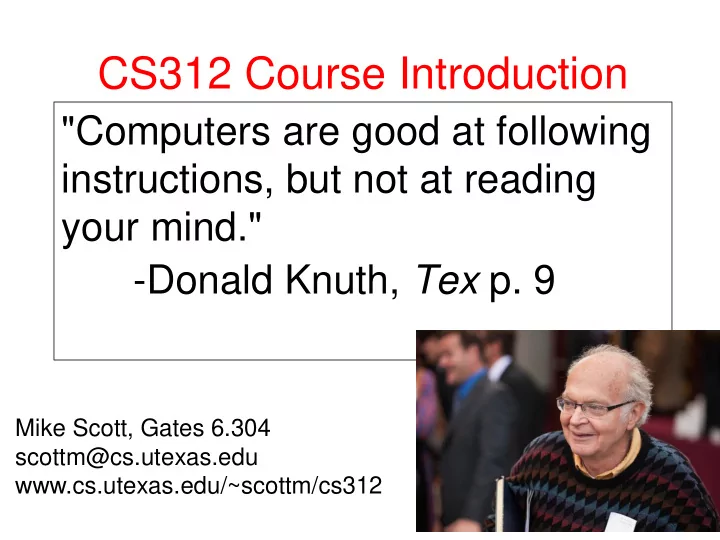
"Computers are good at following instructions, but not at reading your mind."

  • Donald Knuth, Tex p. 9

Mike Scott, Gates 6.304 scottm@cs.utexas.edu www.cs.utexas.edu/~scottm/cs312

slide-2
SLIDE 2

2

Who Am I

Lecturer in CS department since 2000 Undergrad Stanford, MSCS RPI US Navy for 8 years, submarines 2 years Round Rock High School

CS312

slide-3
SLIDE 3

My Path to CS

CS312

3

slide-4
SLIDE 4

4

What We Will Do Today

Introductions and administrative details Start Java Basics

CS312

slide-5
SLIDE 5

Intro to Programming

Learn to design and implement computer programs to solve problems.

CS312

5 1. course Intro 2. basic Java 3. static methods 4. expressions & variables 5. for loops 6. more loops, constants 7. parameters 8. 2d graphics 9. more graphics 10. return values, Math methods 11. conditional statements 12. cumulative algorithms 13. Strings 14. while loops 15. random numbers 16. Boolean logic 17. assertions 18. file input 1 19. file input 2 20. file input 3 21. arrays 22. more arrays 23. tallying algos 24. sorting, searching 25. more array algos 26. 2d arrays 27. classes and objects 28. methods 29. constructors 30. creating classes, Enums 31. inheritance 32. polymorphism 33. ArrayList 34. recursion

slide-6
SLIDE 6

Programing and CS

A tool for doing the cool stuff in CS You can't create a self driving vehicle without the software to control the vehicle

CS312

6

slide-7
SLIDE 7

The Parable of Aaron D.

I assume no prior programming experience. You are limited to what you can use on assignment to what we have covered in the book. I will defer questions that are well past what we are currently covering. Programming is not a spectator sport.

– The only way to learn to program is to program

Aaron D. and the 500 problems.

7

slide-8
SLIDE 8

8

Startup

If you have not already done so … … complete the items on the class start-up page http://www.cs.utexas.edu/~scottm/ cs312/handouts/startup.htm

CS312

slide-9
SLIDE 9

Books and software

Course Overview

9

  • book is required - we follow

it quite closely

  • Chrome and Proctorio extension

for exams

  • Java for programming
  • IDE for programming
  • Canvas for turning in assignments, grades,

UT Instapoll, section problems, exams

slide-10
SLIDE 10

10

Clicker 1

Which of these best describes you?

  • A. first year at UT and first year college student
  • B. first year at UT, transferring from another college
  • r university
  • C. in second year at UT
  • D. in third year at UT
  • E. other

CS312

slide-11
SLIDE 11

Graded Course Components

UT Instapoll (In class questions)

– 42 lectures with UT Instapoll, 7 dropped, 35 points

Discussion section problems (Go to your section.

Do not refer to the course id from Canvas, same for all.)

– 10 problems, 3 points each, 2 dropped, 24 points

Programming projects

– 12 projects, 1st 10, rest 20 points each: 210 points total (lowest grade of assignments 2 - 12 dropped)

Exams: Outside of class

– Exam 1, Wednesday, 9/30, approx. 6:45 – 9:15 pm, 150 points – Exam 2, Wednesday, 11/11, approx. 6:45 – 9:15 pm, 250 points – Exam 3, Date and time TBD (during finals week), 340 points

35 + 24 + 210 + 150 + 250 + 340 + 5 (quiz) = 1014

clicker, Quizzes, Programming Assignments capped at 260 pts

– 14 points of “slack” among those 3 components – Extra Credit: Computing background survey +3 points, practice exam + 3 points, eCIS & TA Survey +6 points

slide-12
SLIDE 12

Grades and Performance

No points added! Grades based on 1000 points, not 1014 Final grade determined by final point total and a 900 – 800 – 700 – 600 scale

– plusses and minuses if within 25 points of cutoff: 875 – 899: B+, 900 – 924: A-

historically my CS312 classes (~2000 Students) 80% C- or higher:

38% A's, 28% B's 12% C's

10% D or F 10% Q or W (drop)

CS312

5 10 15 20 25 30 35 40 A B C D F Q, W

% Students With Grade

slide-13
SLIDE 13

Assignments

Start out easy but get much, much harder Individual – do your own work Programs checked automatically with plagiarism detection software Turn in the right thing - correct name, correct format or you will lose points / slip days Slip days

– 8 for term, max 2 per assignment – don’t use frivolously

13

CS312

slide-14
SLIDE 14

14

Succeeding in the Course

Randy Pausch, CS Professor at CMU said:

"When I got tenure a year early at Virginia, other Assistant Professors would come up to me and say, 'You got tenure early!?!?! What's your secret?!?!?' and I would tell them, 'Call me in my office at 10pm on Friday night and I'll tell you.' " “A lot of people want a shortcut. I find the best shortcut is the long way, which is basically two words: work hard.”

slide-15
SLIDE 15

Succeeding in the Course - Meta

“Be the first penguin”

– Ask questions!!! – lecture, section, Piazza, lab hours

“It is impossible to be perfect”

– Mistakes are okay. – That is how we learn.

– Trying to be perfect means not taking risks.

– no risks, no learning

“Find a Pack”

– Make friends. – Study with them!

CS312

15

slide-16
SLIDE 16

How to Get Help

Piazza Post Help Hours via Zoom SI Sessions Email instructor or TAs

– Prefer Piazza

Class examples Examples from book Discuss with other students at a high level

CS312

16

MONDAYS WEDNESDAY & THURSDAY

slide-17
SLIDE 17

17

Succeeding in the Course - Concrete

Whole course is cumulative! Material builds on itself

– failure to understand a concept leads to bigger problems down the road, so …

do the readings start on assignments early get help from the teaching staff when you get stuck on an assignment attend lecture and discussion sections participate on the class discussion group do extra problems (Practice It!

http://practiceit.cs.washington.edu/)

study for tests using the old tests study for tests in groups ask questions and get help when needed

slide-18
SLIDE 18

Succeeding in the Course

Cannot succeed via memorization. The things I expect you to do are not rote. Learn by doing. If you are brand new to programming or have limited experience I strongly recommend you do lots and lots of practice problems.

– Practice It! web site – JavaBat

CS312

18

slide-19
SLIDE 19

Programming is like Legos…

slide-20
SLIDE 20
slide-21
SLIDE 21

CS312

slide-22
SLIDE 22

Legos and Programming

With Legos and Programming you have a small number of primitives. (basic tools or pieces) But you build huge, elaborate structures out

  • f those simple pieces.

CS312

22

slide-23
SLIDE 23

23

A Brief Look at Computer Science

This class, like most first classes in Computer Science, focuses solving problems and implementing those solutions as computer programs.

– you learn how to program

… and yet, computer science and computer programming are not the same thing! So what is Computer Science?

CS312

slide-24
SLIDE 24

24

What is Computer Science?

Poorly named in the first place. It is not so much about the computer as it is about Computation. “Computer Science is more the study of managing and processing information than it is the study of computers.”

  • Owen Astrachan, Duke University

learn to program

– programming a key tool in later courses

CS312

slide-25
SLIDE 25

25

Computer Programming and Computer Science

Generally the first thing that is studied in Chemistry is stoichiometry.

– Why? It is a skill necessary in order to study more advanced topics in Chemistry

The same is true of problems solving / programming and computer science.

CS312

slide-26
SLIDE 26

26

“What is the linking thread which gathers these disparate branches into a single discipline? …it is the art of programming a

  • computer. It is the art of designing efficient

and elegant methods of getting a computer to solve problems, theoretical or practical, small or large, simple or complex.”

  • C. A. R. Hoare

Sir Tony Hoare. Turing Award Winner. Inventor of the quicksort algorithm

CS312

slide-27
SLIDE 27

27

“Programming is unquestionably the central topic of computing. In addition to being important, programming is an enormously exciting intellectual activity. In its purest form, it is the systematic mastery of complexity. For some problems, the complexity is akin to that associated with designing a fine mechanical watch, i.e., discovering the best way to assemble a relatively small number of pieces into a harmonious and efficient mechanism. For other problems, the complexity is more akin to that associated with putting a man on the moon, i.e, managing a massive amount of detail. In addition to being important and intellectually challenging, programming is a great deal of fun. Programmers get to build things and see them work.. What could be more satisfying? “

  • John V. Guttag, Professor at MIT

research in AI, medical systems, wireless networking

CS312

slide-28
SLIDE 28

28

Computer Programming

a skill and tool that are applied to all other areas of computer science

– artificial intelligence, networks, cpu architecture, graphics, systems (programming languages, operating systems, compilers), security, and on and on …

We will be using solving problems and implementing solutions in a programming language called Java problem solving and computational thinking are key

CS312

slide-29
SLIDE 29

29

What do Computer Scientists do?

Computer Scientists solve problems

– creation of algorithms

Some examples

– you – Kurt Dresner, Intersection Control – Austin Villa, Robot Soccer – Doug and Steve, the TRIPS processor

CS312

slide-30
SLIDE 30

You!

Encryption and Decryption Ever entered your credit card number to a website? game company?

CS312

30

slide-31
SLIDE 31

After a Little Computation:

Apply some human smarts:

CS312

31

slide-32
SLIDE 32

32

Kurt Dresner – Intersection Control

Former PhD student in UTCS department

– working at Google now

area of interest artificial intelligence

Multiagent Traffic Management: A Reservation-Based Intersection Control Mechanism

– how will intersections work if and when cars are autonomous? – Simulator

CS312

slide-33
SLIDE 33

33

Austin Villa – Robot Soccer

Multiple Autonomous Agents Get a bunch of Sony Aibo robots to play soccer Problems:

– vision (is that the ball?) – localization (where am I?) – locomotion (I want to be there!) – coordination (I am open! pass me the ball!) http://www.cs.utexas.edu/~AustinVilla/

 Video Video2

CS312

slide-34
SLIDE 34

34

Doug and Steve

Doug Burger and Steve Keckler

– and many, many others ....

TRIPS

– what has happened to processor speeds the past 5 years? – what is a super computer?

– http://www.cs.utexas.edu/users/cart/trips/

CS312

slide-35
SLIDE 35

35

The Trips Chip Prototype

CS312

slide-36
SLIDE 36

36

Google Trends

http://www.google.com/trends Try these:

– computer science – Mumford and Sons – computer science, Mumford and Sons – facebook, computer science, Mumford and Sons – binary search tree – recursion – linked lists, binary search tree – AP – super bowl

CS312

slide-37
SLIDE 37

Goolge N Grams

http://books.google.com/ngrams

CS312

37