CS 4495 Computer Vision Features 1 Harris and other corners Aaron - - PowerPoint PPT Presentation

cs 4495 computer vision features 1 harris and other
SMART_READER_LITE
LIVE PREVIEW

CS 4495 Computer Vision Features 1 Harris and other corners Aaron - - PowerPoint PPT Presentation

Features 1: Harris CS 4495 Computer Vision A. Bobick and other corners CS 4495 Computer Vision Features 1 Harris and other corners Aaron Bobick School of Interactive Computing Features 1: Harris CS 4495 Computer Vision A. Bobick


slide-1
SLIDE 1

Features 1: Harris and other corners CS 4495 Computer Vision – A. Bobick
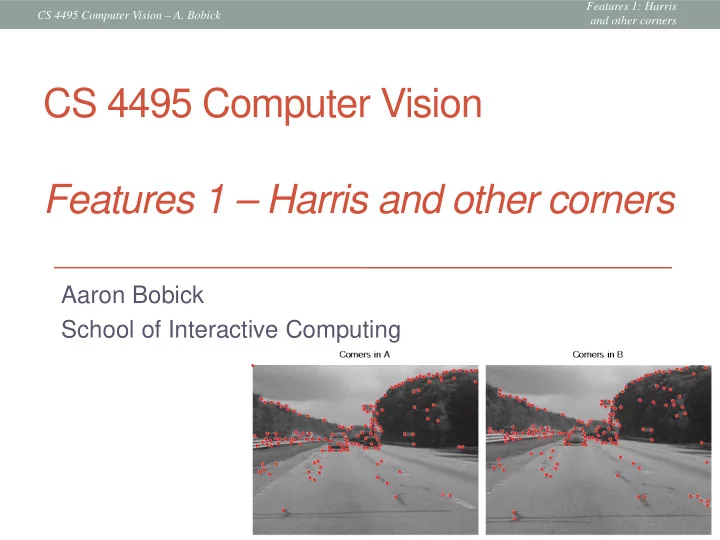
Aaron Bobick School of Interactive Computing

CS 4495 Computer Vision Features 1 – Harris and other corners

slide-2
SLIDE 2

Features 1: Harris and other corners CS 4495 Computer Vision – A. Bobick

Administrivia

  • PS 4: Out and not changed. Due Sunday Oct

12th, 11:55pm

  • It is application of the last few lectures. Mostly straight forward

Matlab but if you’re linear algebra is rusty it can take a while to figure out. Question 2 takes some doing to understand.

  • You have been warned…
  • It is cool
  • You have been warned…
  • Today: Start on features.
  • Forsyth and Ponce: 5.3-5.4
  • Szeliski also covers this well – Section 4 – 4.1.1
  • These next 3 lectures will provide detail for Project 4.
slide-3
SLIDE 3

Features 1: Harris and other corners CS 4495 Computer Vision – A. Bobick

The basic image point matching problem

  • Suppose I have two images related by some
  • transformation. Or have two images of the same object in

different positions.

  • How to find the transformation of image 1 that would align

it with image 2?

slide-4
SLIDE 4

Features 1: Harris and other corners CS 4495 Computer Vision – A. Bobick

  • Goal: Find points in an image that can be:
  • Found in other images
  • Found precisely – well localized
  • Found reliably – well matched
  • Why?
  • Want to compute a fundamental matrix to recover geometry
  • Robotics/Vision: See how a bunch of points move from one frame

to another. Allows computation of how camera moved -> depth -> moving objects

  • Build a panorama…

We want Local(1) Features(2)

slide-5
SLIDE 5

Features 1: Harris and other corners CS 4495 Computer Vision – A. Bobick

Suppose you want to build a panorama

  • M. Brown and D. G. Lowe. Recognising Panoramas. ICCV 2003
slide-6
SLIDE 6

Features 1: Harris and other corners CS 4495 Computer Vision – A. Bobick

  • We need to match (align) images

How do we build panorama?

slide-7
SLIDE 7

Features 1: Harris and other corners CS 4495 Computer Vision – A. Bobick

  • Detect features (feature points) in both images

Matching with Features

slide-8
SLIDE 8

Features 1: Harris and other corners CS 4495 Computer Vision – A. Bobick

  • Detect features (feature points) in both images
  • Match features - find corresponding pairs

Matching with Features

slide-9
SLIDE 9

Features 1: Harris and other corners CS 4495 Computer Vision – A. Bobick

Matching with Features

  • Detect features (feature points) in both images
  • Match features - find corresponding pairs
  • Use these pairs to align images
slide-10
SLIDE 10

Features 1: Harris and other corners CS 4495 Computer Vision – A. Bobick

Matching with Features

  • Problem 1:
  • Detect the same point independently in both images

no chance to match!

We need a repeatable detector

slide-11
SLIDE 11

Features 1: Harris and other corners CS 4495 Computer Vision – A. Bobick

Matching with Features

  • Problem 2:
  • For each point correctly recognize the corresponding one

?

We need a reliable and distinctive descriptor

slide-12
SLIDE 12

Features 1: Harris and other corners CS 4495 Computer Vision – A. Bobick

More motivation…

  • Feature points are used also for:
  • Image alignment (e.g. homography or fundamental

matrix)

  • 3D reconstruction
  • Motion tracking
  • Object recognition
  • Indexing and database retrieval
  • Robot navigation
  • … other
slide-13
SLIDE 13

Features 1: Harris and other corners CS 4495 Computer Vision – A. Bobick

Characteristics of good features

  • Repeatability/Precision
  • The same feature can be found in several images despite geometric

and photometric transformations

  • Saliency/Matchability
  • Each feature has a distinctive description
  • Compactness and efficiency
  • Many fewer features than image pixels
  • Locality
  • A feature occupies a relatively small area of the image; robust to

clutter and occlusion

slide-14
SLIDE 14
slide-15
SLIDE 15

Features 1: Harris and other corners CS 4495 Computer Vision – A. Bobick

Corner Detection: Basic Idea

  • We should easily recognize the point by looking through a

small window

  • Shifting a window in any direction should give a large

change in intensity “edge”: no change along the edge direction “corner”: significant change in all directions with small shift “flat” region: no change in all directions

Source: A. Efros

slide-16
SLIDE 16

Features 1: Harris and other corners CS 4495 Computer Vision – A. Bobick

Finding Corners

  • Key property: in the region around a corner, image

gradient has two or more dominant directions

  • Corners are repeatable and distinctive

C.Harris and M.Stephens. "A Combined Corner and Edge Detector.“ Proceedings of the 4th Alvey Vision Conference: pages 147—151, 1988

slide-17
SLIDE 17

Features 1: Harris and other corners CS 4495 Computer Vision – A. Bobick

Finding Harris Corners

  • Key property: in the region around a corner, image

gradient has two or more dominant directions

  • Corners are repeatable and distinctive
  • C. Harris and M.Stephens. "A Combined Corner and Edge Detector.“

Proceedings of the 4th Alvey Vision Conference: pages 147—151, 1988

slide-18
SLIDE 18

Features 1: Harris and other corners CS 4495 Computer Vision – A. Bobick

Corner Detection: Mathematics

[ ]

2 ,

( , ) ( , ) ( , ) ( , )

x y

E u v w x y I x u y v I x y = + + −

Change in appearance for the shift [u,v]:

Intensity Shifted intensity Window function

  • r

Window function w(x,y) = Gaussian 1 in window, 0 outside

Source: R. Szeliski

slide-19
SLIDE 19

Features 1: Harris and other corners CS 4495 Computer Vision – A. Bobick

Corner Detection: Mathematics

[ ]

2 ,

( , ) ( , ) ( , ) ( , )

x y

E u v w x y I x u y v I x y = + + −

Change in appearance for the shift [u,v]: I(x, y) E(u, v)

E(0,0) E(3,2)

slide-20
SLIDE 20

Features 1: Harris and other corners CS 4495 Computer Vision – A. Bobick

Corner Detection: Mathematics

[ ]

2 ,

( , ) ( , ) ( , ) ( , )

x y

E u v w x y I x u y v I x y = + + −

Change in appearance for the shift [u,v]: We want to find out how this function behaves for small shifts (u,v near 0,0)

slide-21
SLIDE 21

Features 1: Harris and other corners CS 4495 Computer Vision – A. Bobick

Corner Detection: Mathematics

[ ]

2 ,

( , ) ( , ) ( , ) ( , )

x y

E u v w x y I x u y v I x y = + + −

Change in appearance for the shift [u,v]: Second-order Taylor expansion of E(u,v) about (0,0) (local quadratic approximation for small u,v):

(0,0) (0,0) (0,0) 1 ( , ) (0,0) [ ] [ ] (0,0) (0,0) (0,0) 2

u uu uv v uv vv

E E E u E u v E u v u v E E E v       ≈ + +            

2 2 2

(0) (1D 1 ): ( ) (0) · ) · ( 2 d F x d dF F x F x x dx δ δ δ ≈ + +

slide-22
SLIDE 22

Features 1: Harris and other corners CS 4495 Computer Vision – A. Bobick

Corner Detection: Mathematics

            +       + ≈ v u E E E E v u E E v u E v u E

vv uv uv uu v u

) , ( ) , ( ) , ( ) , ( ] [ 2 1 ) , ( ) , ( ] [ ) , ( ) , (

[ ]

2 ,

( , ) ( , ) ( , ) ( , )

x y

E u v w x y I x u y v I x y = + + −

Second-order Taylor expansion of E(u,v) about (0,0):

[ ] [ ] [ ]

) , ( ) , ( ) , ( ) , ( 2 ) , ( ) , ( ) , ( 2 ) , ( ) , ( ) , ( ) , ( ) , ( 2 ) , ( ) , ( ) , ( 2 ) , ( ) , ( ) , ( ) , ( ) , ( 2 ) , (

, , , , ,

v y u x I y x I v y u x I y x w v y u x I v y u x I y x w v u E v y u x I y x I v y u x I y x w v y u x I v y u x I y x w v u E v y u x I y x I v y u x I y x w v u E

xy y x x y y x uv xx y x x x y x uu x y x u

+ + − + + + + + + + = + + − + + + + + + + = + + − + + =

∑ ∑ ∑ ∑ ∑

slide-23
SLIDE 23

Features 1: Harris and other corners CS 4495 Computer Vision – A. Bobick

Corner Detection: Mathematics

            +       + ≈ v u E E E E v u E E v u E v u E

vv uv uv uu v u

) , ( ) , ( ) , ( ) , ( ] [ 2 1 ) , ( ) , ( ] [ ) , ( ) , (

[ ]

2 ,

( , ) ( , ) ( , ) ( , )

x y

E u v w x y I x u y v I x y = + + −

Second-order Taylor expansion of E(u,v) about (0,0):

[ ] [ ] [ ]

) , ( ) , ( ) , ( ) , ( 2 ) , ( ) , ( ) , ( 2 ) , ( ) , ( ) , ( ) , ( ) , ( 2 ) , ( ) , ( ) , ( 2 ) , ( ) , ( ) , ( ) , ( ) , ( 2 ) , (

, , , , ,

v y u x I y x I v y u x I y x w v y u x I v y u x I y x w v u E v y u x I y x I v y u x I y x w v y u x I v y u x I y x w v u E v y u x I y x I v y u x I y x w v u E

xy y x x y y x uv xx y x x x y x uu x y x u

+ + − + + + + + + + = + + − + + + + + + + = + + − + + =

∑ ∑ ∑ ∑ ∑

slide-24
SLIDE 24

Features 1: Harris and other corners CS 4495 Computer Vision – A. Bobick

Corner Detection: Mathematics

            +       + ≈ v u E E E E v u E E v u E v u E

vv uv uv uu v u

) , ( ) , ( ) , ( ) , ( ] [ 2 1 ) , ( ) , ( ] [ ) , ( ) , (

[ ]

2 ,

( , ) ( , ) ( , ) ( , )

x y

E u v w x y I x u y v I x y = + + −

Second-order Taylor expansion of E(u,v) about (0,0):

[ ] [ ] [ ]

) , ( ) , ( ) , ( ) , ( 2 ) , ( ) , ( ) , ( 2 ) , ( ) , ( ) , ( ) , ( ) , ( 2 ) , ( ) , ( ) , ( 2 ) , ( ) , ( ) , ( ) , ( ) , ( 2 ) , (

, , , , ,

v y u x I y x I v y u x I y x w v y u x I v y u x I y x w v u E v y u x I y x I v y u x I y x w v y u x I v y u x I y x w v u E v y u x I y x I v y u x I y x w v u E

xy y x x y y x uv xx y x x x y x uu x y x u

+ + − + + + + + + + = + + − + + + + + + + = + + − + + =

∑ ∑ ∑ ∑ ∑

slide-25
SLIDE 25

Features 1: Harris and other corners CS 4495 Computer Vision – A. Bobick

Corner Detection: Mathematics

            +       + ≈ v u E E E E v u E E v u E v u E

vv uv uv uu v u

) , ( ) , ( ) , ( ) , ( ] [ 2 1 ) , ( ) , ( ] [ ) , ( ) , (

Second-order Taylor expansion of E(u,v) about (0,0):

[ ] [ ] [ ]

) , ( ) , ( ) , ( ) , ( 2 ) , ( ) , ( ) , ( 2 ) , ( ) , ( ) , ( ) , ( ) , ( 2 ) , ( ) , ( ) , ( 2 ) , ( ) , ( ) , ( ) , ( ) , ( 2 ) , (

, , , , ,

v y u x I y x I v y u x I y x w v y u x I v y u x I y x w v u E v y u x I y x I v y u x I y x w v y u x I v y u x I y x w v u E v y u x I y x I v y u x I y x w v u E

xy y x x y y x uv xx y x x x y x uu x y x u

+ + − + + + + + + + = + + − + + + + + + + = + + − + + =

∑ ∑ ∑ ∑ ∑

[ ]

2 ,

( , ) ( , ) ( , ) ( , )

x y

E u v w x y I x u y v I x y = + + −

slide-26
SLIDE 26

Features 1: Harris and other corners CS 4495 Computer Vision – A. Bobick

Corner Detection: Mathematics

            +       + ≈ v u E E E E v u E E v u E v u E

vv uv uv uu v u

) , ( ) , ( ) , ( ) , ( ] [ 2 1 ) , ( ) , ( ] [ ) , ( ) , (

Evaluate at (u,v) = (0,0):

[ ] [ ] [ ]

) , ( ) , ( ) , ( ) , ( 2 ) , ( ) , ( ) , ( 2 ) , ( ) , ( ) , ( ) , ( ) , ( 2 ) , ( ) , ( ) , ( 2 ) , ( ) , ( ) , ( ) , ( ) , ( 2 ) , (

, , , , ,

v y u x I y x I v y u x I y x w v y u x I v y u x I y x w v u E v y u x I y x I v y u x I y x w v y u x I v y u x I y x w v u E v y u x I y x I v y u x I y x w v u E

xy y x x y y x uv xx y x x x y x uu x y x u

+ + − + + + + + + + = + + − + + + + + + + = + + − + + =

∑ ∑ ∑ ∑ ∑

= 0 = 0 = 0 = 0

[ ]

2 ,

( , ) ( , ) ( , ) ( , )

x y

E u v w x y I x u y v I x y = + + −

slide-27
SLIDE 27

Features 1: Harris and other corners CS 4495 Computer Vision – A. Bobick

Corner Detection: Mathematics

[ ]

2 ,

( , ) ( , ) ( , ) ( , )

x y

E u v w x y I x u y v I x y = + + −

Second-order Taylor expansion of E(u,v) about (0,0):

(0,0) (0,0) (0,0)

u v

E E E = = =

            +       + ≈ v u E E E E v u E E v u E v u E

vv uv uv uu v u

) , ( ) , ( ) , ( ) , ( ] [ 2 1 ) , ( ) , ( ] [ ) , ( ) , (

, , ,

(0,0) 2 ( , ) ( , ) ( , ) (0,0) 2 ( , ) ( , ) ( , ) (0,0) 2 ( , ) ( , ) ( , )

uu x x x y vv y y x y uv x y x y

E w x y I x y I x y E w x y I x y I x y E w x y I x y I x y = ∑ = ∑ = ∑

slide-28
SLIDE 28

Features 1: Harris and other corners CS 4495 Computer Vision – A. Bobick

Corner Detection: Mathematics

[ ]

2 ,

( , ) ( , ) ( , ) ( , )

x y

E u v w x y I x u y v I x y = + + −

Second-order Taylor expansion of E(u,v) about (0,0):

                ≈

∑ ∑ ∑ ∑

v u y x I y x w y x I y x I y x w y x I y x I y x w y x I y x w v u v u E

y x y y x y x y x y x y x x , 2 , , , 2

) , ( ) , ( ) , ( ) , ( ) , ( ) , ( ) , ( ) , ( ) , ( ) , ( ] [ ) , (

(0,0) (0,0) (0,0)

u v

E E E = = =

, , ,

(0,0) 2 ( , ) ( , ) ( , ) (0,0) 2 ( , ) ( , ) ( , ) (0,0) 2 ( , ) ( , ) ( , )

uu x x x y vv y y x y uv x y x y

E w x y I x y I x y E w x y I x y I x y E w x y I x y I x y = ∑ = ∑ = ∑

slide-29
SLIDE 29

Features 1: Harris and other corners CS 4495 Computer Vision – A. Bobick

Corner Detection: Mathematics

The quadratic approximation simplifies to

2 2 ,

( , )

x x y x y x y y

I I I M w x y I I I   =      

where M is a second moment matrix computed from image derivatives:

      ≈ v u M v u v u E ] [ ) , (

Without weight M Each product is a rank 1 2x2

slide-30
SLIDE 30

Features 1: Harris and other corners CS 4495 Computer Vision – A. Bobick

The surface E(u,v) is locally approximated by a quadratic form.

Interpreting the second moment matrix

      ≈ v u M v u v u E ] [ ) , (

        =

y x y y x y x x

I I I I I I y x w M

, 2 2

) , (

slide-31
SLIDE 31

Features 1: Harris and other corners CS 4495 Computer Vision – A. Bobick

Consider a constant “slice” of E(u, v):

Interpreting the second moment matrix

This is the equation of an ellipse. const ] [ =       v u M v u

2 2 2 2

2

x x y y

u I I uv I k I v + + =

slide-32
SLIDE 32

Features 1: Harris and other corners CS 4495 Computer Vision – A. Bobick

      =         =∑

2 1 , 2 2

) , ( λ λ

y x y y x y x x

I I I I I I y x w M

First, consider the axis-aligned case where gradients are either horizontal or vertical If either λ is close to 0, then this is not a corner, so look for locations where both are large.

Interpreting the second moment matrix

slide-33
SLIDE 33

Features 1: Harris and other corners CS 4495 Computer Vision – A. Bobick

      =         =∑

2 1 , 2 2

) , ( λ λ

y x y y x y x x

I I I I I I y x w M

First, consider the axis-aligned case where gradients are either horizontal or vertical If either λ is close to 0, then this is not a corner, so look for locations where both are large.

Interpreting the second moment matrix

slide-34
SLIDE 34

Features 1: Harris and other corners CS 4495 Computer Vision – A. Bobick

Consider a horizontal “slice” of E(u, v):

Interpreting the second moment matrix

This is the equation of an ellipse.

R R M       =

− 2 1 1

λ λ

The axis lengths of the ellipse are determined by the eigenvalues and the orientation is determined by R

direction of the slowest change direction of the fastest change

(λmax)-1/2 (λmin)-1/2 const ] [ =       v u M v u Diagonalization of M:

slide-35
SLIDE 35

Features 1: Harris and other corners CS 4495 Computer Vision – A. Bobick

Interpreting the eigenvalues

λ1 λ2 “Corner” λ1 and λ2 are large, λ1 ~ λ2; E increases in all

directions

λ1 and λ2 are small; E is almost constant

in all directions

“Edge” λ1 >> λ2 “Edge” λ2 >> λ1 “Flat” region

Classification of image points using eigenvalues

  • f M:
slide-36
SLIDE 36

Features 1: Harris and other corners CS 4495 Computer Vision – A. Bobick

Harris corner response function

“Corner” R > 0 “Edge” R < 0 “Edge” R < 0 “Flat” region |R| small

2 2 1 2 1 2

) ( ) ( trace ) det( λ λ α λ λ α + − = − = M M R

α: constant (0.04 to 0.06)

  • R depends only on

eigenvalues of M, but don’t compute them (no sqrt, so really fast!

  • R is large for a corner
  • R is negative with large

magnitude for an edge

  • |R| is small for a flat

region

slide-37
SLIDE 37

Features 1: Harris and other corners CS 4495 Computer Vision – A. Bobick

Low texture region

– gradients have small magnitude

– small λ1, small λ2

slide-38
SLIDE 38

Features 1: Harris and other corners CS 4495 Computer Vision – A. Bobick

Edge

– large gradients, all the same

– large λ1, small λ2

slide-39
SLIDE 39

Features 1: Harris and other corners CS 4495 Computer Vision – A. Bobick

High textured region

– gradients are different, large magnitudes

– large λ1, large λ2

slide-40
SLIDE 40

Features 1: Harris and other corners CS 4495 Computer Vision – A. Bobick

Harris detector: Algorithm

1.

Compute Gaussian derivatives at each pixel

2.

Compute second moment matrix M in a Gaussian window around each pixel

3.

Compute corner response function R

4.

Threshold R

5.

Find local maxima of response function (nonmaximum suppression)

C.Harris and M.Stephens. "A Combined Corner and Edge Detector.“ Proceedings of the 4th Alvey Vision Conference: pages 147—151, 1988.

slide-41
SLIDE 41

Features 1: Harris and other corners CS 4495 Computer Vision – A. Bobick

Harris Detector: Workflow

slide-42
SLIDE 42

Features 1: Harris and other corners CS 4495 Computer Vision – A. Bobick

Harris Detector: Workflow

Compute corner response R

slide-43
SLIDE 43

Features 1: Harris and other corners CS 4495 Computer Vision – A. Bobick

Harris Detector: Workflow

Find points with large corner response: R>threshold

slide-44
SLIDE 44

Features 1: Harris and other corners CS 4495 Computer Vision – A. Bobick

Harris Detector: Workflow

Take only the points of local maxima of R

slide-45
SLIDE 45

Features 1: Harris and other corners CS 4495 Computer Vision – A. Bobick

Harris Detector: Workflow

slide-46
SLIDE 46

Features 1: Harris and other corners CS 4495 Computer Vision – A. Bobick

Other corners:

  • Shi-Tomasi ’94:
  • “Cornerness” = min (λ1, λ2) Find local maximums
  • cvGoodFeaturesToTrack(...)
  • Reportedly better for region undergoing affine deformations
  • Brown, M., Szeliski, R., and Winder, S. (2005):
  • there are others…

1 1

det tr M M λ λ λ λ = +

slide-47
SLIDE 47

Features 1: Harris and other corners CS 4495 Computer Vision – A. Bobick

Harris Detector: Some Properties

slide-48
SLIDE 48

Features 1: Harris and other corners CS 4495 Computer Vision – A. Bobick

Harris Detector: Some Properties

  • Rotation invariance?
slide-49
SLIDE 49

Features 1: Harris and other corners CS 4495 Computer Vision – A. Bobick

Harris Detector: Some Properties

  • Rotation invariance

Ellipse rotates but its shape (i.e. eigenvalues) remains the same

Corner response R is invariant to image rotation

slide-50
SLIDE 50

Features 1: Harris and other corners CS 4495 Computer Vision – A. Bobick

Rotation Invariant Detection

Harris Corner Detector

C.Schmid et.al. “Evaluation of Interest Point Detectors”. IJCV 2000

Repeatability rate:

# correspondences # possible correspondences

slide-51
SLIDE 51

Features 1: Harris and other corners CS 4495 Computer Vision – A. Bobick

  • Invariance to image intensity change?

Harris Detector: Some Properties

slide-52
SLIDE 52

Features 1: Harris and other corners CS 4495 Computer Vision – A. Bobick

Harris Detector: Some Properties

  • Partial invariance to additive and multiplicative intensity

changes (threshold issue for multiplicative)  Only derivatives are used => invariance to intensity shift I → I + b  Intensity scale: I → a I R x (image coordinate)

threshold

R x (image coordinate)

slide-53
SLIDE 53

Features 1: Harris and other corners CS 4495 Computer Vision – A. Bobick

  • Invariant to image scale?

Harris Detector: Some Properties

slide-54
SLIDE 54

Features 1: Harris and other corners CS 4495 Computer Vision – A. Bobick

Harris Detector: Some Properties

  • Not invariant to image scale!

All points will be classified as edges

Corner !

slide-55
SLIDE 55

Features 1: Harris and other corners CS 4495 Computer Vision – A. Bobick

Harris Detector: Some Properties

  • Quality of Harris detector for different scale changes
slide-56
SLIDE 56

Features 1: Harris and other corners CS 4495 Computer Vision – A. Bobick

*IF* we want scale invariance…

slide-57
SLIDE 57

Features 1: Harris and other corners CS 4495 Computer Vision – A. Bobick

Scale Invariant Detection

  • Consider regions (e.g. circles) of different sizes around a

point

  • Regions of corresponding sizes will look the same in both

images

slide-58
SLIDE 58

Features 1: Harris and other corners CS 4495 Computer Vision – A. Bobick

Scale Invariant Detection

  • The problem: how do we choose corresponding circles

independently in each image?

slide-59
SLIDE 59

Features 1: Harris and other corners CS 4495 Computer Vision – A. Bobick

Scale Invariant Detection

  • Solution:
  • Design a function on the region (circle), which is “scale invariant”

(the same for corresponding regions, even if they are at different scales) Example: average intensity. For corresponding regions (even of different sizes) it will be the same. scale = 1/2

For some given point in one image, we can consider it as a function of region size (circle radius) f

region size Image 1

f

region size Image 2

slide-60
SLIDE 60

Features 1: Harris and other corners CS 4495 Computer Vision – A. Bobick

Scale Invariant Detection

  • Common approach:

scale = 1/2

f

region size Image 1

f

region size Image 2

Take a local maximum of this function Observation: region size, for which the maximum is achieved, should be invariant to image scale.

s1 s2

Important: this scale invariant region size is found in each image independently!

slide-61
SLIDE 61

Features 1: Harris and other corners CS 4495 Computer Vision – A. Bobick

Scale Invariant Detection

  • A “good” function for scale detection:

has one stable sharp peak

f

region size

bad

f

region size

bad

f

region size

Good !

  • For usual images: a good function would be a one

which responds to contrast (sharp local intensity change)

slide-62
SLIDE 62

Features 1: Harris and other corners CS 4495 Computer Vision – A. Bobick

Scale sensitive response

slide-63
SLIDE 63

Features 1: Harris and other corners CS 4495 Computer Vision – A. Bobick

Scale Invariant Detection

( )

2

( , , ) ( , , )

xx yy

L G x y G x y σ σ σ = +

Kernel Image f = ∗

Function is just application of a kernel:

50 100 150 20 40 60 80 100 120

  • 2

2 4 6 8 10 x 10

  • 6

(Laplacian of Gaussian - LoG)

Laplacian of Gaussian

slide-64
SLIDE 64

Features 1: Harris and other corners CS 4495 Computer Vision – A. Bobick

Scale Invariant Detection

  • Functions for determining scale

2 2 2

1 2 2

( , , )

x y

G x y e

σ πσ

σ

+ −

=

( )

2

( , , ) ( , , )

xx yy

L G x y G x y σ σ σ = + ( , , ) ( , , ) k DoG G x y G x y σ σ = −

Kernel Image f = ∗

Kernels: where Gaussian

Note: both kernels are invariant to scale and rotation (Laplacian) (Difference of Gaussians)

slide-65
SLIDE 65

Features 1: Harris and other corners CS 4495 Computer Vision – A. Bobick

Key point localization

  • General idea: find

robust extremum (maximum or minimum) both in space and in scale.

Blur Resample Subtract
slide-66
SLIDE 66

Features 1: Harris and other corners CS 4495 Computer Vision – A. Bobick

Key point localization

  • SIFT: Scale Invariant

Feature Transform

  • Specific suggestion:

use DoG pyramid to find maximum values (remember edge detection?) – then eliminate “edges” and pick only corners.

Blur Resample Subtract
slide-67
SLIDE 67

Features 1: Harris and other corners CS 4495 Computer Vision – A. Bobick

Key point localization

Blur Resample Subtract

(Each point is compared to its 8 neighbors in the current image and 9 neighbors each in the scales above and below.)

slide-68
SLIDE 68

Features 1: Harris and other corners CS 4495 Computer Vision – A. Bobick

Scale space processed one octave at a time

slide-69
SLIDE 69

Features 1: Harris and other corners CS 4495 Computer Vision – A. Bobick

Extrema at different scales

slide-70
SLIDE 70

Features 1: Harris and other corners CS 4495 Computer Vision – A. Bobick

Remove low contrast, edge bound

Extrema points Contrast > C Not on edge

slide-71
SLIDE 71

Features 1: Harris and other corners CS 4495 Computer Vision – A. Bobick

Scale Invariant Detectors

  • Harris-Laplacian2

Find local maximum of:

  • Harris corner detector in

space (image coordinates)

  • Laplacian in scale

1D.Lowe. “Distinctive Image Features from Scale-Invariant Keypoints”. IJCV 2004 2K.Mikolajczyk, C.Schmid. “Indexing Based on Scale Invariant Interest Points”. ICCV 2001

scale

x y

← Harris → ← Laplacian →

  • SIFT (Lowe)1

Find local maximum of: – Difference of Gaussians in space and scale scale

x y

← DoG → ← DoG →

slide-72
SLIDE 72

Features 1: Harris and other corners CS 4495 Computer Vision – A. Bobick

  • Experimental evaluation of detectors

w.r.t. scale change

Scale Invariant Detectors

K.Mikolajczyk, C.Schmid. “Indexing Based on Scale Invariant Interest Points”. ICCV 2001

Repeatability rate:

# correspondences # possible correspondences

slide-73
SLIDE 73

Features 1: Harris and other corners CS 4495 Computer Vision – A. Bobick

  • Given: two images of the same scene with a large scale

difference between them

  • Goal: find the same interest points independently in each

image

  • Solution: search for maxima of suitable functions in scale

and in space (over the image)

Scale Invariant Detection: Summary

Methods:

  • 1. SIFT [Lowe]: maximize Difference of Gaussians over scale and

space

  • 2. Harris-Laplacian [Mikolajczyk, Schmid]: maximize Laplacian
  • ver scale, Harris’ measure of corner response over the

image

slide-74
SLIDE 74

Features 1: Harris and other corners CS 4495 Computer Vision – A. Bobick

  • We know how to detect points
  • Next question: How to match them?

Point Descriptors

?

Point descriptor should be:

  • 1. Invariant
  • 2. Distinctive
slide-75
SLIDE 75

Features 1: Harris and other corners CS 4495 Computer Vision – A. Bobick

Next time…

  • SIFT, SURF, SFOP, oh my…