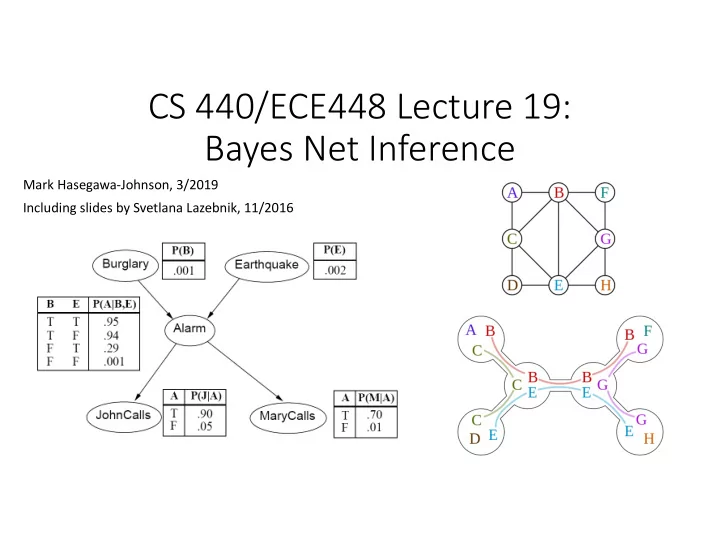
SLIDE 1 CS 440/ECE448 Lecture 19: Bayes Net Inference
Mark Hasegawa-Johnson, 3/2019 Including slides by Svetlana Lazebnik, 11/2016
SLIDE 2 Bayes Network Inference & Learning
Bayes net is a memory-efficient model of dependencies among:
- Query variables: X
- Evidence (observed) variables and their values: E = e
- Unobserved variables: Y
Inference problem: answer questions about the query variables given the evidence variables
- This can be done using the posterior distribution P(X | E = e)
- The posterior can be derived from the full joint P(X, E, Y)
- How do we make this computationally efficient?
Learning problem: given some training examples, how do we learn the parameters of the model?
- Parameters = p(variable|parents), for each variable in the net
SLIDE 3 Outline
- Inference Examples
- Inference Algorithms
- Trees: Sum-product algorithm
- Poly-trees: Junction tree algorithm
- Graphs: No polynomial-time algorithm
- Parameter Learning
SLIDE 4 Practice example 1
- Variables: Cloudy, Sprinkler, Rain, Wet Grass
SLIDE 5 Practice example 1
- Given that the grass is wet, what is the probability
that it has rained?
P(r | w) = P(r,w) P(w) = P(c,s,r,w)
C=c,S=s
∑
P(c,s,r,w)
C=c,S=s,R=r
∑
= P(c)P(s | c)P(r | c)P(w | r,s)
C=c,S=s
∑
P(c)P(s | c)P(r | c)P(w | r,s)
C=c,S=s,R=r
∑
SLIDE 6 Practice Example #2
- Suppose you have an observation, for example, “Jack called” (J=1)
- You want to know: was there a burglary?
- You need
𝑄 𝐶 = 1 𝐾 = 1 = 𝑄(𝐶, 𝐾 = 1) ∑* 𝑄(𝐶 = 𝑐, 𝐾 = 1)
- So you need to compute the table P(B,J) for all possible settings of
(B,J)
SLIDE 7 Bayes Net Inference: The Hard Way
- 1. P(B,E,A,J,M)=P(B)P(E)P(A|B,E)P(J|A)P(M|A)
- 2. 𝑄 𝐶, 𝐾 = ∑. ∑/ ∑0 𝑄(𝐶, 𝐹, 𝐵, 𝐾, 𝑁)
Exponential complexity (#P-hard, actually): N variables, each of which has K possible values ⇒ 𝑃{𝐿8} time complexity
SLIDE 8 Is there an easier way?
- Tree-structured Bayes nets: the sum-product algorithm
- Quadratic complexity, 𝑃{𝑂𝐿;}
- Polytrees: the junction tree algorithm
- Pseudo-polynomial complexity, 𝑃{𝑂𝐿0}, for M<N
- Arbitrary Bayes nets: #P complete, 𝑃{𝐿8}
- The SAT problem is a Bayes net!
- Parameter Learning
SLIDE 9
- 1. Tree-Structured Bayes Nets
- Suppose these are all binary variables.
- We observe E=1
- We want to find P(H=1|E=1)
- Means that we need to find both
P(H=0,E=1) and P(H=1,E=1) because 𝑄 𝐼 = 1 𝐹 = 1 = 𝑄(𝐼 = 1, 𝐹 = 1) ∑= 𝑄(𝐼 = ℎ, 𝐹 = 1)
SLIDE 10 The Sum-Product Algorithm (Belief Propagation)
- Find the only undirected path from the
evidence variable to the query variable (EDBFGIH)
- Find the directed root of this path P(F)
- Find the joint probabilities of root and
evidence: P(F=0,E=1) and P(F=1,E=1)
- Find the joint probabilities of query and
evidence: P(H=0,E=1) and P(H=1,E=1)
- Find the conditional probability P(H=1|E=1)
SLIDE 11 The Sum-Product Algorithm
Starting with the root P(F), we find P(F,E) by alternating product steps and sum steps:
- 1. Product: P(B,D,F)=P(F)P(B|F)P(D|B)
- 2. Sum: 𝑄 𝐸, 𝐺 = ∑ABC
D
𝑄(𝐶, 𝐸, 𝐺)
- 3. Product: P(D,E,F)=P(D,F)P(E|D)
- 4. Sum: 𝑄 𝐹, 𝐺 = ∑EBC
D
𝑄(𝐸, 𝐹, 𝐺)
The Sum-Product Algorithm (Belief Propagation)
SLIDE 12 The Sum-Product Algorithm
Starting with the root P(E,F), we find P(E,H) by alternating product steps and sum steps:
- 1. Product: P(E,F,G)=P(E,F)P(G|F)
- 2. Sum: 𝑄 𝐹, 𝐻 = ∑GBC
D
𝑄(𝐹, 𝐺, 𝐻)
- 3. Product: P(E,G,I)=P(E,G)P(I|G)
- 4. Sum: 𝑄 𝐹, 𝐽 = ∑IBC
D
𝑄(𝐹, 𝐻, 𝐽)
- 5. Product: P(E,H,I)=P(E,I)P(I|G)
- 6. Sum: 𝑄 𝐹, 𝐼 = ∑JBC
D
𝑄(𝐹, 𝐼, 𝐽)
The Sum-Product Algorithm (Belief Propagation)
SLIDE 13
- Each product step generates a table with 3
variables
- Each sum step reduces that to a table with
2 variables
- If each variable has K values, and if there
are 𝑃{𝑂} variables on the path from evidence to query, then time complexity is 𝑃{𝑂𝐿;}
Time Complexity of Belief Propagation
SLIDE 14 Time Complexity of Bayes Net Inference
- Tree-structured Bayes nets: the sum-product algorithm
- Quadratic complexity, 𝑃{𝑂𝐿;}
- Polytrees: the junction tree algorithm
- Pseudo-polynomial complexity, 𝑃{𝑂𝐿0}, for M<N
- Arbitrary Bayes nets: #P complete, 𝑃{𝐿8}
- The SAT problem is a Bayes net!
- Parameter Learning
SLIDE 15
- 2. The Junction Tree Algorithm
- a. Moralize the graph (identify each variable’s Markov blanket)
- b. Triangulate the graph (eliminate undirected cycles)
- c. Create the junction tree (form cliques)
- d. Run the sum-product algorithm on the junction tree
SLIDE 16 2.a. Markov Blanket
- Suppose there is a Bayes net
with variables A,B,C,D,E,F,G,H
variable F is D,E,G if P(F|A,B,C,D,E,G,H) = P(F|D,E,G)
SLIDE 17 2.a. Markov Blanket
- Suppose there is a Bayes net
with variables A,B,C,D,E,F,G,H
variable F is D,E,G if P(F|A,B,C,D,E,G,H) = P(F|D,E,G)
A B C D E F G H
SLIDE 18 2.a. Markov Blanket
- The “Markov blanket” of variable F is
D,E,G if P(F|A,B,C,D,E,G,H) = P(F|D,E,G)
- How can we prove that?
- P(A,…,H) = P(A)P(B|A) …
- Which of those terms include F?
A B C D E F G H
SLIDE 19 2.a. Markov Blanket
- Which of those terms include F?
- Only these two:
P(F|D) and P(G|E,F)
A B C D E F G H
SLIDE 20 2.a. Markov Blanket
The Markov Blanket of variable F includes only its immediate family members:
- Its parent, D
- Its child, G
- The other parent of its child, E
Because P(F|A,B,C,D,E,G,H) = P(F|D,E,G)
A B C D E F G H
SLIDE 21 2.a. Moralization
“Moralization” =
- 1. If two variables have a child
together, force them to get married.
- 2. Get rid of the arrows (not
necessary any more). Result: Markov blanket = the set of variables to which a variable is connected.
A B C D E F G H
SLIDE 22
2.b. Triangulation
Triangulation = draw edges so that there is no unbroken cycle of length > 3. There are usually many different ways to do this. For example, here’s one:
A B C D E F G H
SLIDE 23 2.c. Form Cliques
Clique = a group of variables, all of whom are members of each other’s immediate family. Junction Tree = a tree in which
- Each node is a clique from the
- riginal graph,
- Each edge is an “intersection set,”
naming the variables that overlap between the two cliques.
A B C D E F G H AB BCD CDF CEF EFG GH
B CD CF EF G
SLIDE 24 2.d. Sum-Product
Suppose we need P(B,G):
- 1. Product: P(B,C,D,F)=P(B)P(C|B)P(D|B)P(F|D)
- 2. Sum: 𝑄 𝐶, 𝐷, 𝐺 = ∑E 𝑄(𝐶, 𝐷, 𝐸, 𝐺)
- 3. Product: P(B,C,E,F)=P(B,C,F)P(E|C)
- 4. Sum: 𝑄 𝐶, 𝐹, 𝐺 = ∑L 𝑄(𝐶, 𝐷, 𝐹, 𝐺)
- 5. Product: P(B,E,F,G) = P(B,E,F)P(G|E,F)
- 6. Sum: 𝑄 𝐶, 𝐻 = ∑. ∑G 𝑄(𝐶, 𝐹, 𝐺, 𝐻)
Complexity: 𝑃{𝑂𝐿0}, where N=# cliques, K = # values for each variable, M = 1 + # variables in the largest clique
B C D E F G
SLIDE 25 Junction Tree: Sample Test Question
Consider the burglar alarm example.
- a. Moralize this graph
- b. Is it already triangulated? If
not, triangulate it.
- c. Draw the junction tree
SLIDE 26 Solution
B E A J M
SLIDE 27 Solution
- b. Is it already triangulated?
Answer: yes. There is no unbroken cycle of length > 3.
B E A J M
SLIDE 28 Solution
- c. Draw the junction tree
ABE AJ AM
A A
SLIDE 29 Time Complexity of Bayes Net Inference
- Tree-structured Bayes nets: the sum-product algorithm
- Quadratic complexity, 𝑃{𝑂𝐿;}
- Polytrees: the junction tree algorithm
- Pseudo-polynomial complexity, 𝑃{𝑂𝐿0}, for M<N
- Arbitrary Bayes nets: #P complete, 𝑃{𝐿8}
- The SAT problem is a Bayes net!
- Parameter Learning
SLIDE 30 Bayesian network inference
- In full generality, NP-hard
- More precisely, #P-hard: equivalent to counting satisfying assignments
- We can reduce satisfiability to Bayesian network inference
- Decision problem: is P(Y) > 0?
Y = (U1 ∨U2 ∨U3)∧(¬U1 ∨¬U2 ∨U3)∧(U2 ∨¬U3 ∨U4)
SLIDE 31 Bayesian network inference
- In full generality, NP-hard
- More precisely, #P-hard: equivalent to counting satisfying assignments
- We can reduce satisfiability to Bayesian network inference
- Decision problem: is P(Y) > 0?
- G. Cooper, 1990
Y = (U1 ∨U2 ∨U3)∧(¬U1 ∨¬U2 ∨U3)∧(U2 ∨¬U3 ∨U4)
C1 C2 C3
SLIDE 32
Bayesian network inference
P(U1,U2,U3,U4,C1,C2,C3, D1, D2,Y) = P(U1)P(U2)P(U3)P(U4) P(C1 |U1,U2,U3)P(C2 |U1,U2,U3)P(C3 |U2,U3,U4) P(D1 |C1)P(D2 | D1,C2)P(Y | D2,C3)
SLIDE 33
Bayesian network inference
Why can’t we use the junction tree algorithm to efficiently compute Pr(Y)?
SLIDE 34 Bayesian network inference
Why can’t we use the junction tree algorithm to efficiently compute Pr(Y)? Answer: after we moralize and triangulate, the size of the largest clique (u2u3c1c2c3) is 𝑁 ≈ 𝑂, same order
- f magnitude as the original problem
SLIDE 35 Time Complexity of Bayes Net Inference
- Tree-structured Bayes nets: the sum-product algorithm
- Quadratic complexity, 𝑃{𝑂𝐿;}
- Polytrees: the junction tree algorithm
- Pseudo-polynomial complexity, 𝑃{𝑂𝐿0}, for M<N
- Arbitrary Bayes nets: #P complete, 𝑃{𝐿8}
- The SAT problem is a Bayes net!
- Parameter Learning
SLIDE 36 Parameter learning
- Inference problem: given values of evidence variables
E = e, answer questions about query variables X using the posterior P(X | E = e)
- Learning problem: estimate the parameters of the
probabilistic model P(X | E) given a training sample {(x1,e1), …, (xn,en)}
SLIDE 37 Parameter learning: complete data
- Suppose we know the network structure (but not the
parameters), and have a training set of complete
Sample
C S R W 1 T F T T 2 F T F T 3 T F F F 4 T T T T 5 F T F T 6 T F T F … … … …. …
? ? ? ? ? ? ? ? ?
Training set
SLIDE 38 Parameter learning
- Suppose we know the network structure (but not the
parameters), and have a training set of complete
𝑄 𝑇 = 𝑈 𝐷 = 𝑈 = #samples with 𝑇 = 𝑈, 𝐷 = 𝑈 # samples with 𝐷 = 𝑈 = 1 4
Sample
C S R W 1 T F T T 2 F T F T 3 T F F F 4 T T T T 5 F T F T 6 T F T F … … … …. …
Training set
SLIDE 39 Parameter learning
- Suppose we know the network structure (but not the
parameters), and have a training set of complete
- bservations
- P(X | Parents(X)) is given by the observed frequencies of
the different values of X for each combination of parent values
SLIDE 40 Parameter learning: missing data
- Suppose we know the network structure (but not the
parameters), and have a training set, but the training set is missing some observations.
? ? ? ? ? ? ? ? ?
Training set
Sample
C S R W 1 ? F T T 2 ? T F T 3 ? F F F 4 ? T T T 5 ? T F T 6 ? F T F … … … …. …
SLIDE 41 Missing data: the EM algorithm
- The EM algorithm starts (“Expectation Maximization”)
starts with an initial guess for each parameter value.
- We try to improve the initial guess, using the algorithm on the
next two slides:
0.5? 0.5? 0.5? 0.5? 0.5? 0.5? 0.5? 0.5? 0.5?
Training set
Sample
C S R W 1 ? F T T 2 ? T F T 3 ? F F F 4 ? T T T 5 ? T F T 6 ? F T F … … … …. …
SLIDE 42 Missing data: the EM algorithm
- E-Step (Expectation): Given the model parameters, replace each of the missing
numbers with a probability (a number between 0 and 1) using 𝑄 𝐷 = 1 𝑇, 𝑆, 𝑋 = 𝑄(𝐷 = 1, 𝑇, 𝑆, 𝑋) 𝑄 𝐷 = 1, 𝑇, 𝑆, 𝑋 + 𝑄(𝐷 = 0, 𝑇, 𝑆, 𝑋)
0.5? 0.5? 0.5? 0.5? 0.5? 0.5? 0.5? 0.5? 0.5?
Training set
Sample
C S R W 1 0.5? F T T 2 0.5? T F T 3 0.5? F F F 4 0.5? T T T 5 0.5? T F T 6 0.5? F T F … … … …. …
SLIDE 43 Missing data: the EM algorithm
- M-Step (Maximization): Given the missing data estimates, replace each of the
missing model parameters using 𝑄 Variable = T Parents = value = 𝐹[# times Variable = 𝑈, Parents = value] 𝐹[#times Parents = value]
0.5 0.5 0.5 0.5 0.5 1.0 1.0 0.5 0.0
Training set
Sample
C S R W 1 0.5? F T T 2 0.5? T F T 3 0.5? F F F 4 0.5? T T T 5 0.5? T F T 6 0.5? F T F … … … …. …
SLIDE 44 Missing data: the EM algorithm
- Iterate back and forth between E-step and M-step until the model converges.
0.5 0.5 0.5 0.5 0.5 1.0 1.0 0.5 0.0
Training set
Sample
C S R W 1 0.5? F T T 2 0.5? T F T 3 0.5? F F F 4 0.5? T T T 5 0.5? T F T 6 0.5? F T F … … … …. …
SLIDE 45 Summary: Bayesian networks
- Structure
- Parameters
- Inference
- Learning