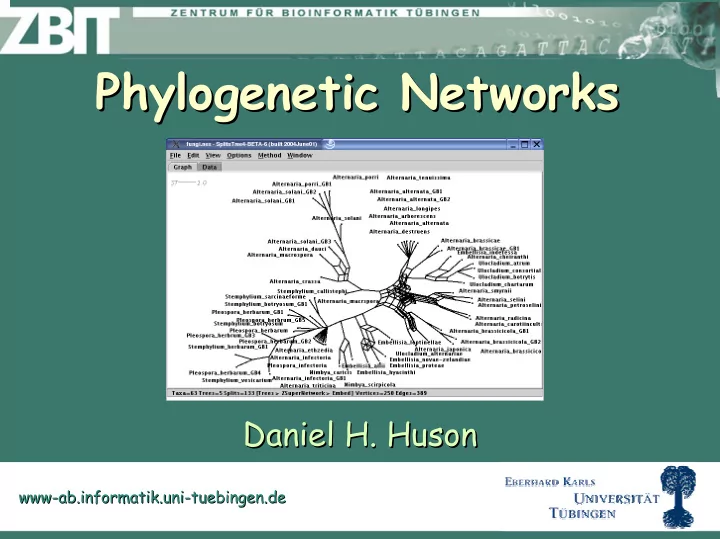
Phylogenetic Networks Networks Phylogenetic Daniel H. Huson - - PowerPoint PPT Presentation

phylogenetic networks networks phylogenetic
SMART_READER_LITE
LIVE PREVIEW

Phylogenetic Networks Networks Phylogenetic Daniel H. Huson - - PowerPoint PPT Presentation

Phylogenetic Networks Networks Phylogenetic Daniel H. Huson Daniel H. Huson www- -ab.informatik.uni ab.informatik.uni- -tuebingen.de tuebingen.de www 1 1 Phylogenetic Networks Networks Phylogenetic As a data representation As a


slide-1
SLIDE 1

1 1

Phylogenetic Phylogenetic Networks Networks

Daniel H. Huson Daniel H. Huson

www www-

  • ab.informatik.uni

ab.informatik.uni-

  • tuebingen.de

tuebingen.de

slide-2
SLIDE 2

2 2

Phylogenetic Phylogenetic Networks Networks

  • As a data representation

As a data representation technique technique

  • Splits graphs and others

Splits graphs and others

  • As a more complex

As a more complex model of evolution model of evolution

  • Reticulation graphs:

Reticulation graphs: such as hybridization such as hybridization graphs or ancestor graphs or ancestor recombination graphs recombination graphs

x x1

1

x x3

3

x x4

4

x x9

9

x x10

10

x x2

2

x x5

5

x x8

8

x x6

6

slide-3
SLIDE 3

3 3

Phylogenetic Phylogenetic Networks Networks

  • Rooted splits graph

Rooted splits graph

  • Unrooted

Unrooted reticulation graph reticulation graph Either type of graph can be Either type of graph can be unrooted unrooted or rooted

  • r rooted
slide-4
SLIDE 4

4 4

What is a Splits Graph? What is a Splits Graph?

  • The

The split encoding split encoding Σ Σ(T) of a tree T: (T) of a tree T:

G G1

1

G G8

8

G G7

7

G G6

6

G G5

5

G G4

4

G G3

3

G G2

2

G G1

1,G

,G3

3,G

,G4

4,G

,G6

6,G

,G7

7 vs

vs G G2

2,G

,G5

5,G

,G8

8

e e G G8

8

G G5

5

G G2

2

slide-5
SLIDE 5

5 5

What is a Splits Graph? What is a Splits Graph?

Cut Cut-

  • set of parallel edges defines split {

set of parallel edges defines split {A,B A,B} } vs vs rest rest

slide-6
SLIDE 6

6 6

Glossary Glossary

  • Splits system

Splits system Σ Σ: a set of splits : a set of splits ( (bipartitionings bipartitionings) of a given ) of a given taxon taxon set X set X

  • Splits graph G

Splits graph G: graph representing : graph representing Σ Σ (includes trees, not necessarily planar!) (includes trees, not necessarily planar!)

  • SplitsTree

SplitsTree: a program providing various : a program providing various algorithms for computing splits graphs algorithms for computing splits graphs

  • Split decomposition

Split decomposition: an algorithm for : an algorithm for computing splits from distances computing splits from distances (other: (other: Neighbor Neighbor-

  • Net, consensus networks,

Net, consensus networks,

  • r Z
  • r Z-
  • super networks)

super networks)

slide-7
SLIDE 7

7 7

Example: Consensus Networks Example: Consensus Networks

Six input trees: Six input trees: Σ Σ( (1/6): 1/6): Σ Σ( (0): 0): Σ Σ( (1/2): 1/2):

slide-8
SLIDE 8

8 8

SplitsTree4 SplitsTree4

Provides many Provides many algorithms for algorithms for phylogenetic phylogenetic analysis analysis using trees and using trees and networks networks

slide-9
SLIDE 9

9 9

The The SplitsTree SplitsTree Program Program

slide-10
SLIDE 10

10 10

The The SplitsTree SplitsTree Program Program

Taxa Taxa Unaligned Unaligned Characters Characters Distances Distances Quartets Quartets Trees Trees Splits Splits Main Window Main Window Method Window Method Window

slide-11
SLIDE 11

11 11

Example: Z Example: Z-

  • Super Network

Super Network

  • Five trees fungal trees from

Five trees fungal trees from (Pryor 2000) and (Pryor 2003) (Pryor 2000) and (Pryor 2003)

  • Trees:

Trees:

  • ITS (two trees)

ITS (two trees)

  • SSU (two trees)

SSU (two trees)

  • Gpd

Gpd (one tree) (one tree)

  • Numbers of

Numbers of taxa taxa differ: “partial trees” differ: “partial trees”

  • Trees from

Trees from TreeBase TreeBase

  • Unfortunately, no edge lengths

Unfortunately, no edge lengths

slide-12
SLIDE 12

12 12

Individual Gene Trees Individual Gene Trees

ITS00 ITS00 46 46 taxa taxa

slide-13
SLIDE 13

13 13

Individual Gene Trees Individual Gene Trees

ITS03 ITS03 40 40 taxa taxa

slide-14
SLIDE 14

14 14

Individual Gene Trees Individual Gene Trees

SSU00 SSU00 29 29 taxa taxa

slide-15
SLIDE 15

15 15

Individual Gene Trees Individual Gene Trees

SSU03 SSU03 40 40 taxa taxa

slide-16
SLIDE 16

16 16

Individual Gene Trees Individual Gene Trees

Gpd03 Gpd03 40 40 taxa taxa

slide-17
SLIDE 17

17 17

Gene Trees as Super Network Gene Trees as Super Network

Z Z-

  • closure: a fast super

closure: a fast super-

  • network method (WABI 2004)

network method (WABI 2004)

slide-18
SLIDE 18

18 18

Gene Trees as Super Network Gene Trees as Super Network

ITS00+ ITS00+ ITS03 ITS03

slide-19
SLIDE 19

19 19

Gene Trees as Super Network Gene Trees as Super Network

ITS03+ ITS03+ SSU00 SSU00

slide-20
SLIDE 20

20 20

Gene Trees as Super Network Gene Trees as Super Network

ITS00+ ITS00+ ITS00+ ITS00+ SSU03 SSU03

slide-21
SLIDE 21

21 21

Gene Trees as Super Network Gene Trees as Super Network

ITS00+ ITS00+ ITS03+ ITS03+ SSU03+ SSU03+ Gpd03 Gpd03

slide-22
SLIDE 22

22 22

Gene Trees as Super Network Gene Trees as Super Network

ITS00+ ITS00+ ITS03+ ITS03+ SSU00+ SSU00+ SSU03+ SSU03+ Gpd03 Gpd03

slide-23
SLIDE 23

23 23

Z Z-

  • Super Network

Super Network

A A2

2

B B2

2

  • Idea:

Idea: Extend Extend partial splits. partial splits.

  • Z

Z-

  • rule:

rule:

  • Repeatedly apply to completion.

Repeatedly apply to completion.

  • Return all full splits.

Return all full splits.

A A1

1

B B1

1

A A2

2

B B2

2

A A1

1

B B1

1∪

∪ B B2

2

A A1

1 ∪

∪ A A2

2

B B2

2 ∩ ∩

, , A A1

1

B B1

1

slide-24
SLIDE 24

24 24

Reticulation Networks Reticulation Networks

a a b b1

1

c c b b3

3

b b2

2

h h P P Q Q Ancestral genome Ancestral genome g g1

1

Build gene trees Build gene trees

slide-25
SLIDE 25

25 25

Reticulation Networks Reticulation Networks

P P g g1

1

P P-

  • tree

tree Q Q h h b b1 a a c c b b3

3 1

slide-26
SLIDE 26

26 26

Reticulation Networks Reticulation Networks

P P g g2

2

Q Q h h a a b b1

1

c c b b3

3

slide-27
SLIDE 27

27 27

Reticulation Networks Reticulation Networks

P P g g2

2

Q Q-

  • tree

tree Q Q h h a a b b1

1

c c b b3

3

slide-28
SLIDE 28

28 28

From Gene Trees to Reticulation Graphs From Gene Trees to Reticulation Graphs

gene tree1 gene tree1 gene tree2 gene tree2 combined combined splits reticulation reticulation graph splits graph

slide-29
SLIDE 29

29 29

Multiple Independent Reticulations Multiple Independent Reticulations

Two hybridizations Two hybridizations ⇒ ⇒ four different gene trees reconstructed reconstructed reticulations all splits all splits reticulations four different gene trees

slide-30
SLIDE 30

30 30

Non Non-

  • Independent Reticulation Events

Independent Reticulation Events

base tree base tree

slide-31
SLIDE 31

31 31

Splits Graph Splits Graph

slide-32
SLIDE 32

32 32

Reticulation Graph Reticulation Graph

slide-33
SLIDE 33

33 33

Reticulation Graph Reticulation Graph

Ambiguous, Ambiguous, unless root in unless root in {t {t5

5,t

,t6

6} or {b

} or {b1

1,…,b

,…,b4

4}

}

slide-34
SLIDE 34

34 34

Application to Real Data: Buttercups Application to Real Data: Buttercups

ITS (nuclear genome) ITS (nuclear genome) JSA (chloroplast genome) JSA (chloroplast genome)

jointly with Pete Lockhart jointly with Pete Lockhart

slide-35
SLIDE 35

35 35

Application to Real Data: Buttercups Application to Real Data: Buttercups

slide-36
SLIDE 36

36 36

Application to Real Data: Buttercups Application to Real Data: Buttercups

slide-37
SLIDE 37

37 37

Algorithm to Detect Reticulation Algorithm to Detect Reticulation

  • Input: set of splits

Input: set of splits Σ Σ

  • Process each component of the

Process each component of the incompatibility graph IG( incompatibility graph IG(Σ Σ) separately ) separately

  • Generate all possible “linear”

Generate all possible “linear” reticulation scenarios reticulation scenarios

  • Check necessary conditions on splits

Check necessary conditions on splits

  • Check sufficient conditions on splits

Check sufficient conditions on splits

  • Modify splits graph to display

Modify splits graph to display detected reticulations detected reticulations

slide-38
SLIDE 38

38 38

Splits Graphs and Reticulations Splits Graphs and Reticulations

X X A A B B1

1

B B2

2

B B3

3

B B4

4

X X C C

slide-39
SLIDE 39

39 39

Recognizing an Isolated Reticulation Recognizing an Isolated Reticulation

X X B B1

1

B B2

2

B B3

3

B B4

4

u u1 u u3 u u2 u u4

1 3 2 4

A A C C A A B B1

1

B B2

2

B B3

3

B B4

4

X X d d2 d d1 d d3 d d4

2 1 3 4

C C

slide-40
SLIDE 40

40 40

Recognizing an Isolated Reticulation Recognizing an Isolated Reticulation

The associated splits graph… The associated splits graph… B B1

1

B B2

2

B B3

3

B B4

4

X X u u1

1

u u2

2

u u3

3

u u4

4

d d1

1

d d2

2

d d3

3

d d4

4

u u1

1

d d3

3

u u2

2

u u3

3

u u4

4

d d4

4

d d2

2

d d1

1

A A C C

slide-41
SLIDE 41

41 41

Splits Graph to Reticulation Graph Splits Graph to Reticulation Graph

The associated splits graph… B B2

2

B B3

3

A A C C B B4

4

B B1

1

The associated splits graph… Delete all Delete all internal edges internal edges X X

slide-42
SLIDE 42

42 42

Splits Graph to Reticulation Graph Splits Graph to Reticulation Graph

& the reticulation graph A A X X Delete all Delete all internal edges internal edges C C B B4

4

B B3

3

B B1

1

B B2

2

The associated splits graph… The associated splits graph… & the reticulation graph

slide-43
SLIDE 43

43 43

Reconstruction From Mosaic Sequences Reconstruction From Mosaic Sequences

Mosaic sequences evolving Mosaic sequences evolving along two different trees along two different trees Splits graph containing Splits graph containing the splits of both trees the splits of both trees

Neighbor Neighbor-

  • net

net As sequences grow longer As sequences grow longer

A A B B C C D D E E

f f e e

A A B B C C D D E E A A B B C C D D E E

e e f f Neighbor Neighbor-

  • net consistent

net consistent

  • n circular distances
  • n circular distances

Galled trees always circular Galled trees always circular

Bryant, Huson, Bryant, Huson, Kloepper Kloepper and and Nieselt Nieselt, WABI 2003 , WABI 2003

slide-44
SLIDE 44

44 44

Summary Summary

  • Splits graphs and reticulation networks

Splits graphs and reticulation networks are different, but related types of are different, but related types of phylogenetic phylogenetic networks networks

  • Based on this, algorithms for detecting

Based on this, algorithms for detecting and visualizing “linear” reticulation and visualizing “linear” reticulation scenarios can be developed scenarios can be developed

  • Implementations exist and will be made

Implementations exist and will be made available in available in SplitsTree SplitsTree

slide-45
SLIDE 45

45 45

Acknowledgements Acknowledgements

  • Tobias

Tobias Kloepper Kloepper and Mike Steel and Mike Steel (hybridization detection algorithms) (hybridization detection algorithms)

  • Pete Lockhart (application to plants)

Pete Lockhart (application to plants)

  • Dave Bryant (SplitsTree4)

Dave Bryant (SplitsTree4)

Software: www Software: www-

  • ab.informatik.uni

ab.informatik.uni-

  • tuebingen.de

tuebingen.de