Phylogenetic analysis of Cytochrome P450 Phylogenetic analysis of - - PowerPoint PPT Presentation

phylogenetic analysis of cytochrome p450 phylogenetic
SMART_READER_LITE
LIVE PREVIEW

Phylogenetic analysis of Cytochrome P450 Phylogenetic analysis of - - PowerPoint PPT Presentation

Phylogenetic analysis of Cytochrome P450 Phylogenetic analysis of Cytochrome P450 Structures Structures Gowri Shankar, University of Sydney, Australia. Gowri Shankar, University of Sydney, Australia. Overview Overview Introduction


slide-1
SLIDE 1

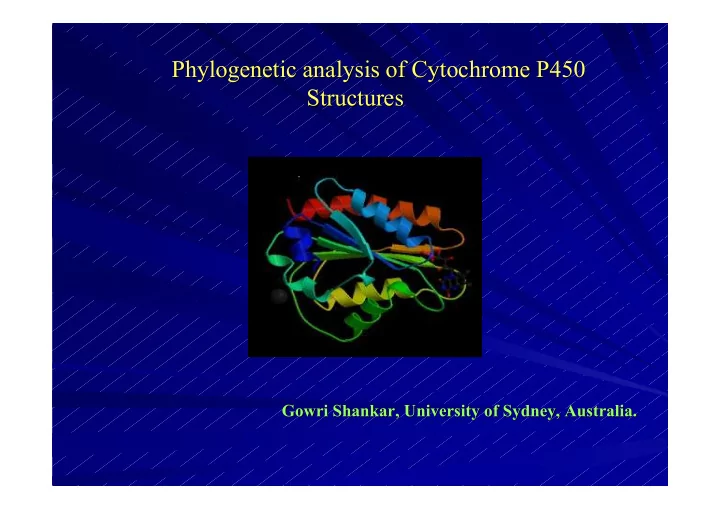
Phylogenetic analysis of Cytochrome P450 Phylogenetic analysis of Cytochrome P450 Structures Structures

Gowri Shankar, University of Sydney, Australia.

Gowri Shankar, University of Sydney, Australia.

slide-2
SLIDE 2

Gowri Shankar, University of Sydney. Gowri Shankar, University of Sydney.

Overview Overview Introduction Introduction Cytochrome P450 -- Structures. Cytochrome P450 -- Structures. Results. Results. Conclusion. Conclusion. Future Work. Future Work.

slide-3
SLIDE 3

Gowri Shankar, University of Sydney. Gowri Shankar, University of Sydney.

Aims Aims

How the structure of the cytochrome P450 changes How the structure of the cytochrome P450 changes

– – Time Time – – Across species. Across species.

Estimate the ages and functional Changes with structural changes. Estimate the ages and functional Changes with structural changes. How the residues changes with time and its impact on structure and How the residues changes with time and its impact on structure and function of CYPs. function of CYPs.

slide-4
SLIDE 4

Gowri Shankar, University of Sydney. Gowri Shankar, University of Sydney.

slide-5
SLIDE 5

Gowri Shankar, University of Sydney. Gowri Shankar, University of Sydney.

Introduction Introduction

Cytochrome P450 (CYPs) - important element of oxidative Cytochrome P450 (CYPs) - important element of oxidative metabolism metabolism Heme Heme-containing

  • containing monooxygenase

monooxygenase proteins proteins Responsible for oxidative metabolism of different endogenous and Responsible for oxidative metabolism of different endogenous and exogenous compounds exogenous compounds 7 of the 57 known human P450s are responsible for more than 90% 7 of the 57 known human P450s are responsible for more than 90%

  • f the metabolism of all pharmaceuticals in current use
  • f the metabolism of all pharmaceuticals in current use

Some of them display polymorphisms which can result in the poor Some of them display polymorphisms which can result in the poor metabolism pf drugs metabolism pf drugs

slide-6
SLIDE 6

Gowri Shankar, University of Sydney. Gowri Shankar, University of Sydney.

Introduction Introduction

They are found in almost all eukaryotes, prokaryotes, plants and They are found in almost all eukaryotes, prokaryotes, plants and even in hyperthermophilic archea. even in hyperthermophilic archea. ~1000 genes/enzymes are ~1000 genes/enzymes are avilable avilable till date till date Divided into 70 different families. Divided into 70 different families. Classifications of families - based on nucleotide sequence similarity Classifications of families - based on nucleotide sequence similarity Enzymes with less than ~40% sequence identity are placed in Enzymes with less than ~40% sequence identity are placed in different gene families different gene families

slide-7
SLIDE 7

Gowri Shankar, University of Sydney. Gowri Shankar, University of Sydney.

Cytochrome P450 --Structures Cytochrome P450 --Structures

CYP enzymes are membrane bound proteins, So difficult to crystallize. CYP enzymes are membrane bound proteins, So difficult to crystallize. First crystal structure of P450 was solved in the year 1985, it was from First crystal structure of P450 was solved in the year 1985, it was from pseudomonas pseudomonas putia putia with a resolution of 2.6 with a resolution of 2.6 Å Å. . After 2 decades, in 2000 the first mammalian P450 structure was After 2 decades, in 2000 the first mammalian P450 structure was determined. determined. CYP proteins have large binding pockets accommodating all exogenous CYP proteins have large binding pockets accommodating all exogenous and endogenous substances. and endogenous substances. CYPs have 6 Substrate Binding Sites (SRS), enabling CYPs to assimilate a CYPs have 6 Substrate Binding Sites (SRS), enabling CYPs to assimilate a large number of compounds. large number of compounds.

slide-8
SLIDE 8

Gowri Shankar, University of Sydney. Gowri Shankar, University of Sydney.

Cytochrome Cytochrome P450 --Structures P450 --Structures

slide-9
SLIDE 9

Gowri Shankar, University of Sydney. Gowri Shankar, University of Sydney.

Cytochrome P450 -- Structures Cytochrome P450 -- Structures

Pseudomonas putida 1.6 20/07/2000 1dz4 Streptomyces coelictor 1.7 11/12/2202 1lfk Sulfolbus sulfataricus 1.5 28/02/2001 1io7 Mycobacterium tuberculosis 2.05 3/10/2003 1h5z Polyangium cellulosum 1.93 23/10/2003 1q5d Saccaropolyspora erythrea 2.1 28/04/2000 1eup Streptomyces coelictor 1.85 2/01/2004 1odo Fusarium oxysporum 1 20/12/2001 1jfb Pseudomonas Sp 2.3 26/11/1993 1cpt Thermus thermophilus 1.8 25/02/2003 1n97 Bacillus subtillis 2.1 18/03/2003 1izo Synthetic Pseudomonas putida 1.65 9/11/2001 1jpz Homo sapiens 2.05 27/07/2004 1tqn Oryctolagus cuniculus 1.6 7/10/2003 1po5 Oryctolagus cuniculus 2.1 12/08/2003 1nr6 Source Resolution Date PDB ID

slide-10
SLIDE 10

Gowri Shankar, University of Sydney. Gowri Shankar, University of Sydney.

Method - Overview Method - Overview

slide-11
SLIDE 11

Gowri Shankar, University of Sydney. Gowri Shankar, University of Sydney.

Method Method – – Structural Analysis Structural Analysis

15 structures were compared pair-wise using FATCAT (Flexible structure 15 structures were compared pair-wise using FATCAT (Flexible structure Alignment by Chaining Aligned fragment pairs allowing Twists) Alignment by Chaining Aligned fragment pairs allowing Twists) Alignment of one-to-one carbon atoms of each pair of protein structures. Alignment of one-to-one carbon atoms of each pair of protein structures. From FATCAT analysis From FATCAT analysis – – FATCAT scores (Structural Similarity) FATCAT scores (Structural Similarity) – – Sequence Identity and Similarity Sequence Identity and Similarity

slide-12
SLIDE 12

Gowri Shankar, University of Sydney. Gowri Shankar, University of Sydney.

Methods Methods – – Phylogenetic Analysis Phylogenetic Analysis

Sequences were aligned using Multiple Sequence Alignment. Sequences were aligned using Multiple Sequence Alignment. Aligned amino acids are subjected to tree building Aligned amino acids are subjected to tree building – – PAUP* - Maximum Parsimony PAUP* - Maximum Parsimony – – PHYLIP using Maximum Likelihood method with molecular clock and PHYLIP using Maximum Likelihood method with molecular clock and Jones-Taylor-Thornton model of amino acid change. Jones-Taylor-Thornton model of amino acid change. Evolutionary distances were calculated from the inferred trees. Evolutionary distances were calculated from the inferred trees.

slide-13
SLIDE 13

Gowri Shankar, University of Sydney. Gowri Shankar, University of Sydney.

SIMILAR Vs IDENTICAL AMINO ACID

5 10 15 20 25 30 35 40 45 50 15 25 35 45 55 65 75 SIMILAR IDENTICAL

Human with Human with Rabbit

Rabbit

Human with Archaea Human with Archaea

  • The amino acid similarity between CYPs is approximately double

he amino acid similarity between CYPs is approximately double the sequence identity the sequence identity

  • Property of the amino acid play an important role in structure-

Property of the amino acid play an important role in structure- function than its identity. function than its identity.

Results Results

slide-14
SLIDE 14

Gowri Shankar, University of Sydney. Gowri Shankar, University of Sydney.

Results Results

FATCAT SCORE Vs E VOLUTIONARY DISTANCE

500 1000 1500 1 2 3 4 5 6 7 DISTANCE DISTANCE

Human with Human with Rabbit

Rabbit

Human with Human with Archaea

Archaea

The structures are similar in most aspects, except at some The structures are similar in most aspects, except at some positions, which are the functionality sites of these proteins. positions, which are the functionality sites of these proteins. In SRS 1,6,2 there is little conserved sequences and structures. In SRS 1,6,2 there is little conserved sequences and structures. In SRS 3-5 there is a considerable similarity in the protein In SRS 3-5 there is a considerable similarity in the protein structures. structures.

slide-15
SLIDE 15

Gowri Shankar, University of Sydney. Gowri Shankar, University of Sydney.

Observations Observations

The The Heme Heme binding are conserved and they exhibits a unique pattern. binding are conserved and they exhibits a unique pattern. Significant conservation in SRS3-5. This conversation observed is in F/G Significant conservation in SRS3-5. This conversation observed is in F/G helix region which forms the major binding region. helix region which forms the major binding region. The catalytic residues of CYPs are present in the helix region of the CYP The catalytic residues of CYPs are present in the helix region of the CYP proteins. proteins. The tyrosine residue in the catalytic site plays an important role in the The tyrosine residue in the catalytic site plays an important role in the catalysis because the Iron ion oxidises the tyrosine side chain and produces catalysis because the Iron ion oxidises the tyrosine side chain and produces a a tyrosyl tyrosyl free radical, which is essential for catalysis. free radical, which is essential for catalysis.

slide-16
SLIDE 16

Gowri Shankar, University of Sydney. Gowri Shankar, University of Sydney.

Observations Observations

Very few crystal structures available for the extensive Very few crystal structures available for the extensive study of this enzyme. study of this enzyme. Phylogenetic analysis gives an insight on the Phylogenetic analysis gives an insight on the structural aspects of these proteins, evolution and structural aspects of these proteins, evolution and structure-function relation. structure-function relation. This paves the way to future research like mutational This paves the way to future research like mutational and modelling analysis. and modelling analysis.

slide-17
SLIDE 17

Gowri Shankar, University of Sydney. Gowri Shankar, University of Sydney.

Future Work Future Work

Explore the binding sites of these proteins and how these binding sites of these proteins have changed with time. Mutational studies on these proteins and how the substrate acts

  • n the mutational sites.

Molecular Dynamics and Molecular Modeling of these proteins.

slide-18
SLIDE 18

Gowri Shankar, University of Sydney. Gowri Shankar, University of Sydney.

References References

http://drnelson.utmem.edu/CytochromeP450.html Nelson et al., 1996. P450 superfamily: update on new sequences, gene mapping, accession numbers and nomenclature. Pharmacogenetics 6:1–42. Yuzhen Ye & Adam Godzik., 2003. Flexible structure alignment by chaining aligned fragment pairs allowing twists. Bioinformatics. 2: 246- 255. Swofford, D. L. 2002. PAUP*. Phylogenetic Analysis Using Parsimony (*and Other Methods). Version 4. Sinauer Associates, Sunderland, Massachusetts. Felsenstein, J. 2005. PHYLIP (Phylogeny Inference Package) version 3.6. Distributed by the author. Department of Genome Sciences, University of Washington, Seattle.

slide-19
SLIDE 19

Gowri Shankar, University of Sydney. Gowri Shankar, University of Sydney.

Acknowledgment Acknowledgment

  • Prof. Michael Murray, Professor Pharmacogenomics, University of
  • Prof. Michael Murray, Professor Pharmacogenomics, University of

Sydney. Sydney. Dr Michael Charleston, Lecturer Bioinformatics, University of Sydney. Dr Michael Charleston, Lecturer Bioinformatics, University of Sydney.

  • Dr. David
  • Dr. David Hibbs

Hibbs, Lecturer Pharmaceutical Chemistry, University of , Lecturer Pharmaceutical Chemistry, University of Sydney. Sydney.

slide-20
SLIDE 20

Gowri Shankar, University of Sydney. Gowri Shankar, University of Sydney.

Thank You Thank You