CS 440/ECE448 Lecture 22: Reinforcement Learning Slides by Svetlana - - PowerPoint PPT Presentation

cs 440 ece448 lecture 22 reinforcement learning
SMART_READER_LITE
LIVE PREVIEW

CS 440/ECE448 Lecture 22: Reinforcement Learning Slides by Svetlana - - PowerPoint PPT Presentation

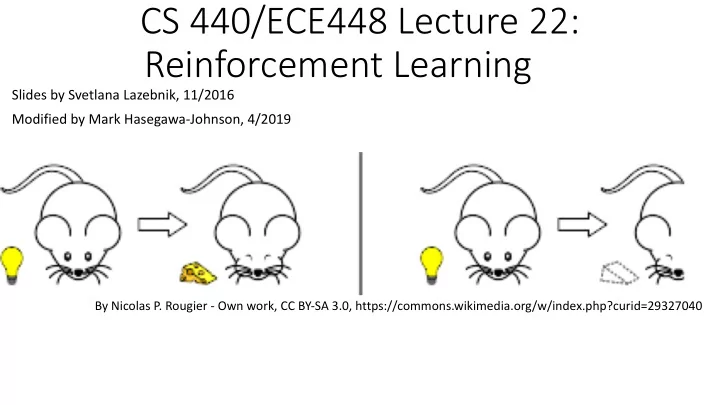
CS 440/ECE448 Lecture 22: Reinforcement Learning Slides by Svetlana Lazebnik, 11/2016 Modified by Mark Hasegawa-Johnson, 4/2019 By Nicolas P. Rougier - Own work, CC BY-SA 3.0, https://commons.wikimedia.org/w/index.php?curid=29327040

slide-1
SLIDE 1

CS 440/ECE448 Lecture 22: Reinforcement Learning

Slides by Svetlana Lazebnik, 11/2016 Modified by Mark Hasegawa-Johnson, 4/2019

By Nicolas P. Rougier - Own work, CC BY-SA 3.0, https://commons.wikimedia.org/w/index.php?curid=29327040

slide-2
SLIDE 2

Reinforcement learning

  • Regular MDP
  • Given:
  • Transition model P(s’ | s, a)
  • Reward function R(s)
  • Find:
  • Policy p(s)
  • Reinforcement learning
  • Transition model and reward function initially unknown
  • Still need to find the right policy
  • “Learn by doing”
slide-3
SLIDE 3

Reinforcement learning: Basic scheme

  • In each time step:
  • Take some action
  • Observe the outcome of the action: successor state and reward
  • Update some internal representation of the environment and policy
  • If you reach a terminal state, just start over (each pass through the

environment is called a trial)

  • Why is this called reinforcement learning?
slide-4
SLIDE 4

Outline

  • Applications of Reinforcement Learning
  • Model-Based Reinforcement Learning
  • Estimate P(s’|s,a) and R(s)
  • Exploration vs. Exploitation
  • Model-Free Reinforcement Learning
  • Q-learning
  • Temporal Difference Learning
  • SARSA
  • Function approximation; policy learning
slide-5
SLIDE 5

Applications of reinforcement learning

Action GreetS Welcome to NJFun. Please say an activity name or say 'list activities' for a list of activities I know about. GreetU Welcome to NJFun. How may I help you? ReAsk 1 S I know about amusement parks, aquariums, cruises, historic sites, museums, parks, theaters, wineries, and zoos. Please say an activity name from this list. ReAsk 1M Please tell me the activity type. You can also tell me the location and time.

Spoken Dialog Systems (Litman et al., 2000)

slide-6
SLIDE 6

Applications of reinforcement learning

  • Learning a fast gait for Aibos

Initial gait Learned gait Policy Gradient Reinforcement Learning for Fast Quadrupedal Locomotion Nate Kohl and Peter Stone. IEEE International Conference on Robotics and Automation, 2004.

slide-7
SLIDE 7

Applications of reinforcement learning

  • Stanford autonomous helicopter

Pieter Abbeel et al.

slide-8
SLIDE 8

Applications of reinforcement learning

  • Playing Atari with deep reinforcement learning

Video

  • V. Mnih et al., Nature, February 2015
slide-9
SLIDE 9

Applications of reinforcement learning

  • End-to-end training of deep visuomotor policies

Video Sergey Levine et al., Berkeley

slide-10
SLIDE 10

Applications of reinforcement learning

  • Active object localization with deep reinforcement learning
  • J. Caicedo and S. Lazebnik, ICCV 2015
slide-11
SLIDE 11

Learning to Translate in Real Time with Neural Machine Translation

Graham Neubig, Kyunghyun Cho, Jiatao Gu, Victor O. K. Li

Figure 2: Illustration of the proposed framework: at each step, the NMT environment (left) computes a candidate

  • translation. The recurrent agent (right) will the observation including the candidates and send back decisions–READ or

WRITE.

slide-12
SLIDE 12

Reinforcement learning strategies

  • Model-based
  • Learn the model of the MDP (transition probabilities and rewards)

and try to solve the MDP concurrently

  • Model-free
  • Learn how to act without explicitly learning

the transition probabilities P(s’ | s, a)

  • Q-learning: learn an action-utility function Q(s,a)

that tells us the value of doing action a in state s

slide-13
SLIDE 13

Outline

  • Applications of Reinforcement Learning
  • Model-Based Reinforcement Learning
  • Estimate P(s’|s, a) and R(s)
  • Exploration vs. Exploitation
  • Model-Free Reinforcement Learning
  • Q-learning
  • Temporal Difference Learning
  • SARSA
  • Function approximation; policy learning
slide-14
SLIDE 14

Model-based reinforcement learning

  • Basic idea:

Try to learn the model of the MDP (transition probabilities and rewards) and learn how to act (solve the MDP) simultaneously

  • Learning the model:
  • Keep track of how many times state s’ follows state s when you take action a
  • Update the transition probability P(s’ | s, a)

according to these relative frequencies

  • Keep track of the rewards R(s)
  • Learning how to act:
  • Estimate the utilities U(s) using Bellman’s equations
  • Choose the action that maximizes expected future utility:

å

Î

=

' ) ( *

) ' ( ) , | ' ( max arg ) (

s s A a

s U a s s P s p

slide-15
SLIDE 15

Model-based reinforcement learning

  • Learning how to act:
  • Estimate the utilities U(s) using Bellman’s equations
  • Choose the action that maximizes expected future utility

given the model of the environment we’ve experienced through our actions so far:

  • Is there any problem with this “greedy” approach?

å

Î

=

' ) ( *

) ' ( ) , | ' ( max arg ) (

s s A a

s U a s s P s p

slide-16
SLIDE 16

Exploration vs. exploitation

  • Exploration: take a new action with unknown consequences
  • Pros:
  • Get a more accurate model of the environment
  • Discover higher-reward states than the ones found so far
  • Cons:
  • When you’re exploring, you’re not maximizing your utility
  • Something bad might happen
  • Exploitation: go with the best strategy found so far
  • Pros:
  • Maximize reward as reflected in the current utility estimates
  • Avoid bad stuff
  • Cons:
  • Might also prevent you from discovering the true optimal strategy
slide-17
SLIDE 17

Incorporating exploration

  • Idea: explore more in the beginning,

become more and more greedy over time

  • Standard (“greedy”) selection of optimal action:
  • Modified strategy with exploration function f(u,n)

f(u,n) trades off greed [preference for high utility u] against curiosity [preference for low observed frequencies n]

÷ ø ö ç è æ =

å

Î ' ) ( '

) ' , ( ), ' ( ) ' , | ' ( max arg

s s A a

a s N s U a s s P f a î í ì < =

+

  • therwise

if ) , ( u N n R n u f

e

exploration function Number of times we’ve taken action a’ in state s

å

Î

=

' ) ( '

) ' ( ) ' , | ' ( max arg

s s A a

s U a s s P a

Set utility of a’ to R+ [= optimistic reward estimate] if a’ in state s explored less than Ne [a constant] times Set utility to actual observed utility

slide-18
SLIDE 18

Outline

  • Applications of Reinforcement Learning
  • Model-Based Reinforcement Learning
  • Estimate P(s’|s,a) and R(s)
  • Exploration vs. Exploitation
  • Model-Free Reinforcement Learning
  • Q-learning
  • Temporal Difference Learning
  • SARSA
  • Function approximation; policy learning
slide-19
SLIDE 19

Model-free reinforcement learning

  • Idea: learn how to act without explicitly learning the

transition probabilities P(s’ | s, a)

  • Q-learning: learn an action-utility function Q(s,a) that

tells us the value of doing action a in state s

  • Relationship between Q-values and utilities:
  • Selecting an action:
  • Compare with:
  • With Q-values, don’t need to know the transition model to

select the next action

) , ( max ) ( a s Q s U

a

=

) , ( max arg ) (

*

a s Q s

a

= p

å

=

' *

) ' ( ) , | ' ( max arg ) (

s a

s U a s s P s p

slide-20
SLIDE 20

TD Q-learning result

Source: Berkeley CS188

slide-21
SLIDE 21

Model-free reinforcement learning

  • Q-learning: learn an action-utility function Q(s,a)

that tells us the value of doing action a in state s

  • Equilibrium constraint on Q values:
  • What is the relationship between this constraint and

the Bellman equation?

) , ( max ) ( a s Q s U

a

=

å

+ =

' '

) ' , ' ( max ) , | ' ( ) ( ) , (

s a

a s Q a s s P s R a s Q g

å

Î

+ =

' ) (

) ' ( ) , | ' ( max ) ( ) (

s s A a

s U a s s P s R s U g

slide-22
SLIDE 22

Model-free reinforcement learning

  • Q-learning: learn an action-utility function Q(s,a)

that tells us the value of doing action a in state s

  • Equilibrium constraint on Q values:
  • Problem: we don’t know (and don’t want to learn) P(s’ | s, a)

) , ( max ) ( a s Q s U

a

=

å

+ =

' '

) ' , ' ( max ) , | ' ( ) ( ) , (

s a

a s Q a s s P s R a s Q g

slide-23
SLIDE 23

Temporal difference (TD) learning

  • Equilibrium constraint on Q values:
  • Temporal difference (TD) update:
  • Pretend that the currently observed transition (s,a,s’)

is the only possible outcome. Call this “local quality” as !"#$%" &, ( ; it is computed using ! &, ( .

  • Then interpolate between ! &, ( and !"#$%"(&, ()

to compute !+,-(&, ().

å

+ =

' '

) ' , ' ( max ) , | ' ( ) ( ) , (

s a

a s Q a s s P s R a s Q g

) , ( ) , ( ) 1 ( ) , ( a s Q a s Q a s Q

local new

a a +

  • =

) ' , ' ( max ) ( ) , (

'

a s Q s R a s Q

a local

g + =

slide-24
SLIDE 24

Temporal difference (TD) learning

  • The interpolated form:
  • The temporal-difference form:
  • The computationally efficient form

(all calculations rolled into one):

( )

) , ( ) , ( ) , ( ) , ( a s Q a s Q a s Q a s Q

local new

  • +

= a ) , ( ) , ( ) 1 ( ) , ( a s Q a s Q a s Q

local new

a a +

  • =

( )

) , ( ) ' , ' ( max ) ( ) , ( ) , (

'

a s Q a s Q s R a s Q a s Q

a new

  • +

+ = g a

) ' , ' ( max ) ( ) , (

'

a s Q s R a s Q

a local

g + = ) ' , ' ( max ) ( ) , (

'

a s Q s R a s Q

a local

g + =

slide-25
SLIDE 25

Temporal difference (TD) learning

  • At each time step t
  • From current state s, select an action a:
  • Observe the reward r, next state s’
  • Perform the TD update:

( )

) , ( ) ' , ' ( max ) ( ) , ( ) , (

'

a s Q a s Q s R a s Q a s Q

a

  • +

+ ¬ g a

( )

) ' , ( ), ' , ( max arg

'

a s N a s Q f a

a

=

Exploration function Number of times we’ve taken action a’ from state s

! ← !′

slide-26
SLIDE 26

Temporal difference (TD) learning

  • At each time step t
  • From current state s, select an action a:
  • Observe the reward r, next state s’
  • Perform the TD update:

! ← !′

( )

) , ( ) ' , ' ( max ) ( ) , ( ) , (

'

a s Q a s Q s R a s Q a s Q

a

  • +

+ ¬ g a

( )

) ' , ( ), ' , ( max arg

'

a s N a s Q f a

a

=

Exploration function Number of times we’ve taken action a’ from state s

???

slide-27
SLIDE 27

Temporal difference (TD) learning

  • At each time step t
  • From current state s, select an action a:
  • Observe the reward r, next state s’
  • Perform the TD update:

! ← !′

( )

) , ( ) ' , ' ( max ) ( ) , ( ) , (

'

a s Q a s Q s R a s Q a s Q

a

  • +

+ ¬ g a

( )

) ' , ( ), ' , ( max arg

'

a s N a s Q f a

a

=

Exploration function Number of times we’ve taken action a’ from state s

That’s not necessarily the action we will take next time…

slide-28
SLIDE 28

SARSA: State-Action-Reward-State-Action

  • Initialize: choose an initial state s, initial action a
  • At each time step t
  • Observe the reward r, next state s’
  • From next state s’, select next action a’:

!" = arg max

)" * + ,", !" , .(,", !")

  • Perform the TD update:

+ ,, ! ← + ,, ! + 3(4 , + 5+ ,", !" − + ,, ! )

, ← ,′

Exploration function Number of times we’ve taken action a’ from state s’

That is the action we will take next time…

slide-29
SLIDE 29

Outline

  • Applications of Reinforcement Learning
  • Model-Based Reinforcement Learning
  • Estimate P(s’|s,a) and R(s)
  • Exploration vs. Exploitation
  • Model-Free Reinforcement Learning
  • Q-learning
  • Temporal Difference Learning
  • Function approximation; policy learning
slide-30
SLIDE 30

Function approximation

  • So far, we’ve assumed a lookup table representation for utility

function U(s) or action-utility function Q(s,a)

  • But what if the state space is really large or continuous?
  • Alternative idea: approximate the utility function, e.g.,

as a weighted linear combination of features:

  • RL algorithms can be modified to estimate these weights
  • More generally, functions can be nonlinear (e.g., neural networks)
  • Recall: features for designing evaluation functions in games
  • Benefits:
  • Can handle very large state spaces (games), continuous state spaces (robot

control)

  • Can generalize to previously unseen states

) ( ) ( ) ( ) (

2 2 1 1

s f w s f w s f w s U

n n

! + + =

slide-31
SLIDE 31

Other techniques

  • Policy search: instead of getting the Q-values right, you simply need

to get their ordering right

  • Write down the policy as a function of some parameters and adjust the

parameters to improve the expected reward

  • Learning from imitation: instead of an explicit reward function, you

have expert demonstrations of the task to learn from